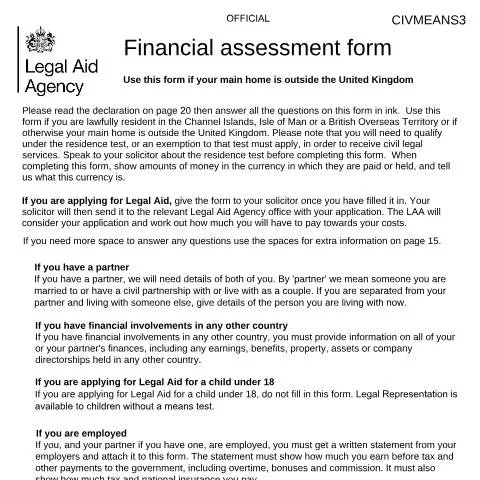
Navigating the CIV MEANS 3 Form: A Vital Step for Clients Outside the UK
When considering legal aid in the UK, understanding the intricacies of the CIV MEANS 3 form is essential, especially for clients whose main home is outside the UK. This official document plays a crucial role in determining a client's eligibility for civil legal services provided by the Legal Aid Agency (LAA). Given the unique circumstances of these clients, the process requires careful navigation to ensure that all requirements are met and that the client can secure the legal assistance they need.Understanding the Role of the CIV MEANS 3 Form
The CIV MEANS 3 form is not just another bureaucratic hurdle; it serves as a financial assessment tool for individuals residing outside the UK, including those living in the Channel Islands, the Isle of Man, or British Overseas Territories. Its main function is to detail the financial situation of the applicant and their partner, if applicable, to establish their eligibility for legal aid. Unlike other forms, such as the CIV MEANS 1 and 2, which cater to clients living within the UK, the CIV MEANS 3 specifically addresses financial assessments in the context of clients abroad. This distinction is vital, as it requires additional information that may not be relevant for UK residents, such as foreign income, assets, and the currency in which they are held.Who Needs to Fill Out the CIV MEANS 3?
Individuals eligible to submit the CIV MEANS 3 form include:- Those who reside primarily outside the UK but are lawfully resident in territories like the Channel Islands or the Isle of Man.
- Applicants requiring legal representation in civil cases that necessitate a means test.
- Individuals living in a foreign country with significant financial ties to the UK.
A Step-by-Step Guide to Completing the Form
Completing the CIV MEANS 3 form is a task that requires attention to detail and a clear understanding of one’s financial circumstances. Here’s a structured approach to guide applicants through the process:- Gather Financial Documentation: Collect necessary documents such as proof of income, assets, and any financial holdings in foreign currencies. These documents will include:
- Written statements from employers detailing earnings and deductions.
- Bank statements indicating account balances and transactions.
- Declarations of any foreign financial interests.
- Complete Personal Information: The form requires personal details, including your name, address, and contact information. If applicable, include information about your partner.
- Detail Your Financial Situation: Provide comprehensive information about your income source(s), whether employed, self-employed, or receiving benefits. Remember to report amounts in the currency they are held.
- Partner's Details: If you have a partner, their financial details must also be included. This includes income, assets, and liabilities, which might impact your application.
- Submit the Form: Once completed, the form should be handed to your solicitor, who will send it to the appropriate LAA office along with your legal aid application.
The Timing of Your Application: Key Deadlines
Timeliness is critical when it comes to legal aid applications. The LAA sets strict deadlines for the submission of the CIV MEANS 3 form. If you are applying for legal aid, your solicitor must submit the completed form along with other required documentation within two months of signing it. Failure to meet this deadline could result in the rejection of your application. Additionally, if your financial circumstances change after you have submitted your application, it is imperative to report these changes immediately to avoid complications or potential legal ramifications.The Implications of Inaccurate Information
Completing the CIV MEANS 3 form inaccurately can have serious consequences. The LAA requires that all information presented in the application is truthful and complete. If discrepancies or omissions are identified, it could lead to:- Rejection of your application for legal aid.
- Potential legal repercussions for providing false information.
- Delays in obtaining necessary legal representation, which could adversely affect your case.
Understanding Your Rights and Responsibilities
Filling out the CIV MEANS 3 form is not just about eligibility; it also involves understanding your rights and responsibilities as an applicant. By submitting the form, you are entitled to receive legal aid if you meet the financial eligibility criteria, which means that:- You have the right to receive assistance in your legal matter without having to bear the full financial burden of legal costs.
- You are responsible for notifying the LAA of any changes in your financial situation promptly.
- Failure to comply with these responsibilities could jeopardise your ongoing legal support.
Legal Aid Agency: Your Partner in Navigating Legal Support
The Legal Aid Agency plays a pivotal role in the legal aid process, guiding applicants through the maze of necessary documentation and requirements. The LAA evaluates your application based on the completed CIV MEANS 3 form and other supporting documents submitted by your solicitor. It is advisable to maintain open communication with the LAA and your solicitor throughout the process. If you encounter any uncertainties, they can provide clarity on requirements, timelines, and the implications of your application.What Happens After Submission?
Once your application is submitted, the LAA will carry out a financial assessment based on the information provided in the CIV MEANS 3 form. This assessment will determine how much, if anything, you will need to contribute towards the costs of your legal representation. The LAA will notify you and your solicitor of their decision. If legal aid is granted, you will receive a statement detailing any contributions required, along with information on the legal services that will be covered. If your application is denied, the LAA will outline the reasons for rejection, which can often stem from financial eligibility criteria not being met.Final Thoughts: The Importance of Thorough Preparation
Completing the CIV MEANS 3 form is a significant step for individuals seeking legal aid while living outside the UK. The thoroughness of your information and the accuracy of your documentation directly influence the outcome of your application. Therefore, it is crucial to prepare diligently, ensuring that all financial details are captured accurately and all necessary supporting documents are included. By approaching the CIV MEANS 3 form with care and attention, applicants can secure the legal aid they need to navigate their legal challenges effectively, ensuring their rights are upheld no matter where they reside.Understanding CIV Means 3 for Clients Living Outside the UK
When dealing with the Civil Means Test (CIV Means 3) for clients residing outside the UK, several unique considerations come into play. This assessment is crucial for those seeking to access legal aid for civil cases, especially as it determines financial eligibility based on income and capital. Individuals living abroad often find themselves seeking clarity on how their financial circumstances are assessed under UK law.
One of the primary factors influencing the assessment is the consideration of income received from overseas. For instance, if you receive a salary or pension from abroad, this income must be declared. It is advisable to convert any foreign income into GBP using the appropriate Bank of England exchange rates at the time of conversion. This ensures that all income is correctly assessed against the UK means test thresholds, which are regularly updated to reflect changes in economic conditions.
In addition to foreign income, clients must also account for any capital they hold outside the UK. This can include savings in foreign bank accounts, property ownership, or investments in foreign entities. Such assets can significantly impact the eligibility for legal aid under the CIV Means 3 framework. Clients should be prepared to provide detailed evidence of their financial situation, including bank statements and valuations, as part of their application.
Moreover, individuals living abroad should be aware that UK legal aid may only cover specific types of cases, and those seeking assistance must demonstrate that their issue falls within these categories. For instance, legal aid for family law cases is more commonly granted than for commercial disputes. Therefore, it is essential for clients to consult with a legal professional familiar with the nuances of the CIV Means 3 to ascertain their eligibility accurately.
Implications of Residency Status on Legal Aid Eligibility
Residency status plays a pivotal role in determining eligibility for legal aid under the CIV Means 3 assessment. Clients must establish their residency status accurately, as it influences how their financial circumstances are evaluated. The UK government typically distinguishes between individuals who are habitually resident and those who are not. Habitual residency indicates that the individual has settled in the UK for the time being, whereas non-resident status could mean that legal aid might not be accessible.
Those who have recently moved abroad or are in the process of relocating should consider their previous residency ties to the UK. If clients have maintained a permanent address in the UK, they may still qualify for legal aid even if they live abroad. However, specific documentation will be required to prove these ties, including proof of UK citizenship or indefinite leave to remain.
Additionally, clients need to consider any potential impacts from the recent shifts in immigration policies that could affect their residency status. It is vital to stay informed about the latest legal developments surrounding residence and legal aid eligibility to avoid pitfalls during the application process.
In cases where clients cannot provide sufficient evidence of their habitual residency, they may be advised to seek legal advice on their options. This could include understanding the implications of their status on ongoing legal matters, especially if they are involved in proceedings that commenced while they were residing in the UK.
Maintaining Compliance with Data Protection Regulations
For clients living outside the UK, complying with data protection regulations is a critical aspect of the CIV Means 3 application process. The UK’s Data Protection Act 2018 and the UK GDPR govern the handling of personal data during the legal aid application process. These regulations impose strict guidelines on how client information, particularly sensitive financial data, is collected, processed, and stored.
It is imperative for clients to understand their rights under these regulations, especially regarding the provision of their personal information. For example, clients have the right to request confirmation of how their data is being used and stored by the organizations processing their legal aid applications. Failure to comply with these regulations can result in delays or even rejection of applications due to concerns over data integrity.
Additionally, clients should ensure that they share personal data only with authorized representatives or legal advisors who are aware of data protection protocols. This includes understanding the importance of sharing financial information securely, especially when dealing with overseas transactions or bank statements.
Legal aid organizations must also be vigilant in maintaining compliance with UK data protection laws when handling applications from overseas clients. This includes implementing robust data security measures and providing clear guidelines for clients on how their data will be handled. By doing so, clients can feel more secure in sharing their financial information as part of the CIV Means 3 assessment.