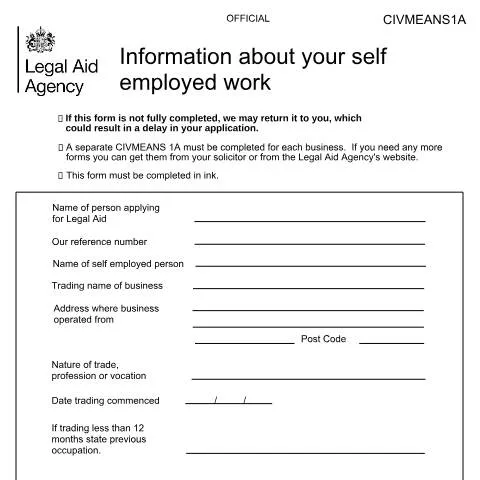
Navigating the CIV MEANS 1A Form: A Crucial Step for Sole Traders Seeking Legal Aid
For self-employed individuals operating as sole traders in the UK, the journey towards obtaining legal aid can feel daunting. The CIV MEANS 1A form is not merely a piece of paperwork; it is a pivotal document that can significantly impact your access to essential legal services. This guide offers an in-depth look at the form's implications, completion necessities, and procedural steps, aiming to demystify the application process for those in need of legal assistance.
The Importance of the CIV MEANS 1A Form
Understanding why the CIV MEANS 1A form is integral to the legal aid application process is vital. This document serves as an assessment tool, allowing the Legal Aid Agency (LAA) to evaluate the financial standing of applicants and determine their eligibility for legal aid. A failure to complete this form accurately may lead to delays or even denial of assistance, leaving applicants without the necessary support in legal matters.
Who Needs to Complete the CIV MEANS 1A?
The requirement to complete the CIV MEANS 1A form applies to self-employed individuals who are sole traders and are seeking legal aid. Each business operated by the applicant necessitates a separate form. This means that if an applicant runs multiple businesses, they must fill out a distinct CIV MEANS 1A for each. The form solicits detailed information about the applicant's business operations, financial standing, and personal circumstances, forming the backbone of the legal aid eligibility assessment.
Consequences of Incomplete or Incorrect Submissions
It's crucial to recognize the stakes involved. Submitting an incomplete or incorrectly filled out CIV MEANS 1A can result in the form being returned by the LAA, potentially causing significant delays in the legal aid application process. In some cases, essential deadlines may be missed, thereby affecting the applicant's ability to secure legal representation when needed most. Ensuring that all sections are meticulously completed and that any required supporting documents are attached is essential for a smooth application.
Step-by-Step Guide to Completing the CIV MEANS 1A Form
The completion of the CIV MEANS 1A form requires careful attention to detail. Below is a step-by-step guide outlining the key components of the form and how to approach each section effectively.
1. Basic Information and Business Details
- Name of Applicant: Clearly state your full name as the individual applying for legal aid.
- Trading Name of Business: If applicable, provide the name under which your business operates.
- Business Address: Include the complete address where the business is conducted, including the postcode.
- Nature of Trade: Provide a brief description of the type of business you operate (e.g., retail, services).
- Date Trading Commenced: Indicate when you officially started trading. If you have been trading for less than 12 months, be prepared to state your previous occupation.
2. Financial Accounts
One of the critical sections revolves around your financial accounts. Here’s how to navigate this component:
- Completed Financial Accounts: Indicate whether you have prepared financial accounts such as profit and loss statements. If yes, attach the most recent copies.
- Age of Accounts: If your accounting period ended less than 18 months ago, proceed to the next question. Otherwise, finalise your accounts for the most recent trading year and attach them; if they are over 18 months old, submit the L31 form for each business instead.
3. Business Turnover and Drawings
This part of the form requires you to provide your business's turnover and personal income:
- Turnover: Clearly state your total income received from the business before deducting any expenses.
- Personal Drawings: Indicate how much money you take from the business weekly as your personal income.
Understanding Your Financial Position
After establishing basic business information, the form delves deeper into your financial standing. Here’s a breakdown of what to consider:
Assets and Liabilities
Reporting your business's financial health requires a detailed understanding of your assets and liabilities. In this section, you will need to provide:
- Balance Sheet: If you have one, attach it with the form. If not, list your assets (e.g., equipment, property) and liabilities (e.g., loans, debts).
- Property Ownership: Disclose any buildings or land owned or leased in connection with your business, including details on freehold or leasehold status and market value.
Employment Information
If you employ others, you must provide:
- Details of Employment: State the number of employees and whether any are family members, along with their annual salaries.
Potential Changes in Business Circumstances
It's important to anticipate any changes in your business that could impact your financial situation. You will need to indicate:
- Expected Changes: If you foresee changes that could affect your business's profitability or structure in the next 12 months, you must state the nature of these changes and provide supporting evidence.
Submission Process and Follow-Up
Once the CIV MEANS 1A form is meticulously completed, the next step is submission. Here’s what you need to know:
Submitting Your Application
The completed form, along with any required documentation, should be submitted to your solicitor or directly to the Legal Aid Agency, depending on your circumstances. Ensure that:
- You have made copies of everything you submit for your records.
- All documents are legible and organized to avoid any issues during processing.
Tracking Your Application
After submission, it is prudent to follow up on your application. The LAA typically provides a reference number that can be used to track the progress of your application. If you encounter delays or receive a request for additional information, responding promptly can help expedite the process.
Understanding Data Protection Considerations
Your personal data is protected under the Data Protection Act 2018 and UK GDPR standards. When completing the CIV MEANS 1A form, the LAA handles your data with utmost care, ensuring it is used solely for the purpose of assessing your legal aid application.
If you have concerns about how your data is being handled or wish to access copies of your personal information, the privacy notice provided by the LAA outlines your rights and what steps to take.
Conclusion: Empowering Your Application
Completing the CIV MEANS 1A form may seem intricate, but understanding its components can simplify the process significantly. Each section serves a crucial role in portraying your business's financial situation, which ultimately influences your eligibility for legal aid. By approaching the application with diligence and clarity, you can better position yourself to receive the legal support necessary for your circumstances. Remember, this is not merely a bureaucratic hurdle; it is a gateway to crucial legal assistance that can protect your rights and interests in challenging times.
Understanding the Financial Implications of Being a Self-Employed Sole Trader
When you choose to operate as a self-employed sole trader in the UK, it is vital to understand the financial implications that come with this responsibility. One of the key aspects to consider is your obligation to register for Self Assessment with HMRC. This registration is crucial for filing your tax returns accurately and on time.
As a sole trader, you'll need to keep detailed financial records of your income and expenses. This includes all sales, purchases, and operational costs. It’s advisable to use accounting software or maintain a manual ledger. In doing so, you can better manage your finances and ensure compliance with tax regulations.
Furthermore, you are responsible for paying Income Tax on your profits, calculated after deducting your business expenses. You will also need to pay Class 2 and Class 4 National Insurance contributions. Understanding these contributions is essential because they impact your entitlements to various benefits and your future state pension.
For the tax year running from 6 April to 5 April, the income threshold for paying Class 2 contributions may change annually, and it’s advisable to check the latest figures provided by HMRC. For any profits over £12,570 (as of the current tax year), you will be liable for Class 4 contributions at a rate of 9% on profits between £12,571 and £50,270, and 2% on any profits above that threshold.
Financial planning for a self-employed individual also involves setting aside funds to cover your tax liabilities. It’s generally a good idea to save approximately 20-30% of your income throughout the year to ensure you can meet your tax obligations come January 31st, the deadline for submitting your Self Assessment return and paying any tax owed.
Benefits and Challenges of Being a Sole Trader
Operating as a sole trader has both its benefits and its challenges. On one hand, one of the most substantial advantages is the simplicity of the business structure. You have complete control over your business decisions and retain all profits after tax. There is also less administrative burden compared to setting up a limited company, as you’re not required to file annual accounts with Companies House.
Another benefit is the potential for a more flexible work schedule. As a sole trader, you can set your working hours, allowing for a better work-life balance, particularly if you have personal commitments. This flexibility can be particularly appealing to those who are looking to juggle family responsibilities or pursue other interests alongside their business.
However, with the benefits also come significant challenges. The most pressing issue is that your personal assets may be at risk if your business encounters financial difficulties. As a sole trader, there is no legal distinction between you and your business, meaning creditors can pursue your personal assets to settle business debts. This risk is something to consider seriously when weighing your options as a sole trader.
Another challenge is the need for self-discipline and motivation. Without a formal structure, it can be easy to lose focus or procrastinate. Time management skills become essential for productivity and maintaining a steady flow of income. Additionally, securing financing for expansion or operations can be more difficult for sole traders compared to limited companies.
Accessing Support and Resources for Sole Traders
As a self-employed sole trader, accessing support and resources can significantly enhance your chances of success. Several government and non-government organizations provide information, guidance, and financial support tailored to the needs of self-employed individuals.
The Business Support Helpline offers advice on starting and running a business. They can provide information on grants, funding, and training opportunities. It’s worth noting that the criteria for support may vary depending on your region in the UK, so always check local provisions.
Additionally, the DWP offers various financial support options for self-employed individuals, including Universal Credit, which can provide a safety net during challenging economic times. If your income fluctuates or falls below a certain threshold, you might be eligible for additional assistance.
Networking with other self-employed individuals can also be a vital resource. Joining local business groups or online forums can provide support, potential partnerships, and an exchange of ideas and best practices. In many areas, local councils host workshops and seminars that focus on skills development, marketing, and other key areas beneficial to sole traders.
Lastly, keeping abreast of changes in legislation and tax regulations is crucial. Subscribing to newsletters from HMRC or following dedicated financial blogs and forums can keep you informed about any updates that may impact your business.