Navigating the Complexities of Forced Marriage Protection Orders: When Circumstances Change
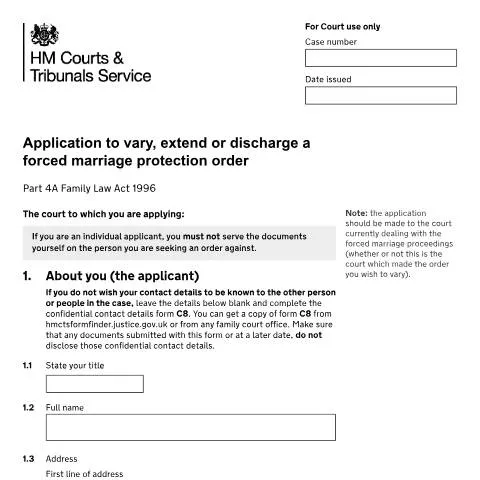
When a Forced Marriage Protection Order has been granted by the family courts, the legal framework doesn't end there. Life circumstances evolve, threats may diminish or intensify, and the protective measures initially put in place might require adjustment. Form FL403A serves as the gateway for individuals seeking to modify, extend, or completely discharge an existing Forced Marriage Protection Order under Part 4A of the Family Law Act 1996.
This application process recognises that protection orders aren't static documents – they must adapt to changing realities. Whether you're the person originally protected by the order, a family member who initiated proceedings, or someone named within the order's provisions, understanding when and how to use FL403A becomes crucial when the original circumstances have shifted significantly.
The form operates within a sensitive legal landscape where individual safety remains paramount, yet acknowledges that overly restrictive orders might sometimes require modification as situations stabilise or, conversely, need strengthening when new threats emerge.
Understanding the Three Pathways: Vary, Extend, or Discharge
Form FL403A offers three distinct legal routes, each addressing different scenarios that might arise after a Forced Marriage Protection Order has been implemented.
Variation Applications: Adjusting the Terms
A variation application allows modification of specific terms within an existing order without completely starting afresh. Common scenarios include:
- Geographic restrictions that need adjustment due to employment or educational commitments
- Contact provisions that require refinement as family dynamics change
- Third-party restrictions affecting siblings or extended family members
- Communication limitations that may need updating in the digital age
When completing section 2.3 for variation requests, applicants must provide detailed specifications of the exact changes sought. Vague requests like "make the order less restrictive" will likely result in delays or rejection.
Extension Applications: Prolonging Protection
Extension applications become necessary when the original order's duration proves insufficient. This might occur when:
- Threats persist beyond the initially anticipated timeframe
- New evidence emerges suggesting ongoing risk
- The protected person requires additional time to establish independence
- Family pressures intensify as the original order's expiry approaches
Extensions require compelling justification in section 3.1, supported by evidence demonstrating continued necessity for protection.
Discharge Applications: Complete Removal
Discharge applications seek complete termination of the protection order. These are typically sought when:
- Reconciliation has occurred and all parties consent
- The original threat has permanently resolved
- The protected person has achieved complete independence and safety
- Circumstances have changed so fundamentally that protection is no longer required
Decoding Section 1: Applicant Information and Safety Considerations
The applicant section of FL403A contains crucial safety provisions often overlooked by those unfamiliar with family court procedures.
Address Confidentiality Protocols
Section 1.3 includes specific guidance about not revealing your address if disclosure might compromise safety. This links directly to Form C8 (Confidential Contact Details), which should be completed simultaneously if you're concerned about your whereabouts being known to respondents.
This provision recognises that applicants might include:
- The originally protected person who has relocated
- Family members who supported the protection order
- Third parties named in the original order
Age-Specific Requirements
Section 1.5 requires date of birth disclosure only for applicants under 18. This reflects the particular vulnerabilities of younger individuals in forced marriage situations and ensures appropriate procedural safeguards are applied.
Legal Representation Considerations
Sections 1.6 through 1.11 accommodate both represented and unrepresented applicants. However, the complexity of forced marriage protection proceedings often makes legal representation advisable, particularly given the prohibition on self-service highlighted in the form's warnings.
Evidence Requirements and Supporting Documentation Strategy
Form FL403A demands substantial supporting evidence, though the specific requirements vary significantly depending on whether you're seeking variation, extension, or discharge.
| Application Type | Essential Documentation | Additional Evidence |
|---|---|---|
| Variation | Copy of original order, detailed variation proposals | Changed circumstance evidence, risk assessments |
| Extension | Copy of original order, continuing threat evidence | Police reports, witness statements, expert opinions |
| Discharge | Copy of original order, safety confirmation | Reconciliation evidence, independent living proof |
Original Order Documentation
Section 2.2 requires the exact date of the original order, while the form requests attachment of a copy "if possible". In practice, courts expect this documentation and applications may be delayed without it. If you've lost your copy, contact the court registry where the original order was made before submitting FL403A.
Justification Standards
Section 3.1 asks for "brief" reasons, but this shouldn't be interpreted as requiring minimal detail. Courts need sufficient information to understand:
- How circumstances have changed since the original order
- Why the requested modification serves justice and safety
- What specific outcomes you're seeking
- How the proposed changes affect all parties named in the original order
Service Requirements and Third-Party Notification Protocols
Section 4 of FL403A establishes complex service requirements that distinguish these proceedings from standard civil applications. The form explicitly states that individual applicants cannot serve documents themselves on persons they're seeking orders against.
Mandatory Service Recipients
Applications must be served upon:
- All respondents named in the original order
- The person protected by the original order (if different from the applicant)
- Any other persons specifically named in the original order's terms
This comprehensive service requirement ensures all affected parties can respond to proposed changes, maintaining procedural fairness while acknowledging the sensitive nature of forced marriage cases.
Professional Service Arrangements
The self-service prohibition means applicants must arrange for:
- Court bailiff service (through the court office)
- Professional process serving companies
- Solicitor-arranged service
- Police service in exceptional circumstances
Each method carries different costs and timeframes, affecting overall application processing speed.
Court Jurisdiction and Application Routing
A critical aspect often misunderstood involves determining the correct court for your FL403A application. The form specifies that applications should be made to "the court currently dealing with the forced marriage proceedings" rather than necessarily the court that made the original order.
Ongoing Proceedings Scenarios
If related proceedings continue – such as:
- Breach applications for the original order
- Associated family law matters
- Criminal proceedings involving the same parties
- Immigration matters connected to the forced marriage
Then the FL403A application should typically be directed to whichever court is actively managing these related cases.
Dormant Case Situations
When no related proceedings are active, applications generally return to the court that made the original order. However, if parties have relocated significantly, applications for transfer to a more convenient court location can be made simultaneously with the FL403A submission.
Statement of Truth: Legal Implications and Compliance
The final section of FL403A contains a statement of truth carrying serious legal consequences. This isn't merely a formality – it represents a legal declaration with potential contempt of court implications for false statements.
Personal vs Representative Signatures
The form accommodates both personal signatures from applicants and signatures from authorised legal representatives. When legal representatives sign, they must:
- Confirm their authorisation to act
- Provide their full name and firm details
- Specify their position within the firm
- Take responsibility for the accuracy of information provided
Verification Responsibilities
Before signing, applicants or their representatives must verify:
- Factual accuracy of all information provided
- Completeness of documentation and evidence
- Honest belief in the truth of statements made
- Understanding of contempt of court consequences
Post-Application Procedures and Court Response Timelines
Once FL403A is submitted with appropriate service arrangements, the court initiates a structured review process. Understanding these procedures helps applicants manage expectations and prepare for subsequent steps.
Initial Court Review
Courts typically conduct preliminary reviews within 5-10 working days, examining:
- Jurisdictional appropriateness
- Service compliance
- Documentation completeness
- Urgency indicators requiring expedited handling
Applications with deficiencies may be returned with specific correction requirements, potentially adding 2-3 weeks to processing times.
Response Periods and Hearing Scheduling
Served parties typically receive 14 days to file responses, though courts may shorten this period in urgent cases or extend it where complex issues require detailed consideration. Hearing dates are usually set within 4-8 weeks of successful service, depending on court availability and case complexity.
Emergency applications – particularly those involving immediate safety concerns – may receive priority listing with hearings scheduled within days rather than weeks. However, such urgency must be clearly demonstrated and justified within the application itself.
Evidence Requirements and Supporting Documentation
The strength of your Form FL403A application largely depends on the quality and comprehensiveness of evidence you provide to support your request. Courts require substantial proof to justify varying, extending, or discharging a Forced Marriage Protection Order, as these decisions directly impact the safety and wellbeing of vulnerable individuals.
For applications to vary an existing order, you must demonstrate why the current terms are either insufficient or overly restrictive given changed circumstances. This might include witness statements detailing new threats or harassment that existing provisions don't address, or conversely, evidence showing successful compliance that warrants relaxed conditions. Medical reports can be particularly compelling if they document physical or psychological harm resulting from ongoing forced marriage pressures, or improvement in mental health following protective measures.
When seeking to extend a protection order, focus on evidence showing continued risk or threat. This could include recent communications (texts, emails, voicemails) from family members discussing marriage arrangements, travel bookings suggesting plans to take you abroad, or witness accounts of ongoing coercion. Social services reports, if you're receiving support, can provide professional assessment of ongoing vulnerability. School or college attendance records might demonstrate disruption to education due to family pressure, while employment records could show forced absence from work.
Fill in your form directly online
No printing: type your details into the boxes of the official form, tick, then download the PDF ready to send.
- 1Type into the form boxes
- 2Tick in one click
- 3Save and download the PDF
Applications to discharge an order entirely require particularly careful documentation. You'll need to prove either that the original circumstances have fundamentally changed or that the order is no longer necessary for protection. This might include evidence of family reconciliation through mediation, relocation that removes you from immediate risk, or marriage to a partner of your choosing that provides alternative protection. However, courts scrutinise discharge applications intensively, as premature removal of protection can have devastating consequences.
Documentary evidence should be organised chronologically and clearly labelled. Include official documents like police incident reports, medical records, or social services assessments where available. Personal evidence such as diary entries, photographs of injuries, or records of threatening communications should be authenticated where possible. Character references from teachers, employers, or community leaders who understand your situation can add credibility to your account.
Remember that all evidence submitted becomes part of the court record and may be disclosed to other parties unless you successfully apply for it to be heard in private. Consider whether any evidence might compromise your safety if disclosed, and discuss confidentiality concerns with legal representatives or court staff when submitting your application.
Court Procedures and What to Expect During Hearings
Understanding court procedures for Form FL403A applications helps reduce anxiety and ensures you're properly prepared for hearings. The family court system aims to be less formal than criminal courts, but specific protocols still apply that vary depending on whether your application is contested or unopposed.
Most applications are initially considered by a district judge or magistrates on paper, without a full hearing. If your application appears straightforward and unopposed, the court may grant your request based solely on written evidence. However, complex cases or those involving disputes between parties typically require a hearing where you can present your case in person and respond to questions.
When a hearing is scheduled, you'll receive advance notice with the date, time, and court location. Arrive early to familiarise yourself with the building layout and security procedures. Family courts have specific entrances and waiting areas designed to prevent accidental contact between parties in sensitive cases. Court staff can arrange separate waiting areas if you're concerned about encountering family members or other parties.
During the hearing, you'll typically sit at a table facing the judge rather than in a witness box. The atmosphere is more conversational than adversarial, though proceedings remain formal. The judge will review your application and supporting evidence, then ask questions to clarify key points. Be prepared to explain clearly why you're seeking the variation, extension, or discharge, focusing on specific facts rather than general statements.
If other parties are present, they'll have opportunity to respond to your application and present their own evidence. This might include family members arguing against protection measures or supporting agencies advocating for continued or enhanced protection. Remember that the judge's primary concern is your safety and wellbeing, not family relationships or cultural considerations that might conflict with your protection.
The judge may make an immediate decision or reserve judgment for later delivery. In urgent cases involving immediate risk, interim orders can be granted pending full consideration of your application. If your request is refused, you'll receive written reasons explaining the decision and information about appeal rights. Successful applications result in a new or amended order that takes effect immediately, with copies provided to relevant parties and enforcement agencies.
Court hearings can be emotionally challenging, particularly when family members are present or when recounting traumatic experiences. Consider requesting support from a friend, counsellor, or advocate to accompany you. Some courts provide special measures such as screens or video links if direct confrontation would cause distress, though these must be requested in advance through your application or legal representative.
Long-term Planning and Ongoing Safety Considerations
Successfully obtaining variation, extension, or discharge of a Forced Marriage Protection Order through Form FL403A is often just one step in a longer journey toward safety and independence. Effective long-term planning requires consideration of how court decisions integrate with broader protective strategies and life goals.
If your application results in an extended or varied order, use this time to strengthen your support network and develop practical skills for independent living. This might involve completing education or training programmes, securing stable employment, or building relationships with professionals who understand forced marriage issues. Many survivors find that having concrete future plans makes them feel more confident about eventually seeking discharge when circumstances genuinely improve.
Consider how protection orders interact with other aspects of your life. Employment situations may require discrete adjustments to accommodate court hearings or safety restrictions. Educational institutions can often provide additional support through pastoral care services or flexible attendance arrangements. Housing considerations are particularly important—protection orders may restrict family contact, but they don't automatically provide alternative accommodation if you're unable to remain in the family home safely.
Technology safety requires ongoing attention, especially as digital threats evolve. Protection orders may include specific provisions about online contact or monitoring, but staying safe often requires additional precautions like changing passwords, adjusting social media privacy settings, or using different devices. Be aware that family members may use mutual contacts or community networks to circumvent direct contact restrictions, requiring broader awareness of potential information sources.
Financial independence often takes time to achieve, but protection orders can provide the breathing space needed to develop economic stability. Explore available support through benefits systems, educational grants, or specialist organisations supporting forced marriage survivors. Document any financial abuse or control you've experienced, as this information may be relevant for future applications or civil proceedings.
Regular review of your protection needs ensures orders remain appropriate as circumstances change. Even if your immediate application is successful, consider scheduling periodic assessments with support services to evaluate whether further legal action might be beneficial. Changes in family dynamics, living situations, or personal circumstances may warrant additional applications or modifications to existing orders.
Building cultural and community support networks can be particularly challenging for forced marriage survivors, as traditional community ties may be compromised by legal proceedings. However, many areas have specialist support groups, religious leaders who understand forced marriage issues, or cultural organisations that provide safe spaces for individuals in similar situations. These connections can be invaluable for long-term emotional recovery and practical support.
Emergency planning remains important even with protection orders in place. Ensure you have access to emergency funds, important documents, and alternative accommodation should circumstances change suddenly. Keep contact details for police, support services, and legal representatives easily accessible. Share your safety plan with trusted friends or professionals who can assist if needed, while being mindful of who has access to sensitive information about your whereabouts and activities.