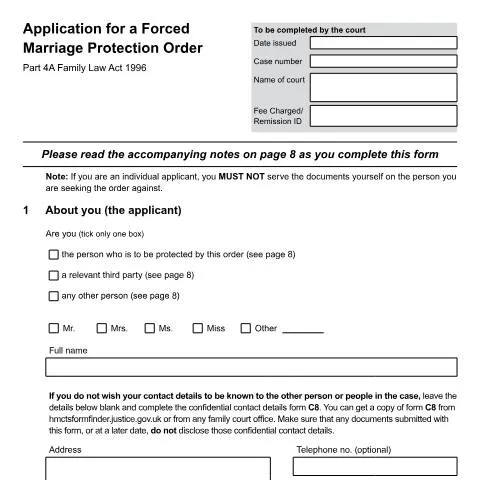
Understanding Forced Marriage Protection Orders: A Critical Legal Safeguard
When individuals face the threat of being compelled into marriage against their will, or find themselves trapped in arrangements they never consented to, the legal system provides a powerful intervention mechanism. Form FL401A represents the gateway to obtaining a Forced Marriage Protection Order (FMPO), a judicial tool designed to prevent forced marriages and protect victims from coercion, violence, or intimidation related to marriage arrangements.
The gravity of forced marriage situations often demands urgent legal intervention. Unlike domestic violence cases where protective measures might focus on past incidents, forced marriage scenarios frequently involve imminent threats and family pressure that can escalate rapidly. This application form enables courts to issue orders that can prevent someone being taken abroad for marriage, stop harassment from family members, or require the return of identity documents.
Forced Marriage Protection Orders operate under Part 4A of the Family Law Act 1996, introduced following the Forced Marriage (Civil Protection) Act 2007. These orders carry significant legal weight—breaching an FMPO constitutes contempt of court, punishable by up to two years' imprisonment.
Who Can Apply: Navigating the Three Categories of Applicants
The FL401A form accommodates three distinct types of applicants, each with different legal standing and procedural requirements. Understanding these categories proves crucial for determining the appropriate application route.
Direct Applications by the Person at Risk
Individuals facing forced marriage can apply directly for protection. This includes adults who recognise the coercive nature of arrangements being made on their behalf, as well as young people approaching the age of majority who anticipate being compelled into marriage. Self-applicants complete only sections 1 and 4 onwards, bypassing section 2 entirely since they are both applicant and protected person.
The form acknowledges that applicants may fear for their safety by requiring them to disclose their address. In such cases, the Confidential Contact Details Form C8 allows sensitive information to remain hidden from respondents whilst enabling court communication.
Relevant Third Party Applications
Certain organisations hold statutory authority to apply for FMPOs without requiring court permission. Local authorities represent the most common relevant third parties, typically applying when social services identify vulnerable individuals at risk. These applications often arise from:
- Safeguarding investigations involving minors
- Adult social care cases where individuals lack capacity to apply themselves
- Multi-agency referrals from schools, healthcare providers, or police
- Cases where direct application might expose the vulnerable person to greater risk
Relevant third parties must complete section 3, explaining their knowledge of circumstances and the protected person's wishes where known. This requirement acknowledges that third party applications should reflect, rather than override, the individual's own preferences wherever possible.
Other Persons Requiring Court Permission
Friends, extended family members, teachers, or other concerned individuals can apply for FMPOs, but must first obtain court permission using Form FL430. This two-stage process prevents frivolous applications whilst ensuring genuine concerns receive proper consideration.
Decoding the Application Sections: Essential Information Requirements
The FL401A form demands specific, detailed information across eight distinct sections, each serving particular legal and practical purposes in the court's assessment process.
Respondent Details and Multiple Party Situations
Section 4 requires comprehensive information about respondents—those against whom the order is sought. Forced marriage cases frequently involve multiple family members, requiring careful identification of all relevant parties. Parents, siblings, extended family members, community leaders, or marriage facilitators might all warrant inclusion as respondents depending on their involvement in coercive activities.
The form provides space for two respondents but acknowledges that complex family dynamics often involve more parties. Additional respondents require continuation sheets, ensuring comprehensive coverage of all individuals contributing to the forced marriage threat.
Crafting Effective Order Requests
Section 5 represents the heart of the application, where applicants specify exactly what protective measures they seek. Effective FMPO applications typically request combinations of:
| Order Type | Typical Provisions | Legal Effect |
|---|---|---|
| Prohibition Orders | Prevent taking person abroad; stop marriage arrangements | Direct legal restraint on specific actions |
| Positive Requirements | Return passport/documents; reveal location | Compulsory action by respondents |
| Communication Restrictions | Limit contact about marriage; stop threats | Regulated interaction parameters |
| Third Party Provisions | Prevent involvement of marriage facilitators | Extended protection network |
Courts require detailed supporting evidence for each requested provision. Vague requests like "stop the forced marriage" prove insufficient—applications must specify particular behaviours, threats, or arrangements that require judicial intervention.
Without Notice Applications: Emergency Protection Mechanisms
The FL401A form includes a critical tick box enabling without notice applications—court hearings conducted without informing respondents in advance. This mechanism proves essential when standard notification procedures might trigger escalated violence, overseas removal, or destruction of evidence.
Without notice applications require compelling justification through sworn statements demonstrating:
- Immediate risk if respondents receive advance warning
- Evidence that notification would defeat the order's purpose
- Specific threats or past behaviour indicating likely escalation
- Time-sensitive circumstances, such as planned travel or imminent ceremonies
Courts scrutinise without notice applications carefully, balancing protection needs against respondents' rights to defend themselves. Successful applications typically involve situations where individuals face removal from the UK within days, or where family violence has escalated following previous intervention attempts.
Supporting Documentation for Urgent Applications
Without notice applications require comprehensive sworn statements replacing the detailed oral evidence typically presented at contested hearings. These statements must address:
All material facts known to the applicant, including circumstances that might favour the respondents' position. Courts expect full and frank disclosure, not one-sided presentations of evidence.
Supporting documentation might include text messages, emails, witness statements from concerned professionals, medical records documenting injury or distress, or travel documents suggesting imminent overseas travel.
Court Procedures and Practical Considerations
Section 6 addresses practical court attendance requirements, recognising that forced marriage cases often involve vulnerable individuals requiring additional support. The form specifically asks about interpreter needs and disability accommodations, acknowledging that applicants may come from diverse linguistic backgrounds or face accessibility challenges.
Language and Cultural Considerations
Forced marriage cases frequently involve community languages, requiring professional interpretation services. Courts need advance notice to arrange qualified interpreters, particularly for less common languages or specific regional dialects. Family members should never interpret in these proceedings due to obvious conflicts of interest and potential intimidation factors.
The form also addresses security arrangements, recognising that applicants may fear confrontation with respondents in court buildings. Separate waiting areas, staggered hearing times, or enhanced security presence might prove necessary for safe participation in proceedings.
Service Requirements and Safety Protocols
A prominent warning appears twice on the FL401A form: "If you are an individual applicant, you MUST NOT serve the documents yourself on the person you are seeking the order against." This restriction acknowledges the inherent danger in forced marriage situations and ensures professional service through court bailiffs or process servers.
Service requirements vary depending on application type. Standard applications require respondents to receive advance notice, allowing them to prepare defences and attend hearings. Without notice applications bypass initial service requirements but typically include provisions for subsequent notification once emergency orders are in place.
Linking Related Proceedings and Ongoing Court Involvement
Section 8 requires disclosure of related family proceedings, recognising that forced marriage cases rarely exist in isolation. Applicants must identify:
- Existing child protection proceedings involving younger siblings
- Immigration cases where marriage might affect visa status
- Criminal proceedings against family members for related offences
- Previous domestic violence orders or harassment injunctions
- Divorce or separation proceedings between parents or other family members
This information helps courts coordinate multiple proceedings and avoid conflicting orders. For example, contact arrangements in child proceedings might require modification if extended family members pose forced marriage risks to older siblings.
Cross-Border Complications and International Elements
Many forced marriage cases involve international elements, requiring courts to consider jurisdictional issues and enforcement challenges. The form captures essential information about respondents' locations and travel patterns, enabling courts to assess whether UK orders will provide effective protection.
Cases involving planned overseas marriages present particular challenges. Courts might need to order passport surrender, prohibit travel, or require respondents to inform authorities of any travel plans. International recovery orders might prove necessary if individuals have already been taken abroad against their will.
Post-Application Procedures and Enforcement Mechanisms
Once submitted, FL401A applications trigger established court procedures designed to balance protection needs with fair hearing principles. Initial court consideration focuses on whether immediate interim orders are necessary while arranging full hearings.
Successful applications result in Forced Marriage Protection Orders containing specific, enforceable provisions tailored to individual circumstances. These orders typically include:
- Immediate protective measures preventing specific threatened actions
- Ongoing restrictions governing respondents' behaviour towards the protected person
- Positive requirements compelling specific actions, such as document return
- Review provisions enabling order modification as circumstances change
Order enforcement relies on contempt of court proceedings for breaches. Unlike civil remedies, contempt carries potential imprisonment, providing significant deterrent effect. However, enforcement requires careful documentation of breaches and may necessitate further court applications.
Long-term Protection and Order Variation
Forced Marriage Protection Orders can remain in force indefinitely, recognising that family pressure might persist for years. However, changing circumstances—such as the protected person reaching majority, family reconciliation, or new threats emerging—might require order variation or discharge.
The FL401A form represents the initial step in what might become ongoing court involvement. Protected persons retain the right to apply for order variation or discharge as their circumstances and wishes evolve, ensuring that legal protection remains aligned with individual autonomy and choice.
Understanding the FL401A application process proves crucial for anyone encountering forced marriage situations, whether as potential victims, concerned third parties, or supporting professionals. The form's detailed requirements reflect the complexity of these cases and the court's need for comprehensive information to provide effective protection whilst respecting all parties' rights and interests.
Understanding the Legal Framework Behind Forced Marriage Protection Orders
The Forced Marriage (Civil Protection) Act 2007 fundamentally transformed how the UK legal system addresses forced marriage situations. This legislation created a civil remedy pathway that operates independently of criminal proceedings, recognising that victims often need immediate protection without necessarily wanting to pursue criminal charges against family members.
Under section 63A of the Family Law Act 1996 (as amended), forced marriage protection orders carry significant legal weight. The High Court, County Court, or family court can issue these orders when satisfied that a person has been forced into marriage or that there are attempts to force them into marriage. The civil standard of proof applies—meaning the court needs to be satisfied on the balance of probabilities rather than beyond reasonable doubt.
What makes these orders particularly robust is their flexibility. Unlike many statutory remedies, forced marriage protection orders can be tailored to specific circumstances. The court might prohibit certain individuals from arranging a marriage ceremony, prevent passport confiscation, require the return of identity documents, or even prohibit taking someone abroad. This adaptability proves crucial when dealing with the varied tactics used to coerce individuals into unwanted marriages.
The legislation also recognises that forced marriage often involves multiple perpetrators across extended family networks or communities. Consequently, orders can name several respondents and include provisions affecting third parties who might assist in circumventing the protection. For instance, if there's evidence that community leaders might facilitate a forced ceremony, the order can specifically prohibit such involvement.
Fill in your form directly online
No printing: type your details into the boxes of the official form, tick, then download the PDF ready to send.
- 1Type into the form boxes
- 2Tick in one click
- 3Save and download the PDF
Breach of a forced marriage protection order constitutes contempt of court, punishable by up to two years' imprisonment. This civil enforcement mechanism often proves more accessible than criminal prosecution, particularly when victims maintain complex relationships with potential perpetrators. The court can also attach a power of arrest to specific provisions within the order, enabling police to arrest breaching parties immediately without requiring separate warrant applications.
Cross-border enforcement presents additional considerations. Where forced marriage attempts involve international elements—such as taking someone abroad for ceremony or bringing someone to the UK under false pretenses—the court can make passport surrender orders or require notification before international travel. These provisions work alongside existing immigration protections and consular services.
Specialist Support Services and Multi-Agency Collaboration
Forced marriage cases invariably require coordinated responses from multiple agencies, and understanding these support networks proves essential when completing Form FL401A applications. The Forced Marriage Unit, jointly operated by the Foreign, Commonwealth & Development Office and the Home Office, serves as the central coordination point for policy and casework support.
Local authority safeguarding teams play pivotal roles, particularly when applicants are under 18 or vulnerable adults. Social services departments have statutory duties under the Care Act 2014 and Children Act 1989 to investigate safeguarding concerns. When completing FL401A applications involving minors, expect social services involvement and potential parallel care proceedings. Adult safeguarding referrals might also run alongside forced marriage protection applications where there are capacity concerns or other vulnerabilities.
Police involvement varies considerably depending on circumstances. While forced marriage protection orders operate within civil law, associated behaviours often involve criminal offences—harassment, assault, false imprisonment, or threats to kill. Some police forces maintain specialist honour-based violence units with particular expertise in forced marriage situations. These officers understand the cultural complexities involved and can provide specialised risk assessments.
Educational institutions frequently serve as first points of contact, particularly for younger potential victims. Schools, colleges, and universities have safeguarding obligations and often maintain relationships with specialist charities. When forced marriage concerns emerge in educational settings, institutions typically follow established protocols involving designated safeguarding leads and external agency referrals.
Healthcare professionals also encounter forced marriage situations, particularly through mental health presentations or during routine appointments where concerning patterns emerge. NHS safeguarding procedures require healthcare workers to report suspected forced marriage situations, and GP practices or hospital departments might provide crucial evidence for FL401A applications.
Specialist charities bring invaluable expertise to forced marriage cases. Organisations such as Karma Nirvana, Southall Black Sisters, and Freedom Charity offer culturally sensitive support, safe accommodation referrals, and practical assistance with legal proceedings. These organisations often help applicants navigate the FL401A process and can provide expert witness testimony about cultural contexts and risk factors.
Immigration advice becomes crucial where forced marriage intersects with visa status concerns. Victims might fear that reporting forced marriage attempts could jeopardise their immigration status, particularly those on spouse or family visas. Specialist immigration advisers understand these complexities and can advise on protections available under domestic violence immigration rules.
When preparing FL401A applications, consider which agencies are already involved or should be contacted. Coordinated approaches often prove more effective than isolated legal action, and courts appreciate evidence of multi-agency support when assessing applications.
Tactical Considerations and Strategic Planning
Successfully obtaining forced marriage protection requires careful strategic thinking beyond simply completing Form FL401A. The timing of applications often proves critical—too early, and evidence might be insufficient; too late, and the forced marriage might already have occurred or the applicant removed from the jurisdiction.
Risk assessment forms the foundation of effective strategy. Courts need to understand not just current dangers but potential escalation following legal intervention. Family reactions to protection order applications can be unpredictable—some families withdraw when faced with legal consequences, while others escalate pressure or employ more sophisticated coercion methods. Consider whether the application itself might increase immediate risks and what safety measures need implementing during proceedings.
Evidence gathering requires particular sensitivity in forced marriage cases. Traditional documentary evidence—written threats, recorded conversations, or photographic evidence—might be limited where coercion operates through emotional manipulation or cultural pressure rather than explicit threats. Witness statements from friends, teachers, healthcare professionals, or community members who have observed concerning behaviours often prove valuable.
Cultural evidence plays a significant role in many forced marriage cases. Expert witnesses with understanding of specific cultural practices, religious requirements, or community dynamics can help courts understand why certain behaviours constitute coercion within particular contexts. This proves particularly important where respondents argue that their actions represent legitimate cultural practices rather than forced marriage attempts.
Consider the respondents' likely legal representation and arguments. Forced marriage cases often involve respondents who genuinely believe their actions are in the applicant's best interests or who argue cultural or religious justifications. Anticipating these defences and preparing counter-evidence strengthens applications considerably.
International elements require additional strategic consideration. Where forced marriage attempts involve travel abroad, timing becomes even more critical. Emergency applications might be necessary to prevent immediate travel, while longer-term orders need addressing ongoing risks. Consider whether parallel applications for passport retention or travel restrictions are necessary.
Financial considerations also require attention. While forced marriage protection orders themselves don't involve court fees, associated costs—legal representation, expert witnesses, or safe accommodation—can be substantial. Legal aid availability for forced marriage cases provides some support, but understanding funding limitations helps in planning realistic legal strategies.
Communication strategies prove crucial throughout proceedings. Forced marriage cases often involve complex family dynamics where some relatives support the applicant while others oppose them. Consider how legal action might affect these relationships and whether mediated solutions might be appropriate in some circumstances—though never where there are immediate safety concerns.
Post-order planning requires equal attention to initial applications. Forced marriage protection orders provide legal framework for protection, but practical safety often depends on ongoing support services, accommodation arrangements, and sometimes complete separation from family networks. Consider what support systems need establishing before applying, as orders prove most effective when backed by comprehensive safety planning.