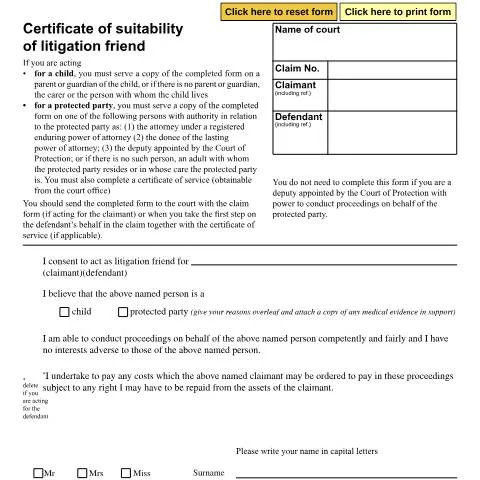
When Court Proceedings Require a Guardian: Understanding Form N235
In England and Wales, certain individuals cannot represent themselves in legal proceedings due to their age or mental capacity. When a child under 18 or a protected party becomes involved in civil litigation, the law requires someone to act as their litigation friend – essentially a legal guardian for the duration of the case. Form N235 serves as the formal certificate that confirms a person's suitability to take on this significant responsibility.
This certificate system exists to safeguard vulnerable parties in the justice system. Without proper representation through a litigation friend, children and protected parties would be unable to pursue legitimate claims or defend themselves against legal action. The N235 form creates a legal framework that ensures someone competent and trustworthy can navigate the complexities of court proceedings on their behalf.
Who Qualifies as a Litigation Friend Under the Certificate
The role of litigation friend carries substantial responsibilities, and not everyone can assume this position. The person seeking certification must demonstrate they can conduct proceedings competently and fairly while having no interests that conflict with those of the person they represent.
Essential Criteria for Certification
To obtain an N235 certificate, applicants must meet several fundamental requirements:
- Demonstrate competence to handle legal proceedings effectively
- Show they can act fairly and in the best interests of the child or protected party
- Confirm they have no adverse interests that could create conflicts
- Undertake financial responsibility for any costs orders (when acting for claimants)
The courts take particular care when assessing someone's suitability. Competence doesn't necessarily require legal training, but the litigation friend must understand the implications of legal proceedings and be capable of making informed decisions. This might include understanding settlement offers, the risks of litigation, and the importance of following court directions.
Automatic Disqualifications
Certain individuals cannot serve as litigation friends, regardless of their relationship to the child or protected party. Anyone with financial interests that conflict with the person they would represent faces automatic disqualification. For instance, if a potential litigation friend stands to benefit financially from a particular outcome that might not serve the child's best interests, they cannot obtain certification.
Importantly, the form makes clear that deputies appointed by the Court of Protection with power to conduct proceedings don't need to complete Form N235. Their existing court appointment already provides the necessary authority.
Distinguishing Between Children and Protected Parties
Form N235 covers two distinct categories of vulnerable individuals, each with different requirements and considerations.
Child Proceedings
Any person under 18 years old requires a litigation friend for court proceedings. The age threshold is absolute – even a 17-year-old with apparent maturity needs representation. When acting for a child, the completed N235 form must be served on specific individuals in order of priority:
- A parent or guardian of the child
- If no parent or guardian exists, the child's carer
- The person with whom the child lives
This service requirement ensures that those closest to the child know about the legal proceedings and the appointment of the litigation friend.
Protected Party Certification
Protected parties are individuals who lack capacity to conduct proceedings themselves due to mental impairment or disability. Unlike the clear age threshold for children, determining protected party status requires careful assessment and often medical evidence.
The person seeking to act as litigation friend must provide reasons for believing someone is a protected party and attach supporting medical evidence. This evidence typically comes from healthcare professionals who can assess the individual's capacity to understand and participate in legal proceedings.
| Category | Service Requirements | Evidence Needed |
|---|---|---|
| Child | Parent/guardian, or carer/person child lives with | Proof of age (birth certificate) |
| Protected Party | Attorney, donee of LPA, deputy, or carer | Medical evidence of incapacity |
The Financial Undertaking: Understanding Cost Responsibilities
One of the most significant aspects of the N235 certificate involves the financial undertaking that litigation friends must provide when representing claimants. This undertaking creates personal liability for any costs the court might order against the claimant.
Scope of Financial Liability
When someone signs Form N235 as a litigation friend for a claimant, they agree to pay any costs the court orders against that claimant, subject to any right to be repaid from the claimant's assets. This means if the case fails and the court orders the claimant to pay the defendant's legal costs, the litigation friend becomes personally responsible for those amounts.
However, the undertaking includes an important limitation. The litigation friend has the right to seek repayment from the claimant's assets if any exist. This might include compensation awarded in the case, existing savings, or future assets the claimant might acquire.
Strategic Considerations
The financial undertaking requirement often influences who can realistically serve as a litigation friend for claimants. Family members or friends without substantial financial resources may find themselves unable to take on this role, despite being otherwise suitable. This can create practical barriers to access to justice, particularly in cases involving significant potential cost exposure.
Notably, the financial undertaking doesn't apply when acting as litigation friend for defendants. This distinction reflects the different risk profiles – claimants initiate proceedings and thus bear greater responsibility for costs if unsuccessful.
Procedural Requirements and Court Interaction
The N235 form must be filed at specific times and accompanied by particular documents, depending on whether the litigation friend represents a claimant or defendant.
Timing of Submission
For claimants, the completed N235 form accompanies the initial claim form when proceedings begin. This ensures the court knows from the outset that a child or protected party is involved and that proper representation has been arranged.
When acting for defendants, the form must be submitted when taking the first step in the proceedings on the defendant's behalf. This might be filing an acknowledgment of service or a defence, depending on the specific case circumstances.
Service Requirements and Documentation
Beyond filing with the court, Form N235 triggers service requirements that vary depending on who the litigation friend represents. In all cases involving protected parties, a certificate of service must be completed and filed alongside the N235 form.
The service provisions for protected parties are more complex than those for children. The completed form must be served on individuals with authority in relation to the protected party, following a specific hierarchy:
- The attorney under a registered enduring power of attorney
- The donee of a lasting power of attorney
- A deputy appointed by the Court of Protection
- If none exist, an adult with whom the protected party resides or in whose care they are
Medical Evidence and Capacity Assessment
When seeking certification to act for a protected party, the quality and specificity of medical evidence can determine whether the court accepts the application. The form requires applicants to attach medical evidence supporting their belief that someone lacks capacity to conduct proceedings.
Types of Acceptable Medical Evidence
Courts typically expect evidence from qualified medical professionals who have assessed the individual's capacity. This might include reports from:
- General practitioners who know the patient's medical history
- Consultant psychiatrists or neurologists
- Clinical psychologists specialising in capacity assessments
- Geriatricians for cases involving dementia or age-related conditions
The medical evidence should specifically address the person's ability to understand legal proceedings, make informed decisions about litigation, and communicate their wishes regarding the case.
Ongoing Capacity Considerations
Capacity isn't always permanent or absolute. Some individuals may have fluctuating capacity due to their condition, while others might recover capacity during the course of proceedings. The litigation friend and court must remain alert to changes in the protected party's condition that might affect their need for representation.
If a protected party regains capacity during proceedings, the litigation friend's role ends, and the individual can represent themselves. Conversely, if someone develops incapacity after proceedings begin, they may need a litigation friend appointed mid-case.
Court Office Procedures and Administrative Considerations
The practical aspects of submitting Form N235 involve interaction with specific court offices, each with their own procedures and requirements.
Court Office Operations
As stated on the form, court offices operate between 10am and 4pm, Monday to Friday. All correspondence must be addressed to the Court Manager and include the claim number for proper case identification. This standardised approach ensures consistent handling across different courts in England and Wales.
When submitting Form N235, applicants should prepare for potential queries from court staff. Complex cases involving protected parties often require additional documentation or clarification, particularly regarding the medical evidence or service requirements.
Record Keeping and Case Management
Once accepted, the N235 certificate becomes part of the court file and establishes the litigation friend's authority to act throughout the proceedings. This authority continues until the case concludes, the litigation friend withdraws with court permission, or circumstances change significantly.
The court maintains records of all litigation friends, which helps ensure consistency in case management and enables proper oversight of vulnerable parties' interests. These records also facilitate communication between different court departments and judges who might handle various aspects of the case.
Practical Implications for Legal Representatives
Solicitors and barristers working with children or protected parties must understand how Form N235 affects their professional responsibilities and client relationships.
Professional Conduct Considerations
Legal representatives cannot take instructions directly from children or protected parties – instead, they must work through the certified litigation friend. This creates a triangular relationship where the lawyer owes duties to both the litigation friend and the underlying client, though the child or protected party's interests remain paramount.
The litigation friend makes tactical decisions about the case, including whether to accept settlement offers or continue to trial. However, lawyers retain their professional obligations to ensure these decisions serve the child or protected party's best interests, even if this sometimes means challenging the litigation friend's preferred approach.
Cost Protection and Funding
Cases involving children and protected parties often benefit from special cost protection rules that limit their exposure to adverse costs orders. However, these protections don't eliminate the litigation friend's liability under the N235 undertaking. Legal representatives must ensure litigation friends understand this distinction and consider appropriate insurance or funding arrangements.
The interplay between cost protection for vulnerable parties and the litigation friend's personal undertaking creates complex scenarios that require careful legal advice. In some cases, the litigation friend's financial exposure might be minimal due to protective costs orders, while in others, substantial liability could arise.
Understanding the Court's Assessment Process for N235 Applications
When you submit Form N235, the court embarks on a structured assessment process designed to evaluate your suitability comprehensively. Understanding this process helps you prepare more effectively and anticipate potential queries from court staff.
The initial review typically occurs within the court office, where administrative staff examine your application for completeness and obvious deficiencies. They check whether you've provided all required documentation, signed the form correctly, and paid any applicable fees. If basic requirements aren't met, you'll receive correspondence requesting additional information before your application progresses further.
For straightforward applications—such as parents applying to represent their minor children in personal injury claims—the assessment often remains administrative. Court staff may approve your certificate without requiring a hearing, particularly when your relationship to the protected party is clear and you've demonstrated basic financial competence through bank statements or employment records.
More complex situations trigger enhanced scrutiny. If you're applying to represent someone with whom you have a potential conflict of interest, or if the case involves substantial financial claims, the court may request additional documentation. This could include detailed financial statements, character references, or evidence of your understanding of the legal proceedings' implications.
Fill in your form directly online
No printing: type your details into the boxes of the official form, tick, then download the PDF ready to send.
- 1Type into the form boxes
- 2Tick in one click
- 3Save and download the PDF
The court maintains particular vigilance regarding professional litigation friends. If you're a solicitor or other legal professional seeking appointment, expect questions about your professional indemnity insurance, any disciplinary history with your regulatory body, and your specific experience in similar cases. The court recognises that professional status doesn't automatically guarantee suitability for every case.
Timeline expectations vary considerably based on case complexity and court workload. Simple applications in busy county courts might receive decisions within 2-3 weeks, while complex High Court matters could require 6-8 weeks or longer. Courts generally prioritise applications where proceedings are time-sensitive, such as cases approaching limitation periods or requiring urgent interim relief.
During assessment, the court may contact other parties to the proceedings for their views on your suitability. This consultation isn't automatic but becomes likely if opposing parties have previously raised concerns about your involvement or if the case involves multiple potential litigation friends.
Handling Objections and Challenges to Your Appointment
Not all litigation friend appointments proceed smoothly. Other parties may object to your suitability, or the court itself may express concerns requiring your response. Understanding how to navigate these challenges effectively can determine whether your application succeeds.
Common objection grounds include conflicts of interest, inadequate financial resources, or questions about your competence to conduct proceedings. For instance, if you're seeking to represent a child in a claim against your employer, opposing parties will likely highlight this conflict. Similarly, if you've previously been involved in unsuccessful litigation or have experienced financial difficulties, these factors may prompt objections.
When facing objections, respond promptly and comprehensively. Address each concern directly with supporting evidence rather than dismissing them as unfounded. If opponents question your financial capability, provide updated bank statements, evidence of stable employment, or confirmation of litigation insurance. For conflict allegations, demonstrate how you'll prioritise the protected party's interests above your own.
The court may schedule a hearing to resolve disputed appointments, particularly in high-value or complex cases. These hearings follow standard civil procedure rules, allowing all parties to present arguments and evidence. You'll need to attend personally unless the court permits representation by a solicitor, which is unusual given that your personal suitability is the central issue.
Prepare thoroughly for any hearing by organising your evidence logically and anticipating likely questions. Courts often focus on practical matters: How will you make decisions about the case? What happens if expert evidence suggests accepting a settlement offer you personally oppose? How will you manage potential conflicts between the protected party's immediate wishes and their long-term interests?
If your initial application fails, consider whether alternative arrangements might work. Sometimes appointing a different litigation friend resolves concerns, particularly if objections relate to specific conflicts rather than general competence issues. The Official Solicitor remains available as a last resort, though courts prefer avoiding this option due to cost implications and the Official Solicitor's limited resources.
Document all communications during dispute resolution carefully. Courts expect litigation friends to maintain proper records, and your handling of the appointment process provides early evidence of your organisational capabilities. Keep copies of all correspondence, note dates and times of telephone conversations, and maintain a clear file showing how you've addressed each concern raised.
Ongoing Responsibilities and Compliance Requirements
Securing appointment as a litigation friend marks the beginning, not the end, of your responsibilities. The role carries ongoing obligations that extend throughout the proceedings and, in some cases, beyond their conclusion.
Your primary ongoing duty involves making decisions about the case that serve the protected party's best interests. This requires staying informed about case developments, understanding advice from legal representatives, and making timely decisions about procedural steps. You'll need to approve settlement negotiations, decide whether to appeal adverse judgments, and authorise expenditure on case preparation.
Financial management represents a crucial ongoing responsibility. You must monitor legal costs carefully, ensuring they remain proportionate to the claim's value and prospects. Courts expect litigation friends to challenge excessive fee estimates and seek detailed explanations of proposed expenditure. If costs threaten to exceed any potential recovery, you must consider whether continuing makes financial sense for the protected party.
Communication requirements demand regular attention throughout proceedings. You must keep the protected party informed about case progress in age-appropriate or capacity-appropriate terms. For children, this might involve explaining complex legal concepts simply, while for adults lacking capacity, communication methods must respect their particular needs and limitations.
The court expects regular updates on the protected party's circumstances, particularly if these affect their capacity or the case's merits. If a child approaches majority during proceedings, you must consider when your role should end. For adults lacking capacity, any improvement in their condition might affect your continued appointment.
Settlement approval requires court permission in all cases involving protected parties. You cannot simply accept offers, even apparently generous ones, without judicial scrutiny. This process involves filing detailed evidence about the settlement's terms, the protected party's circumstances, and your assessment of its adequacy. Courts examine proposed settlements carefully, sometimes requesting independent expert opinions on their appropriateness.
Record-keeping obligations continue throughout your appointment. Maintain detailed files showing all decisions made, advice received, and expenditure authorised. These records may require court scrutiny during proceedings or audit afterwards. Poor record-keeping can lead to personal cost liability or challenges to your continued suitability.
Insurance considerations require ongoing attention. Ensure any litigation insurance remains valid and adequate for the case's current value. If circumstances change—perhaps due to increased medical evidence about the protected party's injuries—review whether additional cover is needed. Some litigation friends arrange personal professional indemnity insurance to protect against potential liability for poor decisions.
When proceedings conclude, your responsibilities don't automatically end. You may need to oversee settlement fund investment, arrange periodic payment structures, or ensure ongoing care arrangements are implemented properly. Courts sometimes require litigation friends to file final reports detailing how settlement funds have been applied and what ongoing arrangements exist for the protected party's welfare.