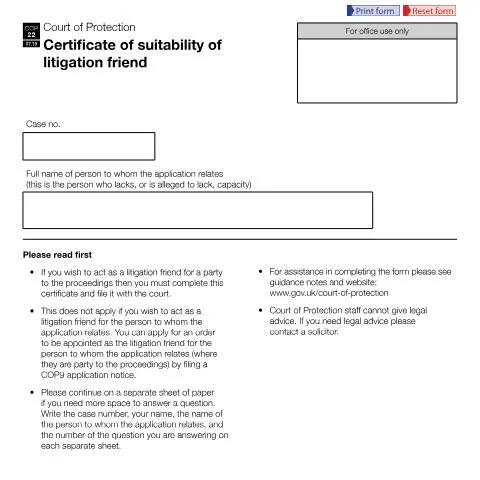
When Court Proceedings Require a Champion: Understanding the COP22 Certificate
In the Court of Protection, vulnerable individuals often find themselves at the heart of complex legal proceedings concerning their capacity, welfare, or finances. When someone lacks the mental capacity to represent themselves in court, the law requires a litigation friend to step forward and champion their interests. The COP22 Certificate of Suitability of Litigation Friend serves as the formal gateway for individuals seeking to fulfil this crucial protective role within England and Wales' specialist jurisdiction.
This certificate represents more than mere paperwork—it establishes a legal safeguard ensuring that only suitable individuals can speak for those who cannot speak for themselves in court. Whether you're a family member concerned about a relative's welfare, a professional deputy appointed under the Mental Capacity Act 2005, or someone with a genuine connection to a vulnerable person, understanding the COP22 process is essential for navigating Court of Protection proceedings effectively.
The Litigation Friend Role: Legal Champion for the Vulnerable
A litigation friend occupies a unique position within the Court of Protection framework, acting as the legal voice for someone who lacks capacity to conduct proceedings independently. This role extends beyond simple representation—the litigation friend becomes responsible for making crucial decisions about legal strategy, settlement negotiations, and procedural matters that could significantly impact the protected person's life.
The Mental Capacity Act 2005 underpins this system, establishing clear principles about when someone requires a litigation friend. The Act's presumption of capacity means that detailed evidence must support any assertion that an individual cannot make decisions about their legal proceedings. This evidence often includes medical assessments, capacity evaluations, and observations about the person's ability to understand legal concepts, retain information, and communicate their wishes effectively.
Distinguishing Between Different Protective Roles
The Court of Protection recognises several distinct protective roles, each serving different purposes:
- Litigation friends for existing parties: These individuals represent someone already involved in proceedings who lacks capacity to continue independently
- Litigation friends for new parties: When bringing someone into proceedings, their litigation friend ensures proper representation from the outset
- Appointed deputies: Court-appointed individuals with ongoing authority to make specific decisions for someone lacking capacity
- Attorneys under lasting powers: People granted authority through advance planning documents
The COP22 certificate specifically addresses the first scenario—when someone wishes to act as litigation friend for an existing party to proceedings. Importantly, if you seek to represent the person who is the subject of the application (rather than merely a party to it), you must use the separate COP9 application process instead.
Eligibility Criteria and Relationship Requirements
Not everyone can assume the litigation friend role, regardless of their good intentions. The Court of Protection maintains strict eligibility criteria designed to protect vulnerable individuals from inappropriate representation or potential conflicts of interest.
Essential Qualifications for Litigation Friends
The COP22 certificate requires applicants to demonstrate three fundamental qualifications:
| Requirement | Evidence Expected | Common Issues |
|---|---|---|
| Competence to conduct proceedings | Understanding of legal processes, ability to instruct solicitors, capacity to make strategic decisions | Lack of legal knowledge, communication barriers, geographical distance from proceedings |
| No adverse interests | Absence of financial conflicts, family disputes, or competing claims | Inheritance disputes, family tensions, business relationships affecting judgment |
| Proper service of certificate | Completion of COP20B service certificates for all required recipients | Incorrect identification of service recipients, inadequate proof of service |
Relationship and Connection Requirements
The certificate demands detailed disclosure of your relationship or connection to the person requiring representation. The Court of Protection recognises various legitimate connections, including:
- Family relationships: Spouses, civil partners, children, parents, siblings, and other relatives
- Professional connections: Social workers, care managers, or other professionals with ongoing responsibility
- Personal relationships: Close friends, neighbours, or community members with genuine concern for the person's welfare
- Formal appointments: Existing deputies, attorneys, or court-appointed representatives in other matters
However, mere acquaintance or distant family connections may prove insufficient. The court expects evidence of ongoing concern for the person's welfare and understanding of their circumstances, values, and preferences.
Completing the Certificate: Section-by-Section Guidance
The COP22 certificate follows a logical progression through four distinct sections, each serving specific evidentiary purposes. Understanding the court's expectations for each section helps ensure your application meets the required standards.
Section 1: Your Personal Details
This foundational section establishes your identity and contact information. Beyond basic demographic details, you must clearly articulate your relationship or connection to the protected person. The court scrutinises this relationship evidence carefully, looking for indicators of genuine concern, ongoing involvement, and understanding of the person's circumstances.
When describing your relationship, provide specific examples of your involvement in the person's life. Generic statements like "family friend" prove less compelling than detailed explanations such as "neighbour of fifteen years who has provided regular practical support and accompanies P to medical appointments since their stroke in 2019."
Section 2: Protected Person Details and Capacity Assessment
This section requires you to demonstrate your belief that the person lacks capacity to conduct proceedings independently. The Mental Capacity Act 2005 sets clear standards for capacity assessments, focusing on the person's ability to:
- Understand information relevant to the decision
- Retain that information long enough to make the decision
- Use or weigh the information as part of decision-making
- Communicate their decision through any means
Your grounds for belief should reference specific observations, medical opinions, or capacity assessments. If relying on medical evidence, attach relevant reports, assessment summaries, or professional letters. Remember that capacity is decision-specific and time-specific—someone might have capacity for simple decisions but lack capacity for complex legal proceedings.
Section 3: Suitability Declarations and Service Requirements
The suitability section contains three critical declarations that form the heart of your application. Each declaration carries significant legal weight and ongoing obligations.
The competence declaration requires honest self-assessment of your ability to conduct proceedings effectively. Consider your understanding of legal processes, availability to participate in hearings, ability to instruct solicitors, and capacity to make strategic decisions under pressure.
The adverse interests declaration demands careful consideration of potential conflicts. Financial interests in the outcome, family disputes affecting your judgment, or professional relationships that might compromise your independence could all constitute adverse interests.
Service Requirements and the COP20B Process
The COP22 certificate cannot stand alone—it must be accompanied by proper service on specified individuals and comprehensive COP20B service certificates documenting your compliance with service requirements.
Identifying Required Recipients
Service requirements vary depending on the protected person's status and circumstances. The certificate provides clear guidance for different categories:
For children, you must serve someone with parental responsibility under the Children Act 1989, or alternatively, someone with whom the child lives or who provides their care. This often includes parents, guardians, or local authority social workers with ongoing responsibility.
For protected parties (adults lacking capacity), service targets those authorised to conduct proceedings on their behalf, appointed attorneys or deputies, or caregivers with whom they live. This reflects the court's recognition that multiple individuals might have legitimate interests in the person's welfare.
COP20B Documentation Requirements
Each service must be documented through a separate COP20B certificate, creating a comprehensive record of your compliance with procedural requirements. These certificates require:
- Precise identification of the person served
- Method of service (personal service, postal service, email where permitted)
- Date and time of service
- Evidence of receipt where available
Failure to complete COP20B certificates properly can result in delayed proceedings or rejection of your litigation friend application, even where the underlying COP22 certificate meets all substantive requirements.
Medical Evidence and Supporting Documentation
While the COP22 certificate doesn't mandate medical evidence, practical experience suggests that robust medical documentation significantly strengthens applications, particularly in contested cases or where capacity questions remain unclear.
Types of Supporting Medical Evidence
Various medical documents can support your capacity assessment, each offering different perspectives on the protected person's abilities:
Consultant reports provide specialist medical opinions about cognitive function, particularly valuable in cases involving dementia, brain injury, or psychiatric conditions affecting decision-making capacity.
GP summaries offer longitudinal perspectives on mental health, medication effects, and functional abilities over time, helping establish when capacity difficulties first emerged.
Occupational therapy assessments focus on functional abilities and practical decision-making skills, often providing detailed evidence about real-world capacity limitations.
Social care assessments document support needs and decision-making difficulties in daily life, complementing medical perspectives with practical observations.
Presenting Medical Evidence Effectively
When attaching medical evidence, ensure documents clearly address the specific question of litigation capacity rather than general medical conditions. A comprehensive medical report might detail extensive physical health problems while confirming retained mental capacity for legal proceedings.
Fill in your form directly online
No printing: type your details into the boxes of the official form, tick, then download the PDF ready to send.
- 1Type into the form boxes
- 2Tick in one click
- 3Save and download the PDF
Highlight relevant sections that specifically address cognitive function, understanding of legal concepts, or ability to participate in court proceedings. Where medical reports use technical terminology, consider providing brief explanatory summaries to help court staff understand the relevance to litigation capacity.
After Submission: Court Processing and Potential Challenges
Once filed, your COP22 certificate enters the Court of Protection's administrative processes, which can vary significantly depending on case complexity, court workload, and whether other parties raise objections to your appointment.
Standard Processing Timeline
Uncontested litigation friend appointments typically process within several weeks, though complex cases or incomplete documentation can extend timescales considerably. The court prioritises applications where proceedings are already listed for hearing, recognising the importance of proper representation for case progression.
During processing, court staff review your certificate for completeness, verify service documentation, and assess your suitability declarations. Administrative queries about missing information or unclear declarations may result in requests for additional documentation or clarification.
Handling Objections and Challenges
Other parties to proceedings may object to your appointment as litigation friend, raising concerns about your suitability, conflicts of interest, or relationship with the protected person. Such objections typically require court hearings where you must defend your application and demonstrate your fitness for the role.
Common objection grounds include:
- Family disputes affecting your ability to represent the person's interests objectively
- Financial conflicts where you might benefit from particular case outcomes
- Lack of knowledge about the person's values, preferences, or circumstances
- Practical difficulties preventing effective participation in proceedings
Preparing for potential challenges involves gathering evidence of your relationship with the protected person, documenting your understanding of their wishes and feelings, and demonstrating your commitment to their welfare rather than your own interests.
Ongoing Duties and Responsibilities of Litigation Friends
Appointment as a litigation friend creates ongoing legal duties extending throughout the proceedings and beyond. Understanding these responsibilities helps ensure effective representation and compliance with court expectations.
Fundamental Duties Throughout Proceedings
Your primary duty involves making decisions in the protected person's best interests as defined by the Mental Capacity Act 2005. This requires considering their past and present wishes, beliefs and values that would influence their decision, and other factors they would likely consider if they had capacity.
Practical duties include:
- Regular communication with the protected person about proceedings, adapted to their communication needs and capacity levels
- Instruction of solicitors and other legal representatives, ensuring they understand the person's circumstances and preferences
- Attendance at hearings where your presence is required or beneficial for effective representation
- Decision-making about settlements or procedural matters, always prioritising the person's welfare over convenience or cost
Financial Responsibilities and Cost Management
Litigation friends bear responsibility for managing legal costs appropriately, seeking court approval for significant expenditure, and ensuring public funding applications are pursued where eligible. The court expects litigation friends to balance thorough representation with proportionate cost management.
Where the protected person has limited financial resources, you must explore legal aid eligibility, after-the-event insurance options, or protective costs orders that might limit their financial exposure to adverse costs if the case is unsuccessful.
Conclusion of Proceedings and Ongoing Obligations
Your role as litigation friend continues until formal conclusion of proceedings, which might involve successful resolution, settlement, or court orders determining the substantive issues. Even after conclusion, you may retain responsibilities for implementing court orders or managing ongoing matters arising from the proceedings.
The court expects litigation friends to provide final accounts of costs incurred, confirm implementation of any protective measures ordered, and ensure appropriate arrangements exist for the person's ongoing welfare where proceedings have addressed personal welfare matters.