When Legal Proceedings Require a Guardian: Understanding the FP9 Certification Process
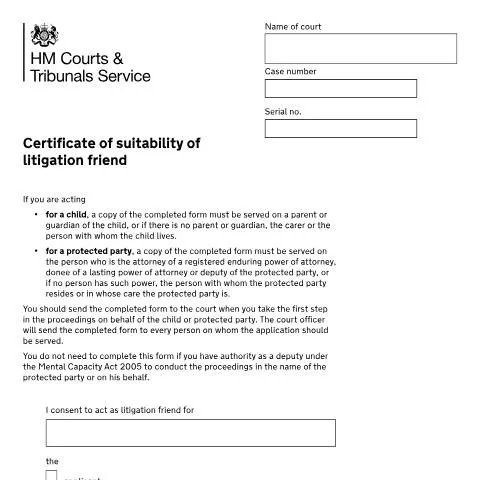
In England and Wales, certain individuals cannot represent themselves in court proceedings due to age or mental capacity limitations. When a child under 18 or a protected party with impaired mental capacity becomes involved in litigation, the court requires a litigation friend to act on their behalf. The FP9 Certificate of Suitability of Litigation Friend serves as the formal declaration that confirms someone's willingness and ability to fulfil this crucial role.
This certificate represents more than administrative paperwork—it establishes legal accountability for representing someone's interests in court when they cannot do so themselves. The litigation friend assumes significant responsibilities, including potential financial liability for court costs, making the FP9 certification a weighty commitment that requires careful consideration.
The Legal Framework Governing Litigation Friends
The requirement for litigation friends stems from fundamental legal principles protecting vulnerable parties in court proceedings. Under the Civil Procedure Rules, children and protected parties lack the legal capacity to conduct litigation independently. A protected party is defined as someone who, by reason of mental disorder within the meaning of the Mental Health Act 1983, is incapable of managing and administering their property and affairs.
The FP9 certificate operates within this protective framework, ensuring that someone suitable takes responsibility for representing the vulnerable party's interests. This system prevents exploitation whilst ensuring access to justice for those who cannot advocate for themselves.
Exemptions from FP9 Requirements
Notably, the FP9 certificate is not required in specific circumstances. If someone already holds authority as a deputy under the Mental Capacity Act 2005 to conduct proceedings in the name of or on behalf of a protected party, they may proceed without completing the FP9. This exemption recognises that court-appointed deputies already possess the necessary legal authority and have undergone appropriate scrutiny.
Who Can Serve as a Litigation Friend and Certification Criteria
The role of litigation friend carries substantial obligations, and not everyone is suitable for this responsibility. The FP9 certificate requires the proposed litigation friend to make several critical declarations about their competence and suitability.
Essential Suitability Requirements
| Requirement | Purpose | Verification Method |
|---|---|---|
| Ability to conduct proceedings competently | Ensures effective representation | Self-declaration on form |
| Ability to conduct proceedings fairly | Protects vulnerable party's interests | Self-declaration on form |
| No adverse interests | Prevents conflicts of interest | Declaration and ongoing duty |
| Financial undertaking | Guarantees cost liability | Formal undertaking on certificate |
The competency requirement encompasses both practical ability to understand legal proceedings and the capacity to make informed decisions about case strategy. This doesn't necessarily require legal training, but the litigation friend must be capable of instructing solicitors effectively and understanding the implications of procedural decisions.
The Financial Undertaking: A Serious Commitment
Perhaps the most significant aspect of the FP9 certificate is the undertaking to pay any costs that the represented party may be ordered to pay in the proceedings. This creates personal financial liability for the litigation friend, subject only to their right to seek repayment from the represented party's assets.
This financial responsibility extends beyond court fees to include potential liability for the opposing party's costs if the case is unsuccessful. Litigation friends should therefore consider whether the represented party has sufficient assets to cover potential costs orders and whether they can personally bear this financial risk.
Mandatory Service Requirements and Procedural Obligations
The FP9 certificate triggers specific service requirements that vary depending on whether the represented party is a child or protected party. These requirements ensure that appropriate persons are notified of the litigation friend's appointment and can object if necessary.
Service Requirements for Child Cases
When acting as litigation friend for a child, a copy of the completed FP9 must be served on:
- A parent or guardian of the child, or
- If no parent or guardian exists, the carer or person with whom the child lives
This service requirement recognises that parents and guardians retain fundamental interests in their child's legal affairs, even when someone else serves as litigation friend. It provides an opportunity for challenge if the proposed litigation friend is unsuitable or if there are concerns about the child's representation.
Service Requirements for Protected Party Cases
For protected parties, the service requirements reflect the more complex arrangements that may exist for managing their affairs:
- The attorney under a registered enduring power of attorney
- The donee of a lasting power of attorney
- A court-appointed deputy
- If none of the above exist, the person with whom the protected party resides or in whose care they are
These provisions ensure that those already involved in managing the protected party's affairs are aware of the litigation and can raise concerns if the proposed litigation friend's appointment conflicts with existing arrangements.
Timing and Procedural Requirements for FP9 Submission
The timing of FP9 submission is crucial and directly linked to the commencement of proceedings. The certificate must be sent to the court when taking the first step in proceedings on behalf of the child or protected party. This ensures that the court is immediately aware of the representation arrangements and can verify their appropriateness.
Court Processing and Distribution
Once the court receives the completed FP9, the court officer takes responsibility for serving copies on the appropriate persons. This centralised service system ensures compliance with procedural requirements and reduces the risk of procedural errors that could delay or compromise the proceedings.
The court's role extends beyond mere administrative processing. Court officers will scrutinise the certificate to ensure completeness and may raise queries if the proposed litigation friend appears unsuitable or if there are obvious conflicts of interest.
Documenting Protected Party Status: Evidence and Justification
When the FP9 relates to a protected party rather than a child, additional documentation and justification become necessary. The form requires the litigation friend to provide reasons for believing the person qualifies as a protected party, supported by appropriate medical evidence.
Medical Evidence Requirements
The requirement for medical evidence reflects the serious nature of determining that someone lacks mental capacity to conduct litigation. Acceptable evidence typically includes:
- Medical reports from treating physicians
- Psychiatric assessments
- Capacity assessments conducted under Mental Capacity Act protocols
- Court of Protection orders or judgments
The evidence must specifically address the individual's capacity to understand and participate in legal proceedings, not merely their general mental health status. This distinction is important because someone may have mental health difficulties whilst retaining litigation capacity, or conversely, may appear generally competent whilst lacking specific capacity for legal decision-making.
Ongoing Obligations and Capacity Changes
The litigation friend's obligations continue throughout the proceedings and include monitoring whether the protected party's capacity changes. If capacity is regained, the litigation friend should notify the court immediately, as continued representation may no longer be appropriate or necessary.
Common Challenges and Practical Considerations
Several practical issues frequently arise in litigation friend appointments, many of which can be addressed through careful completion of the FP9 certificate and proper preparation.
Conflicts of Interest
The requirement that litigation friends have no interests adverse to the represented party can be complex in practice. Family disputes, inheritance issues, or commercial relationships may create subtle conflicts that aren't immediately apparent. Proposed litigation friends should carefully consider their relationship with the represented party and any potential conflicts that might arise during proceedings.
Insurance and Cost Protection
Given the financial undertaking required, many litigation friends seek insurance protection or consider whether after-the-event insurance might be available. Whilst the FP9 doesn't address insurance arrangements directly, prudent litigation friends often explore these options before accepting appointment.
Multiple Potential Litigation Friends
Sometimes multiple people might be suitable or willing to serve as litigation friend. The court will consider factors such as:
- Relationship to the represented party
- Practical ability to manage the proceedings
- Financial capacity to meet potential cost orders
- Absence of conflicts of interest
Court Supervision and Ongoing Responsibilities
Appointment as litigation friend through the FP9 certificate creates an ongoing relationship with the court that extends throughout the proceedings. The court retains supervisory jurisdiction and may remove or replace a litigation friend if circumstances change or if they fail to fulfil their obligations adequately.
Reporting and Communication Duties
Litigation friends must maintain regular communication with the court about significant developments, particularly any changes in the represented party's circumstances or capacity. They also bear responsibility for ensuring that the represented party is kept informed about proceedings to the extent of their understanding.
Settlement negotiations require particular care, as litigation friends cannot compromise claims without court approval. This protection ensures that settlements genuinely serve the represented party's interests rather than the litigation friend's convenience.
Professional Support and Legal Representation
Whilst litigation friends need not be legally qualified, they frequently require professional support to discharge their duties effectively. Most litigation friends instruct solicitors to handle the technical aspects of proceedings whilst maintaining overall responsibility for strategic decisions.
The relationship between litigation friend and legal representatives requires careful management to ensure that the represented party's interests remain paramount. Legal representatives owe duties both to their litigation friend client and to the court regarding the vulnerable party's welfare.
Understanding these responsibilities and preparing thoroughly before completing the FP9 certificate helps ensure that vulnerable parties receive effective representation whilst protecting litigation friends from unnecessary risks or complications during proceedings.
Specific Scenarios Requiring FP9 Certification
The Certificate of Suitability of Litigation Friend extends beyond straightforward cases involving children or adults lacking mental capacity. Several complex scenarios demand careful consideration of when Form FP9 becomes necessary and how different circumstances affect the certification process.
In cases involving temporary incapacity, such as when a party suffers a serious accident resulting in temporary cognitive impairment, the court may require FP9 certification even if the condition is expected to improve. The proposed litigation friend must demonstrate understanding that their role may be time-limited and establish procedures for reassessing capacity as the person recovers. Medical evidence supporting both current incapacity and potential recovery timeline becomes crucial in these applications.
For fluctuating capacity conditions, including certain mental health conditions, dementia in early stages, or learning disabilities that affect understanding inconsistently, the FP9 process requires particularly detailed medical assessment. The litigation friend must show capability to recognise when the protected party may have periods of greater understanding and ensure their involvement in decision-making during such periods, whilst maintaining protective oversight throughout the proceedings.
Cross-border complications arise when the protected party resides outside England and Wales, or when potential litigation friends live abroad. The court examines whether foreign residence affects the proposed litigation friend's ability to fulfil their duties effectively. Additional documentation may include evidence of the proposed litigation friend's understanding of English legal procedures, arrangements for communication across time zones, and confirmation of their availability for court hearings that cannot be conducted remotely.
In family disputes where multiple relatives seek to act as litigation friend, Form FP9 submissions often include detailed explanations of family dynamics, potential conflicts of interest, and reasons why the applicant represents the most suitable choice. The court particularly scrutinises situations where family members disagree about the protected party's best interests, requiring the proposed litigation friend to demonstrate neutrality and commitment to the protected party's welfare above family politics.
Fill in your form directly online
No printing: type your details into the boxes of the official form, tick, then download the PDF ready to send.
- 1Type into the form boxes
- 2Tick in one click
- 3Save and download the PDF
Commercial litigation scenarios present unique challenges when companies or their directors lack capacity due to insolvency, regulatory action, or incapacitation of key personnel. The FP9 process must address corporate governance issues, the proposed litigation friend's understanding of commercial law principles, and their ability to make informed decisions about complex business disputes while protecting the entity's interests.
Documentation Requirements and Supporting Evidence
Beyond the standard Form FP9, comprehensive supporting documentation proves essential for successful applications. The court expects a carefully assembled evidence package that substantiates both the need for litigation friend appointment and the proposed person's suitability.
Medical evidence requirements vary significantly depending on the protected party's condition. For children, age-appropriate assessment reports from educational psychologists or child development specialists may supplement standard medical reports. When dealing with adults, the court typically requires recent medical assessments from relevant specialists—consultant psychiatrists for mental health conditions, neurologists for brain injuries, or geriatricians for age-related cognitive decline. These reports must address the person's capacity to understand legal proceedings specifically, not merely their general mental state.
The medical professional's report should explicitly address the person's ability to understand the nature and consequences of legal proceedings, their capacity to instruct solicitors, and their capability to make informed decisions about settlement offers or trial strategy. Generic statements about mental health conditions prove insufficient; the assessment must relate directly to litigation capacity and decision-making abilities in legal contexts.
Financial disclosure documentation becomes particularly important when the proposed litigation friend has financial interests that might conflict with the protected party's position. Bank statements, property ownership records, business interests, and details of any existing financial relationships with the protected party require disclosure. The court examines whether these financial connections could compromise the litigation friend's independence or create situations where personal gain might influence decision-making.
For professional litigation friends, additional documentation includes professional indemnity insurance certificates, references from previous cases where they've acted in similar capacities, and evidence of continuing professional development in relevant legal areas. Solicitors acting as litigation friends must provide details of their firm's complaints procedures and how potential conflicts of interest are managed.
Character references and background checks carry particular weight when non-family members seek appointment. The court may require references from employers, professional colleagues, or community leaders who can attest to the proposed litigation friend's integrity, reliability, and decision-making capabilities. In sensitive cases involving vulnerable adults, enhanced background checks through the Disclosure and Barring Service may be necessary.
Communication and accessibility arrangements require documentation when the protected party has sensory impairments, language barriers, or communication difficulties. Evidence of the proposed litigation friend's ability to communicate effectively—whether through sign language skills, language interpretation arrangements, or familiarity with assistive communication technologies—strengthens the application considerably.
Ongoing Obligations and Case Management Responsibilities
Appointment as litigation friend through Form FP9 creates continuing obligations that extend far beyond the initial court order. These responsibilities evolve throughout the litigation process and require careful attention to changing circumstances and developing case requirements.
Regular capacity reassessment obligations form a cornerstone of ongoing litigation friend duties. The appointed person must monitor the protected party's condition continuously, arranging updated medical assessments when circumstances suggest capacity changes. This proves particularly crucial in cases involving progressive conditions, recovery from injuries, or treatment of mental health conditions where capacity might improve with appropriate intervention.
The litigation friend must establish systematic communication protocols with the protected party, ensuring regular consultation about case developments while recognising capacity limitations. This involves adapting communication methods to the person's abilities—using simplified language for learning disabilities, visual aids for communication disorders, or structured decision-making frameworks for cognitive impairments. Documentation of these consultations becomes essential for demonstrating ongoing compliance with duties.
Financial management responsibilities require meticulous record-keeping throughout the case. The litigation friend must maintain detailed accounts of all litigation-related expenditure, ensure costs remain proportionate to potential outcomes, and seek court approval for significant financial decisions. This includes managing legal aid arrangements where applicable, considering after-the-event insurance options, and evaluating settlement offers against potential trial outcomes and associated costs.
Strategic decision-making authority encompasses numerous case management choices that arise during litigation. The litigation friend decides whether to engage expert witnesses, determines the extent of disclosure obligations, evaluates alternative dispute resolution opportunities, and makes tactical decisions about case presentation. Each decision requires careful consideration of the protected party's best interests, taking into account their expressed wishes where determinable, their past preferences, and objective assessment of optimal outcomes.
The court reporting obligations extend beyond routine case management orders. Litigation friends must promptly notify the court of any material changes in the protected party's circumstances, including capacity improvements, deterioration in condition, changes in living arrangements, or emergence of conflicts between the litigation friend and protected party. Failure to report such changes can result in removal from the role and potential personal liability for continued costs.
Settlement negotiations and approval processes require particular attention to court procedures. Any proposed settlement exceeding £1,000 for children or any settlement for adults lacking capacity requires court approval regardless of amount. The litigation friend must prepare detailed settlement approval applications, including medical evidence supporting the settlement amount for personal injury cases, actuarial assessments for future loss calculations, and structured settlement evaluations where appropriate.
Professional relationship management with legal representatives demands ongoing oversight to ensure the protected party's interests remain paramount. This includes reviewing legal costs regularly, ensuring appropriate case progression, challenging legal advice that appears contrary to the protected party's interests, and changing legal representation when necessary. The litigation friend must balance respect for professional expertise with their ultimate responsibility for protecting their charge's welfare.
When cases conclude, post-litigation responsibilities may continue, particularly regarding damages awards or settlement funds. The litigation friend must ensure appropriate investment or protection of awarded funds, compliance with court orders regarding fund management, and transition arrangements if the protected party regains capacity or reaches majority age.