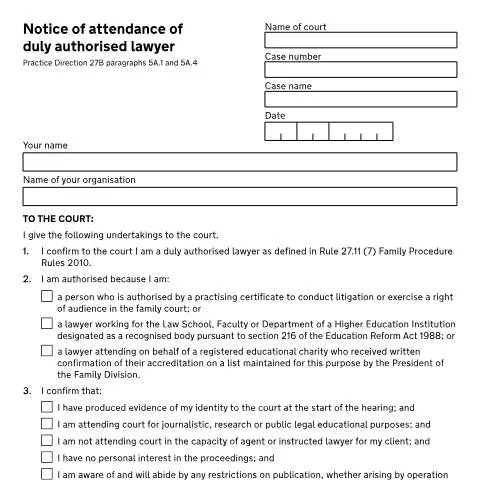
Navigating Your Role in Family Court: Understanding Form FP301
When you find yourself involved in the family court system, understanding the nuances of your role is crucial. A significant document in this realm is the Form FP301, which enables duly authorised lawyers to notify the court of their attendance. This guide will walk you through the intricacies of this document, its implications, and how it fits into the broader family court context.
Unpacking the Essentials of Form FP301
Form FP301 is not merely a procedural document; it embodies a framework of legal obligations and undertakings that ensure the integrity of family court proceedings. This form specifically applies to lawyers attending court not as representatives of clients but for purposes such as journalism or research. Understanding its content and implications is essential for legal professionals and stakeholders.
Key Components of Form FP301
- Lawyer's Confirmation: The lawyer must confirm their status as duly authorised under Rule 27.11 (7) of the Family Procedure Rules 2010.
- Identification Verification: The lawyer is required to show evidence of their identity at the beginning of the hearing.
- Purpose of Attendance: It should be clear that the attendance is not in a representative capacity but for educational or journalistic reasons.
- Awareness of Publication Restrictions: The lawyer must acknowledge any restrictions on publication that pertain to the proceedings, ensuring compliance with laws such as the Children Act 1989.
Situations Demanding the Use of Form FP301
Understanding when Form FP301 comes into play is vital for those involved in family law. This document is indispensable for lawyers attending to observe proceedings for educational purposes, which can include:
- Legal scholars seeking to understand case law applications.
- Journalists covering cases of public interest while adhering to legal and ethical guidelines.
- Representatives from educational charities aiming to gain insight into family law practice.
Key Legal Concepts in Family Court Proceedings
To effectively use Form FP301, it's essential to grasp certain legal concepts that underpin family proceedings:
- Child Protection Laws: Understanding sections like the Children Act 1989 which sets out the welfare of the child as the paramount concern.
- Contempt of Court: Recognising the repercussions of failing to adhere to court orders or restrictions imposed during private proceedings.
- Family Procedure Rules: Familiarity with the procedural framework that governs family law, especially regarding the roles and obligations of participants.
Common Misinterpretations and Pitfalls
While navigating the family court system, certain common misinterpretations about Form FP301 can lead to confusion:
Misinterpretation of Authorisation
Many may think that any lawyer can use Form FP301. However, it’s critical to clarify that only those with specific authorisations, such as those outlined in the Family Procedure Rules, can submit this notice.
Assumptions About Purpose
Another frequent pitfall is assuming that attendance for educational purposes equates to representation. Form FP301 must explicitly state the lawyer is not acting in a client’s interest, which is fundamental to avoid breaches of legal ethics.
Form FP301 and its Relationship with Other Court Documents
In the context of family court proceedings, understanding how Form FP301 interacts with other official documents is paramount:
| Document | Purpose | Relation to Form FP301 |
|---|---|---|
| Form FP302 | Notice of attendance for legal representatives | Distinct from FP301, which is for authorised lawyers not representing clients. |
| Form A | Application for a financial remedy | May be observed with FP301, but serves a different function in proceedings. |
| P60 Certificate | Proof of income for financial assessments | Not directly related, but financial matters often arise in family cases where FP301 may be used. |
Procedure for Submitting Form FP301: A Step-by-Step Guide
For those involved in the family court's intricate workings, submitting Form FP301 correctly is key. Here’s a detailed procedure to follow:
- Gather Required Information: Ensure you have all necessary details, including your identity verification and the case specifics.
- Complete the Form: Clearly articulate your purpose of attendance, adhering to the specific language and obligations as outlined in the form.
- Submit to the Court: File the completed form with the relevant court, ensuring you retain a copy for your records.
- Attend the Hearing: Arrive at the court, having verified your identity, and be prepared to comply with any additional court directives.
Additional Resources and Support for Legal Professionals
For lawyers and legal professionals navigating the complexities of family law and the use of Form FP301, a range of resources exists:
- The Law Society: Offers guidance on best practices and updates on family law.
- Continuing Professional Development (CPD): Engaging in training focused on family law updates can provide valuable insights.
- Legal Education Institutions: Many provide workshops and seminars focused on family court procedures.
Ultimately, understanding Form FP301 and its place in family law proceedings can significantly impact your ability to navigate the court system effectively. By grasping the intricacies of this notice, legal professionals can ensure they are prepared for the responsibilities and obligations inherent in attending family court hearings.
Understanding Form FP301: Purpose and Key Information
The FP301 form is a crucial document within the family court system in the UK, specifically designed for notifying the court of your attendance at a hearing. It is typically used in situations where family-related disputes arise, such as divorce proceedings, child custody cases, or financial settlements. By submitting this form, you ensure that the court is aware of your intention to attend, which helps facilitate the proper scheduling and management of court resources.
Fill in your form directly online
No printing: type your details into the boxes of the official form, tick, then download the PDF ready to send.
- 1Type into the form boxes
- 2Tick in one click
- 3Save and download the PDF
The form requests essential details including your personal information, the case reference number, and the date of the hearing. Accurate completion of this form is vital, as any discrepancies could result in delays or even complications in your case. You can obtain Form FP301 from the official HM Courts & Tribunals Service website, as well as various court offices across the UK. It's important to verify that you’re using the most up-to-date version to avoid any administrative issues.
Common Mistakes to Avoid When Submitting Form FP301
Filing Form FP301 may seem straightforward, but there are several common mistakes that individuals should be cautious of to prevent delays and complications in their cases. Here are some pitfalls to watch out for:
- Inaccurate Personal Information: Ensure that your name, address, and contact information are precisely entered. Any errors could lead to miscommunication or a failure to receive important court updates.
- Failure to Include Case Reference: Always include the case reference number provided in previous court documents. This number is essential for the court to associate your attendance with the correct case.
- Inadequate Notice Period: Make sure that you submit Form FP301 within a reasonable timeframe before the hearing date. While there is no strict deadline, it is advisable to notify the court as soon as you are aware of your intention to attend.
- Neglecting to Keep Copies: After submitting Form FP301, always keep a copy for your records. This can be beneficial if any disputes arise regarding your attendance.
By being mindful of these common mistakes, you can improve the efficiency of the court process and reduce the likelihood of unnecessary delays or complications.
How to Handle Issues Stemming from Non-Attendance
Sometimes circumstances can prevent a party from attending a scheduled court hearing, despite having submitted Form FP301. If you find yourself unable to attend, it’s crucial to address this proactively to safeguard your legal interests. Here are steps you can take:
- Notify the Court Immediately: As soon as you know you cannot attend, contact the court to inform them of your situation. This can sometimes be done via phone, but follow up with a written notice if possible, explaining your reasons.
- Request a Postponement: In some cases, you may be able to request a postponement of the hearing. This could be due to illness, emergencies, or other valid reasons. Be prepared to provide evidence supporting your request, such as medical certificates or documentation of unexpected circumstances.
- Consider Legal Advice: If your absence could significantly impact the outcome of your case, it may be wise to seek legal advice. A solicitor can guide you through the ramifications of non-attendance and help you assess whether you should take any additional steps.
- Follow Court Protocols: Each court may have specific protocols for handling non-attendance. Check the guidelines provided by the HM Courts & Tribunals Service or consult with court staff for further instructions.
Ultimately, ensuring that the court is aware of your situation can help mitigate potential negative consequences, such as the court proceeding without your input, which could adversely affect the ruling.