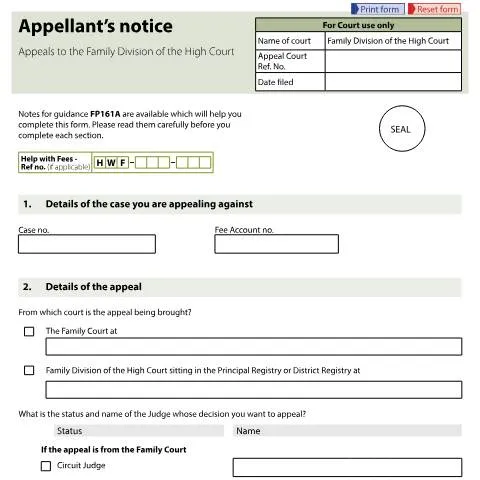
Naviguer dans la procédure d'appel devant la Family Division : comprendre le formulaire FP161
Lorsqu'une décision judiciaire en matière familiale ne correspond pas à vos attentes ou présente selon vous des erreurs de droit, le formulaire FP161 constitue votre passeport vers la juridiction d'appel. Ce document officiel de HM Courts & Tribunals Service structure votre demande d'appel devant la Family Division of the High Court, mais sa complexité apparente masque une logique procédurale qu'il convient de décrypter méthodiquement.
Le formulaire FP161 ne se contente pas de recueillir des informations : il organise votre stratégie d'appel en distinguant clairement les éléments factuels de votre argumentation juridique. Comprendre cette architecture permet d'éviter les écueils qui conduisent au rejet technique de l'appel, indépendamment du bien-fondé de vos griefs.
Architecture procédurale : de la juridiction d'origine à la High Court
Le formulaire établit d'emblée une cartographie judiciaire précise. La section 2 exige l'identification exacte de la juridiction dont émane la décision contestée, qu'il s'agisse de la Family Court ou déjà de la Family Division siégeant en première instance dans un District Registry.
Cette distinction revêt une importance capitale car elle détermine les voies de recours disponibles. Les appels depuis la Family Court peuvent concerner des décisions rendues par :
- Circuit Judges pour les affaires les plus complexes
- Recorders dans leur fonction juridictionnelle
- District Judges pour les contentieux de routine, notamment les questions patrimoniales
En revanche, les appels depuis la Family Division elle-même impliquent généralement des District Judges du Principal Registry ou des Costs Judges, révélant une procédure déjà avancée dans la hiérarchie judiciaire.
Identification du statut décisionnel
Le formulaire distingue trois catégories de décisions susceptibles d'appel : les case management decisions, l'octroi ou le refus d'ordonnances provisoires, et les décisions finales. Cette typologie influence directement les conditions d'autorisation d'appel et les délais applicables.
Stratégie d'autorisation : permission requise ou acquise
La section 5 constitue le cœur stratégique du formulaire. Elle matérialise la distinction fondamentale entre les appels de plein droit et ceux nécessitant une permission to appeal. Cette autorisation peut être sollicitée soit auprès du juge ayant rendu la décision contestée, soit directement auprès de la juridiction d'appel.
| Situation | Action requise | Documentation |
|---|---|---|
| Permission déjà accordée | Compléter Box A | Date et identité du juge |
| Permission refusée partiellement | Préciser les motifs non autorisés | Détail des griefs rejetés |
| Aucune demande antérieure | Compléter Box B | Justification de la demande |
L'obtention d'une permission partielle crée une situation hybride : l'appelant peut procéder sur les motifs autorisés tout en sollicitant l'extension aux griefs initialement rejetés. Cette approche évite la multiplication des procédures.
Critères d'appréciation de la permission
Bien que le formulaire ne détaille pas les critères, la jurisprudence établit que la permission dépend de la real prospect of success ou de l'existence d'une compelling reason justifiant l'examen par la juridiction supérieure. Les questions de pure procédure obtiennent plus difficilement cette autorisation que les points de droit substantiel.
Construction argumentative : grounds of appeal et skeleton argument
Les sections 7 et 8 organisent la présentation de votre argumentation selon une méthode bipartite. Les grounds of appeal exposent synthétiquement vos griefs, tandis le skeleton argument développe l'argumentation juridique détaillée.
Cette séparation répond à une logique procédurale : les grounds constituent l'acte d'appel proprement dit, limitant le périmètre du litige d'appel, tandis que le skeleton argument peut être affiné jusqu'à 14 jours après le dépôt du formulaire principal.
Rédaction des grounds of appeal
Le formulaire exige une présentation en paragraphes numérotés sur document séparé, identifié par le numéro de dossier et le nom complet de l'appelant. Cette formalisation n'est pas accessoire : elle facilite les références ultérieures lors des audiences et évite les ambiguïtés sur le périmètre de l'appel.
Chaque ground doit identifier précisément l'erreur reprochée au premier juge. Les formulations générales du type "the judge was wrong" sont insuffisantes. La pratique recommande de structurer chaque grief autour :
- De l'identification factuelle du point litigieux
- De la règle de droit applicable
- De l'erreur d'application ou d'interprétation
- De l'impact sur le dispositif de la décision
Demandes accessoires et mesures conservatoires
La section 10 permet de solliciter des mesures d'accompagnement de l'appel principal. Ces applications accessoires revêtent souvent une importance pratique considérable, particulièrement dans les contentieux familiaux où l'urgence domine.
Le stay of execution suspend l'exécution de la décision contestée pendant la procédure d'appel. Cette mesure s'avère cruciale lorsque l'exécution immédiate risque de créer des situations irréversibles, notamment en matière de résidence d'enfants ou de partage patrimonial.
Le stay of proceedings interrompt la procédure en première instance, évitant que de nouvelles décisions viennent compliquer l'état du litige pendant l'examen de l'appel.
Extension de délai : une procédure d'exception
La Part C de la section 10 concerne les demandes d'extension de délai pour dépôt tardif. Le formulaire exige une justification détaillée du retard et la démonstration des diligences accomplies depuis la décision contestée. Cette exigence reflète le principe selon lequel les délais d'appel constituent des délais de forclusion, non susceptibles de prorogation automatique.
Coordination des représentations : mapping des intérêts en présence
Les sections 3 et 4 établissent une cartographie complète des parties et de leurs représentants. Cette identification dépasse la simple formalité administrative : elle conditionne la régularité de la procédure contradictoire et l'efficacité des notifications.
La distinction entre applicants/petitioners de première instance et appellant/respondents en appel matérialise le changement de perspective procédurale. L'ancien demandeur peut devenir respondent à l'appel, modifiant sa position stratégique.
Représentation légale et legal aid
Le formulaire recueille les informations relatives au Legal Aid Certificate ou au Community Legal Service Fund certificate. Ces mentions influencent les questions de costs et peuvent justifier des aménagements procéduraux.
L'identification précise des solicitors inclut les références DX (Document Exchange), système de messagerie juridique encore utilisé par les cabinets traditionnels. Cette information facilite les communications formelles entre représentants.
Délais et formalités de dépôt : respecter le calendrier procédural
La section 6 aborde frontalement la question temporelle. Le formulaire interroge directement sur le respect des délais, renvoyant aux Guidance Notes FP161A pour les précisions techniques. Cette approche préventive vise à éviter les rejets techniques pour dépôt tardif.
Les délais d'appel varient selon la nature de la décision et les circonstances de sa notification. Les décisions finales bénéficient généralement d'un délai de 21 jours, tandis que certaines décisions interlocutoires peuvent exiger une réaction plus rapide.
La mention "Help with Fees" en première page signale la possibilité de remission des frais de justice pour les justiciables aux ressources limitées. Le système HWF (Help with Fees) permet une approche graduée selon les revenus et la composition familiale.
Relief recherché : définir l'objectif de l'appel
La section 9 exige la précision du relief recherché : annulation (set aside), modification (vary) ou renvoi (re-hearing). Cette distinction oriente l'examen par la juridiction d'appel et influence l'étendue des débats.
L'option "vary and substitute" permet de proposer une solution alternative précise, évitant un renvoi coûteux en première instance. Cette approche constructive trouve particulièrement sa place dans les contentieux patrimoniaux où les éléments factuels sont stabilisés.
Articulation avec l'écosystème procédural familial
Le formulaire FP161 s'insère dans un ensemble procédural plus large. Sa compréhension implique la maîtrise des interactions avec les autres documents de la procédure familiale, notamment les Family Procedure Rules qui gouvernent les délais et formalités.
L'appel en matière familiale présente des spécificités liées à la nature des enjeux. Les questions relatives aux enfants bénéficient d'une approche particulière, privilégiant leur welfare sur les considérations procédurales strictes. Cette priorité peut influencer l'appréciation des demandes de permission et l'urgence des mesures conservatoires.
La reference aux Guidance Notes FP161A souligne l'importance de ces documents d'accompagnement. Ces notes détaillent les aspects techniques non développés dans le formulaire principal, notamment les modalités de calcul des délais et les exceptions procédurales.
L'efficacité de l'utilisation du formulaire FP161 repose finalement sur la compréhension de sa logique interne : organiser méthodiquement une contestation tout en respectant les exigences formelles qui conditionnent la recevabilité de l'appel. Cette approche structurée transforme un document administratif complexe en outil stratégique au service d'une argumentation juridique cohérente.
Grounds for Appeal and Legal Framework Considerations
When completing Form FP161, appellants must articulate their grounds for appeal with precision, as these form the cornerstone of their case before the Family Division. The grounds typically fall into several distinct categories, each requiring specific legal foundations and supporting evidence.
Appeals based on errors of law represent the most common category. These occur when the lower court misinterpreted or misapplied relevant legislation, such as the Children Act 1989, Matrimonial Causes Act 1973, or Family Procedure Rules 2010. Appellants must identify the specific legal provision that was incorrectly applied and explain how this error materially affected the outcome. For instance, if a district judge incorrectly applied the welfare checklist under section 1(3) of the Children Act 1989, the appellant should reference the specific subsection and demonstrate how proper application would have led to a different decision.
Procedural irregularities constitute another significant ground for appeal. These might include failures to follow proper procedures during hearings, inadequate case management directions, or breaches of natural justice. Common examples include situations where a party was not given adequate opportunity to present their case, where evidence was admitted or excluded inappropriately, or where the judge failed to provide sufficient reasons for their decision. The Family Procedure Rules 2010 set out detailed procedural requirements, and any material departure from these can form valid grounds for appeal.
Appeals on the basis of fresh evidence require careful consideration under the principles established in Ladd v Marshall. The evidence must be such that it could not have been obtained with reasonable diligence for use at the original hearing, it would probably have had an important influence on the result, and it must be apparently credible. In family cases, fresh evidence might include newly discovered financial information in ancillary relief proceedings or updated welfare reports in children matters. However, appellants should note that the Family Division applies these criteria strictly, particularly the requirement that the evidence could not reasonably have been available earlier.
When drafting grounds relating to findings of fact, appellants face a higher threshold. The Court of Appeal will only interfere with factual findings if they are clearly wrong or if the judge's approach to the evidence was flawed. This might occur where a judge failed to take account of relevant evidence, gave excessive weight to unreliable testimony, or made findings that were not supported by the available evidence. Appellants must be specific about which findings they challenge and provide detailed reasons why these findings were erroneous.
Fill in your form directly online
No printing: type your details into the boxes of the official form, tick, then download the PDF ready to send.
- 1Type into the form boxes
- 2Tick in one click
- 3Save and download the PDF
The adequacy of reasons can also form grounds for appeal. While family judges are not required to deal with every argument raised, they must provide sufficient reasoning to enable parties to understand why they reached their decision and to allow the appellate court to review the decision meaningfully. Inadequate reasons might justify an appeal, particularly in complex financial cases or where significant welfare issues are at stake.
Strategic Timing and Procedural Considerations
The timing of an appeal application involves multiple critical deadlines that can significantly impact the prospects of success. The primary 21-day deadline from the date of the order runs from the date the order was made, not when it was served or when the appellant became aware of it. However, this general rule contains important exceptions and nuances that practitioners must navigate carefully.
In cases involving consent orders, special considerations apply. Where parties have agreed to an order, the grounds for appeal are necessarily limited. Appeals against consent orders typically succeed only where there has been a material non-disclosure, mistake, or where the agreement was reached under duress or undue influence. The 21-day time limit still applies, but appellants may need to demonstrate why they were not aware of the grounds for appeal until after the order was made.
For orders made without notice, the time limit may be extended in appropriate circumstances. If an appellant was not present when the order was made and was not served with notice of the hearing, they may be able to argue that time should run from when they first became aware of the order. However, this does not provide indefinite protection, and appellants are expected to act promptly once they become aware of adverse orders.
The concept of finality in litigation plays a crucial role in family appeals. Courts are particularly reluctant to revisit final orders in financial remedy proceedings, recognising that parties need certainty to move forward with their lives. This policy consideration affects both the grant of permission to appeal and the substantive appeal hearing. Appellants must demonstrate not only that the original decision was wrong, but also that the interests of justice require the matter to be reopened.
When considering whether to make an application for stay of execution pending appeal, appellants must weigh several factors. A stay prevents the implementation of the order being appealed, but courts will only grant stays where there are compelling reasons. In children cases, stays are rarely granted due to the paramountcy of the child's welfare and the importance of stability. In financial cases, stays might be appropriate where implementation of the order would make it impossible to provide effective relief if the appeal succeeds, such as where assets would be dissipated or transferred beyond the jurisdiction.
The interaction with other proceedings can complicate appeal timing. Where related proceedings are ongoing in other courts, or where enforcement proceedings have been commenced, appellants must consider how their appeal affects these processes. In some cases, it may be appropriate to seek directions from the court about case management, particularly where multiple family members are involved in different proceedings or where there are parallel proceedings in other jurisdictions.
Case Management and Post-Filing Procedures
Once Form FP161 has been filed, the appeal enters a structured case management process designed to ensure efficient resolution while maintaining procedural fairness. Understanding these procedures is essential for effective appeal preparation and can significantly influence the ultimate outcome.
The initial administrative screening conducted by court staff focuses on compliance with formal requirements. This includes verification that the correct fee has been paid, that all required documents are attached, and that the form has been properly completed. Where deficiencies are identified at this stage, the court may reject the application or require remedial action within a specified timeframe. Appellants should ensure that all supporting documents are clearly legible and properly paginated, as administrative delays can affect subsequent timetables.
The permission stage represents a crucial filter in the appeal process. Applications for permission are initially considered on paper by a single judge, typically a High Court judge or designated Circuit judge. The test applied is whether the appeal has a real prospect of success or whether there is some other compelling reason why the appeal should be heard. This is a relatively low threshold, but it serves to exclude hopeless appeals and those that seek to re-argue points already properly decided.
Where permission is refused on paper, appellants have the right to request an oral hearing for reconsideration. This request must be made within seven days of service of the refusal notice. Oral permission hearings are typically brief, lasting 30 minutes or less, and provide an opportunity for advocates to address the judge's concerns directly. Success rates at oral hearings are generally higher than on paper applications, making this an important right that should not be overlooked.
The respondent's involvement varies depending on the stage of proceedings. At the permission stage, respondents are not automatically required to file evidence, though they may do so if they wish to oppose the application. Once permission is granted, respondents must file a respondent's notice if they wish to uphold the original decision on different grounds or if they seek to cross-appeal. The time limit for respondent's notices is typically 14 days from service of the appellant's notice or permission grant.
Case management directions will typically address several key areas. The preparation of appeal bundles follows specific requirements set out in Practice Direction 27A. The appellant is usually responsible for preparing the bundle, which must include the notice of appeal, the order being appealed, the judgment or reasons, and relevant evidence from the lower court proceedings. The bundle must be paginated and indexed, with core documents easily identifiable.
The court may also give directions about skeleton arguments, which are essential documents setting out each party's case in structured form. Skeleton arguments should identify the issues on appeal, summarise the relevant facts, set out the legal principles to be applied, and provide a chronological guide to the bundle. These documents serve both to focus the hearing and to assist the judge in pre-reading.
In complex cases, the court may order a case management conference to address procedural issues, estimate hearing time requirements, and resolve any disputes about bundle preparation or expert evidence. These conferences provide an opportunity to identify areas of agreement and focus the appeal hearing on genuine points of difference.
The listing and hearing procedures vary depending on the complexity and urgency of the case. Straightforward appeals may be listed for half-day hearings, while complex financial or children cases may require several days. The court will consider any constraints on party or advocate availability, but appellants should be prepared to accommodate court availability, particularly given the limited sitting days available for family appeals.