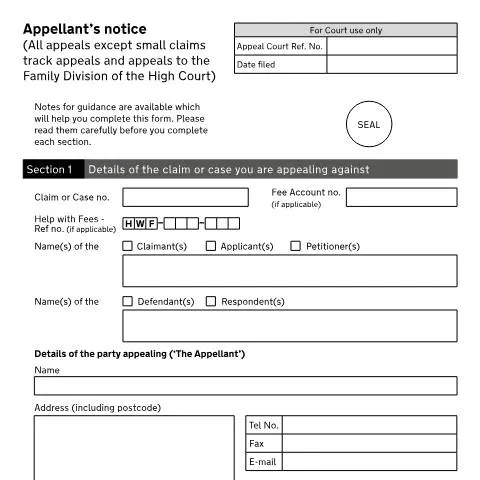
When Court Decisions Go Against You: The Appeal Process Through Form N161
Receiving an unfavourable court judgment can feel overwhelming, but the English legal system provides a structured pathway for challenging decisions through the appeals process. Form N161, the appellant's notice, serves as your formal gateway to requesting a higher court review a lower court's decision. This document transforms your dissatisfaction with a judgment into a legally recognised challenge, setting in motion a complex procedural framework that could ultimately overturn or modify the original ruling.
The appellant's notice isn't merely a complaint form—it's a strategic legal document that must demonstrate clear grounds why a judge's decision was legally flawed. Whether you're challenging a County Court ruling on a contract dispute, appealing a Family Court decision about child arrangements, or contesting a High Court judgment in commercial litigation, Form N161 provides the standardised format courts require to process your appeal efficiently.
Understanding this form's intricacies becomes crucial when you consider that appeals aren't automatic rights. Most require permission either from the original trial judge or the appeal court itself, and strict time limits apply. Getting Form N161 wrong could mean losing your only chance to challenge an adverse decision, making precision in completion absolutely essential.
Navigating the Permission Maze: When You Can and Cannot Appeal
The appeal system operates on a fundamental principle: not every disappointed litigant gets a second bite at the cherry. Section 4 of Form N161 addresses this critical threshold question—whether you need permission to appeal and, if so, whether you've obtained it.
Appeals fall into distinct categories with different permission requirements. Small claims track appeals and certain statutory appeals proceed as of right, meaning you can file your notice without prior permission. However, most appeals require explicit permission, either from the judge who made the original decision or from the appeal court.
| Appeal Type | Permission Required | Who Grants Permission | Key Considerations |
|---|---|---|---|
| Final orders over £25,000 | Yes | Trial judge or appeal court | Real prospect of success or compelling reason |
| Small claims final orders | No | N/A | Direct appeal right |
| Interim orders | Yes | Appeal court only | Higher threshold for permission |
| Family proceedings | Usually yes | Family Court or Court of Appeal | Child welfare considerations may apply |
When completing Box A or Box B in Section 4, precision matters enormously. If you tick Box A claiming permission has been granted, you must provide the exact date and judge's name. Getting this wrong could result in your appeal being struck out immediately. Box B applicants face the additional burden of convincing the appeal court that permission should be granted—a process that requires compelling legal arguments beyond mere dissatisfaction with the outcome.
The permission stage also determines your appeal's trajectory. If the original judge refused permission partially, you can seek permission from the appeal court for the refused grounds while proceeding on the permitted ones. This dual-track approach requires careful coordination in your paperwork to avoid confusion.
Dissecting Your Grounds of Appeal: The Heart of Form N161
Section 6 represents the substantive core of your appeal—the grounds explaining why the original judge was wrong. This isn't where you rehash factual disputes or express general dissatisfaction; it's where you identify specific legal errors that justify appellate intervention.
Successful grounds typically fall into recognised categories: errors of law where the judge misapplied legal principles, procedural irregularities that affected the trial's fairness, or perverse findings where no reasonable judge could have reached the same conclusion on the evidence presented. Each ground must be numbered and presented as a separate paragraph on attached sheets, with your case number and full name clearly marked.
The format requirements aren't bureaucratic pedantry—they serve practical purposes. Appeal judges review hundreds of cases annually, and standardised presentation helps them quickly identify the legal issues at stake. Your grounds should read like precise legal arguments, not emotional narratives about unfair treatment.
Consider these examples of well-constructed versus poorly constructed grounds:
- Effective ground: "The learned judge erred in law by failing to apply the test established in Bolam v Friern Hospital Management Committee when determining the standard of care expected of the defendant medical practitioner."
- Ineffective ground: "The judge was biased and didn't listen to my evidence properly, which was clearly better than the other side's witnesses."
Remember that appeals courts don't generally interfere with judges' findings of fact unless they're demonstrably unsupportable. If your case turns purely on whose evidence was more credible, you'll struggle to formulate compelling grounds unless you can identify specific procedural errors in how that evidence was assessed.
Timing Your Appeal: Critical Deadlines and Extensions
Section 5's seemingly simple question about lodging your notice "in time" masks a complex web of deadlines that vary depending on your case type and the decision being appealed. Getting this wrong doesn't just delay your appeal—it can kill it entirely.
The standard appeal period is 21 days from the date of the decision you're challenging, but this seemingly straightforward rule contains multiple complications. The "decision date" isn't necessarily when judgment was delivered orally in court—it's typically when the written order was drawn up and sealed. For complex judgments requiring detailed orders, this gap can be significant.
Different appeal types carry different time limits:
- Civil appeals generally: 21 days from the sealed order
- Appeals against case management decisions: Often 7 days
- Statutory appeals: Varies by legislation (can be as short as 28 days or as long as 6 months)
- Appeals from tribunals: Usually 28 days but check specific tribunal rules
If you're filing late, Section 10 Part B becomes crucial. Here you must apply for an extension of time, providing compelling reasons for the delay and demonstrating what steps you've taken since the original decision. Courts scrutinise these applications carefully—administrative oversight or solicitor delays rarely suffice unless accompanied by exceptional circumstances.
The extension criteria focus on: the length of delay, reasons for delay, whether the delay prejudices other parties, and whether the proposed appeal has merit. A week's delay with good reasons might be acceptable; several months of unexplained inaction probably won't be.
Constructing Your Legal Arguments: Skeleton Arguments and Supporting Evidence
Section 7 addresses skeleton arguments—concise legal documents that flesh out your grounds of appeal with detailed reasoning, case law citations, and statutory references. While the grounds of appeal identify what went wrong, skeleton arguments explain why it matters legally and how the appeal court should respond.
You have two options: file your skeleton argument with Form N161 or commit to filing it within 14 days. This choice carries strategic implications. Filing immediately demonstrates your appeal's readiness and can expedite listing, but rushing might compromise quality. The 14-day option allows more preparation time but requires absolute adherence to the deadline—late skeleton arguments face potential rejection.
Effective skeleton arguments follow a recognised structure: summary of the case, identification of issues, legal analysis with authorities, and proposed relief. They shouldn't exceed 25 pages for most appeals, forcing you to prioritise your strongest arguments. Remember that appeal judges often read skeleton arguments before the hearing, making them your first opportunity to persuade.
Section 11 handles supporting evidence for any additional applications in Section 10. This evidence must be directly relevant to your specific applications—stay of execution, extension of time, or other relief. Generic submissions about your case's merits won't suffice; you need targeted evidence addressing the specific criteria for each application type.
Special Considerations: Aarhus Claims and Environmental Appeals
Section 8 introduces a specialised area—Aarhus Convention claims relating to environmental matters. These appeals enjoy special cost protection under European environmental law principles, potentially limiting your liability for the other side's legal costs if you lose.
Aarhus claims typically arise from planning decisions, environmental permits, or public participation in environmental decision-making. If your appeal challenges a local authority's planning decision or a regulatory body's environmental determination, you might qualify for Aarhus protection. However, claiming Aarhus status isn't automatic—you must demonstrate your case genuinely concerns environmental matters affecting the public interest.
The cost implications are substantial. Normal appeals can expose you to five or six-figure adverse costs orders if unsuccessful. Aarhus claims typically cap your liability at £5,000 for individuals or £10,000 for groups, making appeals more accessible for environmental challenges. However, incorrectly claiming Aarhus status could backfire if the court later determines your claim doesn't qualify.
Fill in your form directly online
No printing: type your details into the boxes of the official form, tick, then download the PDF ready to send.
- 1Type into the form boxes
- 2Tick in one click
- 3Save and download the PDF
When completing this section, consider whether your underlying dispute genuinely concerns environmental protection, public access to environmental information, or public participation in environmental decision-making. Commercial disputes with incidental environmental elements rarely qualify, regardless of the underlying facts.
The Relief You Seek: Setting Aside, Varying, or Ordering Retrials
Section 9 requires you to specify exactly what you want the appeal court to do—a decision that shapes your entire appeal strategy and determines the scope of the court's review. Your three main options carry different implications for how your case proceeds.
Setting aside the order seeks complete reversal, returning parties to their pre-judgment positions. This option suits cases where the original decision was fundamentally flawed—wrong in law, procedurally unfair, or based on inadmissible evidence. However, setting aside doesn't automatically give you what you originally sought; it simply removes the adverse judgment.
Varying the order allows more nuanced relief where part of the original decision was correct but other elements need modification. You might seek to vary a damages award's quantum while accepting liability, or modify an injunction's scope without challenging its basic validity. When requesting variation, you must specify exactly what substitute order you want—vague requests for "appropriate relief" won't suffice.
Ordering a new trial becomes necessary when the original proceedings were so flawed that no appellate court could properly determine the correct outcome on the existing record. This might occur where crucial evidence was wrongly excluded, where procedural unfairness prevented proper case presentation, or where the judge's conduct compromised the trial's integrity.
Your choice here constrains the appeal court's options and influences case management directions. Retrials require extensive preparation and delay final resolution, making courts reluctant to order them without compelling justification. Variations require detailed proposals for substitute orders, while setting aside applications must address what happens next if you succeed.
Managing Additional Applications: Stays, Extensions, and Strategic Considerations
Section 10 handles applications beyond the basic appeal—requests for stays of execution, time extensions, or other procedural relief that can significantly affect your case's trajectory. These applications often determine whether your appeal provides meaningful protection or merely academic vindication after irreversible consequences have occurred.
Stays of execution prevent the successful party from enforcing the original judgment while your appeal proceeds. Without a stay, they might recover money damages, implement injunctive relief, or take other steps that could make your eventual appeal victory pyrrhic. However, stays aren't granted lightly—you must demonstrate either a strong prospect of appeal success or that enforcement would cause irreparable harm that damages couldn't adequately compensate.
Courts balance several factors when considering stay applications: your appeal's prospects, the enforcement delay's impact on the successful party, whether you can provide adequate security for their position, and the broader public interest. Commercial cases often require payment of the judgment sum into court or provision of equivalent security.
The evidence required for Section 11 varies depending on your applications. Stay applications need financial evidence about enforcement consequences and security arrangements. Extension applications require detailed chronologies explaining delays and evidence of steps taken since the original decision. Generic submissions rarely succeed—each application needs targeted evidence addressing specific legal criteria.
Strategic timing matters enormously here. Applications made with Form N161 benefit from unified consideration, but they also extend the initial hearing's scope and potentially delay substantive appeal determination. Sometimes separate applications immediately after filing Form N161 provide faster interim relief while preserving appeal momentum.