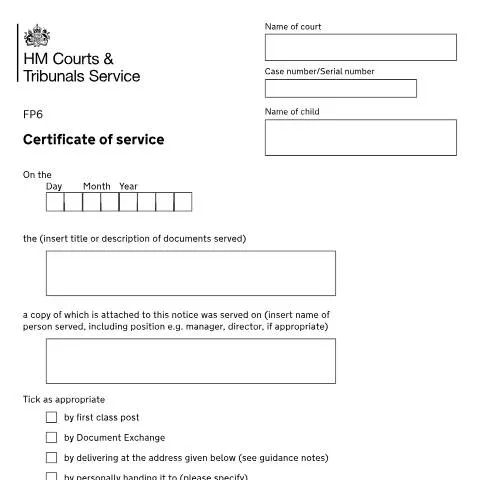
Understanding Form FP6: The Essential Service Certificate in Family Court Proceedings
When family court documents must reach their intended recipients with absolute certainty, Form FP6 serves as the crucial verification mechanism that proves proper service has occurred. This certificate becomes the definitive record that legal papers have been delivered according to the strict procedural requirements governing family cases in England and Wales. Whether dealing with divorce proceedings, child arrangement orders, or financial remedy applications, the FP6 certificate transforms what might otherwise be disputed claims of document delivery into legally recognised proof of service.
The certificate's significance extends far beyond simple administrative convenience. In family law proceedings, where emotions run high and parties may actively avoid receiving court documents, establishing that proper service has taken place can determine whether a case progresses or stalls indefinitely. Courts cannot proceed with hearings, make orders, or enforce judgments without clear evidence that all parties have been properly notified of the proceedings against them.
Legal Framework and Procedural Requirements for Service Certification
Form FP6 operates within the comprehensive framework established by Part 6 of the Family Procedure Rules 2010, which governs all aspects of document service in family proceedings. These rules recognise several distinct methods of service, each with specific requirements and deemed service dates that must be accurately recorded on the certificate.
The certificate must capture precise details about the service method employed, whether through first class post, Document Exchange, personal delivery, electronic means, or other court-permitted methods. Each method carries different evidential weight and triggers different deemed service dates, making accuracy in completion absolutely critical for subsequent procedural steps.
Deemed Service Calculations and Their Legal Consequences
| Method of Service | Deemed Day of Service | Key Considerations |
|---|---|---|
| First class post | Second day after posting | Must exclude Saturdays, Sundays and bank holidays from calculation |
| Document Exchange | Second day after deposit | DX number must be recorded accurately on certificate |
| Personal delivery to address | Day after delivery | Time of delivery affects calculation if after 5pm on business day |
| Electronic service | Day of transmission | Requires prior court permission or party agreement |
The timing calculations become particularly complex when service occurs on or near weekends and bank holidays. Documents served personally after 5pm on a business day, or at any time on Saturday, Sunday or bank holidays, are treated as served on the next business day for calculating subsequent time periods. This rule prevents parties from gaining unfair advantage through strategic timing of service.
Statement of Truth and Contempt of Court Implications
The FP6 certificate requires completion of a statement of truth, making false declarations a serious matter potentially resulting in contempt of court proceedings. The person signing must have direct knowledge of the service details or be properly authorised to sign on behalf of the serving party. This requirement ensures accountability and deters false service claims that could undermine the integrity of family proceedings.
Who Can Complete and Submit Form FP6 Certificates
The authority to complete and sign Form FP6 extends to several categories of individuals, each carrying different responsibilities and requiring different types of verification. Understanding these distinctions proves crucial for ensuring certificates are properly executed and will withstand scrutiny if challenged.
Primary Parties and Their Representatives
Applicants and respondents can personally complete FP6 certificates when they have arranged service themselves, though this approach requires them to have direct knowledge of the service details. More commonly, legal representatives handle service and certification, as they possess the procedural expertise to ensure compliance with complex service rules.
Legal representatives signing FP6 certificates must be properly defined under FPR 2.3(1), typically meaning qualified solicitors or barristers instructed in the case. The certificate must clearly identify the legal representative's firm and their position within it, establishing their authority to act on behalf of their client.
Litigation Friends and Special Circumstances
When proceedings involve children or protected parties, litigation friends may need to complete FP6 certificates, though service on such parties follows special rules contained within Part 6 of the Family Procedure Rules. These situations often require additional court approval or specific procedural steps that must be reflected accurately in the service certificate.
Court staff occasionally complete FP6 certificates when they have arranged service on the court's behalf, particularly in cases involving difficult-to-locate parties or where the court has ordered alternative service methods. Such certificates carry particular weight as they represent the court's own record of service completion.
Detailed Service Methods and Documentation Requirements
Form FP6 accommodates the full range of service methods recognised by family court procedures, each requiring specific information to validate the service and establish the correct deemed service date. The choice of service method often depends on the urgency of proceedings, the nature of the documents being served, and the relationship between the parties.
Traditional Postal and Exchange Services
First class post remains the most commonly used service method for routine family court documents, requiring the certificate to record the exact posting date and the address used. The second day rule for deemed service must account for postal delays and non-business days, making precise date recording essential for calculating subsequent deadlines.
Document Exchange (DX) service offers advantages for legal representatives who subscribe to this system, providing secure delivery between professional offices. FP6 certificates must include the specific DX number used, as incorrect DX details can invalidate service and require re-serving of documents with consequent delays to proceedings.
Personal Service and Electronic Communications
Personal service, while often the most reliable method, requires detailed recording of how the person was identified and the exact time and location of service. This becomes particularly important when serving individuals who may deny receiving documents or claim mistaken identity.
Electronic service through email, SMS, or social media platforms requires prior court permission or express agreement from the receiving party. FP6 certificates must record not just the transmission time but also evidence of the court's permission or the party's agreement to accept electronic service.
Common Challenges and Dispute Resolution in Service Certification
Service disputes frequently arise in contentious family proceedings, making accurate FP6 completion crucial for avoiding costly delays and additional court applications. Understanding potential challenges helps ensure certificates can withstand scrutiny and support the smooth progression of family cases.
Addressing Service at Incorrect or Outdated Addresses
When parties provide outdated addresses or deliberately avoid service, the FP6 certificate becomes evidence of reasonable attempts at proper service. Courts may accept service at a party's last known address even when they no longer reside there, provided the serving party has made reasonable enquiries about current whereabouts.
The certificate must clearly identify whether service occurred at the party's usual residence, last known residence, place of business, or other permitted location. This distinction affects both the validity of service and the court's willingness to proceed with hearings in the served party's absence.
Corporate Service and Business Address Complications
Serving companies and corporations presents unique challenges that FP6 certificates must address precisely. Service on companies registered in England and Wales can occur at their principal office or any place of business with a real connection to the case, but the certificate must justify the chosen location.
Professional service agents sometimes refuse documents or claim lack of authority to accept service, requiring detailed recording of such refusals in the FP6 certificate. These details become crucial if courts must later determine whether reasonable attempts at service justify proceeding with alternative service methods.
Procedural Consequences and Court Acceptance of FP6 Evidence
Properly completed FP6 certificates carry significant weight in court proceedings, often determining whether cases can proceed to substantive hearings or must be delayed pending further service attempts. Courts scrutinise these certificates carefully, particularly when challenged by parties claiming inadequate service.
Impact on Hearing Schedules and Case Progression
Family courts rely heavily on FP6 certificates when deciding whether to proceed with hearings in a party's absence. Clear evidence of proper service enables courts to make substantive orders even when respondents fail to attend, while defective service certificates typically result in adjournments and wasted hearing time.
The certificate's accuracy becomes particularly crucial in urgent cases involving child protection or domestic violence, where delays caused by service disputes can have serious consequences for vulnerable family members. Courts may accept imperfect service in exceptional circumstances, but require detailed explanations in the FP6 certificate of attempts made and obstacles encountered.
Enforcement and Contempt Proceedings
When courts later need to enforce orders or pursue contempt proceedings against non-compliant parties, FP6 certificates provide essential evidence that parties were properly notified of their obligations. Defective service certificates can render enforcement impossible, regardless of the strength of the underlying case.
Courts examining FP6 certificates in enforcement contexts pay particular attention to the statement of truth and the signatory's authority, as false service claims can themselves constitute contempt of court. This scrutiny underscores the importance of accurate, honest completion of all certificate sections.
Record Keeping and Administrative Best Practices
Effective management of FP6 certificates requires systematic record keeping that supports both immediate procedural requirements and potential future challenges. Legal representatives and court users must maintain comprehensive files that demonstrate compliance with service obligations throughout family proceedings.
Supporting Documentation and Evidence Retention
FP6 certificates should be supported by contemporaneous records of service attempts, including postal receipts, email delivery confirmations, or witness statements from process servers. These supporting documents become crucial when service is challenged or when courts require additional evidence of compliance with procedural requirements.
Photographs of addresses where service was attempted, records of enquiries made to locate parties, and correspondence regarding service difficulties all strengthen FP6 certificates and demonstrate reasonable efforts to achieve proper service. Such documentation proves particularly valuable in cases involving evasive parties or disputed addresses.
Court File Management and Procedural Compliance
Courts require FP6 certificates to be filed within specific timeframes, often tied to hearing dates or other procedural deadlines. Late filing can jeopardise hearing dates and may require additional court applications to regularise service, adding costs and delays to family proceedings.
Electronic case management systems increasingly require digital filing of FP6 certificates, making legible completion and accurate scanning essential for court acceptance. Poor quality submissions may be rejected, necessitating re-filing and potentially affecting crucial procedural deadlines in time-sensitive family cases.
Understanding Service Requirements for Different Types of Family Applications
The service requirements for family court applications vary significantly depending on the nature of your case and the specific relief you're seeking. Understanding these distinctions is crucial for completing Form FP6 accurately and ensuring your application progresses without unnecessary delays.
For divorce applications, you must serve the divorce petition on your spouse personally unless the court grants permission for alternative service. The certificate must confirm that your spouse received the petition at least eight days before any hearing date. If your spouse lives abroad, service requirements become more complex, often requiring compliance with international conventions such as the Hague Service Convention or bilateral treaties between the UK and the destination country.
In children proceedings under the Children Act 1989, service rules differ markedly. Applications for child arrangements orders typically require service on all persons with parental responsibility, which may include biological parents, step-parents with formal parental responsibility, or guardians appointed by the court. The timing is particularly critical – respondents must receive documents at least 14 days before the first hearing, though this period may be shortened in urgent cases involving child protection concerns.
When dealing with financial remedy applications, the service requirements encompass not just your former spouse but potentially third parties who hold relevant financial information. This might include pension providers, banks, or employers where disclosure orders are sought. Each category of respondent may have different service requirements, and your FP6 certificate must address each separately.
Domestic violence applications present unique challenges for service. Where you're seeking a non-molestation order or occupation order, the court may authorise service by methods that protect your safety and location. This could include service through a solicitor, at the respondent's workplace, or through family members. The FP6 must clearly document any special arrangements approved by the court and confirm that service was effected without compromising your safety.
Fill in your form directly online
No printing: type your details into the boxes of the official form, tick, then download the PDF ready to send.
- 1Type into the form boxes
- 2Tick in one click
- 3Save and download the PDF
For international cases involving the Hague Convention on Child Abduction or Brussels II bis Regulation, service requirements are governed by international protocols. These cases often require additional documentation, certified translations, and compliance with the domestic laws of the country where service is effected. Your certificate must confirm compliance with both UK requirements and the relevant international framework.
Addressing Common Service Complications and Court Interventions
Even with careful preparation, service of family court documents frequently encounters practical obstacles that require court intervention or alternative approaches. Recognising these potential complications early can help you prepare appropriate solutions and complete your FP6 certificate accurately.
Evasion of service represents one of the most frequent challenges in family proceedings. If a respondent deliberately avoids service by not answering the door, providing false addresses, or instructing others to refuse documents, you'll need to document these attempts meticulously. The court requires evidence of at least three separate attempts at personal service, made at different times and days, before considering alternative methods. Your FP6 should detail each attempt, including the date, time, method used, and the specific response encountered.
When the respondent's whereabouts are unknown, the court may authorise service by advertisement in local newspapers or through social media platforms where the respondent is known to be active. This process requires a formal application supported by evidence of your efforts to locate the respondent through last known addresses, employers, family members, and public records searches. The certificate must confirm that all reasonable enquiries have been made before the court will consider deemed service.
Mental capacity issues can complicate service requirements significantly. If the respondent lacks mental capacity to understand the proceedings, you may need to serve documents on their litigation friend or the Official Solicitor. The court may require medical evidence about the respondent's capacity, and service timescales may be extended to allow for proper representation to be arranged. Your FP6 must clearly identify who was served and their relationship to the respondent.
For respondents in prison or other institutions, special service rules apply. Documents should typically be served on the governor or appropriate administrator, who then ensures delivery to the individual. However, some institutions have specific procedures for legal documents, and you must confirm these arrangements before attempting service. The certificate should identify both the institution and the individual who accepted service on the respondent's behalf.
Service on corporate entities in family proceedings – such as pension providers or employers in financial remedy cases – requires compliance with company law requirements. Service is typically effected on the registered office or through a designated agent for service. The FP6 must identify the specific method used and confirm it complies with the relevant statutory requirements.
When urgent applications require abbreviated service, such as in cases involving immediate risk to children or domestic violence, the court may accept service by telephone, email, or fax, followed by hard copy documents. Your certificate must clearly distinguish between the initial urgent notification and subsequent formal service, providing precise timing for each stage.
Post-Service Obligations and Ongoing Compliance Monitoring
Completing and filing Form FP6 marks the beginning rather than the end of your service obligations in family proceedings. Understanding your ongoing responsibilities helps ensure continued compliance throughout the case and prevents procedural complications that could delay resolution.
Monitoring acknowledgment of service forms a crucial next step after filing your certificate. Most family applications require respondents to file an acknowledgment within specified timeframes – typically 7 to 14 days depending on the application type. If acknowledgments are not received, you may need to take further action to confirm service was effective, potentially requiring additional evidence or alternative service methods for future documents.
In ongoing proceedings, subsequent documents often have different service requirements from the initial application. Directions orders, expert reports, and hearing notices may require service by specific methods or within particular timeframes. Maintaining accurate records of all service becomes essential, as the court may require updated certificates for significant developments in the case.
Changes in circumstances affecting service must be promptly reported to the court. If a respondent moves address, changes legal representation, or their circumstances alter in ways that affect service requirements, you have a continuing duty to inform the court and adjust your service methods accordingly. This may require filing supplementary certificates or applications to vary service directions.
For cases involving children, service obligations may extend to additional parties as proceedings develop. If new parties are joined – such as grandparents seeking contact or local authorities intervening – each requires proper service with accompanying certificates. The complexity multiplies in cases where children develop sufficient understanding to participate directly in proceedings.
Enforcement proceedings create additional service obligations if initial orders are breached. Contempt applications, for example, require personal service of both the application and supporting evidence, with strict compliance required given the potential for imprisonment. The certificate standards for enforcement proceedings are typically higher, requiring more detailed evidence of service and the respondent's understanding of the consequences.
International enforcement under various conventions requires ongoing compliance with both UK and foreign jurisdictions' requirements. If orders need recognition or enforcement abroad, service certificates may need to meet additional standards, including certified translations and compliance with destination country formalities.
Finally, case management considerations require maintaining comprehensive service records throughout proceedings. Courts increasingly expect electronic case management, with service certificates filed promptly and organised systematically. Late or incomplete certificates can result in case management orders requiring explanations and potentially cost sanctions against the serving party.
Understanding these post-service obligations ensures that your initial compliance with Form FP6 requirements supports rather than complicates the broader conduct of your family proceedings, contributing to more efficient and effective case resolution.