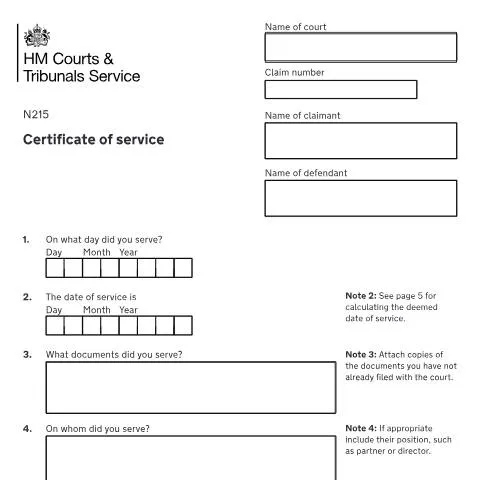
The Crucial Documentation Bridge Between Service and Court Recognition
When legal documents change hands in civil proceedings, one critical question emerges: how do you prove that service actually occurred? The Certificate of service (Form N215) stands as the definitive answer to this fundamental challenge in civil litigation. Far from being mere paperwork, this certificate represents the essential bridge between attempting service of court documents and establishing legal proof that such service was properly completed according to Civil Procedure Rules.
In civil cases, the act of serving documents—whether claim forms, witness statements, or court orders—triggers crucial legal timelines and obligations. Yet without proper documentation of this service, parties may find themselves unable to progress their cases, facing disputed timelines, or worse, having their claims struck out for failure to prove compliance with court requirements. Form N215 transforms what might otherwise be disputed assertions into legally recognised facts, providing courts with the evidence they need to move proceedings forward.
The certificate operates within the framework of Part 6 of the Civil Procedure Rules, which governs service of documents in civil proceedings. Unlike simple postal receipts or delivery confirmations, this form captures the specific legal requirements that determine when service is deemed effective, accounting for the complex interplay between method of service, timing, and the legal status of recipients.
Legal Weight and Evidentiary Value in Civil Proceedings
Form N215 carries substantial legal weight through its incorporation of a statement of truth, making false declarations subject to contempt of court proceedings. This elevates the certificate beyond administrative convenience to become compelling evidence in civil litigation, particularly when service is disputed or challenged.
The certificate's evidentiary value stems from its detailed capture of service circumstances. Courts rely on this information to determine whether service complies with Civil Procedure Rules, calculate deemed dates of service for procedural deadlines, and resolve disputes about whether proper service occurred. When a defendant claims never to have received documents, or when timing becomes critical for limitation periods, Form N215 provides the authoritative record.
Interaction with Civil Procedure Rules
The certificate directly supports compliance with CPR 6.17, which requires proof of service for most court documents. By systematically documenting the who, what, when, where, and how of service, Form N215 ensures that legal representatives can demonstrate adherence to procedural requirements. This becomes particularly crucial in cases involving:
- Service on corporate entities where specific requirements apply
- Alternative service methods authorised by court order
- Service outside standard business hours or locations
- Electronic service where technical details matter for validity
The form's structure reflects the court's need to verify not just that service occurred, but that it occurred in a manner that satisfies legal requirements for the specific type of document and recipient involved.
Navigating the Completion Process: From Service to Certification
Completing Form N215 effectively requires understanding both the practical mechanics of service and the legal significance of each field. The process begins before service occurs, as proper completion depends on careful attention to method, timing, and documentation throughout the service process.
Critical Timing Considerations
The distinction between the day of service (Section 1) and the date of service (Section 2) reflects fundamental concepts in civil procedure. The day of service records when the physical act occurred, while the date of service captures when service is legally deemed effective under Civil Procedure Rules. This distinction proves crucial for calculating deadlines, as the deemed date determines when response periods begin running.
| Service Method | Key Timing Rule | Business Day Cut-off |
|---|---|---|
| First class post | Second day after posting | N/A |
| Personal service | Same day if before 4:30pm | 4:30pm |
| Fax transmission | Same day if before 4:30pm | 4:30pm |
| Email/electronic | Same day if before 4:30pm | 4:30pm |
| Document Exchange | Second day after delivery | N/A |
Method Selection and Documentation Requirements
Section 5 of Form N215 requires careful consideration of service method, as each carries different evidential requirements. Personal service demands identification of the specific individual who received documents, while postal service relies on presumptions about delivery timing. Electronic methods require precise timing records, particularly for fax transmissions where transmission sheets provide corroborating evidence.
When serving by other means permitted by the court, the certificate must specify the exact method authorised, referencing the relevant court order. This ensures that alternative service methods receive proper judicial recognition and that parties cannot later dispute the validity of non-standard approaches.
Eligibility and Authority: Who Can Issue Valid Certificates
The authority to complete Form N215 extends beyond the immediate parties to litigation, recognising the practical realities of legal representation and the various roles individuals may play in civil proceedings. The statement of truth section identifies several categories of authorised signatories, each carrying different implications for the certificate's validity and the signer's responsibilities.
Party Representatives and Legal Professionals
Legal representatives, as defined by CPR 2.3(1), carry primary responsibility for ensuring accurate completion when acting on behalf of clients. Their professional obligations extend beyond mere form completion to encompass proper training of staff involved in service, maintenance of adequate records, and verification of service details before certification.
When litigation friends sign certificates on behalf of children or protected parties, additional considerations apply. The certificate must reflect not only the service details but also the litigation friend's authority to act, particularly relevant in cases involving disputed capacity or appointment challenges.
Corporate and Partnership Service
Service on business entities presents particular complexities that Form N215 must accurately capture. The certificate's location options distinguish between various types of business addresses—principal offices, places of business within jurisdiction, and registered addresses—each carrying different legal significance under Civil Procedure Rules.
For partnerships, the certificate must identify whether service occurred at the principal office or another authorised location, while company service may involve registered offices, principal places of business, or other locations depending on the specific circumstances and court requirements.
Strategic Deployment: When and Why Form N215 Becomes Essential
The tactical importance of Form N215 extends far beyond routine compliance, becoming a critical tool in contested litigation where service disputes can derail entire cases. Understanding when to deploy the certificate strategically can mean the difference between successful case progression and costly procedural failures.
High-Stakes Service Scenarios
Certain litigation contexts elevate the importance of meticulous service certification. Limitation period cases demand absolute precision in service timing, as even minor discrepancies can result in claims being time-barred. Similarly, injunction applications often require immediate proof of service to establish that respondents had proper notice before enforcement actions commence.
In commercial disputes involving multiple jurisdictions, Form N215 provides crucial evidence for establishing English court jurisdiction, particularly when service methods or locations become contested. The certificate's detailed address information and method documentation can prove decisive in jurisdictional challenges.
Defensive Applications
Beyond its obvious use in proving service, Form N215 serves defensive purposes when parties face allegations of inadequate or improper service. A properly completed certificate can defeat applications to set aside default judgments based on service challenges, provided the documentation demonstrates clear compliance with applicable rules.
The certificate also supports applications for alternative service orders by providing courts with detailed evidence of attempted conventional service methods. When standard service proves impossible or impractical, Form N215 documentation of failed attempts becomes essential evidence supporting applications for substituted service.
Rectifying Errors and Managing Disputes Over Service Evidence
Even careful completion of Form N215 cannot prevent all service-related disputes, making understanding of correction mechanisms and dispute resolution procedures essential for effective case management. The interplay between procedural requirements and practical realities often generates complications requiring sophisticated responses.
Amendment and Correction Procedures
When errors emerge in completed certificates, the approach depends on the nature and significance of the mistake. Minor clerical errors—such as typographical mistakes in addresses or incorrect date formatting—may be correctable through simple amendment procedures, particularly if all parties consent and no prejudice results.
More substantial errors affecting the validity of service itself require different approaches. If the certificate incorrectly states the method of service or misrepresents fundamental aspects of the service process, parties may need to seek court permission to re-serve documents or apply for retrospective validation of service under CPR 6.16.
Fill in your form directly online
No printing: type your details into the boxes of the official form, tick, then download the PDF ready to send.
- 1Type into the form boxes
- 2Tick in one click
- 3Save and download the PDF
Challenging Service Evidence
When opposing parties dispute service based on Form N215 evidence, several tactical options emerge. Direct challenges might focus on technical non-compliance with Civil Procedure Rules, arguing that the certificate fails to demonstrate proper service despite its formal completion.
Collateral challenges may attack the reliability of the evidence itself, questioning whether the person signing the certificate had adequate knowledge of service details or whether the statement of truth accurately reflects the service circumstances. Such challenges require careful consideration of the professional and personal consequences for certificate signatories.
Electronic Service Evolution and Modern Certificate Applications
The increasing prevalence of electronic service methods has transformed how Form N215 operates in contemporary civil litigation, requiring adaptation of traditional concepts to digital realities while maintaining the fundamental evidential purposes the certificate serves.
Digital Documentation Requirements
Electronic service via email or other digital platforms creates unique documentation challenges that Form N215 must address. Unlike postal service, where physical posting provides clear timing evidence, electronic methods require precise timestamp documentation and verification of successful transmission or delivery.
The certificate's provisions for email service demand attention to technical details that may prove crucial in disputed cases. Server logs, delivery confirmations, and read receipts can provide corroborating evidence supporting certificate assertions, particularly when recipients claim non-receipt or technical failures.
Court Portal Integration
As courts increasingly adopt digital case management systems, Form N215 documentation must integrate with electronic filing requirements while maintaining its evidential value. The transition from paper-based to digital service creates new opportunities for comprehensive documentation but also new potential points of failure requiring careful attention.
When serving documents through court-approved electronic systems, the certificate must capture not only the electronic service details but also any system-generated confirmations or error messages that might affect service validity. This integration of traditional form completion with modern technology requires understanding both procedural requirements and technical capabilities.
Long-term Case Management and Certificate Retention
Form N215 certificates create lasting evidential records that may prove crucial long after initial service occurs, making proper retention and management essential components of effective legal practice. The certificate's value extends throughout litigation lifecycles and beyond final judgment in many cases.
Professional obligations require legal representatives to maintain adequate records of service certificates, particularly in cases involving complex procedural histories or multiple service attempts. The Data Protection Act 2018 governs retention periods and access rights, while professional conduct rules establish minimum standards for record-keeping and client access to service documentation.
In cases proceeding to appeal, original service certificates may prove essential for establishing lower court jurisdiction or demonstrating compliance with procedural requirements. Similarly, enforcement proceedings often require reference to original service documentation to establish the validity of underlying judgments, making long-term certificate retention a practical necessity rather than mere administrative preference.
The certificate's integration with court records creates permanent documentation that supports not only immediate procedural requirements but also long-term case integrity. When combined with proper case management practices, Form N215 provides the evidential foundation that enables civil litigation to proceed with confidence in its procedural validity, ensuring that substantive legal issues receive proper judicial consideration rather than being derailed by service-related disputes.