When Courts Hold Your Money: Understanding the Payment Schedule Process
When legal proceedings conclude with monetary awards, settlements, or when funds need safekeeping during litigation, the courts don't simply hand over cheques at the courthouse steps. Instead, money often flows through the Court Funds Office, a specialised arm of the Ministry of Justice that manages billions of pounds on behalf of litigants, beneficiaries, and other parties to legal proceedings.
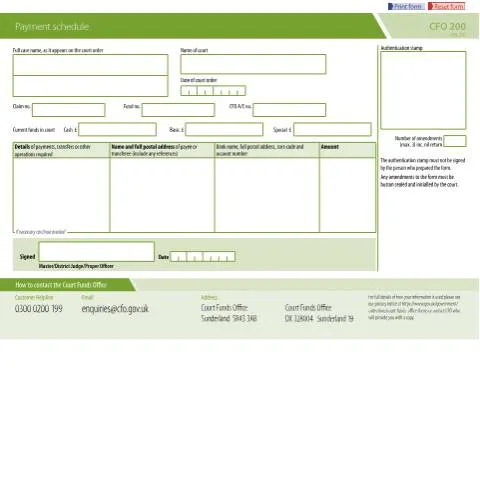
The Court funds: payment schedule form (CFO 200) serves as the crucial bridge between a court's decision to release funds and the actual transfer reaching the intended recipient. This document transforms judicial orders into actionable financial instructions, ensuring that money held in court accounts reaches the right hands through proper banking channels.
Unlike standard banking transfers, court-ordered payments carry significant legal weight and must follow strict procedural safeguards. The payment schedule system protects vulnerable beneficiaries, ensures compliance with court orders, and maintains an auditable trail of how public and private funds move through the judicial system.
The Court Funds Office Ecosystem: Where Your Money Lives
The Court Funds Office operates three distinct types of accounts, each serving different purposes and offering varying levels of return. Understanding these categories helps explain why payment schedules require specific details about fund sources and destinations.
| Account Type | Purpose | Interest Rate | Typical Contents |
|---|---|---|---|
| Cash Account | Short-term holdings | Minimal interest | Interim payments, security deposits |
| Basic Account | Medium-term investments | Government bond rates | Damages awards, settlement funds |
| Special Account | Long-term investments | Higher returns possible | Inheritance disputes, trust funds |
Each account type requires different handling procedures when funds transfer out. Cash accounts typically process within days, whilst Special accounts may involve selling securities or unwinding complex investments, potentially taking weeks to complete.
The CFO manages approximately £18 billion in court funds at any given time, with money flowing in from personal injury settlements, inheritance disputes, commercial litigation, and protective proceedings for vulnerable adults. When courts order payments from these funds, the payment schedule ensures every penny reaches its intended destination with full legal authority.
Securities Holdings and Investment Complications
Beyond simple cash holdings, the Court Funds Office manages substantial securities portfolios on behalf of beneficiaries. When payment schedules involve securities transfers, additional complexity arises around market timing, valuation dates, and transfer procedures.
The form's reverse side specifically addresses securities holdings, requiring detailed descriptions of share certificates, bonds, or other financial instruments. Courts must decide whether to transfer securities in specie (as actual shares) or liquidate holdings and transfer cash proceeds.
Judicial Authority: Who Can Authorise Fund Releases
Not every court official can authorise payments from court funds. The authentication requirements on CFO 200 reflect strict hierarchical controls designed to prevent unauthorised releases of what may represent someone's entire life savings or compensation for catastrophic injuries.
Masters and District Judges possess primary authority to sign payment schedules in their respective jurisdictions. In the High Court, Masters handle most routine fund releases, whilst District Judges perform similar functions in County Courts. However, certain high-value payments or complex cases may require senior judicial approval.
The Proper Officer designation covers court administrators with delegated authority for specific types of payments, typically routine transfers that follow standard patterns established by previous court orders. This delegation prevents judicial bottlenecks whilst maintaining oversight of fund movements.
Crucially, the form demands that authentication stamps must not be signed by the person who prepared the form. This separation of duties prevents fraudulent manipulation whilst ensuring independent review of payment instructions before funds transfer.
Amendment Controls and Audit Trails
Courts may amend payment schedules up to three times, but each change requires button sealing and judicial initialling. This old-fashioned but effective security measure involves physically embossing changes with the court's official seal, making alterations immediately visible and tamper-evident.
The amendment limit reflects practical realities: beyond three changes, payment instructions become sufficiently complex that courts should issue fresh schedules rather than layering modifications upon modifications. This approach reduces errors whilst maintaining clear audit trails for financial investigators or beneficiaries questioning fund movements.
Banking Integration: From Court Order to Bank Account
The Court Funds Office doesn't simply post cheques to successful litigants. Instead, payment schedules trigger electronic transfers directly into recipients' bank accounts, requiring complete banking details including sort codes, account numbers, and full postal addresses for receiving institutions.
This electronic approach serves multiple purposes: it accelerates payment delivery, reduces fraud risks associated with intercepted cheques, and creates automatic records of successful transfers. However, it also means that incorrect banking details can delay payments significantly.
International transfers present additional complexity. When payment schedules specify overseas bank accounts, the CFO must navigate currency conversion, international banking regulations, and extended processing times. Recipients should expect delays of several weeks for international transfers, particularly those involving non-European Union destinations.
Payment Verification and Failed Transfers
When electronic transfers fail due to incorrect account details or closed accounts, the CFO implements a systematic verification process. Rather than simply returning funds to court accounts, the office attempts to contact recipients through multiple channels, including registered mail to last-known addresses and communication through legal representatives.
Failed payments don't disappear into administrative limbo. The CFO maintains detailed records of unsuccessful transfer attempts, and recipients can reclaim funds even years after initial payment attempts, provided they can demonstrate entitlement through court documentation.
Protective Procedures: Safeguarding Vulnerable Recipients
Court funds often protect vulnerable individuals unable to manage substantial financial awards independently. When payment schedules involve protected parties, minors, or individuals lacking mental capacity, additional safeguards activate automatically.
For minors receiving substantial settlements, courts rarely authorise full immediate payment. Instead, payment schedules typically establish structured settlements or transfer funds to appointed guardians with strict reporting requirements. The CFO collaborates with the Court of Protection to ensure vulnerable beneficiaries receive appropriate financial protection.
Protected parties' representatives must demonstrate authority to receive funds through properly executed lasting powers of attorney or court-appointed deputyships. Payment schedules involving protected parties undergo enhanced scrutiny, with the CFO requiring additional documentation before releasing funds.
Trust Fund Establishments
Rather than direct payments, courts sometimes order the CFO to establish ongoing trust arrangements for vulnerable beneficiaries. These structures provide regular income whilst preserving capital for future needs. Payment schedules for trust establishments require detailed specifications about distribution terms, trustee appointments, and beneficiary protections.
The CFO maintains specialist teams experienced in establishing and administering court-ordered trusts, ensuring compliance with both judicial instructions and trust law requirements. These arrangements can continue for decades, providing financial security for beneficiaries unable to manage lump-sum awards safely.
Operational Timescales: From Submission to Payment
Processing times for payment schedules vary significantly based on fund types, payment amounts, and recipient circumstances. Standard releases from cash accounts typically complete within five working days of receiving properly completed schedules, whilst complex securities transfers may require several weeks.
The CFO operates a triage system prioritising urgent payments, particularly those involving medical expenses or immediate hardship situations. Courts can flag urgent cases through specific annotations on payment schedules, though such designations require judicial justification.
International payments invariably take longer, with processing times extending from two to six weeks depending on destination countries and local banking regulations. Recipients planning immediate expenditure of court awards should factor these delays into their financial planning.
Tracking and Status Updates
The Court Funds Office provides limited tracking facilities for pending payments. Recipients can contact the CFO helpline using case references and fund numbers from their payment schedules to obtain status updates. However, detailed progress information may require formal written requests, particularly for high-value or sensitive transfers.
Legal representatives often maintain better access to payment status information than individual recipients. Solicitors and barristers can obtain detailed updates through professional channels, making legal representation valuable even after court proceedings conclude.
Integration with Broader Legal Processes
Payment schedules don't operate in isolation but form part of broader legal frameworks governing court proceedings, enforcement actions, and post-judgment procedures. Understanding these connections helps recipients navigate potential complications or delays.
Enforcement proceedings may freeze court funds pending resolution of creditor claims or judgment debts. When payment schedules encounter such complications, the CFO must balance competing legal obligations, potentially delaying transfers until courts resolve priority disputes.
Tax implications also intersect with court fund payments. Large settlements or investment returns may trigger substantial tax liabilities, and recipients should consider professional advice before requesting immediate payment of accumulated funds. The CFO doesn't provide tax advice but will coordinate with HMRC when required for compliance purposes.
Appeal Procedures and Payment Suspensions
Active appeals against court judgments can suspend payment schedule processing, even when lower courts have authorised fund releases. The CFO monitors appellate proceedings affecting funds under its control and may freeze payments pending appeal resolution.
Recipients facing payment delays due to ongoing appeals have limited recourse beyond participating in appellate proceedings or negotiating security arrangements that permit partial releases pending final determination. These situations highlight the importance of understanding broader litigation timescales when planning around expected court fund payments.
Practical Compliance and Documentation Standards
Successfully completing CFO 200 requires attention to specific formatting and documentation standards that reflect the form's integration with broader court administration systems. Case names must appear exactly as shown on court orders, including punctuation and capitalization, whilst reference numbers must match court records precisely.
The Court Funds Office operates strict version control for its forms, with regular updates reflecting changes in banking technology, legal requirements, or administrative procedures. Using outdated form versions can delay processing or require resubmission with current documents.
Authentication stamps represent physical security measures that cannot be replicated electronically. Courts must use official embossed seals, making photocopies or scanned submissions insufficient for payment processing. This requirement necessitates original document handling throughout the submission process.
Data protection considerations under UK GDPR affect how payment schedules handle personal information. The CFO maintains strict privacy protocols whilst enabling legitimate access by legal representatives, beneficiaries, and relevant government agencies. Recipients concerned about data handling can request detailed privacy notices explaining information usage and retention policies.
Regional Variations and Specialist Court Fund Arrangements
Court fund payment schedules can vary significantly across different jurisdictions within the UK, reflecting the distinct legal systems operating in England and Wales, Scotland, and Northern Ireland. Each jurisdiction maintains separate court fund arrangements with their own administrative procedures and payment timelines.
In Scotland, the Accountant of Court oversees funds held on behalf of parties under legal disability, with payment schedules governed by different procedural rules compared to the Court Funds Office in England and Wales. Scottish court funds typically follow a quarterly review system, where fund managers assess portfolio performance and determine distribution schedules every three months. However, emergency withdrawals can be processed within 5-10 working days when supported by appropriate court orders or solicitor certifications.
Northern Ireland operates its own Court Service with distinct fund management protocols. The Northern Ireland Courts and Tribunals Service maintains separate accounting procedures, often requiring additional documentation for cross-border fund transfers. Payment schedules in Northern Ireland may extend slightly longer during peak periods, particularly around the traditional court vacation periods in July and August.
Fill in your form directly online
No printing: type your details into the boxes of the official form, tick, then download the PDF ready to send.
- 1Type into the form boxes
- 2Tick in one click
- 3Save and download the PDF
Specialist courts also maintain unique payment arrangements. The Family Court, for instance, handles substantial funds related to children's settlements and inheritance matters. These funds often involve more complex approval processes, with payment schedules requiring input from the Official Solicitor or Children and Family Court Advisory and Support Service (Cafcass). Child settlement funds typically cannot be accessed until the beneficiary reaches 18, though interim payments for education or medical expenses may be approved through accelerated schedules.
Commercial Court funds, particularly those arising from substantial business disputes or insolvency proceedings, may involve international banking arrangements that can affect payment timelines. When funds are held in foreign currencies or require conversion, additional processing time of 3-5 working days is typically added to standard schedules.
The Technology and Construction Court often deals with performance bonds and retention funds in construction disputes. These funds may have staged release schedules tied to project milestones or defect liability periods, creating more complex payment arrangements that extend well beyond standard court fund timelines.
Impact of Banking Holidays and Court Closure Periods on Payment Schedules
Court fund payment schedules are significantly affected by the UK's banking calendar and court closure periods, requiring careful planning from legal practitioners and fund beneficiaries. Understanding these disruptions is crucial for managing client expectations and ensuring adequate cash flow planning.
Bank holidays create the most immediate impact on payment schedules. Standard processing times are effectively suspended during these periods, with payments due on bank holidays typically processed on the next working day. This affects not only the major holidays like Christmas and Easter but also the various regional bank holidays, such as the Spring Bank Holiday in late May and the Summer Bank Holiday in late August.
The Christmas and New Year period presents particular challenges, with courts typically closing from December 23rd until January 2nd or 3rd, depending on how weekends fall. During this extended closure, no new payment authorisations are processed, and urgent applications require special arrangements through the Royal Courts of Justice emergency contact procedures. Funds requiring immediate access during this period may need to be arranged well in advance, sometimes requiring court orders obtained before the December 20th deadline.
Easter holidays, while shorter, can still create significant delays, particularly when Good Friday and Easter Monday create a four-day weekend. The timing of Easter varies annually, potentially affecting different quarters' payment schedules unpredictably.
Summer court closures, traditionally known as the "Long Vacation," historically ran from late July to early October, though modern practice has significantly reduced this period. However, reduced staffing levels during August can still extend standard payment timelines by 2-3 additional working days.
Regional variations in court closure can create additional complications. Scottish courts observe different holiday patterns, including St. Andrew's Day (November 30th) and local holidays that may not align with English bank holidays. This can affect cross-border fund transfers or cases involving multiple jurisdictions.
Emergency provisions exist for genuinely urgent payments during closure periods. The Court Funds Office maintains emergency contact procedures for situations involving immediate medical expenses, funeral costs, or other urgent financial needs. However, these emergency procedures require exceptional justification and may involve additional fees or expedited processing charges.
International fund transfers face additional complexity during UK bank holidays, as foreign banking systems may operate on different schedules. Payments to European banks during UK bank holidays may still process if the European Central Bank system remains operational, but transfers to US accounts may be delayed if they coincide with US federal holidays.
Technology Integration and Digital Payment Processing Developments
The court funds system has undergone significant technological modernisation in recent years, fundamentally altering traditional payment schedules and processing methods. Digital transformation initiatives have introduced new efficiencies while creating fresh considerations for practitioners managing court fund payments.
The Courts and Tribunals Service has implemented electronic fund transfer systems that have reduced standard processing times from the historical 7-10 working days to the current 3-5 working day standard. This Electronic Funds Transfer (EFT) system integrates with major UK clearing banks, enabling same-day processing for payments submitted before specific daily cut-off times, typically 2:00 PM for standard transfers.
Digital authentication systems now allow solicitors to submit fund release requests electronically through secure portals, eliminating postal delays that previously extended processing times. The MyHMCTS digital service enables authorised users to track payment requests in real-time, providing transparency into processing stages and expected completion dates.
However, digital systems have introduced new complexities around security verification and data protection compliance. Under the Data Protection Act 2018 and UK GDPR requirements, additional identity verification steps may extend processing times for first-time digital users or when security flags are triggered. Two-factor authentication requirements, while enhancing security, can delay urgent payment requests if practitioners lack immediate access to registered devices.
The integration of artificial intelligence in fraud detection systems has created more sophisticated screening processes. While these systems typically operate seamlessly, they may flag unusual payment patterns or amounts, triggering manual review processes that can extend standard schedules by 1-3 working days. Large fund transfers exceeding £50,000 are more likely to undergo enhanced screening, particularly when beneficiary details differ significantly from historical patterns.
Digital payment systems have also enabled more sophisticated reporting and audit trails. Fund managers can now provide detailed transaction histories and compliance reports more rapidly, though generating comprehensive historical reports for complex funds may still require 5-7 working days during peak periods.
The COVID-19 pandemic accelerated digital adoption, with remote working capabilities now permanently integrated into court fund processing. This has generally improved efficiency, though it has also created new dependencies on digital infrastructure reliability. System maintenance windows, typically scheduled for weekends, can occasionally extend into Monday morning processing, affecting weekly payment schedules.
Future developments include blockchain integration pilots for certain types of court funds, particularly those involving multiple parties or complex distribution arrangements. While still in experimental phases, these technologies promise to further reduce processing times and enhance transparency, though they may initially create parallel processing requirements that could temporarily extend rather than reduce payment schedules.
Mobile applications for fund monitoring are under development, potentially enabling real-time notifications of payment processing stages. However, these systems will require extensive security testing and regulatory approval before full implementation, with pilot programmes expected to run throughout the current year before broader rollout.