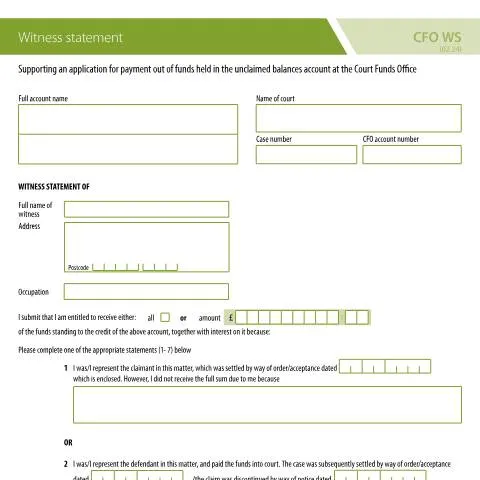
The Court Funds Office Witness Statement: Claiming Forgotten Legal Money
Thousands of pounds sit unclaimed in court accounts across England and Wales, waiting for rightful owners who may not even realise the money exists. When legal proceedings conclude—whether through settlement, discontinuation, or judgment—funds paid into court sometimes remain uncollected due to administrative oversight, changed addresses, or simply because parties moved on without claiming what was due. The Court Funds Office witness statement (CFO WS) serves as the formal mechanism to reclaim these forgotten assets, but navigating this process requires understanding both the legal framework and the practical steps involved.
The witness statement operates within a strict regulatory environment governed by the Civil Procedure Rules and overseen by the Senior Master of the King's Bench Division. Unlike standard court applications, claiming funds through this route involves demonstrating entitlement to money that has effectively disappeared from the normal legal system, often years after the original case concluded. The Court Funds Office in Sunderland maintains these unclaimed balances, but recent rule changes mean time is increasingly of the essence.
Seven Distinct Pathways to Unclaimed Court Funds
The CFO WS form structures claims around seven specific scenarios, each reflecting different legal relationships to the original proceedings. Understanding which category applies determines both the evidence required and the likelihood of success.
Former Claimants and Incomplete Settlements
Scenario 1 addresses claimants who settled their case but never received the full amount due. This commonly occurs when settlement orders specify payment schedules that were partially fulfilled, or when administrative errors resulted in underpayment. The witness must provide the original settlement order or acceptance, clearly dated, alongside detailed explanation of why the shortfall occurred.
Typical examples include personal injury settlements where interim payments were made but final balances remained in court, or commercial disputes where part-payments were released but remainder stayed frozen due to missing paperwork. The witness statement must demonstrate both the original entitlement and the specific reason for non-payment, whether through solicitor oversight, changed banking details, or court administrative error.
Defendants and Discontinued Claims
Scenario 2 covers defendants who paid money into court as security or settlement, only to see claims discontinued or settled without their funds being returned. This frequently happens in property disputes where defendants lodge substantial sums as protective measures, then find the claimant withdraws or the matter resolves through alternative means.
The evidential burden here involves proving both the original payment into court and the subsequent events that should have triggered return of funds. Discontinued claims require formal notices of discontinuation, while settlements need properly executed orders showing the defendant's entitlement to recovery of their lodged funds.
Estate Representatives and Inherited Claims
Scenario 3 applies when the original party has died, leaving personal representatives to claim on behalf of the estate. This creates additional complexity as representatives must establish both their authority to act and the deceased's original entitlement. The form specifically requires sealed copies of grants of probate or letters of administration, emphasising the Court Funds Office's need for unambiguous proof of legal authority.
| Estate Document | When Required | Issuing Authority |
|---|---|---|
| Grant of Probate | Deceased left valid will | Probate Registry |
| Letters of Administration | No valid will exists | Probate Registry |
| Letters of Administration (with will) | Will exists but no executor appointed/willing | Probate Registry |
Beneficiaries Under Wills
Scenario 4 specifically addresses beneficiaries claiming directly under wills, requiring both office copies of wills and grants proving entitlement. This differs from scenario 3 as the beneficiary acts in their own right rather than as estate representative. The witness statement must clearly establish the chain of entitlement from the original court proceedings through the deceased party to the specific beneficiary making the claim.
Property-Related Claims and Statutory Deposits
Landlords, Freeholders and Mortgagees
Scenario 5 encompasses property-related claims where funds were paid into court in connection with land disputes, rent reviews, or mortgage proceedings. These claims often involve complex property law questions about beneficial ownership and entitlement priorities. Freeholders claiming against funds paid by tenants, landlords seeking rent deposits held by courts, or mortgagees claiming against proceeds of possession actions all fall within this category.
The witness statement must establish the property relationship giving rise to the claim, whether through lease agreements, mortgage deeds, or freehold titles. The complexity increases when property ownership has changed since the original proceedings, requiring updated title documentation and clear chains of assignment.
Statutory Deposits and Regulatory Payments
Scenario 6 addresses funds deposited under specific legislative requirements, such as planning law deposits, environmental bonds, or regulatory securities. The witness must identify the relevant Act of Parliament and explain their entitlement under that statutory scheme. These claims often involve technical legal questions about when statutory conditions have been satisfied and deposits become returnable.
Evidence Requirements and Documentation Standards
The Civil Procedure Rules impose strict requirements on witness statement format and content, with the CFO WS guidance emphasising several critical elements that determine whether claims succeed or fail.
Personal Details and Capacity
Every witness statement must include the witness's full name, residential address (or business address if acting professionally), occupation, and relationship to the proceedings. This seemingly administrative requirement serves important legal purposes—establishing the witness's authority to make the claim and their knowledge of the underlying facts.
Professional representatives must clearly state their firm name, position held, and the capacity in which they act. Solicitors claiming on behalf of clients need clear authority documentation, while personal representatives require proof of their appointment. The form's emphasis on these details reflects the Court Funds Office's need to verify legitimate claims against fraudulent attempts.
Knowledge Versus Belief
The Civil Procedure Rules require witness statements to distinguish between facts within the witness's personal knowledge and matters of information or belief, identifying sources for the latter. This distinction proves crucial in court funds claims where events may have occurred years earlier or involved multiple parties.
Witnesses claiming under scenario 1 (incomplete settlements) typically have personal knowledge of the original proceedings but may rely on solicitor information about why payments failed. Estate representatives under scenario 3 often combine personal knowledge of the deceased's circumstances with documentary evidence about the original case. The witness statement must clearly delineate these different types of evidence.
Exhibit Handling and References
Supporting documents must be properly exhibited and referenced within the witness statement. The guidance requires exhibits to be verified, identified, and kept separate from the main statement. When referring to exhibits, witnesses must use the prescribed format: "I refer to the [description] marked '[letter]'."
Common exhibits include original court orders, settlement agreements, probate grants, property titles, and correspondence explaining why funds weren't claimed. Each exhibit must directly support the witness's claim to entitlement, with the statement explaining the document's relevance and authenticity.
The Statement of Truth and Legal Consequences
The witness statement concludes with a mandatory statement of truth: "I believe that the facts stated in this witness statement are true." This seemingly simple declaration carries significant legal weight, exposing witnesses to contempt of court proceedings if they make false statements without honest belief in their truth.
The Court Funds Office guidance specifically warns about these consequences, reflecting the serious view courts take of false witness statements. In the context of unclaimed funds, this protection guards against speculative claims by parties hoping to exploit administrative confusion or missing records.
The statement must be personally signed by the witness, not their legal representative. This requirement ensures personal accountability and helps prevent frivolous claims. Where multiple people have potential entitlement to the same funds, each must provide their own witness statement rather than relying on joint applications.
Time Limits and the 30-Year Rule
Recent changes to Court Funds Office procedures have introduced crucial time limits that fundamentally alter the landscape for claiming unclaimed funds. From June 2024, accounts dormant for 30 years or more will be permanently closed, extinguishing all rights to claim.
This rule change creates particular urgency for older cases, especially those from the 1990s and earlier. The 30-year period runs from the last activity on the account, which might be the original deposit, the final court order, or any subsequent administrative action. Determining the exact cut-off date requires liaison with the Court Funds Office, as court records from this period may be incomplete or transferred to different storage systems.
Claims in Progress Protection
For accounts within 12 months of the 30-year deadline, claimants can protect their position by notifying the Court Funds Office at [email protected]. This notification must include the account title, case number, CFO account number, and confirmation that a claim has been submitted to court with the submission date.
This protection mechanism recognises that court procedures can take several months, particularly when the Senior Master requires additional evidence or clarification. The notification effectively freezes the account closure process while the formal claim proceeds through the court system.
Fill in your form directly online
No printing: type your details into the boxes of the official form, tick, then download the PDF ready to send.
- 1Type into the form boxes
- 2Tick in one click
- 3Save and download the PDF
Submission Process and Court Procedures
Unlike standard court applications, CFO WS witness statements require submission to the Senior Master of the King's Bench Division rather than the original trial court. This centralised approach reflects the fact that original court files may no longer exist or may have been archived beyond easy retrieval.
Court Fees and Administrative Costs
The guidance notes specify that cheques must be made payable to the "Accountant General of the Senior Courts," indicating that court fees apply to these applications. The fee structure varies depending on the claim value and complexity, with the court retaining discretion to order additional costs if extensive investigation proves necessary.
Successful claimants typically recover their reasonable costs from the fund itself, but unsuccessful applicants may face liability for court costs. This risk factor should influence decisions about whether to pursue marginal claims, particularly where evidence is incomplete or entitlement is disputed.
Court Investigation Powers
The witness statement includes an undertaking that applicants "agree to answer any enquiries which the court may make or direct relating to the application of the monies or securities." This clause grants the court broad investigative powers, potentially requiring additional evidence, oral hearings, or third-party enquiries.
In practice, the Senior Master may direct enquiries to the original solicitors, other potential claimants, or relevant public bodies. Complex cases involving property disputes or estate claims often require extensive investigation before funds can be released. Applicants should expect this process to take several months, particularly for substantial claims or where competing interests exist.
Strategic Considerations for Different Claim Types
The success rate and complexity of CFO WS applications varies significantly depending on the underlying scenario and the quality of available evidence. Understanding these patterns helps potential claimants assess whether formal applications are worthwhile.
High-Success Scenarios
Claims under scenarios 1 and 2 (incomplete settlements and defendant recoveries) typically succeed when supported by clear court orders and explanations for non-payment. The Court Funds Office maintains detailed records of these transactions, making verification relatively straightforward. Administrative errors by solicitors or changes in banking details represent common, easily verified reasons for non-payment.
Estate claims under scenario 3 also show high success rates when proper probate documentation exists and the deceased's entitlement is clearly established. The formal nature of probate proceedings provides strong evidence chains that courts find compelling.
Complex Property and Statutory Claims
Scenarios 5 and 6 (property-related and statutory deposits) present greater challenges due to their technical legal requirements. Property claims may involve questions about beneficial ownership, priority disputes between multiple claimants, or changes in property ownership since the original proceedings. These claims often require specialist legal advice and may face competing applications from other interested parties.
Statutory deposit claims depend heavily on the specific legislative scheme involved and whether the conditions for return have been satisfied. Environmental bonds, planning deposits, and regulatory securities each operate under different rules, requiring detailed knowledge of the relevant statutory framework.
The Court Funds Office witness statement represents more than a simple administrative form—it serves as the gateway to recovering potentially substantial sums that have fallen through gaps in the legal system. With the introduction of the 30-year rule, the window for claiming these forgotten assets is narrowing, making prompt action essential for anyone who suspects they may have unclaimed court funds. Success depends not only on meeting the technical requirements of the witness statement format but also on understanding the underlying legal principles that govern entitlement to these funds and the court's approach to investigating and determining such claims.