When Court-Held Money Needs to Reach Your Bank Account
Money sitting in court funds represents more than just a number on a ledger—it often marks the resolution of significant legal proceedings, the settlement of disputes, or the protection of vulnerable parties' assets. Yet the final step of actually receiving these funds requires navigating the Court Funds Office's formal payment request process through form CFO 205. This mechanism bridges the gap between a court's decision to release money and the practical reality of funds landing in your bank account, whether you're a successful litigant, a solicitor managing client money, or an authorised representative acting under statutory powers.
The Court Funds Office, operating from Sunderland, manages billions of pounds held on behalf of the courts across England and Wales. Unlike standard banking transactions, these funds carry legal weight—they may represent compensation awards, inheritance matters resolved through probate, or money held as security during proceedings. The CFO 205 form serves as the crucial instrument that transforms a court's abstract order into tangible payment, but only when completed with precision and supported by the correct documentation.
Three Distinct Pathways to Payment
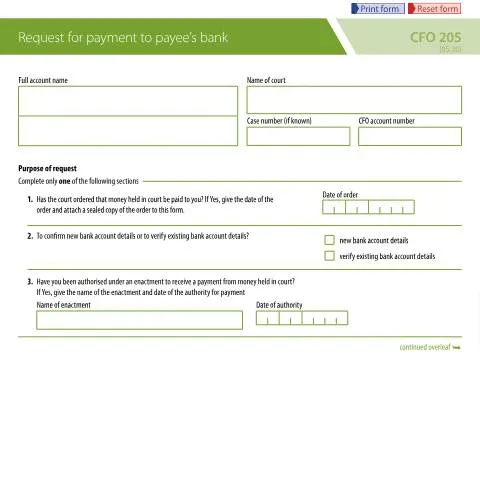
The CFO 205 form accommodates three fundamentally different scenarios for requesting payment, each with its own evidential requirements and processing implications. Understanding which pathway applies to your situation determines both the documentation you must provide and the likely timeframe for receiving funds.
Court-Ordered Payments
When a judge or district judge has issued a specific order directing payment from court funds, this represents the most straightforward pathway. The court order itself provides the legal authority for payment, but the CFO requires a sealed copy of that order—not merely a draft or unsigned version. This sealed copy must accompany your CFO 205 form, as it serves as the CFO's protection against unauthorised payments.
Court orders typically specify not just the amount to be paid, but also to whom payment should be made. If you're named as the recipient in the order, the process flows smoothly. However, complications arise when orders use generic language like "to the claimant's solicitors" without naming the specific firm, or when legal representation has changed since the order was made. In such cases, additional documentation proving your authority to receive the funds becomes essential.
Banking Detail Updates and Verification
The second pathway addresses a common practical need: updating or confirming bank account details for future payments. This might seem administrative, but it carries significant security implications. The CFO maintains strict protocols around account verification because fraudulent requests for bank detail changes represent a primary attack vector for those seeking to divert court funds illegitimately.
When requesting new bank account details, you must provide a bank statement or official letter from your bank dated within the last three months. This requirement serves dual purposes: it confirms the account exists and remains active, and it provides a paper trail linking you to the account. Solicitors' client accounts are exempt from this requirement, reflecting the additional regulatory oversight these accounts already receive through the Solicitors Regulation Authority.
Statutory Authority Payments
The third pathway covers situations where statute law, rather than a specific court order, provides authority for payment. This might include payments to appointed deputies under the Mental Capacity Act 2005, distributions under inheritance legislation, or payments to statutory bodies with defined powers over court funds.
These requests require careful completion because you must specify both the relevant enactment and the date your authority was granted. The CFO will verify your authority independently, which can extend processing times compared to straightforward court-ordered payments.
International Banking Complications
When payment needs to reach an overseas bank account, the CFO 205 form reveals additional complexity that reflects both regulatory requirements and practical banking limitations. International payments from court funds aren't merely a matter of providing different account details—they trigger enhanced due diligence procedures and may face restrictions depending on the destination country.
The form specifically requests IBAN numbers and SWIFT/BIC codes for overseas accounts, but obtaining these details correctly proves crucial. A single digit error in an IBAN can result in payment delays of several weeks while the CFO contacts you for clarification and re-verification. Unlike domestic sort codes and account numbers, international banking identifiers vary significantly in format between countries, and the CFO cannot process payments without complete and accurate information.
| Payment Destination | Required Information | Additional Considerations |
|---|---|---|
| UK Bank Account | Sort code, account number, account name | Bank statement within 3 months (except solicitor client accounts) |
| European Union Account | IBAN, SWIFT/BIC code, account name | Enhanced verification procedures may apply |
| Non-EU International | Full international banking details, SWIFT code | Anti-money laundering checks may delay payment |
Sanctions regulations add another layer of complexity for international payments. The CFO must screen all overseas payments against current sanctions lists, which can result in payments being frozen or rejected entirely if the destination country or banking institution appears on prohibited lists. This screening occurs after you submit your form, potentially leading to frustrating delays when you've already waited weeks for processing.
Partial Payments and Account Management
The CFO 205 form includes a critical question that many applicants overlook: whether you require all funds held in court to be released. This seemingly simple yes/no choice carries significant implications for ongoing case management and future access to remaining funds.
Choosing partial payment makes sense in several scenarios. Personal injury settlements often involve structured payments over time, allowing recipients to manage large sums responsibly. In probate matters, partial releases might fund immediate expenses while keeping reserves for unexpected claims. Commercial disputes might see partial payments to cover legal costs while leaving the remainder available for potential appeals.
However, requesting partial payment creates ongoing administrative obligations. The CFO maintains your account with the remaining balance, generating annual statements and requiring formal procedures for any future payment requests. Each subsequent payment requires a fresh CFO 205 form, creating multiple touchpoints with the system rather than a single, final transaction.
The amount specification requires particular care. The form asks for the amount required in pounds and pence, but you must ensure this figure doesn't exceed the total funds available. The CFO doesn't provide running balances when processing forms, so requesting £50,000 from an account holding £45,000 will result in form rejection and processing delays. If you're unsure of the exact balance, contacting the CFO helpline before submitting your form can prevent unnecessary complications.
Professional Representatives and Authority Questions
Legal professionals and other representatives face particular challenges when completing CFO 205 forms, as they must demonstrate not only their authority to act but also their ongoing right to receive funds on behalf of clients or beneficiaries. The form's signature section acknowledges this complexity by listing several categories of authorised signatories: beneficiaries themselves, solicitors, company secretaries, and managing directors.
Solicitors must be particularly careful about client account designations. When funds should flow to a solicitor's client account, the account name field must specify this clearly—typically including the firm name followed by "Client Account" or similar designation. Generic business account details will trigger queries from the CFO, as they cannot verify that client money protections apply to the receiving account.
Company secretaries and managing directors acting for corporate beneficiaries must provide evidence of their authority if this isn't already on file with the CFO. Recent Companies House filings showing current appointments usually suffice, but the CFO may request additional documentation if there's any doubt about authority to act.
When Authority Changes Hands
Particular complications arise when the person originally authorised to receive payments is no longer available or appropriate. Death of a solicitor, dissolution of law firms, or changes in corporate structure can leave funds effectively stranded until new authority is established. The CFO 205 form alone cannot resolve these situations—additional documentation proving the transfer of authority becomes essential.
In probate matters, this might involve grant of representation documents. For corporate beneficiaries, board resolutions or updated Articles of Association might be required. Legal aid cases present their own challenges when firms merge or lose legal aid contracts, potentially requiring Law Society intervention to establish proper authority chains.
Processing Realities and Common Pitfalls
Understanding the CFO's processing environment helps explain why seemingly simple payment requests can face unexpected delays. The Court Funds Office operates under strict financial controls that prioritise security over speed, resulting in multi-stage verification processes for every payment request.
Form CFO 205 undergoes initial administrative review within five working days of receipt, but this merely confirms that all required fields are completed and supporting documents are attached. Substantive review—verifying authority, checking account details, and processing the actual payment—typically takes an additional 10-15 working days for straightforward cases.
However, several factors can extend this timeline significantly. International payments routinely take 20-25 working days due to enhanced verification requirements. Cases involving large sums may trigger additional security reviews. Missing or unclear documentation invariably results in the form being returned for clarification, restarting the entire processing timeline.
Fill in your form directly online
No printing: type your details into the boxes of the official form, tick, then download the PDF ready to send.
- 1Type into the form boxes
- 2Tick in one click
- 3Save and download the PDF
Processing becomes particularly complex during peak periods. The end of each quarter sees increased volume as solicitors process accumulated cases, while year-end closures create bottlenecks in January and early February.
The Bank Statement Requirement
The requirement for recent bank statements or bank letters creates a common submission error that accounts for approximately 30% of CFO 205 rejections. The statement must be dated within three months of your form submission, but many applicants misunderstand this requirement to mean three months from when they request the statement from their bank.
Online bank statements generally satisfy the requirement, provided they clearly show the account holder name, account number, sort code, and bank details. However, screenshots of mobile banking apps or partial statements showing only recent transactions are insufficient. The CFO requires comprehensive account information that confirms the account's existence and your authority to operate it.
For joint accounts, particular care is needed to ensure the account name on your CFO 205 form exactly matches the account name shown on your bank statement. Minor variations—such as including or omitting middle initials, or different ordering of joint account holders' names—can trigger verification queries that delay payment by several weeks.
Digital Submission and Traditional Postal Routes
Despite the CFO's modernisation efforts, form CFO 205 remains primarily a paper-based process, reflecting the security concerns inherent in handling court funds. While some court procedures have migrated online, payment requests continue to require physical documentation and wet signatures, creating a deliberate friction that reduces fraud risk.
Postal submission to the Sunderland address remains the standard route, with the CFO providing a DX number for legal professionals who use document exchange services. Email submission is not available for completed forms, though the CFO's enquiry service accepts general questions via email. This limitation reflects data protection concerns around transmitting financial information electronically without secure encryption.
The physical submission requirement has practical implications for urgent payment requests. While the CFO operates a telephone helpline for queries, they cannot expedite processing simply because funds are needed urgently. Emergency applications require prior court approval and cannot be processed through the standard CFO 205 route.
Record Keeping and Future Reference
Successful CFO 205 submissions generate several important documents that applicants should retain carefully. The CFO provides written confirmation when payments are processed, including reference numbers that become crucial if queries arise later. For partial payments leaving balances in court, these references are essential for tracking your account and making future payment requests.
Bank transfer receipts from the CFO typically show limited information—often just "CFO PAYMENT" and a reference number. This can create confusion when multiple payments are expected or when funds relate to different cases. Maintaining clear records linking your CFO 205 submissions to received payments becomes essential for accurate accounting, particularly for professional representatives managing multiple client matters.
The CFO's annual statements for accounts holding ongoing balances provide crucial information for tax reporting and estate administration. These statements show opening balances, any payments made during the year, investment returns (where applicable), and closing balances. However, they arrive several months after each year-end, making contemporaneous record-keeping through CFO 205 documentation even more important for ongoing case management.