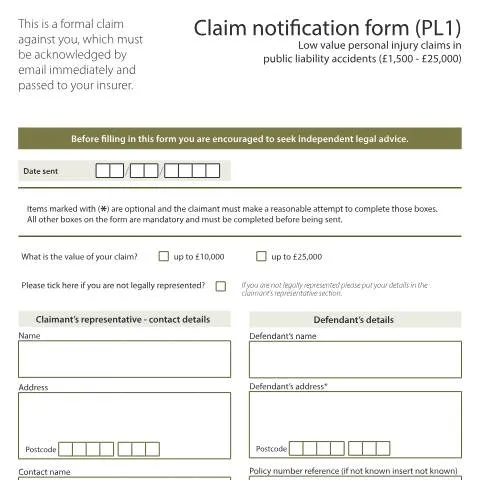
When Public Liability Accidents Lead to Court: Understanding the PL1 Claim Notification Process
A slip on a wet supermarket floor, a fall caused by broken pavement, or an injury from faulty equipment in a public venue can transform an ordinary day into months of medical treatment, lost wages, and mounting expenses. For personal injury claims valued between £1,500 and £25,000 arising from public liability accidents, the PL1 claim notification form serves as the formal gateway to the HM Courts & Tribunals Service low-value claims process.
This structured procedure, governed by Civil Procedure Rules, offers claimants a streamlined alternative to traditional litigation whilst maintaining robust legal protections. The PL1 form isn't merely paperwork—it's a formal legal claim that triggers immediate obligations for defendants and insurers, setting in motion a carefully orchestrated process designed to resolve disputes efficiently and fairly.
The Legal Framework Behind Low-Value Personal Injury Claims
The PL1 process operates within the Civil Procedure Rules (CPR), specifically designed to handle straightforward personal injury cases without the complexity and expense of full court proceedings. This system recognises that many public liability claims share common characteristics: clear circumstances, identifiable defendants, and damages that fall within predictable ranges.
Claims eligible for the PL1 process must meet strict criteria. The accident must have occurred in England and Wales, involve public liability (not motor accidents or employers' liability), and seek damages between £1,500 and £25,000. Importantly, the form itself indicates this range, though some versions reference different thresholds—claimants should verify current limits with HM Courts & Tribunals Service before proceeding.
The process excludes certain types of claims entirely. Clinical negligence cases, product liability claims, and accidents involving children under specific circumstances may require alternative procedures. Disease-related claims, where symptoms develop gradually rather than from a single incident, typically fall outside this framework.
Immediate Legal Consequences of Filing
Once sent, the PL1 form creates binding legal obligations. Defendants must acknowledge receipt immediately by email and forward the claim to their insurer within prescribed timeframes. Failure to respond appropriately can result in default judgments, making this process far more consequential than informal settlement discussions.
Dissecting the PL1 Form: Section-by-Section Requirements
The PL1 form's eight sections each serve specific legal and administrative purposes, with mandatory fields clearly distinguished from optional information marked with asterisks.
Claimant and Representative Details (Section A)
Section A establishes the legal identity of all parties. The claimant's National Insurance number serves as a key identifier, though exceptions exist for individuals who legitimately lack one—recent immigrants or those with religious objections, for instance. When representing yourself, you'll complete both claimant and representative sections with identical information.
Child claims require special handling, with parents or guardians signing on behalf of minors. The form's date of birth field helps identify such cases, triggering additional procedural safeguards throughout the process.
Medical Documentation and Work Impact (Sections B & C)
Sections B and C capture the claim's medical foundation. The injury description should be specific but concise—"fractured left wrist requiring six weeks in plaster" rather than vague references to "arm pain." Hospital attendance details, including overnight stays, significantly influence claim valuation and must be documented precisely.
Work-related losses require careful calculation. The form distinguishes between total time off work and ongoing absence, as these affect different compensation categories. Part-time workers, self-employed individuals, and those on zero-hours contracts may need additional documentation to establish lost earnings accurately.
| Medical Evidence Type | When Required | Impact on Claim |
|---|---|---|
| GP consultation | Within 48 hours of accident | Establishes causation link |
| A&E attendance | Same day or next day | Indicates injury severity |
| Specialist referral | Ongoing treatment needs | Supports higher damages |
| Physiotherapy | Rehabilitation requirements | Demonstrates recovery efforts |
Accident Circumstances and Liability (Sections D & E)
Section D demands precision in location description. "Outside Tesco" isn't sufficient—the form requires details enabling exact identification, such as "junction of High Street and Church Lane, adjacent to bus stop reference XY123." This specificity helps insurers investigate promptly and accurately.
The liability section (Section E) is where legal expertise becomes invaluable. While the form appears straightforward, explaining why the defendant bears responsibility requires understanding of negligence principles. Statements like "the floor was wet without warning signs" or "the pavement had a dangerous pothole" must align with legal standards for duty of care breaches.
Financial Arrangements and Funding Transparency
Section F addresses funding arrangements with remarkable detail, reflecting the legal system's emphasis on cost transparency. Conditional Fee Agreements (CFAs), commonly known as "no win, no fee" arrangements, must be disclosed along with after-the-event (ATE) insurance policies.
The form's insurance premium staging questions relate to policies where costs increase if cases proceed beyond certain stages. This information helps defendants assess potential cost exposure and influences settlement strategies. Membership organisations—such as trade unions or motoring associations—providing legal funding must also be declared.
Success Fees and Cost Implications
When CFAs include success fees, these cannot be recovered from defendants in most personal injury cases following the Legal Aid, Sentencing and Punishment of Offenders Act 2012 reforms. However, disclosure remains mandatory, affecting how solicitors structure their retainer agreements and clients' ultimate recovery.
Strategic Timing and Procedural Deadlines
The PL1 process operates within strict timeframes that begin the moment the form is submitted. Defendants have limited periods to respond, investigate, and either admit liability or mount their defence. Understanding these timelines helps claimants and their representatives plan their approach strategically.
Claims must typically be brought within three years of the accident date under the Limitation Act 1980, though exceptions apply for children and individuals lacking mental capacity. The PL1 process doesn't extend these limitation periods—it simply provides an efficient mechanism for pursuing valid claims within existing time constraints.
Post-Submission Expectations
Once submitted, the PL1 triggers the compensator response section, where defendants must choose between admitting liability, defending the claim, or exiting the process due to contributory negligence allegations. Each option leads to different procedural pathways with varying timeframes and requirements.
Liability admissions can lead to rapid settlement discussions, while defended claims may progress through additional case management stages. Exit from the process returns parties to conventional litigation, potentially increasing costs and complexity significantly.
Common Pitfalls and Procedural Missteps
The PL1's apparent simplicity masks several potential complications that can derail claims or reduce their value substantially. Incomplete mandatory fields result in automatic rejection, forcing resubmission and potentially alerting defendants to weaknesses in the claimant's case.
Medical evidence timing proves particularly problematic. Delayed medical attention—especially gaps of several days or weeks—provides defendants with ammunition to dispute causation. However, legitimate explanations exist: remote accident locations, delayed symptom onset, or initial shock masking injury severity. The form's brief injury description should anticipate and address such challenges.
Location Description Challenges
Accident location descriptions frequently prove inadequate for investigation purposes. Rural accidents, construction sites, or temporary hazards require especially careful documentation. Photographs, witness statements, and contemporaneous records become crucial supporting evidence, though the PL1 form itself provides limited space for such details.
Weather conditions, lighting, and seasonal factors may influence liability assessments but aren't explicitly captured in the form's structure. Claimants should consider how such factors might be incorporated within the accident description section or flagged for later disclosure.
The Defendant's Perspective and Response Obligations
Receiving a PL1 form creates immediate legal obligations for defendants and their insurers. The form's prominent warning about immediate email acknowledgment and insurer notification reflects the process's emphasis on swift resolution rather than delay tactics.
The compensator response section reveals defendants' limited options once claims are formally submitted. Admitting liability while disputing quantum (the amount of damages) allows progression to settlement negotiations. Defending liability entirely may force exit from the streamlined process, returning to conventional litigation with its associated costs and delays.
Contributory Negligence Considerations
The form's reference to contributory negligence reflects a common defence strategy where defendants accept partial responsibility whilst arguing claimants contributed to their own injuries. Such arguments—whether based on inappropriate footwear, failure to observe obvious hazards, or ignoring safety warnings—can significantly reduce compensation even when liability is established.
Understanding how contributory negligence might apply helps claimants address potential criticisms proactively within their PL1 submissions, strengthening their position for subsequent negotiations.
Beyond Form Submission: Managing the Claims Process
The PL1 form represents merely the beginning of what may become a complex negotiation process. Successful claims require ongoing case management, evidence gathering, and strategic decision-making that extends far beyond initial form completion.
Medical evidence continues developing throughout treatment periods, requiring regular updates and assessments. Rehabilitation needs may emerge gradually, affecting both the claimant's recovery and the claim's ultimate value. The form's rehabilitation section provides an initial framework, but comprehensive claims often require extensive ongoing documentation.
Settlement negotiations typically focus on three main compensation categories: pain, suffering and loss of amenity (PSLA), past financial losses, and future financial losses. The PL1's medical and work-related sections provide foundations for these calculations, but detailed quantum assessments require additional evidence and expert input.
For claimants navigating this process, the PL1 form serves as both a legal instrument and a practical roadmap. Its structured approach reflects decades of legal development aimed at balancing efficiency with fairness, providing accessible justice for those injured through others' negligence whilst protecting defendants from unmeritorious claims. Success depends not merely on accurate form completion, but on understanding the broader legal and procedural context within which the PL1 operates—a context where attention to detail, strategic thinking, and professional expertise often determine the difference between satisfactory resolution and prolonged dispute.
Medical Evidence Requirements and Independent Assessment Procedures
The medical evidence component of Form PL1 represents one of the most critical aspects of your claim, requiring careful coordination with healthcare professionals and understanding of the specific documentation standards expected by insurers and courts. Unlike higher-value claims where extensive medical reports may be commissioned later, low-value personal injury claims rely heavily on contemporaneous medical records and targeted assessments that directly correlate your injuries to the incident.
Your initial medical treatment records serve as the foundation of your claim. GP notes, A&E attendance records, physiotherapy reports, and any specialist consultations must be meticulously gathered and presented chronologically. The NHS patient access system allows you to request copies of your medical records, though processing times can vary between trusts. When requesting records, specify the exact date range from the incident onwards and include any pre-existing conditions that might be relevant to demonstrate the distinction between your baseline health and post-accident symptoms.
The medical evidence must establish three key elements: causation (linking your injuries directly to the incident), extent (the severity and nature of your injuries), and prognosis (expected recovery timeline and any permanent effects). For soft tissue injuries common in public liability cases—such as sprains, strains, or minor fractures—the medical evidence should document the initial presentation, treatment provided, response to treatment, and any ongoing symptoms or limitations.
Independent medical examinations may be required, particularly where liability is disputed or injuries are more complex. The defendant's insurer typically has the right to arrange a medical examination by a doctor of their choosing, usually within the first few months of the claim. This examination is not adversarial medical treatment but an assessment for legal purposes. You're entitled to have the examination conducted by a suitably qualified medical professional, and the report produced must be disclosed to both parties.
Photographic evidence of visible injuries should be taken as soon as possible after the incident and at regular intervals during recovery. These images provide compelling visual documentation of the injury's severity and healing progression. Ensure photographs are date-stamped and taken in good lighting conditions, showing the injury in context with surrounding uninjured areas for comparison.
Fill in your form directly online
No printing: type your details into the boxes of the official form, tick, then download the PDF ready to send.
- 1Type into the form boxes
- 2Tick in one click
- 3Save and download the PDF
For psychological injuries resulting from the incident—such as anxiety about returning to the location or general nervousness—documentation becomes more nuanced. GP consultations discussing these symptoms, any counselling or therapy sessions, and detailed personal statements about how the incident has affected your daily life and mental wellbeing all contribute to building a comprehensive picture of your suffering.
Calculating and Substantiating Financial Losses Beyond Medical Costs
While medical expenses often form the most straightforward element of damages calculation, the broader financial impact of your injury requires meticulous documentation and clear presentation within Form PL1. Understanding how different types of losses are categorised and valued ensures you don't inadvertently undervalue your claim or miss recoverable expenses.
Lost earnings calculations must account for your specific employment circumstances and the direct impact of your injuries on your ability to work. If you're employed under PAYE, payslips and employer confirmation of time off due to the injury provide clear evidence. However, calculating loss becomes more complex for self-employed individuals, those with variable income, or workers with multiple income streams. Self-employed claimants should provide recent tax returns, bank statements showing typical income patterns, and detailed records of work cancelled or postponed due to the injury.
The calculation period for loss of earnings isn't simply the time off work immediately following the incident. Consider reduced productivity upon return to work, inability to work overtime or take additional shifts, and any career progression opportunities missed due to the injury. If your role involves physical demands that you can no longer meet, resulting in reduced hours or alternative duties at lower pay, these ongoing losses must be quantified and projected based on medical prognosis.
Travel expenses related to medical treatment extend beyond simple fuel costs or public transport fares. Include parking fees at hospitals or clinics, congestion charges if travelling through London, and any additional costs for accessible transport if your injury affects mobility. If family members or friends have driven you to appointments, their travel costs and time off work may also be recoverable, though this requires careful documentation and reasonableness assessment.
Care and assistance costs represent a significant category often overlooked in lower-value claims. If your injury has required help with daily activities—shopping, cleaning, cooking, childcare, or garden maintenance—these services have quantifiable value even when provided by family or friends gratuitously. The approach isn't to claim the full commercial rate for such services but to recognise the reasonable value of assistance provided. Professional care services, home help, or modifications to your living environment to accommodate temporary or permanent limitations all constitute recoverable expenses when properly evidenced.
Equipment and aids purchased due to your injury—walking aids, supports, ergonomic workplace equipment, or modifications to your home or vehicle—should be documented with receipts and medical recommendations where applicable. The key test is whether these expenses were reasonably incurred as a direct result of the injury and whether they provide genuine benefit to your recovery or ongoing quality of life.
Prescription charges, over-the-counter medications specifically for treating your injury, and therapeutic treatments not available on the NHS require careful documentation. Private physiotherapy, osteopathy, or psychological counselling may be recoverable if recommended by medical professionals and reasonable in the circumstances. The challenge lies in demonstrating these treatments were necessary rather than desirable, particularly where NHS alternatives might have been available with longer waiting times.
Managing Communication and Negotiations Throughout the Claims Process
Effective communication management during your Form PL1 claim process can significantly influence both the timeline and outcome of your case. Understanding how to interact professionally with insurers, their representatives, and other parties while protecting your legal position requires a strategic approach that balances cooperation with appropriate caution.
Initial communications following your Form PL1 submission typically involve acknowledgment from the defendant's insurer and requests for additional information or documentation. Respond promptly to reasonable requests, but scrutinise each demand carefully. Insurers may request extensive documentation that goes beyond what's necessary for your claim, potentially seeking information to identify weaknesses in your case or pre-existing conditions that might reduce their liability. You're entitled to understand why specific information is being requested and how it relates to your claim.
Recorded telephone conversations with insurers have become increasingly common, ostensibly for training and quality purposes but potentially creating evidence that might be used later. Be aware that anything you say during these calls could be analysed for inconsistencies with your written statements or to assess the credibility of your injury claims. Consider requesting written communication where possible, particularly for substantive discussions about liability or settlement offers.
Settlement negotiations often begin informally through telephone discussions or brief written exchanges before any formal offers are made. These early conversations can be crucial in setting expectations and demonstrating the strength of your case. Avoid being drawn into detailed discussions about settlement amounts during initial calls—instead, indicate that any offers should be made in writing and that you need time to consider them properly with appropriate advice.
The timing of settlement discussions varies considerably depending on the complexity of your case and the defendant's approach. Some insurers prefer early settlement to minimise administrative costs and legal fees, while others adopt a more defensive stance, particularly where liability is disputed. Understanding these different approaches helps you gauge whether delays in communication represent genuine procedural requirements or tactical positioning.
Medical disclosure requests from the defendant's insurer require careful consideration. While they're entitled to relevant medical evidence to assess your claim, requests for complete medical histories going back many years may be disproportionate for low-value claims involving straightforward injuries. The proportionality principle means that disclosure requirements should match the value and complexity of the claim. Challenge overly broad requests and seek clarification on the specific relevance of requested records.
Documentation of all communications creates an essential audit trail for your claim. Keep detailed records of telephone conversations, including dates, times, names of individuals spoken to, and summaries of discussions. Email communications should be filed systematically, and any documents sent or received should be copied and stored securely. This documentation becomes invaluable if disputes arise about what was agreed or discussed during the claims process.
Understanding the insurer's internal processes can help you navigate communications more effectively. Claims handlers often work within defined authority levels for settlement, meaning that certain decisions require supervisor approval or referral to specialist teams. Recognising when you might be dealing with a frontline handler versus a more senior decision-maker helps you tailor your communication approach and understand potential delays in responses.
If communications break down or you encounter unreasonable delays, escalation procedures within insurance companies provide structured routes for resolution. Most insurers have complaints procedures that can be invoked if you're dissatisfied with the handling of your claim. The Financial Ombudsman Service provides an additional layer of recourse for insurance-related disputes, though this is typically more relevant for first-party insurance claims rather than third-party liability cases.