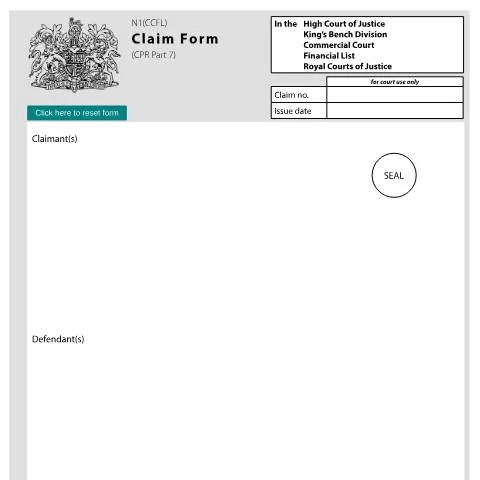
Understanding the N1(CCFL) Claim Form: A Critical Tool in Commercial Disputes
The N1(CCFL) Claim Form plays an indispensable role in the landscape of financial disputes addressed by the Commercial Court in the UK. Serving as the formal initiation of legal proceedings, this form is crucial for claimants seeking resolution in the Commercial Court's Financial List. Understanding its significance goes beyond mere completion; it involves grasping the procedural context within which it operates, the nuances of its requirements, and the ramifications of its submission.
Key Milestones: Timeline from Submission to Resolution
When embarking on the journey of financial dispute resolution in the Commercial Court, the timeline associated with the N1(CCFL) Claim Form is paramount. The first step begins with the proper completion of the form, which must be submitted to the court. This document triggers a series of procedural events that can significantly impact the outcome of a case.
Submission Process
- Preparation: Ensure all required information is accurately filled in, including claimant and defendant details and particulars of the claim.
- Filing: Submit the form to the court registry either online or in person, along with the appropriate court fee.
- Service of Documents: Once filed, copies of the claim form must be served to the defendant, typically within 4 months of filing.
Subsequent Steps
After submission and service, several actions follow:
- Defendant's Response: The defendant has 14 days to acknowledge service or respond to the claim, leading to possible directions from the court.
- Preliminary Hearing: If defence is filed, the court may schedule a preliminary hearing to determine further steps, including potential settlement discussions.
- Trial Preparation: Should the case proceed, both parties will engage in disclosure and witness statements leading up to trial.
The Legislative Framework Surrounding the N1(CCFL) Form
The N1(CCFL) Claim Form is rooted in a broader legislative framework, notably the Civil Procedure Rules (CPR), which govern civil litigation in England and Wales. These rules establish the procedures for claims, ensuring fairness and efficiency in the handling of cases.
Historical Context
The evolution of these rules reflects changes in societal needs and judicial priorities:
- The introduction of the CPR in 1999 aimed to simplify and clarify civil proceedings.
- The Financial List was established in 2012 to facilitate the resolution of complex commercial disputes efficiently.
Regulatory Authority
The HM Courts & Tribunals Service (HMCTS) oversees the operational aspects of the courts, including the processing of the N1(CCFL) Claim Form. Their guidelines and practices are essential for claimants to navigate the legal landscape effectively.
Nuances of Completing the N1(CCFL) Form
Completing the form itself may seem straightforward, but it is laden with specific requirements that demand careful attention to detail. Each section of the N1(CCFL) must be filled out precisely to avoid delays or rejections.
Section Breakdown
- Claimant and Defendant Information: Full names and addresses are crucial. Any inaccuracies could lead to complications in serving the claim.
- Details of the Claim: This section requires a concise yet comprehensive statement of the facts. Clarity is key; vague claims can lead to dismissal.
- Statement of Truth: The claimant must affirm that the information provided is accurate, underscoring the importance of honesty in legal declarations.
Common Pitfalls to Avoid
Claimants should be vigilant about common mistakes, including:
- Inadvertent omissions of information.
- Filing the claim past the statutory time limits.
- Failure to serve the claim form within the required timeframe.
Discerning the N1(CCFL) from Similar Claim Forms
In the realm of legal claims, various forms exist, often leading to confusion among users. Understanding the distinctions between the N1(CCFL) and other forms is essential for effective navigation of the court system.
Comparison Table: N1(CCFL) vs. Other Forms
| Form | Usage | Jurisdiction | Specific Features |
|---|---|---|---|
| N1(CCFL) | Commercial disputes in the Financial List | High Court of Justice | Focus on financial issues, higher claim limits |
| N1 | General civil claims | County Court and High Court | Broader spectrum of claims |
| N5 | Possession claims | County Court | Specific to property possession |
Who Needs to Relay Claims via the N1(CCFL)? A Closer Look
The parties involved in completing the N1(CCFL) Claim Form encompass a wide spectrum of individuals and entities.
Profiles of Involved Parties
- Individuals: Claimants may range from small business owners to large corporate entities seeking redress for financial losses.
- Legal Representatives: Solicitors and barristers often assist in completing and submitting the form, ensuring compliance with legal standards.
- Defendants: These may include other businesses or individuals who dispute the claims made against them.
Examples of Specific Cases
Consider the following scenarios:
- A small software company claiming unpaid invoices from a corporate client.
- A business contesting a breach of contract by another firm relating to a financial transaction.
What Happens After Submission? A Follow-Up on Proceedings
The journey does not end once the N1(CCFL) is submitted. There are further steps that both the claimant and the defendant must be prepared to navigate.
Fill in your form directly online
No printing: type your details into the boxes of the official form, tick, then download the PDF ready to send.
- 1Type into the form boxes
- 2Tick in one click
- 3Save and download the PDF
Post-Submission Actions
- Acknowledgment of Service: The defendant must acknowledge receipt and respond within 14 days or face potential judgment by default.
- Directions Questionnaire: If the case is contested, both parties may be required to complete a directions questionnaire to facilitate trial preparation.
- Settlement Discussions: Courts often encourage settlement discussions, which may occur before any court date.
Potential Outcomes
Based on the progression of the case, outcomes can vary:
- Settlement: Many cases resolve through negotiation before reaching trial.
- Trial: If unresolved, the case may proceed to trial, where evidence will be presented, and a judgment rendered.
- Appeal: If either party disagrees with the judgment, they may consider an appeal, subject to specific criteria.
Final Thoughts on the N1(CCFL) Claim Form
Completion and submission of the N1(CCFL) Claim Form is a pivotal step in the resolution of commercial disputes. Understanding its context, requirements, and implications can equip claimants with the tools necessary for effective engagement with the legal system. By taking the time to learn about each aspect of the form and the broader process it initiates, individuals and businesses can navigate the complexities of the Commercial Court more confidently and competently.
Understanding the Commercial Court Financial List
The Commercial Court Financial List, part of the High Court in England and Wales, deals specifically with financial disputes that exceed £100,000 or involve complex commercial matters. This list is designed to expedite cases that require specialized financial expertise and can handle a variety of claims, including those related to banking, finance, and international trade. The benefits of the Financial List include faster case management and access to judges with specific financial expertise. This specialized focus often leads to more effective resolutions, which is particularly beneficial for businesses and financial institutions.
Who Can Use Form N1(CCFL)? Eligibility Criteria
Form N1(CCFL) is not a universal claim form; it is tailored for use specifically within the Commercial Court Financial List. To be eligible to use this form, the claimant must ensure their claim meets certain criteria. Firstly, the monetary value of the claim must not fall below the threshold of £100,000. Additionally, the claim must involve a financial issue that is complex in nature, which might typically include disputes over financial transactions, breaches of financial agreements, and other intricate financial matters. This form can be utilized by businesses, corporations, and even individuals with significant claims, provided they meet the specified complexity and financial threshold.
Preparing Documentation for Submission
When preparing to submit Form N1(CCFL), it is crucial to gather all necessary documentation to support your claim effectively. This may include contracts, financial statements, correspondence relevant to the dispute, and any previous court orders if applicable. Besides the Form N1, you may also need to submit a particulars of claim that outlines the background of the dispute clearly and concisely. Ensure all documents are organized chronologically and labeled appropriately to facilitate the review process by the court. Remember, the quality of the documentation can influence the speed and efficiency of the court's decision-making process, so take the time to ensure everything is presented clearly.