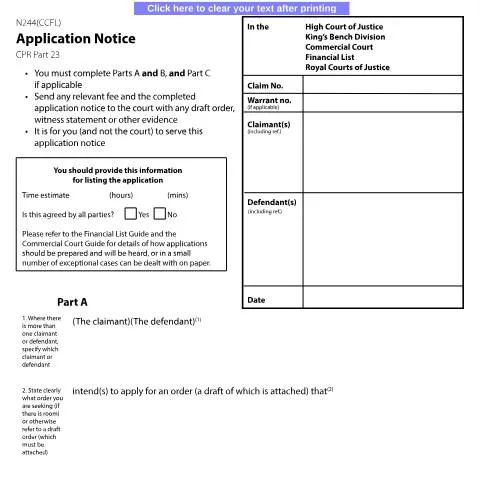
Understanding the N244(CCFL) Application Notice in Commercial Court Financial List Proceedings
When disputes involving financial markets, banking instruments, or complex commercial matters reach the High Court's Commercial Court Financial List, parties must navigate a highly specialised procedural framework. The N244(CCFL) application notice serves as the gateway for making interim applications within this elite jurisdiction, where cases often involve multi-million pound claims and require urgent judicial intervention. Unlike standard commercial court applications, this form acknowledges the unique characteristics of financial disputes—their time-sensitive nature, technical complexity, and the need for judges with specific expertise in financial markets.
The Financial List, established to handle disputes arising from financial markets and instruments, operates under distinct procedural rules that recognise the commercial reality of modern finance. Whether seeking an urgent injunction to prevent the dissipation of trading assets, applying for expedited disclosure of algorithmic trading data, or requesting specialist directions for expert evidence on derivatives, the N244(CCFL) provides the procedural vehicle for these applications.
Navigating the Tripartite Structure of Form N244(CCFL)
The form's architecture reflects the Commercial Court's emphasis on precision and judicial efficiency. Part A demands crystalline clarity about the relief sought—vague or overly broad applications face swift rejection in this jurisdiction where judges expect parties to articulate their case with commercial precision. The requirement to attach a draft order isn't merely procedural; it demonstrates the applicant's understanding of the specific relief required and helps the court assess proportionality.
Part B addresses the evidential foundation, offering three distinct routes for supporting an application. Practitioners can rely on existing statements of case where the application flows naturally from pleaded facts, attach formal witness statements for complex factual disputes, or utilise Part C for straightforward applications requiring limited evidence. This flexibility acknowledges that financial disputes range from urgent freezing orders requiring minimal evidence to complex applications for expert determination needing extensive documentation.
The Critical Evidence Selection Process
Choosing between witness statements, affidavits, and Part C evidence requires strategic consideration. Witness statements suffice for most applications but carry less weight where credibility is contested. Affidavits become essential when the application involves allegations of fraud, misrepresentation, or where the court might need to assess witness credibility without cross-examination. Part C evidence suits technical applications—such as requests for case management directions or procedural orders—where the facts are largely undisputed.
| Evidence Type | Appropriate Use | Key Considerations |
|---|---|---|
| Witness Statement | Standard factual applications | Faster preparation, lower formality |
| Affidavit | Fraud allegations, urgent injunctions | Sworn evidence, criminal sanctions for perjury |
| Part C Evidence | Procedural applications, case management | Convenience, limited scope |
Strategic Timing and the Commercial Court's Expedition Expectations
The N244(CCFL) operates within the Commercial Court's culture of expedition, where delay can destroy commercial value. The time estimate requirement isn't perfunctory—it directly impacts listing and judicial resource allocation. Underestimating hearing time risks adjournment and costs sanctions, whilst overestimating may delay listing in a busy court. The form's emphasis on party agreement regarding time estimates reflects the court's expectation that professional representatives will engage constructively to facilitate efficient case management.
Financial List cases often involve market-sensitive information where timing affects commercial outcomes. Applications for freezing orders, urgent disclosure, or interim declarations about trading positions require immediate judicial attention. The form's design acknowledges this urgency whilst maintaining procedural rigour—applications can be made without notice where justified, but the evidential requirements remain stringent.
The Interplay with Financial List and Commercial Court Guides
The form explicitly references both the Financial List Guide and Commercial Court Guide, recognising the dual procedural framework governing these specialised proceedings. The Financial List Guide provides specific guidance for market-related disputes, including provisions for expert evidence on financial instruments, expedited procedures for time-sensitive matters, and special arrangements for confidential information. The Commercial Court Guide supplies the broader procedural framework, including case management expectations and the court's approach to interim applications.
Addressing Jurisdictional Complexity in Multi-Party Financial Disputes
Financial disputes frequently involve multiple parties across different jurisdictions, creating complexity in application notices. The N244(CCFL) accommodates this reality by allowing specification of which claimant or defendant makes the application—crucial where parties have conflicting interests or where strategic considerations affect who should seek particular relief. This is particularly relevant in derivatives disputes, where original contracting parties, clearing houses, and regulatory bodies may all have distinct positions.
The requirement to identify the specific party making the application becomes critical in cases involving corporate groups, where parent companies, subsidiaries, and special purpose vehicles may all be parties with different standing to seek particular forms of relief. The court's approach to this identification affects everything from security for costs to the scope of any orders granted.
Service Obligations and the Applicant's Responsibility
The form's clear statement that service responsibility lies with the applicant, not the court, reflects the Commercial Court's expectation of professional competence. In financial disputes involving urgent applications, proper service becomes crucial—failed service can delay urgent relief and expose applicants to significant costs sanctions. The complexity increases in international cases where service may require translation, adherence to foreign procedural rules, or diplomatic channels.
Drafting Orders and Judicial Expectations in Financial Cases
The mandatory requirement to attach a draft order reflects the Commercial Court's efficiency-focused approach. Judges expect practitioners to draft orders that are immediately enforceable, precisely worded, and tailored to the specific circumstances. Generic precedent orders rarely suffice in financial disputes, where relief must often be calibrated to market realities, regulatory requirements, and commercial practicalities.
Draft orders in Financial List cases must consider the interaction with regulatory regimes—freezing orders affecting authorised financial institutions require different terms from those affecting unregulated entities. Similarly, disclosure orders concerning trading algorithms or proprietary financial models need specific confidentiality provisions that standard commercial court orders don't address.
The Statement of Truth and Professional Responsibility
The form's Statement of Truth carries particular weight in financial disputes where market manipulation, fraud, or regulatory breaches are alleged. The criminal sanctions for false statements aren't theoretical—the Commercial Court has seen practitioners face professional disciplinary action for inadequate verification of evidence. The alternative formulations—"I believe" versus "The applicant believes"—reflect different levels of personal knowledge and corresponding responsibility.
Legal representatives signing on behalf of clients must ensure adequate instructions and verification. In complex financial cases involving technical evidence, this may require detailed briefing from client personnel with direct knowledge of trading systems, market practices, or regulatory compliance procedures.
Practical Integration with Case Management and Listing Systems
The N244(CCFL) integrates with the Commercial Court's sophisticated case management system, where applications are tracked electronically and listing decisions made based on complexity, urgency, and judicial availability. The Admiralty and Commercial Registry's limited opening hours—10am to 4.30pm—reflect the court's focus on scheduled business rather than emergency out-of-hours applications, though provisions exist for truly urgent matters.
The requirement to quote claim numbers and correspond through the Clerk to the Commercial Court ensures applications are processed efficiently within the court's administrative framework. This becomes particularly important in cases with multiple concurrent applications or where applications are made in related proceedings.
Fee Considerations and Proportionality Assessment
The reference to "relevant fee" acknowledges that application fees vary based on the nature and value of relief sought. In high-value financial disputes, application fees represent minimal cost compared to potential commercial consequences, but the court's proportionality assessment considers both monetary and non-monetary factors. Applications for injunctive relief, expert determination, or expedited trial dates carry different fee implications and procedural requirements.
Common Pitfalls and Professional Standards in Financial List Applications
The Commercial Court's intolerance for procedural defects means that seemingly minor errors in completing the N244(CCFL) can have significant consequences. Incomplete party identification affects the court's jurisdiction and the scope of any orders made. Inadequate time estimates disrupt court listing and can result in costs sanctions. Poorly drafted evidence sections may require the court to adjourn applications for proper evidence, causing delay in time-sensitive financial matters.
The form's emphasis on clarity and precision reflects the Commercial Court's expectation that parties will approach litigation with the same professional standards applied to commercial transactions. Vague applications, inadequate evidence, or procedural shortcuts that might be tolerated in other jurisdictions face swift correction in this specialised environment.
Success in Financial List applications requires understanding both the technical requirements of the N244(CCFL) and the broader commercial and regulatory context in which these applications operate. The form serves not merely as a procedural gateway but as a tool for crystallising complex financial disputes into manageable judicial proceedings, where precision in pleading and evidence directly affects commercial outcomes.
Specific Requirements for International Commercial Disputes
The Commercial Court Financial List attracts a significant proportion of international commercial disputes, making Form N244(CCFL) applications particularly complex when cross-border elements are involved. These cases often require careful consideration of jurisdictional challenges, service of process abroad, and coordination with parallel proceedings in other countries.
When filing applications involving foreign parties, applicants must address service arrangements early in the process. The court requires clear evidence of how service will be effected on overseas defendants, whether through diplomatic channels, appointed process agents, or alternative service methods authorised under CPR Part 6. Applications for service out of the jurisdiction must demonstrate that the Commercial Court Financial List has jurisdiction under the Civil Jurisdiction and Judgments Act 2982 or relevant international conventions.
Foreign law evidence presents another layer of complexity. Applications seeking declarations on foreign law principles, or where the substantive dispute turns on overseas regulatory requirements, must include properly authenticated expert evidence. The court expects foreign law to be pleaded and proved as fact, with expert witnesses meeting the requirements under CPR Part 35. This often means applications must be supported by detailed witness statements from qualified foreign lawyers, complete with their credentials and basis for expertise.
Currency considerations affect both the relief sought and security arrangements. Applications for interim payments, freezing orders, or other financial relief must specify the currency of the claim and any conversion rates applied. Where security for costs is ordered, the court may require deposits in sterling or acceptable foreign currencies, with appropriate conversion mechanisms to account for exchange rate fluctuations during the proceedings.
Document production requests in international cases frequently involve materials held overseas, subject to foreign data protection laws or banking secrecy provisions. Applicants must demonstrate awareness of these constraints and propose realistic compliance mechanisms. The court increasingly requires evidence that foreign disclosure obligations have been considered and that any conflicts with overseas legal requirements have been identified and addressed.
Case Management and Procedural Coordination
The Commercial Court Financial List operates under an intensive case management regime that significantly impacts how Form N244(CCFL) applications are prepared and presented. Understanding this procedural framework is essential for effective application drafting, as the court expects parties to demonstrate awareness of the broader case management objectives and timeline constraints.
Fill in your form directly online
No printing: type your details into the boxes of the official form, tick, then download the PDF ready to send.
- 1Type into the form boxes
- 2Tick in one click
- 3Save and download the PDF
Applications must align with the court's case management directions and existing procedural timetables. Where proceedings are subject to a case management conference (CMC) or pre-trial review (PTR), the timing of applications becomes critical. The court generally expects non-urgent applications to be consolidated and heard at scheduled case management hearings rather than seeking separate hearing dates. This requires careful coordination between legal teams to identify all potential applications early in the proceedings.
The Financial List's emphasis on early case management means that applications for extensions of time or variations to standard directions face enhanced scrutiny. The court expects detailed explanations of why compliance with existing orders was not possible, evidence of attempts to resolve procedural disputes cooperatively, and realistic proposals for revised timetables that maintain overall case momentum. Mere inconvenience or competing commitments are rarely accepted as sufficient justification for procedural variations.
Technology and electronic case management play an increasingly important role in Financial List proceedings. Applications involving electronic disclosure, remote hearings, or digital evidence presentation must address technical capabilities and compatibility requirements. The court may require demonstrations of proposed technology solutions, particularly for complex financial data presentations or real-time document sharing during hearings.
Bundling requirements for applications reflect the court's expectation of proportionate preparation. While comprehensive documentation is essential, applications must avoid unnecessary duplication or inclusion of marginally relevant materials. The court increasingly imposes costs sanctions for excessive or poorly organised bundles, making efficient document management a practical necessity rather than merely good practice.
Coordination with alternative dispute resolution (ADR) processes requires careful attention in application drafting. The Commercial Court actively promotes settlement discussions and mediation, particularly in Financial List cases where commercial relationships may continue beyond the immediate dispute. Applications that could impact ongoing ADR processes, such as interim injunctions or disclosure orders, must address how the relief sought interacts with settlement negotiations and whether modified or staged relief might better serve the overall dispute resolution objectives.
Costs Management and Financial Implications
The financial implications of Form N244(CCFL) applications extend far beyond standard court fees, requiring sophisticated costs planning and budgeting considerations that reflect the high-value nature of Financial List disputes. The court's approach to costs management in these proceedings emphasises proportionality while recognising the complex financial and commercial issues typically involved.
Costs budgeting under CPR Part 3 takes on particular significance in Financial List cases, where application costs can quickly escalate due to the technical expertise required and the volume of financial documentation involved. The court expects detailed costs estimates for substantial applications, broken down by phase of work and level of fee earner involvement. These estimates must demonstrate proportionality not just to the application value, but to the overall claim value and the commercial significance of the issues raised.
Security for costs applications require especially careful financial analysis in international commercial disputes. The court considers not just the applicant's ability to pay adverse costs orders, but also practical enforcement prospects across different jurisdictions. Evidence requirements typically include recent financial statements, details of assets within the jurisdiction, and analysis of any applicable international enforcement treaties or reciprocal arrangements.
The Commercial Court's summary assessment procedures for application costs demand real-time costs preparation during hearings. Legal teams must be prepared to present detailed costs breakdowns immediately following application hearings, with supporting documentation readily available. This requires advance preparation of costs schedules, time recording summaries, and justification for any premium rates or specialist expertise charges.
Funding arrangements disclosure has become increasingly important following changes to costs and litigation funding regulations. Applications by funded parties must address disclosure obligations regarding funding arrangements, potential adverse costs exposure, and any conditions attached to funding that might affect the proceedings. The court may require copies of relevant funding agreements or detailed summaries of their key terms.
Insurance considerations affect both costs protection and the scope of relief that can practically be obtained. After-the-event (ATE) insurance coverage must be considered early in the application process, particularly for high-risk applications such as search orders or complex injunctive relief. The availability and scope of insurance coverage can influence both the court's willingness to grant relief and the practical enforceability of any orders made.
The court's case management powers increasingly extend to costs capping orders and prospective costs control, particularly in cases involving multiple applications or complex procedural disputes. Parties must be prepared to address overall litigation costs exposure and demonstrate that individual applications fit within proportionate overall costs budgets. This requires ongoing costs monitoring and regular reassessment of the commercial justification for continued proceedings.