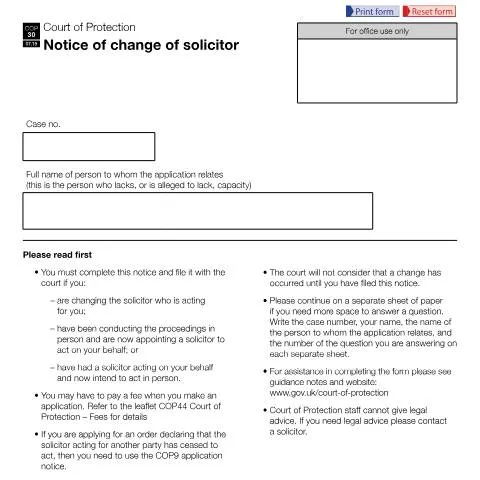
When Legal Representation Changes Mid-Proceedings: Understanding the COP30 Notice
In the complex landscape of Court of Protection proceedings, circumstances often arise where parties need to alter their legal representation arrangements. Whether you're switching from one solicitor to another, deciding to represent yourself after having professional help, or engaging a solicitor for the first time after conducting proceedings in person, the COP30 Notice of change of solicitor serves as the formal mechanism to notify the court and all parties of these significant procedural changes.
This notice isn't merely an administrative formality—it carries substantial legal weight in determining who has authority to act on your behalf and how the court will communicate with you throughout the proceedings. The Court of Protection requires explicit notification through this document before recognising any change in representation status, making proper completion and filing essential for maintaining your position in ongoing cases.
Three Distinct Scenarios Triggering the COP30 Requirement
The notice accommodates three specific situations, each with its own procedural implications and timing considerations. Understanding which scenario applies to your circumstances determines how you complete the form and what supporting documentation may be required.
Switching Between Professional Representatives
The most straightforward application involves changing from one solicitor to another while maintaining professional representation throughout. This might occur due to conflicts of interest that emerge during proceedings, dissatisfaction with current service levels, or practical considerations such as geographical convenience or specialisation requirements.
When completing Section 2.1, you'll tick the first option and provide comprehensive details of both the outgoing and incoming solicitors. The court requires complete contact information for the new representative, including their firm's DX number if applicable, as this facilitates efficient document exchange within the legal profession.
Transitioning from Self-Representation to Professional Help
Parties who initially chose to represent themselves may later decide that professional assistance is necessary, particularly as proceedings become more complex or when facing challenging legal arguments. This transition requires careful coordination to ensure continuity in case management.
The newly appointed solicitor will need access to all previous court documents and correspondence, making the timing of this change crucial. Filing the COP30 notice ensures that future court communications are directed appropriately, preventing potential missed deadlines or procedural complications.
Moving from Professional to Personal Representation
Some parties opt to dispense with professional representation, either due to cost considerations or a desire for greater personal control over proceedings. This decision, while entirely legitimate, requires careful consideration of the ongoing complexities involved in your specific case.
When making this transition, you must ensure that your former solicitor properly transfers all case files and documents to you. The court will redirect all future communications to your personal address, so maintaining accurate contact details becomes particularly important.
Critical Procedural Requirements and Timing Considerations
The COP30 notice operates within a framework of strict procedural requirements that, if overlooked, can significantly impact your case progression. Understanding these requirements prevents unnecessary delays and ensures compliance with Court of Protection rules.
| Requirement | Details | Consequences of Non-Compliance |
|---|---|---|
| Court Filing | Original notice must be filed with the Court of Protection | Change not recognised until filed; continued misdirected correspondence |
| Service on Parties | Copy to every other party in proceedings | Potential procedural challenges; unfair surprise to other parties |
| Former Solicitor Notice | Copy to outgoing solicitor (where applicable) | Continued professional obligations; potential ethical complications |
| Fee Payment | May require fee as per COP44 guidance | Application may be rejected or delayed pending payment |
The Court's Recognition Timeline
A crucial aspect often misunderstood by parties is that the court will not consider that a change has occurred until you have filed this notice. This means that even if you've already engaged a new solicitor or dismissed your current one, the court continues to recognise the previous arrangement until formal notification occurs.
This can create practical complications, particularly in urgent situations where immediate action is required. If your former solicitor receives court communications after your relationship has ended but before the COP30 notice is processed, they may no longer have authority to act on your behalf, potentially causing procedural difficulties.
Navigating Fee Obligations and Associated Costs
The notice itself may attract fees under certain circumstances, though the COP30 form directs users to consult the COP44 fees leaflet for specific details. Fee structures in Court of Protection proceedings can be complex, particularly when considering whether a change of solicitor constitutes a new application or an administrative update to existing proceedings.
Fee liability typically depends on the nature of the change and whether it occurs within existing proceedings or requires separate court consideration. For instance, if you're seeking a court order declaring that a solicitor for another party has ceased to act—a different scenario requiring the COP9 application notice—fee implications may differ significantly.
Remission and Exemption Considerations
Parties experiencing financial hardship may be eligible for fee remissions, but these must be applied for separately using appropriate forms. The timing of fee payment can affect when your notice takes effect, so ensuring you understand your obligations before filing prevents unnecessary delays.
Legal aid recipients face particular considerations, as changes in representation may affect their funding arrangements. Coordination between outgoing and incoming solicitors becomes essential to maintain continuous legal aid coverage where applicable.
Address Management and Communication Protocols
Section 2.4 of the notice requires careful consideration regarding where official documentation should be sent. This seemingly straightforward question carries significant implications for case management and ensuring you receive all necessary court communications.
When appointing professional representation, documents are typically sent to the solicitor's office, utilising established legal communication networks including DX mail systems. However, some parties prefer to receive copies directly, requiring clear instructions to the court about communication preferences.
Managing Multiple Address Requirements
Complex cases may involve multiple addresses serving different purposes—perhaps a correspondence address for routine matters and a different address for urgent communications. The COP30 notice allows specification of these arrangements, but clarity in your instructions prevents confusion that could result in missed deadlines.
International parties face additional considerations, particularly regarding service of documents and time calculations for responses. Ensuring your chosen address facilitates reliable document receipt becomes crucial for maintaining your position in proceedings.
Integration with Broader Court of Protection Procedures
The COP30 notice doesn't operate in isolation but forms part of the broader procedural framework governing Court of Protection cases. Understanding how this notice interacts with other aspects of your case ensures you maintain compliance across all procedural requirements.
Existing case management directions may specify particular requirements for legal representation, potentially affecting the timing or appropriateness of changes. Some court orders explicitly require professional representation, meaning that transitioning to self-representation might necessitate seeking permission to vary existing directions.
Case Management Conference Implications
Changes in representation often coincide with case management conferences, where procedural directions are reviewed and updated. Timing your COP30 notice to align with these conferences can facilitate smoother case progression and ensure that any necessary adjustments to directions are addressed comprehensively.
New solicitors require time to familiarise themselves with case histories and develop appropriate strategies, particularly in complex capacity assessments or disputed financial arrangements. Advance notice of representation changes allows courts to adjust timetables where necessary, preventing unfair disadvantage due to transition periods.
Special Circumstances and Alternative Procedures
While the COP30 notice covers most representation changes, certain situations require different approaches or additional considerations. Understanding these exceptions prevents inappropriate use of the form and ensures you follow correct procedures for your specific circumstances.
When Another Party's Solicitor Ceases to Act
If you need a court order declaring that a solicitor acting for another party has ceased to act—perhaps due to professional conduct issues or withdrawal without proper notice—the COP9 application notice is required instead of the COP30. This distinction reflects the different legal standards and evidence requirements involved in such applications.
These situations often arise in contentious proceedings where professional relationships break down or where solicitors withdraw due to non-payment of fees. The court's intervention becomes necessary to clarify representation status and ensure fair proceedings for all parties.
Emergency Representation Changes
Urgent situations may require representation changes outside normal timescales, particularly where existing solicitors become unavailable due to illness, professional conduct issues, or other unforeseen circumstances. While the COP30 procedure remains necessary, courts can expedite processing where genuine urgency is demonstrated.
Emergency applications may require additional evidence supporting the need for urgent consideration, and fees may be payable despite the urgency. Coordination with court staff becomes essential to ensure proper processing within compressed timeframes.
Practical Completion Guidelines and Common Oversights
Successful completion of the COP30 notice requires attention to detail across multiple sections, with particular care needed to ensure accuracy and completeness. Missing information or inconsistencies can delay processing and potentially affect your case progression.
Section 1 requires precise identification of your role in proceedings—applicant, respondent, or other specified capacity. This designation affects how the court processes your notice and determines what additional documentation may be required. Ensure your stated role matches your position in the original COP1 application or subsequent court orders.
Contact Information Accuracy
Providing comprehensive contact details for all relevant parties prevents communication failures that could compromise your case. This includes telephone numbers, email addresses where appropriate, and DX numbers for professional representatives. Incomplete contact information may result in delayed or misdirected communications.
The confirmation requirement in Section 2.5 serves as a crucial safeguard, ensuring all affected parties receive proper notice of representation changes. Failing to serve copies appropriately can result in procedural challenges and potential costs orders against you.
Remember that the Court of Protection operates within strict confidentiality requirements, making proper identification of the person lacking capacity essential for maintaining case security and ensuring appropriate document handling throughout the representation change process.
When Multiple Solicitors Are Involved in Your Case
Complex Court of Protection cases often involve multiple legal representatives, creating specific obligations when completing Form COP30. If your case involves both a solicitor and a barrister, you must notify the court about changes to either representative, though the procedures differ slightly.
When instructing a new solicitor who will continue working with your existing barrister, complete Form COP30 for the solicitor change first. Your new solicitor should then file a separate notice if they wish to instruct a different barrister. The court requires clear identification of who holds conduct of the case – typically the solicitor rather than the barrister.
In cases where multiple family members have appointed different solicitors (common in contested deputyship applications), each party must file their own COP30 when making changes. The court maintains separate records for each represented party, so cross-referencing becomes crucial. Include the case reference number and clearly state which party you represent in section 2 of the form.
Joint representation scenarios require particular attention. If two siblings initially shared one solicitor for a parent's welfare case, but later decide they need separate representation due to conflicting views, both the continuing client and the departing client must complete Form COP30. The departing client files notice of ceasing to be represented, while the continuing client may file an updated notice confirming sole representation.
Law firms merging or transferring cases present another complexity. When Firm A merges with Firm B, the technical legal position is that your solicitor relationship transfers automatically. However, you retain the right to choose your representation. If you're content with the new firm, no COP30 is required as there's no change of solicitor – merely a change of firm name. If you prefer to move elsewhere, you'll need to complete COP30 to formally notify the court of your new choice.
Fill in your form directly online
No printing: type your details into the boxes of the official form, tick, then download the PDF ready to send.
- 1Type into the form boxes
- 2Tick in one click
- 3Save and download the PDF
Corporate restructuring within law firms can create confusion about whether COP30 is needed. If your named solicitor moves from the litigation department to the private client department within the same firm, but continues handling your case, no notice is required. The court's concern is the identity of your representing solicitor and firm, not internal departmental arrangements.
Financial Implications and Legal Aid Considerations
Changing solicitors mid-case carries significant financial implications that extend beyond the immediate legal fees. Understanding these costs helps you make informed decisions and avoid unexpected financial burdens during an already challenging time.
When you change solicitors, your outgoing firm will typically bill you for all work completed to the date of termination. This includes time spent on case preparation, correspondence, court attendance, and administrative tasks like preparing your file for transfer. Review your original retainer agreement carefully, as some firms include specific clauses about charges for file transfers or early termination.
Your new solicitor may charge a "case review fee" to familiarize themselves with your matter. This legitimate cost reflects the time needed to understand the case history, previous court orders, and current procedural position. Complex cases with extensive documentation naturally incur higher review fees. Request a clear breakdown of these anticipated costs before confirming your instruction.
Legal aid recipients face particular considerations when changing solicitors. If you receive legal aid through the Legal Aid Agency, your new solicitor must hold a contract for Court of Protection work and accept legal aid cases. Not all solicitors meet these criteria, potentially limiting your choice of replacement representation.
The Legal Aid Agency requires notification when you change solicitors, separate from the court notification via Form COP30. Your outgoing solicitor should transfer your legal aid certificate to the new firm, but delays can occur. During any gap in legal aid coverage, you remain personally liable for legal costs, so timing becomes crucial.
After-the-event (ATE) insurance policies, common in Court of Protection cases, may not automatically transfer to your new solicitor. Check your policy terms, as some insurers require notification of solicitor changes and may reassess your coverage. Failure to notify could invalidate your policy, leaving you exposed to potential adverse costs orders.
Consider the timing of your change in relation to upcoming court hearings or deadlines. If a hearing is scheduled within six weeks, your new solicitor may need to request an adjournment to properly prepare, potentially incurring additional court fees and delaying resolution. The court generally accommodates reasonable requests for adjournments following solicitor changes, but this isn't guaranteed.
Before-the-event (BTE) insurance through household or professional policies sometimes covers legal expenses. When changing solicitors, verify whether your BTE cover extends to the new representation and whether any notification requirements apply. Some policies require pre-approval for legal representation changes.
Impact on Ongoing Court Proceedings and Case Management
A change of solicitor during active Court of Protection proceedings creates ripple effects throughout your case management that require careful coordination to avoid procedural complications or missed deadlines.
Court timetables don't pause for solicitor changes. If you're subject to case management directions with specific deadlines for filing evidence or position statements, these remain binding regardless of your representation change. Your new solicitor inherits these obligations and must quickly familiarize themselves with all outstanding requirements. Late compliance due to solicitor changes rarely constitutes acceptable grounds for extensions.
Witness statements already filed by your previous solicitor remain valid evidence in your case. However, if amendments become necessary, your new solicitor must file supplemental statements clearly identifying the changes and reasons. The court prefers continuity in witness evidence, so wholesale replacement of existing statements requires strong justification.
Expert witnesses present particular challenges when changing solicitors. If your previous solicitor instructed medical experts, psychiatrists, or other specialists, the professional relationship technically exists between the expert and your previous firm. Your new solicitor must establish fresh instructions with these experts, potentially requiring new retainer agreements and updated terms of engagement.
Some experts may decline to continue with new solicitors, particularly if payment disputes exist with the previous firm. In such cases, you might need to instruct replacement experts, causing delays and additional costs. The court may require explanations for expert changes, especially if this affects the expert evidence timetable.
Case management conferences (CMCs) scheduled before your solicitor change require careful handling. If the CMC occurs shortly after filing Form COP30, inform the court whether your new solicitor will attend or if you need time for proper instruction. Judges generally accommodate brief adjournments for new solicitors to prepare, but repeated requests for extensions due to representation changes may attract criticism.
Bundle preparation becomes complex when changing solicitors mid-proceedings. Your previous solicitor may have prepared chronological bundles or case summaries that your new representative must review and potentially update. Inconsistencies in bundle organization or document indexing can confuse court hearings, so thorough preparation becomes essential.
Settlement negotiations in progress when you change solicitors require delicate handling. Any "without prejudice" communications between your previous solicitor and opposing parties remain confidential and privileged. Your new solicitor cannot automatically access these discussions, potentially affecting ongoing settlement prospects. Consider whether continuing negotiations or starting fresh serves your interests better.
The court's case management system updates automatically when it processes Form COP30, but administrative delays can occur. During the transition period, court communications might still be sent to your previous solicitor. Arrange with both firms to ensure no correspondence is missed and that urgent court communications reach your new representative promptly.
Multi-track cases with complex procedural histories require your new solicitor to understand not just the current position, but the evolution of court orders and previous judicial decisions. This institutional knowledge transfer takes time and may require consultation with your previous solicitor, potentially incurring additional costs but ensuring continuity in your legal strategy.