Understanding the Financial Burden: Why Deputy Fee Reductions Exist
When the Court of Protection appoints someone as a deputy to make decisions on behalf of a person who lacks mental capacity, this legal responsibility comes with mandatory annual fees that can create significant financial pressure. The Office of the Public Guardian charges deputies both an initial assessment fee and ongoing supervision fees, which can amount to several hundred pounds each year. For many families managing the affairs of a vulnerable relative, these costs represent a substantial burden on already limited resources.
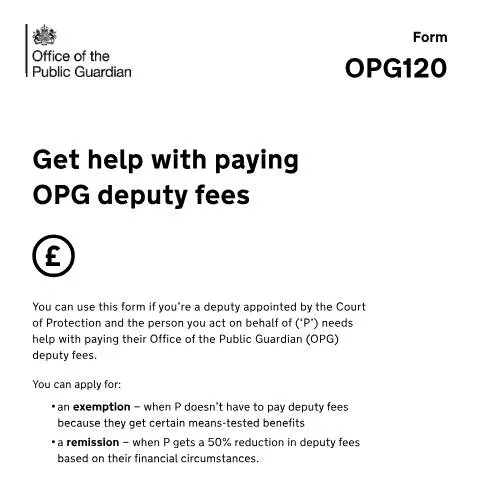
The OPG120 form addresses this challenge by providing a structured pathway for deputies to secure financial relief through two distinct mechanisms: complete exemptions from fees or 50% reductions. This system recognises that the person under protection ('P') should not be penalised financially for requiring legal safeguards, particularly when their income derives primarily from benefits or modest pensions.
The fee structure itself reflects the level of oversight required. A deputy assessment fee of £100 covers the initial evaluation of supervision needs, while ongoing supervision ranges from £35 for minimal oversight to £320 for general supervision. These amounts, whilst necessary for maintaining protective oversight, can represent a disproportionate burden when set against typical benefit income levels.
Two Pathways to Financial Relief: Exemptions versus Remissions
The OPG120 system operates through two fundamentally different approaches to fee reduction, each targeting specific financial circumstances and requiring distinct evidential support.
Complete Fee Exemptions: The Benefits-Based Route
Exemptions eliminate all deputy fees entirely and are primarily benefit-driven. To qualify, P must receive specific means-tested benefits during the period covered by the fee invoice. The qualifying benefits represent those where the state has already assessed the individual's financial need:
- Guarantee Credit element of Pension Credit
- Income-based Employment and Support Allowance (ESA)
- Income-based Jobseeker's Allowance (JSA)
- Income Support
- Housing Benefit and Local Housing Allowance
- Universal Credit
- Council Tax Benefit (excluding single person reductions)
A crucial exemption pathway involves combined Working Tax Credit arrangements where P receives Working Tax Credit alongside Child Tax Credit, Disability Element of Working Tax Credit, or Severe Disability Element of Working Tax Credit. This combination route recognises that working families with disabilities may still face significant financial constraints despite employment income.
One critical limitation applies: if P has received personal injury damages exceeding £16,000 that were disregarded during benefit assessment, exemption eligibility may be affected. This provision prevents situations where substantial compensation payments would ordinarily disqualify someone from benefits but remain ignored for benefit calculation purposes.
50% Fee Remissions: Income-Threshold Reductions
Remissions offer a different approach, providing 50% reductions in deputy assessment and general supervision fees based on P's total gross annual income falling below £12,000. Notably, minimal supervision fees cannot be reduced through remissions, creating an important distinction in fee treatment.
Income calculation encompasses diverse sources including employment wages, state and private pensions, non-means-tested benefits like Attendance Allowance and Personal Independence Payment, property rental income, and investment returns. This comprehensive approach ensures that all revenue streams contribute to the income assessment, preventing selective disclosure.
Navigating Universal Credit Complexities
Universal Credit cases require particular attention due to the benefit's dual qualification potential. Recipients may qualify for either exemptions or remissions depending on their specific circumstances, making careful assessment essential.
For exemption claims involving Universal Credit combined with other qualifying benefits, deputies must provide Universal Credit statements covering the billing year specified on the fee invoice. These statements are accessible through P's Universal Credit online account, requiring deputies to maintain appropriate access arrangements.
The Universal Credit statement serves as primary evidence, but deputies claiming exemptions based on benefit combinations must ensure their documentation clearly demonstrates the qualifying benefit mix during the relevant period. This requirement prevents confusion where Universal Credit alone might not qualify for exemption but combined benefits would.
Strategic Timing and Extended Award Applications
The OPG operates an extended award system allowing fee reductions to run for up to three years without reapplication, providing significant administrative relief for deputies managing stable financial situations. However, this convenience comes with important responsibilities and limitations.
| Award Type | Maximum Duration | Review Conditions | Notification Requirements |
|---|---|---|---|
| Single Year Award | 12 months | Annual reapplication | None during award period |
| Extended Award | 36 months | OPG discretionary review | Immediate change notification |
Extended awards depend on the predictability of P's financial circumstances. The OPG assesses whether benefits or income levels are likely to remain consistent over the three-year period. Deputies must notify the OPG immediately if P's financial situation changes, as failure to do so can result in award withdrawal and potential recovery of incorrectly applied reductions.
Importantly, once an extended award is granted and incorporated into fee invoices, no further reductions can be applied during the award period. This prevents double-dipping but means deputies cannot benefit from subsequent improvements to their circumstances until the next award period.
Evidence Requirements: Building a Compelling Application
Successful OPG120 applications depend heavily on providing appropriate documentary evidence that meets strict OPG standards. The evidence requirements vary significantly between exemptions and remissions, reflecting their different qualifying criteria.
Exemption Evidence: Official Benefit Confirmations
For exemption applications, deputies must provide official correspondence from benefit providers confirming P's receipt of qualifying benefits during the fee period. Acceptable evidence includes award letters, benefit statements, and formal notifications that clearly show:
- P's full name, title, address and postcode
- The specific benefit being received
- The amount and payment dates
- Coverage of the relevant fee period
Generic bank statements showing benefit payments are insufficient, as they lack the official confirmation of benefit type and eligibility that the OPG requires for verification purposes.
Remission Evidence: Comprehensive Income Documentation
Remission applications demand comprehensive income verification covering all revenue sources during the 12 months preceding the fee invoice date. The evidence requirements vary by income type:
Employment income requires the three most recent consecutive payslips from current employment, providing clear demonstration of regular earnings patterns. Self-employed individuals must provide their most recent Self Assessment tax return alongside the corresponding HMRC Tax Calculation, ensuring both declared income and official assessment are available.
Benefits and pensions require official letters or notices from the paying organisation, whether DWP, local authority, or private pension provider. Investment income needs statements, vouchers, or tax certificates showing gross returns from capital, stocks, shares, or bonds.
Where P has no income at all, deputies must provide a signed written statement declaring this situation. This provision recognises that some individuals under protection may have no independent income sources.
Application Processing and Administrative Pathways
The OPG120 form must be submitted alongside supporting evidence to specific OPG addresses, with a critical six-month deadline from the invoice date. This timeframe reflects the administrative need to process applications whilst fee obligations remain current.
Applications can be submitted through multiple channels:
Office of the Public Guardian PO Box 16185 Birmingham B2 2WH DX: 744240 Birmingham 79 Email: [email protected]
The email option provides faster submission for digital documents, though deputies must ensure all supporting evidence is properly scanned and clearly legible. Postal submissions offer security for original documents but require longer processing times.
Once applications are received, the OPG conducts assessment based on the evidence provided and current fee liability. Successful applications result in written confirmation specifying the award duration and any conditions. Unsuccessful applications receive explanatory correspondence detailing the reasons for rejection and any appeal rights.
Managing Ongoing Obligations and Changes
Receiving fee reductions through the OPG120 process creates ongoing obligations for deputies, particularly regarding change notification and award maintenance. These responsibilities extend beyond the initial application and require active monitoring of P's circumstances.
Deputies must maintain awareness of P's financial situation throughout any award period, particularly for extended awards where circumstances might change significantly over three years. Benefits may be stopped, employment might commence or end, and pension arrangements could alter, all potentially affecting eligibility.
The OPG retains authority to review awards at any time, particularly where information suggests circumstances have changed. This review power ensures that reductions remain appropriate to current circumstances and prevents inappropriate ongoing reductions where eligibility has ceased.
For deputies managing complex financial situations, maintaining detailed records of P's income and benefits becomes essential. This documentation supports both ongoing award maintenance and future reapplication processes, creating administrative continuity that benefits both deputy and OPG.
The system ultimately balances necessary fee collection with recognition that protective legal arrangements should not create excessive financial hardship for those they are designed to protect. Through careful application of the OPG120 process, deputies can secure appropriate financial relief whilst maintaining the oversight that ensures P's interests remain protected.
Understanding Fee Structures and Payment Schedules for Different Deputy Types
The Office of the Public Guardian operates a tiered fee structure that varies significantly depending on your specific deputy role and the complexity of your responsibilities. Property and financial affairs deputies face different fee arrangements compared to health and welfare deputies, with distinct assessment criteria for fee reductions in each category.
For property and financial affairs deputies, the annual supervision fee currently applies where the protected person's assets exceed £16,000. This threshold serves as a crucial benchmark – if assets fall below this level, you may qualify for automatic fee exemption rather than a reduction. However, calculating these assets requires careful consideration of what counts towards the total. Cash savings, investments, property values (minus any mortgage), and valuable possessions all contribute to the assessment, whilst certain protected assets like the main residence may receive different treatment depending on circumstances.
The OPG distinguishes between active and dormant cases when determining fee liability. If you're managing minimal financial activity – perhaps just handling a basic pension and utility payments – your supervision requirements differ substantially from deputies overseeing complex investment portfolios or business interests. This distinction affects both the standard fee amount and your potential eligibility for reductions.
Payment scheduling offers flexibility that many deputies overlook. Rather than facing a substantial annual charge, you can request quarterly instalments, which may ease cash flow pressures. The OPG typically accommodates such arrangements, particularly where you're simultaneously applying for fee reductions based on financial hardship.
Health and welfare deputies generally face lower fees, but the reduction criteria focus more heavily on the deputy's personal circumstances rather than the protected person's assets. If you're managing both property/financial affairs and health/welfare matters under separate orders, each attracts distinct fees and reduction assessments.
Joint deputies encounter additional complexity in fee arrangements. Where multiple deputies share responsibility, the OPG may apportion fees differently, and reduction applications must clearly specify which deputy is claiming the reduction and on what grounds. The financial circumstances of all joint deputies may require disclosure, even where only one seeks a fee reduction.
Fill in your form directly online
No printing: type your details into the boxes of the official form, tick, then download the PDF ready to send.
- 1Type into the form boxes
- 2Tick in one click
- 3Save and download the PDF
Corporate deputies – typically solicitors or professional deputy services – face different fee structures entirely and have limited grounds for reduction claims. However, if you're a professional deputy experiencing exceptional circumstances affecting your ability to pay, specific provisions may apply, though these require detailed justification and supporting evidence.
Managing Multiple Applications and Complex Family Situations
Deputies often find themselves managing multiple Court of Protection orders simultaneously, whether for different family members or holding various types of authority for the same person. Each order typically generates separate fee liability, but the OPG recognises that cumulative charges can create disproportionate financial burden, particularly for family members caring for multiple relatives.
When applying for fee reductions across multiple deputyships, your application strategy requires careful coordination. Rather than submitting separate reduction requests for each case, consider preparing a consolidated application that demonstrates the overall impact on your finances. Include a schedule showing all your deputy responsibilities, associated fees, and how these combine to create hardship. The OPG can then assess whether partial reductions across multiple cases, or complete exemption for some orders, provides the most appropriate relief.
Blended family situations present particular challenges where step-parents, divorced parents, or estranged relatives hold deputy roles. Financial disclosure requirements may feel intrusive, especially where family relationships remain strained. However, the OPG maintains strict confidentiality protocols, and your financial information serves solely to assess fee reduction eligibility rather than broader family investigations.
Where adult children serve as deputies for elderly parents whilst managing their own families' financial pressures, the application should clearly articulate competing demands on your resources. University fees for your own children, mortgage payments, and care costs for other family members all constitute legitimate considerations in your hardship assessment. Provide a comprehensive household budget that demonstrates how deputy fees impact your ability to meet these essential commitments.
Inheritance complications can affect fee reduction applications, particularly where you expect to benefit from the protected person's estate eventually. The OPG may scrutinise applications more carefully where deputies stand to inherit, but financial hardship in the present remains valid grounds for reduction regardless of future inheritance prospects. Be transparent about any inheritance expectations whilst emphasising current financial realities.
Divorced or separated deputies face additional complexity where former spouses retain financial connections to the protected person. Your application should clearly delineate your personal financial position from any ongoing financial relationships with ex-partners, particularly where child maintenance or property settlements remain active.
Geographic factors can influence costs and reduction applications. Deputies living far from the protected person may incur significant travel expenses for supervision visits or court hearings. While these costs don't directly qualify for OPG fee reductions, they contribute to your overall financial picture and may strengthen your hardship argument. Document travel costs, accommodation expenses, and lost earnings from attending OPG meetings or court proceedings.
Navigating Appeals and Disputes Over Fee Reduction Decisions
The OPG's initial decision on your fee reduction application isn't necessarily final. Understanding your rights and options for challenging unfavorable decisions can prove crucial, particularly where you believe the assessment overlooked important factors or misinterpreted your financial circumstances.
Before launching formal appeals, consider requesting an internal review of the decision. The OPG operates a reconsideration process where senior officers can examine whether the original assessment followed correct procedures and considered all relevant evidence. This route often proves faster and less formal than tribunal appeals, whilst achieving similar outcomes where genuine errors occurred.
Internal reviews work particularly well where your circumstances changed after submitting the original application but before the decision was made. New evidence of financial hardship, unexpected expenses, or changes in the protected person's situation can all justify reconsideration requests. Submit updated financial statements and explain clearly what has changed since your original application.
If internal review fails to resolve your concerns, you can appeal to the First-tier Tribunal (General Regulatory Chamber). Tribunal appeals follow more formal procedures, requiring specific grounds for challenge and adherence to strict time limits. Most appeals succeed on procedural grounds – where the OPG failed to follow its own guidance – rather than simple disagreement with the decision outcome.
Common grounds for successful appeals include failure to consider relevant financial evidence, misapplication of the hardship criteria, or procedural errors in the decision-making process. The tribunal cannot simply substitute its judgment for the OPG's assessment but can order reconsideration where proper procedures weren't followed.
Preparing for tribunal hearings requires substantial documentation and clear presentation of your case. Unlike the original application process, tribunal proceedings follow court-like procedures with formal evidence requirements and potential cross-examination. Consider whether legal representation might prove beneficial, particularly for complex cases involving substantial fee amounts or ongoing disputes.
The tribunal can uphold the OPG's decision, order complete or partial fee reduction, or require fresh assessment under corrected procedures. However, unsuccessful appeals may result in additional costs, so evaluate your prospects carefully before proceeding to formal tribunal action.
Alternative dispute resolution occasionally offers middle-ground solutions. Where disagreements focus on interpretation of evidence rather than fundamental procedural errors, informal discussions with OPG senior staff might resolve issues without formal appeals. This approach works particularly well for ongoing disputes about annual fee assessments where circumstances fluctuate regularly.
Time limits for appeals operate strictly, typically requiring action within 28 days of receiving the OPG's decision. Late appeals require special permission and compelling reasons for delay, so prioritise prompt action if you're considering challenging a fee reduction decision.
Keep detailed records throughout any dispute process, including all correspondence with the OPG, internal review outcomes, and tribunal documentation. These records prove essential for tracking decision-making progress and ensuring consistency in your arguments across different stages of the dispute process.