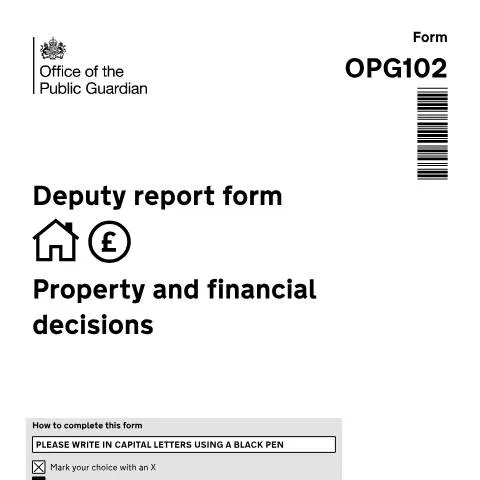
Understanding Your Obligations as a Court-Appointed Property and Financial Deputy
When the Court of Protection appoints you as a deputy for property and financial affairs, you shoulder significant legal responsibilities that extend far beyond simply managing someone's bank account. The OPG102 deputy report form represents your annual accountability checkpoint with the Office of the Public Guardian—a comprehensive document that scrutinises every significant decision you've made on behalf of your client throughout the reporting period.
This isn't merely administrative paperwork. Your completed report becomes part of the official record that demonstrates how you've exercised your court-granted powers, whether you've acted in your client's best interests, and how effectively you've safeguarded their financial wellbeing. The Office of the Public Guardian uses these reports to identify potential concerns, ensure compliance with the Mental Capacity Act 2005, and protect vulnerable adults from financial abuse or poor decision-making.
The form's structure reflects the multi-faceted nature of deputyship: from tracking your client's changing mental capacity to documenting who you've consulted for major decisions, and from monitoring care arrangements to ensuring proper safeguarding measures remain in place. Each section serves a specific supervisory purpose, creating a comprehensive picture of your stewardship during the preceding twelve months.
Navigating the Reporting Timeline and Your Annual Obligations
Your reporting obligations begin immediately upon your appointment by the Court of Protection, though your first report won't be due until twelve months after the court order takes effect. The reporting period highlighted in bold on your OPG correspondence defines your specific timeframe—typically running from the anniversary date of your appointment rather than the calendar year.
The Office of the Public Guardian operates on a structured annual cycle, sending out deputy report forms approximately six to eight weeks before your submission deadline. This advance notice allows sufficient time to gather financial records, compile decision logs, and consult with other parties involved in your client's care. However, the responsibility for maintaining accurate records throughout the year rests entirely with you as deputy.
| Reporting Element | Required Documentation | Preparation Time Needed |
|---|---|---|
| Financial decisions | Bank statements, receipts, investment records | 2-3 weeks |
| Capacity assessments | Professional reports, care plan reviews | 1-2 weeks |
| Consultation records | Correspondence, meeting notes, family discussions | 1 week |
| Safeguarding evidence | Care provider reports, benefits reviews, contact logs | 2-3 weeks |
Late submission can trigger OPG investigations and potentially court proceedings if the delay suggests neglect of duties. The Office of the Public Guardian maintains discretionary powers to impose penalties, request additional documentation, or recommend court supervision where deputies fail to meet their reporting obligations punctually.
Decoding Mental Capacity Changes and Professional Assessment Requirements
Section 2 of the OPG102 form focuses intensively on your client's mental capacity fluctuations—information that directly impacts the scope of your decision-making authority. The Mental Capacity Act 2005 establishes that capacity can vary depending on the complexity of decisions required, timing of assessment, and your client's health status at any given moment.
When reporting capacity changes, you must distinguish between temporary fluctuations caused by factors like medication changes, infections, or emotional distress, and permanent deterioration resulting from progressive conditions such as dementia or brain injury. The OPG uses this information to determine whether your powers remain appropriate or require court review.
Professional capacity assessments carry particular weight in your report. These evaluations—conducted by psychiatrists, clinical psychologists, or approved social workers—provide objective evidence of your client's current abilities. The form specifically asks when capacity was "last assessed by a professional," recognising that informal observations by family members or care workers, while valuable, don't constitute formal assessments for OPG purposes.
If no professional assessment has occurred during your reporting period, this doesn't necessarily indicate neglect. However, significant changes in your client's condition, challenging decisions arising, or family disputes about capacity may prompt the OPG to recommend formal evaluation. The timing and frequency of such assessments should align with your client's specific circumstances rather than following a rigid schedule.
Documenting Significant Decisions and Client Involvement Strategies
The concept of significant decisions extends beyond major financial transactions to encompass any choice that materially affects your client's lifestyle, care arrangements, or long-term financial security. While purchasing a property or making substantial gifts clearly qualify, decisions about changing care providers, relocating your client, or altering investment strategies may also require detailed justification in your report.
Client involvement represents a cornerstone principle of the Mental Capacity Act 2005, requiring you to maximise your client's participation in decisions affecting them, regardless of their capacity limitations. Your report must demonstrate concrete steps taken to include your client in the decision-making process, even when their capacity appears severely compromised.
Effective client involvement might include:
- Timing considerations: Choosing optimal times when your client feels most alert and engaged
- Communication adaptations: Using visual aids, simplified language, or familiar environments to enhance understanding
- Preference exploration: Investigating past wishes, values, and preferences that might guide current decisions
- Emotional support: Ensuring your client feels heard and respected throughout the decision-making process
When client involvement proves impossible due to severe cognitive impairment or communication barriers, your report must explain the specific obstacles encountered and alternative approaches attempted. The OPG scrutinises these explanations to ensure you've made genuine efforts to include your client rather than simply assuming incapacity.
Managing Joint and Several Deputy Arrangements
The Court of Protection may appoint multiple deputies to act either jointly (requiring unanimous agreement for all decisions) or jointly and severally (permitting individual deputies to act independently while maintaining collective responsibility). These arrangements significantly impact how you complete your annual report and coordinate with co-deputies.
For joint appointments, you must ensure all deputies contribute to and approve the single report submitted to the OPG. This requires establishing clear communication protocols, regular meetings to discuss significant decisions, and shared access to financial records and correspondence. Disagreements between joint deputies can complicate reporting and may require court intervention if consensus cannot be reached.
Jointly and severally appointed deputies face different challenges, as individual actions by any deputy affect the collective report. You must maintain awareness of decisions made by co-deputies during the reporting period, even if you weren't directly involved. The OPG expects the submitting deputy to provide comprehensive oversight of all deputy activities, not merely their personal contributions.
Consider establishing these collaborative practices:
- Shared decision log: Maintain a central record accessible to all deputies documenting significant choices and their rationale
- Regular communication schedule: Monthly or quarterly meetings to discuss ongoing matters and coordinate future decisions
- Clear role division: Define specific responsibilities for different deputies to avoid duplication or gaps in oversight
- Dispute resolution mechanism: Agree procedures for handling disagreements before they escalate to court involvement
Safeguarding Responsibilities and Contact Monitoring Requirements
Section 4 of the OPG102 form reflects the Office of the Public Guardian's statutory duty to protect adults who lack capacity from abuse, neglect, and exploitation. Your responses provide crucial intelligence about your client's social isolation levels, care quality, and potential vulnerability to harm from others.
The frequency and nature of your client's social contacts serve as key indicators of their wellbeing and safety. Individuals with limited external contact face higher risks of undetected abuse, declining care standards, or financial exploitation by those with regular access. Your report must demonstrate active monitoring of these relationships and intervention when concerns arise.
Care funding arrangements require particular scrutiny, as complex payment structures can obscure financial irregularities or inappropriate charging practices. Whether funded through local authority arrangements, NHS continuing healthcare, or private resources, you must verify that charges align with services provided and represent value for money. Regular care plan reviews ensure that support levels remain appropriate as your client's needs evolve.
Benefits entitlement checks form another critical safeguarding element, as many adults with capacity limitations fail to claim their full benefit entitlement. The form specifically asks when you last reviewed benefit eligibility—a question that reflects the OPG's awareness that benefit rules change frequently and deputies may lack specialist knowledge in this area. Consider consulting welfare rights advisers or specialist benefits agencies if you're uncertain about current entitlements.
Third-party income arrangements demand careful oversight, as they can provide opportunities for financial abuse. Whether involving appointeeship benefits, pension payments collected by care providers, or family members receiving funds on your client's behalf, these arrangements require clear documentation and regular review to ensure money reaches its intended purpose.
Fill in your form directly online
No printing: type your details into the boxes of the official form, tick, then download the PDF ready to send.
- 1Type into the form boxes
- 2Tick in one click
- 3Save and download the PDF
Record-Keeping Standards and Evidence Requirements
Effective deputyship depends fundamentally on maintaining comprehensive, contemporaneous records that support every aspect of your annual report. The OPG may request additional documentation to verify your submissions, conduct random audits, or investigate concerns raised by third parties. Poor record-keeping can trigger intensive supervision or court proceedings regardless of your good intentions.
Your financial records must extend beyond basic bank statements to include receipts for significant purchases, correspondence with financial institutions, investment performance reports, and documentation of any gifts or loans made using your client's resources. The OPG applies strict scrutiny to unusual transactions, large withdrawals, or patterns suggesting potential financial abuse.
Decision-making records should capture not only what you decided but your reasoning process, alternatives considered, people consulted, and your client's involvement or response. This documentation proves invaluable if decisions are later questioned by family members, care providers, or the OPG itself. Email correspondence, meeting notes, and telephone conversation summaries all contribute to building a comprehensive decision trail.
The General Data Protection Regulation and Data Protection Act 2018 govern how the OPG processes information from your deputy report. While your personal data receives protection under these regulations, safeguarding concerns or Court of Protection proceedings may require disclosure to relevant authorities or court participants.
Professional consultation records demonstrate your commitment to seeking appropriate expertise when facing complex decisions. Whether consulting solicitors about property transactions, accountants about tax obligations, or medical professionals about treatment options, maintaining detailed records of advice received and how it influenced your decisions strengthens your position if your judgment is later questioned.
Responding to OPG Follow-Up and Potential Investigations
Submitting your completed OPG102 form marks the beginning rather than the end of the annual reporting process. The Office of the Public Guardian employs experienced caseworkers who analyse reports for inconsistencies, unusual patterns, or indicators of potential problems requiring further investigation.
Follow-up contact may range from simple telephone calls seeking clarification about specific entries to formal written requests for additional documentation. In some cases, the OPG may arrange home visits to meet your client directly, inspect living conditions, or review physical records. These interventions don't necessarily indicate wrongdoing but reflect the OPG's proactive approach to safeguarding vulnerable adults.
Serious concerns identified through your report can trigger comprehensive investigations involving multiple agencies, court applications for enhanced supervision, or recommendations to remove deputies who've failed in their duties. However, transparent reporting and prompt cooperation with OPG enquiries typically resolve minor concerns without formal proceedings.
The OPG's risk-based approach means that certain factors increase the likelihood of enhanced scrutiny: deputies managing substantial assets, clients with minimal social contact, frequent changes in care arrangements, or patterns suggesting potential conflicts of interest. Understanding these risk factors can help you anticipate areas requiring particularly careful documentation in your annual reports.
Remember that the OPG operates a dedicated helpline (0300 456 0300) staffed by advisers familiar with deputy reporting requirements. Early consultation about complex situations or reporting uncertainties often prevents problems from escalating and demonstrates your commitment to maintaining proper standards throughout your deputyship.