When Power of Attorney Fees Become a Financial Barrier
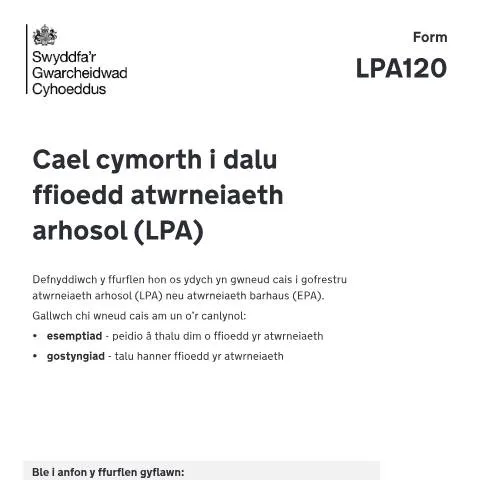
Setting up a Lasting Power of Attorney (LPA) or Enduring Power of Attorney (EPA) represents a crucial step in planning for future incapacity, yet the standard registration fee can create genuine hardship for those with limited means. The Office of the Public Guardian recognises this challenge and operates a comprehensive fee reduction scheme through form LPA120, which enables eligible donors to claim either a complete exemption or a 50% reduction on their attorney fees.
This application process operates entirely separately from the main power of attorney registration, requiring specific evidence and meeting strict criteria based on benefit entitlement or annual income thresholds. Understanding the nuances of this system can mean the difference between paying the full fee, securing substantial savings, or achieving complete exemption from charges altogether.
The Two-Track System: Exemption versus Reduction Pathways
The Office of the Public Guardian operates distinct pathways for fee assistance, each with fundamentally different qualifying criteria and evidence requirements. The exemption route targets those receiving means-tested benefits, while the reduction pathway focuses on income assessment for those not claiming such benefits.
Complete Fee Exemption Through Means-Tested Benefits
Donors receiving qualifying means-tested benefits may avoid paying any registration fee whatsoever, provided they haven't received personal injury compensation exceeding £16,000. This exemption applies regardless of the compensation amount if it was disregarded during the benefit assessment process.
The personal injury threshold encompasses awards resulting from criminal or medical negligence, creating a specific exclusion that many applicants overlook. Crucially, if someone received £20,000 compensation but this was disregarded for benefit calculation purposes, they retain exemption eligibility despite exceeding the £16,000 limit.
| Qualifying Benefit | Required Evidence |
|---|---|
| Guarantee Credit element of Pension Credit | Full breakdown showing guaranteed element with amounts and receipt dates |
| Income-based Employment and Support Allowance | Full breakdown showing income-related element with amounts and dates |
| Income-based Jobseeker's Allowance, Income Support, or Housing Benefit | Entitlement letter showing amounts and receipt dates |
| Council Tax Benefit | Entitlement letter (excluding 25% single person discount or medical exemptions) |
| Local Housing Allowance | Entitlement letter showing amounts and receipt dates |
| Working Tax Credit combined with Child Tax Credit, disability element, or severe disability element | Full breakdown showing combined credits |
50% Fee Reduction Through Income Assessment
Donors with annual gross income of £12,000 or less qualify for a 50% fee reduction, bringing the standard registration cost down to £46 per LPA or EPA. For subsequent LPA applications approved by the Office of the Public Guardian, this reduces further to just £23.
This income threshold applies to gross annual income before tax deductions, encompassing all revenue streams including employment, self-employment, pensions, benefits, investment returns, and rental income. The assessment covers the relevant financial year running from 1st April to 31st March.
Navigating the Evidence Requirements Maze
The Office of the Public Guardian maintains stringent evidence standards, requiring specific document types that many applicants struggle to provide correctly. Bank statements alone never suffice as standalone income proof, necessitating supporting documentation from benefit providers or payment sources.
Employment and Self-Employment Documentation
Current employees must provide their three most recent consecutive payslips, ensuring these reflect ongoing employment rather than sporadic or concluded work arrangements. Self-employed individuals face more complex requirements, needing either their most recent tax return or latest HMRC tax calculation.
This creates particular challenges for newly self-employed individuals who may lack recent tax documentation, potentially requiring them to wait until after their first Self Assessment submission before applying for fee reduction.
Pension and Benefit Income Verification
Pension income requires either a P60 certificate, official letter from the pension provider, or two consecutive payslips confirming gross amounts paid. This includes state pensions, private pensions, occupational schemes, and pension drawdown arrangements.
Non-means-tested benefits such as Attendance Allowance, Disability Living Allowance, and Personal Independence Payment require official letters or notices from the paying authority, demonstrating both entitlement and payment amounts.
Investment and Rental Income Complications
Investment income from savings, shares, stocks, or bonds demands bank statements, dividend vouchers, or tax certificates showing total pre-tax income. Property rental income requires copies of all tenancy agreements or leases showing current rent amounts and payment frequencies, alongside either recent tax returns or HMRC tax calculations.
Many applicants underestimate the complexity of proving rental income, particularly when managing multiple properties or dealing with informal arrangements that lack proper documentation.
Universal Credit: A Special Case Within the System
Universal Credit recipients occupy a unique position within the fee reduction framework, potentially qualifying for either complete exemption or 50% reduction depending on their specific circumstances and total annual income.
Those receiving Universal Credit with annual gross income not exceeding £12,000 may claim the 50% reduction, requiring twelve months of DWP statements or printed screens from the official gov.uk Universal Credit portal for each of the preceding twelve months.
This documentation requirement often proves challenging, as recipients must maintain consistent records over a full year period, with missing months potentially invalidating their entire application.
The Financial Year Timing Challenge
All evidence must correspond to the correct financial year, defined as the period between 1st April and 31st March. This timing requirement frequently catches applicants off-guard, particularly those applying early in a new financial year with outdated documentation.
Evidence must be submitted simultaneously with the power of attorney application to the Office of the Public Guardian, preventing applicants from addressing documentation gaps after initial submission. This coordination requirement demands careful planning, especially when gathering evidence from multiple sources with varying response times.
Cross-Year Application Complications
Applications submitted in April or May often encounter difficulties when the most recent financial year evidence isn't yet available from pension providers, employers, or HMRC. Applicants may need to delay their power of attorney registration until appropriate evidence becomes accessible.
Self-employed individuals face particular challenges when their Self Assessment deadline of 31st January falls after their desired LPA application date, potentially creating a gap in available evidence.
When Standard Routes Don't Apply: Hardship Considerations
The Office of the Public Guardian recognises that rigid qualifying criteria may not capture all genuine cases of financial difficulty. While the source document references hardship provisions, it acknowledges that donors who don't qualify for standard exemption or reduction may still face genuine financial hardship.
This suggests additional discretionary powers exist beyond the standard means-tested benefit exemptions and £12,000 income threshold reductions, though specific criteria and application processes for hardship cases require direct enquiry with the Office of the Public Guardian.
No Income Declarations
Donors with no income whatsoever must provide a signed statement explaining how they maintain themselves financially. This acknowledgement recognises that some individuals rely entirely on family support, savings depletion, or other non-traditional income sources that don't fit standard assessment categories.
Such declarations require careful consideration of ongoing sustainability and may prompt additional enquiries about the donor's overall financial circumstances and support arrangements.
Submission Process and Administrative Practicalities
Completed LPA120 forms must be posted to the Office of the Public Guardian at their Birmingham address (Post Box 16185, Birmingham, B2 2WH), with evidence submission timing proving critical to successful processing.
The requirement for simultaneous submission of both the power of attorney application and fee reduction evidence creates logistical challenges, particularly when coordinating multiple document sources or dealing with time-sensitive evidence that may expire or become outdated.
Evidence Quality and Completeness Standards
All evidence must include the donor's title, full name, last known address, and postcode, ensuring clear identification and preventing processing delays. Incomplete or partially redacted documents frequently result in application rejection, requiring complete resubmission with associated delays.
The Office of the Public Guardian maintains strict standards regarding document authenticity and completeness, with photocopies requiring sufficient clarity to verify all relevant details and official stamps or logos where applicable.
Strategic Timing and Planning Considerations
Successful fee reduction applications require strategic planning that extends beyond simple form completion. The interplay between financial year timing, evidence availability, and power of attorney registration deadlines demands careful coordination to avoid unnecessary delays or additional costs.
Applicants should begin gathering evidence well in advance of their intended submission date, allowing time to address any documentation gaps or clarify requirements with relevant benefit providers or employers. The annual nature of much required evidence means that timing can significantly impact both eligibility and application success.
The Office of the Public Guardian's fee reduction scheme represents a valuable but complex system requiring detailed attention to qualifying criteria, evidence standards, and submission procedures. While the potential savings are substantial—ranging from 50% reduction to complete exemption—the administrative requirements demand careful preparation and precise compliance with established procedures.
Fee Remission vs Fee Exemption: Understanding the Key Differences
When applying for reduced costs on your lasting power of attorney, it's crucial to understand that the Office of the Public Guardian operates two distinct schemes: fee remission and fee exemption. These terms are often confused, but they serve different purposes and have separate eligibility criteria that can significantly impact your application strategy.
Fee remission applies when your gross annual income falls between £12,000 and £23,000. Under this scheme, you'll pay a reduced fee of £82 instead of the standard £82 application fee plus the additional charges. The remission is calculated on a sliding scale - those earning closer to £12,000 receive greater reductions than those approaching the £23,000 threshold. Importantly, this assessment looks at your income for the 12 months preceding your application, not the current tax year.
Fee exemption, conversely, is available if your gross annual income is £12,000 or below, or if you receive specific means-tested benefits. Qualifying benefits include Universal Credit, Income Support, income-based Jobseeker's Allowance, income-related Employment and Support Allowance, Pension Credit (Guarantee Credit), or Housing Benefit. The exemption provides complete waiver of the application fee, representing substantial savings of up to £164 for joint applications.
A critical distinction lies in how these schemes treat different types of income. For fee remission calculations, the OPG includes employment income, self-employment profits, pension payments, investment returns, and rental income. However, certain disability benefits like Personal Independence Payment (PIP) or Disability Living Allowance are typically excluded from income calculations, though you must declare them on your application.
The evidence requirements also differ significantly between schemes. Fee exemption applicants receiving qualifying benefits need only provide recent benefit award letters or screenshots from their Universal Credit account. Fee remission applicants face more complex documentation requirements, potentially needing P60 certificates, self-assessment tax calculations, pension statements, and bank statements showing investment income.
Fill in your form directly online
No printing: type your details into the boxes of the official form, tick, then download the PDF ready to send.
- 1Type into the form boxes
- 2Tick in one click
- 3Save and download the PDF
Timing considerations can influence which scheme applies to your circumstances. If your income fluctuated during the assessment period due to job changes, illness, or retirement, you may need to provide additional context. The OPG typically accepts reasonable explanations for income variations, particularly where circumstances have permanently changed since the assessment period.
Special Circumstances and Complex Financial Situations
Certain financial circumstances require careful navigation when applying for reduced fees, as standard income calculations may not accurately reflect your ability to pay the full LPA charges. Understanding how the Office of the Public Guardian handles these complex situations can prevent application delays and ensure you receive appropriate fee adjustments.
Self-employed applicants face particular challenges in demonstrating their income for fee assessment purposes. Unlike employees who receive straightforward P60 certificates, self-employed individuals must provide their most recent self-assessment tax calculation (SA302) alongside their tax year overview. If you've recently started self-employment or experienced significant business changes, the OPG may request additional documentation such as profit and loss statements or accountant's letters explaining income variations.
Couples and civil partners must navigate joint income assessments carefully. The OPG assesses household income when determining eligibility, meaning both partners' earnings count towards the thresholds regardless of who's applying for the LPA. However, if you're separated but not divorced, or if your partner has moved into residential care, special rules may apply. You'll need to provide evidence of your changed circumstances, such as separation agreements or care home admission letters.
Pension income presents another complexity, particularly for those receiving multiple pension sources. State pension, occupational pensions, and private pension drawdowns all count towards your income assessment. However, pension contributions you make during the assessment period aren't deducted from your gross income calculation. If you've recently retired and your pension income differs significantly from your previous employment earnings, include explanatory documentation with your application.
Property ownership can impact your application in unexpected ways. While the OPG doesn't typically assess property values for fee reduction purposes, rental income from investment properties must be declared in full. If you own your home but rent out rooms under the government's Rent a Room scheme, income up to £7,500 annually may be tax-free but should still be declared on your LPA application as it counts towards the income thresholds.
Inheritance and one-off payments received during the assessment period can complicate income calculations. Large one-time receipts like inheritance, redundancy payments, or insurance payouts may push your annual income above the threshold despite not reflecting your ongoing financial capacity. The OPG sometimes exercises discretion in such cases, particularly where you can demonstrate these were exceptional circumstances rather than regular income.
Investment income requires careful documentation, especially if you hold ISAs, premium bonds, or dividend-paying shares. While ISA interest is tax-free, it still counts towards OPG income thresholds. Dividend income must be declared at its gross amount before any tax credits. If your investments generated significant gains during the assessment period but you've since moved funds to lower-yielding accounts due to changed circumstances, provide evidence of your current financial position.
Application Processing, Review Procedures, and Administrative Safeguards
The Office of the Public Guardian operates robust administrative procedures for processing reduced fee applications, designed to ensure fair assessment while maintaining appropriate oversight of public funds. Understanding these processes can help you navigate potential challenges and respond effectively if additional information is requested.
Initial application screening occurs within five working days of receipt. OPG administrators conduct preliminary checks to ensure all required sections are completed and necessary supporting documents are included. Applications with missing information are typically returned with specific guidance on what additional evidence is needed, rather than being rejected outright. This screening process aims to identify potential issues early, reducing overall processing times.
Income verification procedures vary depending on the complexity of your financial circumstances. Straightforward applications with standard employment income and clear benefit entitlements often progress quickly through automated checking systems. However, applications involving self-employment, multiple income sources, or recent changes in circumstances trigger manual review processes that can extend processing times to several weeks.
The OPG maintains strict confidentiality protocols throughout the assessment process. Your financial information is handled according to Data Protection Act 2018 requirements, with access restricted to authorised personnel directly involved in processing your application. If you're applying for an LPA for someone else and claiming reduced fees based on their financial circumstances, additional consent procedures may apply to ensure compliance with data protection regulations.
Quality assurance measures include random sampling of approved applications for secondary review, ensuring consistent application of fee reduction criteria across all cases. This process occasionally identifies errors in initial assessments, leading to retrospective adjustments. If you receive an unexpected request for additional information weeks after submitting your application, it may result from this quality assurance process rather than indicating problems with your original submission.
Appeals and reconsideration procedures provide safeguards if you believe your application has been incorrectly assessed. You have 28 days from the date of any adverse decision to request a review, providing additional evidence or clarification of your circumstances. The appeals process involves senior OPG staff who weren't involved in the original decision, ensuring independent assessment of your case.
Documentation retention requirements mean the OPG keeps records of your fee reduction application for several years after your LPA is registered. This enables retrospective queries if issues arise later, but also means you should maintain copies of all submitted documents for your own records. If your financial circumstances change significantly after registration, you cannot retrospectively apply for fee reductions, making it important to ensure your initial application accurately reflects your situation.
Electronic submission systems are increasingly used for supporting documentation, though original paper documents may still be required in some circumstances. The OPG's digital systems can process standard formats like PDF bank statements or screenshots of benefit entitlements, but unusual document formats may require postal submission. Always check current submission requirements on the gov.uk website, as digital capabilities continue to expand.
Processing delays can occur during peak periods, particularly in the months leading up to the end of the tax year when many people submit LPA applications. If your application is time-sensitive due to the donor's deteriorating capacity, you can request expedited processing by providing medical evidence of urgency. However, such requests are granted only in exceptional circumstances where delay would cause significant detriment.