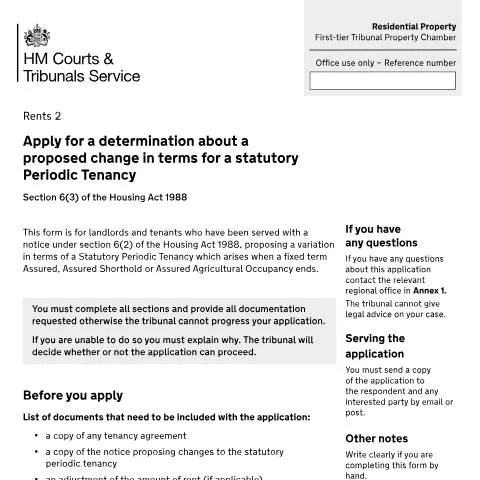
Understanding Statutory Periodic Tenancies and the Need for Formal Variation
When a fixed-term assured tenancy expires without renewal, it automatically transforms into what housing law terms a statutory periodic tenancy under the Housing Act 1988. This continuation arrangement preserves the tenant's occupancy rights whilst maintaining the landlord's property interests, but it also creates a unique legal framework where any changes to tenancy terms require formal judicial oversight.
Form Rents 2 emerges from this specific legal context, addressing situations where either landlords or tenants seek to modify the terms of these automatically-created periodic arrangements. Unlike standard tenancy variations that parties might negotiate privately, statutory periodic tenancies fall under enhanced legal protection, requiring First-tier Tribunal determination for any proposed changes beyond routine rent adjustments.
The distinction proves crucial in practice. A landlord managing a portfolio of mixed tenancy types might assume standard variation procedures apply universally, only to discover that their expired fixed-term assured tenancy now requires tribunal intervention for seemingly straightforward amendments like pet clauses or garden maintenance responsibilities. Similarly, tenants receiving variation notices may not realise they possess formal challenge rights through the tribunal system.
The Section 6(2) Notice Trigger: When Applications Become Necessary
Form Rents 2 applications invariably follow the service of a section 6(2) notice under the Housing Act 1988. This preliminary notice represents the landlord's formal proposal to vary tenancy terms, serving as both notification and the starting point for potential dispute resolution. Understanding this sequence proves essential for both parties navigating the process effectively.
The section 6(2) notice must specify the proposed changes with sufficient detail to enable informed decision-making. Vague proposals like "modernising tenancy conditions" lack the precision required for valid service. Instead, landlords must articulate specific modifications such as:
- Introducing or removing pet keeping restrictions with defined parameters
- Altering garden or communal area maintenance obligations
- Modifying subletting or assignment provisions
- Adjusting repair and decoration responsibilities between parties
- Implementing new restrictions on property use or business activities
Tenants receiving such notices face a critical decision window. Acceptance renders the changes binding without tribunal involvement, whilst objection necessitates formal application through Form Rents 2. The timing proves particularly significant, as delayed responses may affect the tribunal's willingness to consider applications or influence the effective date of any determinations.
Complex Scenarios Requiring Careful Analysis
Certain situations demand nuanced understanding of when Form Rents 2 becomes appropriate. Joint tenancies present particular complexity, especially where one tenant accepts proposed changes whilst another objects. The tribunal must then determine whether partial acceptance affects the entire tenancy or creates separate obligations for different parties.
Agricultural occupancies transitioning to statutory periodic status introduce additional variables, particularly where tied accommodation arrangements influence proposed variations. Former farm workers may find landlords seeking to remove historical concessions like free utilities or maintenance services, requiring careful evaluation of whether such changes reflect genuine modernisation or inappropriate advantage-taking.
Navigating the Application Process: Beyond Basic Form Completion
Successful Form Rents 2 applications require strategic preparation extending well beyond completing the standard fields. The tribunal's emphasis on comprehensive documentation reflects the complex legal and factual determinations involved in assessing proposed tenancy variations.
Section 3.2 demands detailed explanation of proposed changes, but effective applications go further by contextualising these modifications within the broader tenancy relationship. Rather than simply restating the section 6(2) notice content, applicants should explain the practical implications, potential conflicts with existing arrangements, and specific concerns motivating their application.
| Application Element | Minimum Requirement | Strategic Enhancement |
|---|---|---|
| Proposed changes description | Copy section 6(2) notice content | Explain practical implications and specific concerns |
| Tenancy agreement copy | Most recent fixed-term agreement | Include any subsequent written variations or agreements |
| Supporting evidence | Basic documentation only | Photographic evidence, correspondence history, expert reports |
| Property details | Standard accommodation description | Detailed condition reports, improvement records, local comparisons |
The property details sections (4-6) often receive insufficient attention from applicants focused on the legal arguments. However, tribunal decisions frequently turn on practical considerations like whether proposed garden maintenance obligations suit the property's actual outdoor space, or whether service charge modifications reflect genuine cost changes versus profit enhancement.
Documentary Evidence Strategy
Beyond the mandatory attachments, successful applications typically include supplementary evidence addressing the reasonableness of proposed changes. Tenants challenging rent-related modifications might provide local market rent surveys, whilst landlords seeking maintenance obligation transfers could submit professional assessments of property condition and required upkeep standards.
Photographic evidence proves particularly valuable for applications involving physical property modifications or condition disputes. Time-stamped images showing garden conditions, interior wear patterns, or improvement installations can significantly influence tribunal assessments of whether proposed changes reflect genuine property management needs.
Rent Adjustment Complexities: When Section 4 Becomes Critical
Applications involving rent adjustments trigger additional Form Rents 2 requirements, transforming straightforward variation requests into comprehensive property valuations. The tribunal's rent determination powers under section 6(3) extend beyond simple approval or rejection, encompassing detailed assessment of appropriate rent levels for modified tenancy arrangements.
The accommodation details required in sections 4-6 assume heightened importance when rent adjustments accompany tenancy variations. Landlords proposing increased pet deposits alongside pet-keeping permissions must demonstrate how additional wear and cleaning requirements justify specific monetary amounts. Similarly, tenants challenging service charge modifications need detailed understanding of what services actually merit separate charging.
Shared accommodation scenarios present particular complexity for rent-adjustment applications. Where proposed changes affect only part of shared facilities—such as restricting one tenant's garden access whilst maintaining another's—the tribunal must determine appropriate rent apportionment reflecting the modified usage rights.
Service Charge Transparency Requirements
Section 6 demands comprehensive service charge disclosure, but applications involving service modifications require additional strategic consideration. Landlords seeking to introduce new charges must demonstrate both necessity and reasonableness, whilst tenants challenging existing arrangements should prepare evidence of comparable properties and standard market practices.
Variable service charges present ongoing complications extending beyond initial tribunal determination. Applications should address how future variations will be calculated and communicated, particularly for services like heating or maintenance where costs fluctuate seasonally or with property condition changes.
Respondent Obligations and Strategic Response Planning
Form Rents 2 applications create formal legal proceedings requiring careful respondent engagement. The mandatory service requirements ensure all parties receive adequate notice, but effective response strategies extend considerably beyond acknowledging receipt of tribunal communications.
Respondents must evaluate whether to engage representative assistance, particularly for complex applications involving multiple tenancy modifications or significant rent adjustments. Whilst the tribunal process aims for accessibility, housing law technicalities and evidence requirements often exceed typical individual expertise levels.
Counter-applications represent a frequently overlooked strategic option for respondents. Where landlords propose modifications that tenants consider insufficient or misdirected, comprehensive counter-proposals through the same tribunal proceedings can achieve more satisfactory outcomes than simple opposition to original applications.
Joint Tenancy Response Coordination
Joint tenants receiving Form Rents 2 applications face coordination challenges that can significantly affect outcomes. Where co-tenants hold different views about proposed changes, early discussion and potential compromise prove essential for presenting coherent tribunal responses.
The tribunal's tendency to seek practical solutions may favour joint tenants who demonstrate collaborative problem-solving over those presenting conflicting positions without attempted resolution. Coordinated responses addressing individual concerns within unified positions typically receive more favourable consideration than fragmented opposition strategies.
Tribunal Determination Process and Outcome Implementation
First-tier Tribunal Property Chamber determinations on Form Rents 2 applications follow established procedures balancing legal technicality with practical housing management needs. Understanding this process helps applicants and respondents prepare effectively for hearings and implement eventual decisions appropriately.
The tribunal's jurisdiction extends beyond simple approval or rejection of proposed changes. Determinations may modify proposed terms, adjust implementation timescales, or require additional arrangements not originally contemplated by either party. This flexibility reflects the tribunal's role in achieving fair outcomes rather than mechanically applying rigid legal rules.
Rent determinations accompanying tenancy variations often prove particularly complex, requiring tribunal assessment of how proposed changes affect property value and tenant obligations. Modified pet policies, garden responsibilities, or service arrangements can significantly impact appropriate rent levels, necessitating careful evaluation of comparable properties and market conditions.
Implementation Timeline Considerations
Tribunal determinations specify effective dates for approved changes, but practical implementation often requires additional coordination between parties. Rent adjustments may require revised payment arrangements, whilst new tenancy obligations might need phased introduction to allow tenant adaptation.
Appeals against tribunal determinations remain possible through the Upper Tribunal, but strict time limits and grounds restrictions require immediate legal assessment following unfavourable decisions. Parties considering appeals should evaluate prospects carefully, as unsuccessful challenges may result in additional costs and delayed implementation of tribunal decisions.
Regional Variations and Administrative Practicalities
Form Rents 2 applications process through regional First-tier Tribunal offices with varying administrative practices and processing timescales. Understanding these regional differences helps applicants manage expectations and maintain appropriate case progress monitoring.
The DX service availability varies between tribunal regions, affecting communication preferences for legal representatives. Firms handling multiple applications across different regions must adapt their correspondence systems to accommodate these variations whilst maintaining consistent client service standards.
Electronic submission capabilities continue expanding across tribunal regions, but paper applications remain necessary in certain areas or for parties lacking digital access. Mixed submission requirements within single applications—particularly where multiple parties use different communication preferences—require careful coordination to ensure consistent tribunal processing.
Processing timescales reflect regional caseload variations and complexity levels, with straightforward rent-only applications typically resolving faster than comprehensive tenancy restructuring cases. Applicants should factor these timing variations into broader property management planning, particularly where multiple properties require similar variations.
Understanding the Legal Framework Behind Rent Determination Applications
The rent determination process under Form Rents 2 operates within a complex legal framework that has evolved significantly since the Housing Act 1988. Understanding this framework is crucial for both landlords and tenants navigating the system effectively.
The statutory periodic tenancy regime was established to provide security of tenure whilst allowing fair rent adjustments. When an assured shorthold tenancy reaches its fixed term without renewal, it automatically becomes a statutory periodic tenancy under Section 5 of the Housing Act 1988. This transition doesn't require any formal documentation, but it fundamentally changes the rent review mechanism available to landlords.
Under Section 13 of the Housing Act 1988, landlords can propose rent increases for statutory periodic tenancies, but they must follow strict procedural requirements. The proposed increase must be served using Form 4 (Notice of Increase of Rent), and tenants have the right to refer this notice to the First-tier Tribunal (Property Chamber) using Form Rents 2 if they believe the proposed rent is unreasonable.
The tribunal's role is not merely to rubber-stamp or reject rent increases, but to determine what rent the dwelling might reasonably be expected to achieve in the open market. This assessment considers the property as it stands at the date of the determination, assuming it's let on the same terms as the existing tenancy, but disregarding any improvement made by the tenant and any disrepair attributable to the tenant's failure to comply with their obligations.
Crucially, the tribunal must also consider whether the existing rent is significantly below market rate. If the current rent is already at or near market value, even a landlord's proposed increase might be deemed unreasonable. Conversely, if the current rent is substantially below market rate, the tribunal might determine a rent higher than what the landlord originally proposed, though this is relatively uncommon in practice.
The legal test applied by tribunals focuses on comparable properties in the locality, considering factors such as property type, size, condition, amenities, and local market conditions. However, tribunals are not bound to follow estate agents' valuations or asking prices for similar properties, as these may not reflect actual achievable rents.
One often overlooked aspect is the interaction between rent determination and housing benefit or Universal Credit. If a tenant receives housing support, the tribunal's determination becomes the basis for calculating their entitlement, which can have significant implications for both parties. The tribunal cannot consider a tenant's ability to pay when making their determination, focusing purely on market value.
Strategic Considerations and Common Pitfalls in the Application Process
Successfully navigating the Form Rents 2 process requires careful strategic planning and awareness of common pitfalls that can undermine an application's effectiveness. Many applicants, whether experienced landlords or first-time tenants, make critical errors that could easily be avoided with proper preparation.
Fill in your form directly online
No printing: type your details into the boxes of the official form, tick, then download the PDF ready to send.
- 1Type into the form boxes
- 2Tick in one click
- 3Save and download the PDF
Timing represents one of the most crucial strategic elements. Tenants must submit their Form Rents 2 application within the statutory timeframe, but the optimal timing within that window can significantly impact the outcome. Submitting too early, immediately after receiving the Section 13 notice, might not allow sufficient time to gather comprehensive evidence. Conversely, waiting until the last possible moment can create unnecessary pressure and risk missing the deadline entirely.
The quality and relevance of comparable evidence often determines the tribunal's decision. Many applicants make the mistake of relying solely on online property portals, which may show asking prices rather than achieved rents, or properties that aren't truly comparable. Effective evidence gathering requires understanding the local rental market intimately, including seasonal variations, property-specific factors, and recent market movements.
Professional valuations can strengthen an application significantly, but they must be current and specifically prepared for tribunal proceedings. Generic valuations prepared for other purposes, such as mortgage applications or insurance, typically carry less weight. When commissioning professional valuations, ensure the valuer understands they may need to attend the tribunal hearing to defend their assessment.
Photographic evidence serves multiple purposes beyond simply documenting the property's condition. Systematic photography should capture not just obvious defects or improvements, but also contextual factors such as parking arrangements, garden maintenance, local amenities, and any factors that might affect rental value. Date-stamped photographs are essential, and consider including newspapers or other dated materials in shots to verify timing.
Many applicants underestimate the importance of properly documenting their tenancy history and rent payment record. This information helps establish the baseline for comparison and can highlight any patterns in rent increases or property maintenance that might influence the tribunal's decision. Keep detailed records of all communications with the landlord, particularly regarding repairs, improvements, or previous rent discussions.
Understanding the landlord's perspective can inform strategic decisions about the application. Consider why the landlord proposed the specific increase amount – is it to bring the rent in line with market rates, to cover increased costs, or simply because they believe the market will bear it? This analysis can help identify the strongest arguments for your position.
The interaction between Form Rents 2 applications and other ongoing disputes requires careful consideration. If there are existing disputes about repairs, service charges, or other tenancy matters, these might influence the tribunal's assessment of appropriate rent levels. However, be cautious about raising multiple issues simultaneously, as this can complicate proceedings and potentially weaken your primary argument.
Consider the potential consequences of different outcomes before proceeding. If the tribunal determines a rent higher than the landlord's original proposal, you'll be liable for that higher amount. While this outcome is uncommon, it's not impossible, particularly in rapidly rising markets or where the current rent is significantly below market value.
Navigating Complex Scenarios and Special Circumstances
Certain situations require specialized approaches when completing Form Rents 2, and understanding these nuances can be critical to achieving a successful outcome. These complex scenarios often involve multiple overlapping legal considerations that standard guidance doesn't adequately address.
Joint tenancies present particular challenges in rent determination applications. When multiple tenants hold a joint statutory periodic tenancy, any one tenant can refer a Section 13 notice to the tribunal using Form Rents 2. However, the determination will bind all joint tenants, regardless of whether they supported the application. This dynamic can create tensions between joint tenants, particularly if some believe the proposed rent is reasonable while others wish to challenge it.
Properties with mixed residential and commercial use require careful consideration of how the tribunal should assess appropriate rent levels. If part of the property is used for business purposes under the tenancy agreement, this can significantly affect the rental value assessment. The tribunal must consider the property's potential rental value for the specific use permitted under the tenancy, not its theoretical value for alternative uses.
Rent determination applications involving social housing providers or registered providers of social housing operate under additional regulatory constraints. These landlords must comply with rent standard requirements set by the Regulator of Social Housing, which can limit their ability to increase rents beyond prescribed formulas. However, if a property has transitioned from social rent to affordable rent or market rent, different rules may apply.
Properties subject to selective licensing schemes under the Housing Act 2004 present unique considerations. Local authorities can impose additional obligations on landlords through licensing conditions, which might affect the property's rental value. Conversely, unlicensed properties in areas requiring licenses might command lower rents due to legal uncertainties, though tribunals cannot consider illegal activities when determining appropriate rents.
Rent determination becomes particularly complex when properties have been significantly altered or improved since the tenancy began. The Housing Act 1988 requires tribunals to disregard improvements made by tenants, but determining what constitutes a tenant improvement versus normal maintenance can be contentious. Similarly, landlord improvements should increase rental value, but only if they genuinely enhance the property's market appeal.
Properties in areas undergoing regeneration or significant development present valuation challenges due to rapidly changing market conditions. The tribunal must assess current market rental values, but in transitional areas, recent comparable transactions might not reflect future market conditions. In such cases, professional valuations become particularly important, and valuers should address market trends and development impacts explicitly.
Rent determinations involving properties with unusual features or limitations require specialized comparable evidence. Properties with restricted access, unusual layouts, or specific use limitations might not have obvious comparables in the local market. In these cases, consider seeking comparable evidence from similar properties in comparable areas, adjusting for local market differences.
Applications involving rent increases that exceed certain thresholds may trigger additional scrutiny. While there's no statutory limit on rent increases for statutory periodic tenancies, tribunals may examine unusually large proposed increases more carefully, particularly if they suggest the current rent was previously set at an unrealistic level.
International tenants or landlords face additional complications, particularly regarding service of notices and tribunal communications. Ensure all parties can receive correspondence reliably, and consider whether language barriers might affect participation in proceedings. The tribunal has discretion to make arrangements for non-English speakers, but this should be requested in advance.
Finally, rent determination applications during periods of significant market disruption – such as economic uncertainty or major local events – require careful consideration of what constitutes normal market conditions. Tribunals typically focus on current market conditions rather than historical or projected values, but exceptional circumstances might warrant special consideration of market volatility and its impact on rental valuations.