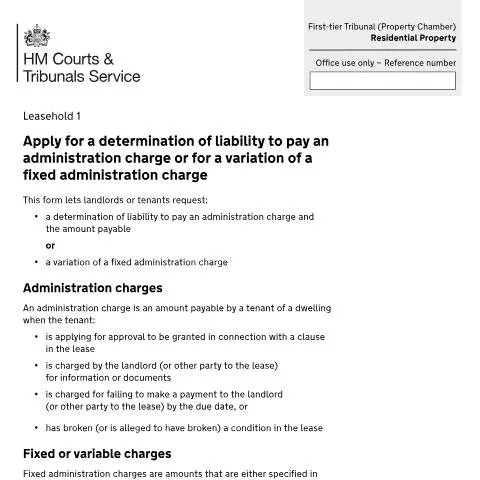
When Leasehold Administration Charges Become Contentious
The relationship between leaseholders and landlords in England and Wales frequently becomes strained over administration charges – those additional fees that appear on quarterly demands for everything from lease variations to breach notices. Unlike service charges that cover building maintenance, administration charges relate specifically to administrative tasks, approvals, or penalties arising from lease obligations. When disputes emerge over whether these charges are justified or reasonable, the First-tier Tribunal (Property Chamber) provides a formal resolution mechanism through Form Leasehold 1.
This tribunal application serves dual purposes: determining liability for administration charges and varying fixed charges written into lease agreements. The distinction matters significantly, as tribunals can only vary fixed charges but can determine liability for both fixed and variable charges. Understanding this fundamental difference shapes the entire approach to challenging administration charges through official channels.
The Legal Framework Behind Administration Charge Challenges
Form Leasehold 1 operates under the Commonhold and Leasehold Reform Act 2002, specifically Schedule 11, which revolutionised how administration charges could be challenged. Prior to this legislation, leaseholders had limited recourse against unreasonable administrative fees imposed by landlords or managing agents.
The Act distinguishes between two categories of administration charges:
- Fixed administration charges: Amounts specified directly in the lease or calculated using a formula written into the lease terms
- Variable administration charges: Fees not predetermined by the lease but varying according to actual costs incurred
This categorisation determines the tribunal's powers. Under paragraph 5 of Schedule 11, tribunals can determine liability and amounts for any administration charge. However, under paragraph 3, they can only vary fixed charges where the specified amount or calculation formula appears unreasonable.
The legislation also introduced Section 20C applications under the Landlord and Tenant Act 1985, allowing tenants to prevent landlords from recovering tribunal proceeding costs through service charges. Similarly, paragraph 5A applications under the 2002 Act can limit liability for administration charges relating to litigation costs.
Scenarios Triggering Administration Charge Disputes
Administration charges typically arise in four specific circumstances outlined by the legislation:
| Trigger Event | Typical Examples | Common Disputes |
|---|---|---|
| Approval applications | Subletting consent, alterations, pet permissions | Excessive fees for routine approvals |
| Information requests | Lease copies, service charge certificates, management packs | Disproportionate charges for standard documents |
| Late payment penalties | Ground rent arrears, service charge delays | Unreasonable penalty amounts or compound interest |
| Breach allegations | Lease covenant violations, unauthorised works | Charges imposed without proper breach procedures |
Each scenario requires different evidential approaches. Approval-related charges often centre on proportionality – whether a £200 fee for subletting consent reflects reasonable administrative costs. Information charges typically involve disputes over statutory entitlements versus chargeable services. Late payment penalties frequently exceed reasonable compensation for administrative inconvenience, whilst breach-related charges may lack proper procedural foundations.
Navigating the Application Process: From Preparation to Submission
Before completing Form Leasehold 1, applicants must gather mandatory documentation. The tribunal requires a copy of the lease (or sample lease for multiple similar properties) and copies of any administration charge demands. Without these documents, applications cannot progress, though tribunals may accept explanations for unavailable documentation in exceptional circumstances.
The form's structure reflects the complexity of administration charge law. Section 1 requires applicants to specify whether they're seeking liability determination or fixed charge variation – a critical choice affecting the tribunal's jurisdiction and potential remedies. This decision should align with the lease provisions and the nature of disputed charges.
Multiple applicants frequently join forces, particularly in blocks with identical lease terms. The form accommodates this through provisions for additional applicant details, requiring signed consent documents or emails from each participant. This collective approach often strengthens cases whilst sharing tribunal fees and legal costs.
Representative Appointments and Professional Support
Form Leasehold 1 includes comprehensive sections for professional representatives. Many applicants engage chartered surveyors specialising in leasehold disputes, particularly for complex service charge elements, or solicitors for procedural and legal arguments. The form captures DX numbers for legal representatives, reflecting traditional legal communication methods still prevalent in tribunal proceedings.
Professional representation isn't mandatory, but the technical nature of lease interpretation and tribunal procedures often justifies the investment. Representatives must provide detailed contact information, as tribunals communicate primarily through nominated representatives once appointed.
Strategic Considerations for Section 20C and Paragraph 5A Applications
Form Leasehold 1 integrates applications to limit landlords' cost recovery, recognising that tribunal proceedings themselves can generate additional charges for leaseholders. The Section 20C application prevents landlords from including their tribunal costs in future service charges, whilst paragraph 5A applications address administration charges for litigation costs.
These ancillary applications require strategic consideration. Section 20C applications are virtually automatic for tenant applicants, as refusing would allow landlords to recover costs regardless of tribunal outcomes. However, paragraph 5A applications depend on specific lease clauses permitting administration charges for legal costs – not all leases contain such provisions.
The form allows additional tenants to join these cost-limiting applications without participating in the main administration charge dispute. This flexibility enables building-wide protection against cost recovery whilst limiting exposure to primary dispute risks.
Tribunal Processing and Case Management Procedures
Once submitted, applications receive reference numbers from the relevant regional office listed in Annex 1. The First-tier Tribunal (Property Chamber) operates through regional centres, with jurisdiction determined by property location rather than applicant residence.
Initial processing involves administrative compliance checks. Incomplete applications or missing documentation trigger requests for additional information, potentially delaying proceedings by several weeks. The tribunal cannot provide legal advice but will clarify procedural requirements and documentation expectations.
Successful applications enter the case management phase, where tribunals issue directions covering:
- Evidence exchange timetables
- Expert witness requirements
- Hearing arrangements (in-person, video, or paper-only)
- Site inspection provisions
Case management reflects the tribunal's inquisitorial approach, actively managing proceedings rather than relying on adversarial party control. This includes power to order disclosure of documents, expert evidence, and witness attendance.
Service Requirements and Respondent Notification
Applicants must serve copies of Form Leasehold 1 on all respondents and interested parties. Service can occur by email or post, but proof of service becomes crucial if respondents fail to engage. The tribunal may proceed with undefended cases but requires evidence of proper notification.
Identifying correct respondents sometimes proves complex. While landlords are obvious respondents for most administration charges, managing agents may be appropriate respondents where they've issued demands under management agreements. Superior landlords might be necessary parties in complex lease structures.
Potential Outcomes and Enforcement Mechanisms
Tribunal determinations carry significant legal weight, binding all parties subject to appeal rights. For liability determinations, tribunals can find charges wholly or partially payable, unreasonable, or invalid. They may reduce amounts to reasonable levels or eliminate liability entirely where proper procedures weren't followed.
For fixed charge variations, tribunals can substitute reasonable amounts or formulae for unreasonable lease provisions. These variations affect future similar charges, not just the disputed amount, making successful applications particularly valuable for ongoing landlord-tenant relationships.
Enforcement of tribunal decisions occurs through county court proceedings if parties don't comply voluntarily. Successful applicants may recover their tribunal fees through the costs provisions, though legal costs recovery remains limited in most residential property cases.
The tribunal's powers extend beyond individual case resolution. Determinations create precedents for similar properties and lease structures, influencing future administration charge practices. Regular tribunal decisions have established benchmarks for reasonable charges across various administrative functions, providing guidance for both landlords and tenants in avoiding future disputes.
Understanding the Legal Framework Behind Form Leasehold 1
Form Leasehold 1 operates within a complex legal framework established primarily by the Commonhold and Leasehold Reform Act 2002 and subsequent amendments through the Housing and Planning Act 2016. This legislation specifically addresses the growing concerns about excessive administration charges imposed by freeholders and managing agents on leaseholders across England and Wales.
The statutory definition of an administration charge encompasses any fee payable by a leaseholder that isn't service charge or ground rent. This includes charges for consent applications (such as subletting or alterations), deed of covenant fees, notice serving charges, and breach of lease administration costs. However, the law distinguishes between variable administration charges—which require reasonableness determinations—and fixed charges specified in the lease terms.
Under Section 158 of the 2002 Act, administration charges are only payable if they're reasonable in amount and have been reasonably incurred. This creates a dual test that tribunals must apply when considering Form Leasehold 1 applications. The reasonableness assessment considers factors including the administrative work actually required, market rates for similar services, and whether the charge represents genuine cost recovery rather than profit generation.
Significantly, the Schedule 11 provisions establish that certain administration charges cannot exceed prescribed amounts. For instance, charges related to providing information required under the Leasehold Reform Act 1967 are capped, though these caps don't apply to all administration charge categories. The legislation also requires that demand notices for administration charges must be in prescribed form and include specific information about leaseholder rights, including the right to apply to the tribunal.
The tribunal's jurisdiction extends beyond simple reasonableness determinations. They can consider whether administration charges were properly demanded, whether required statutory notices were served, and whether the charging party has complied with consultation requirements where applicable. This comprehensive jurisdiction means Form Leasehold 1 applications often encompass multiple legal issues beyond the charge amount itself.
Recent case law has established important precedents affecting Form Leasehold 1 determinations. The Avon Ground Rents Ltd v Child decision clarified that administration charges must reflect actual administrative costs, not arbitrary amounts. Similarly, Fairhold Mercury Ltd v Mehta established that repetitive or template administrative work should command lower fees than bespoke professional services requiring individual attention.
Strategic Considerations for Different Leaseholder Profiles
The approach to Form Leasehold 1 applications varies significantly depending on your specific circumstances as a leaseholder. Individual residential leaseholders typically face different challenges compared to commercial leaseholders or those involved in collective enfranchisement processes, requiring tailored strategies for each scenario.
For first-time leaseholder applicants, the most common administration charges involve consent fees for subletting, pet keeping, or minor alterations. These charges often range from £50 to £500, though some managing agents attempt to impose fees exceeding £1,000 for straightforward consents. When challenging these through Form Leasehold 1, focus on demonstrating the minimal administrative work actually required—typically reviewing documents, updating records, and issuing consent letters. Comparable charges by other managing agents in your area provide valuable evidence for reasonableness assessments.
Commercial leaseholders encounter more complex administration charge scenarios, particularly regarding assignment consents, deed of covenant arrangements, and compliance monitoring. The commercial context doesn't automatically justify higher administration charges, but tribunals may accept that commercial transactions require more sophisticated legal and administrative input. However, charges exceeding £2,000 for standard commercial consents often face successful challenges, particularly where the managing agent uses template processes rather than bespoke professional services.
Leaseholders involved in collective enfranchisement or right to manage processes frequently encounter substantial administration charges for information provision, document preparation, and legal compliance. These charges can reach thousands of pounds, making Form Leasehold 1 applications particularly valuable. The key strategic consideration involves timing—applying before completing the enfranchisement process ensures you're not liable for unreasonable charges that could significantly impact the transaction's financial viability.
Multiple property leaseholders or those with portfolio interests should consider coordinating Form Leasehold 1 applications where the same managing agent or freeholder imposes similar unreasonable charges across different properties. While each application must be property-specific, consistent patterns of excessive charging strengthen individual cases and may lead to broader charge policy changes.
For leaseholders in financial difficulty, the tribunal has discretion to order cost protection or limit liability for the other party's costs in unsuccessful applications. However, this protection isn't automatic and requires specific application with supporting evidence of financial hardship. The potential cost implications make careful case assessment essential before proceeding with Form Leasehold 1 applications in marginal cases.
Leasehold houses present unique considerations, as administration charges often relate to estate management functions, shared facilities, or restrictive covenant compliance. These scenarios may involve charges for services benefiting multiple properties, requiring careful analysis of how costs are apportioned and whether the administration charge represents reasonable cost recovery for services actually provided to your specific property.
Leaseholders considering lease extension or freehold purchase should be particularly vigilant about administration charges related to these processes. Freeholders sometimes impose substantial charges for valuation access, legal document preparation, or transaction administration that may be challengeable through Form Leasehold 1. However, timing is crucial—challenging charges before completing statutory processes ensures you maintain negotiating leverage throughout the transaction.
Navigating Complex Multi-Party Scenarios and Procedural Variations
Form Leasehold 1 applications become significantly more complex when multiple parties are involved or when the administration charge dispute intersects with other ongoing legal proceedings. Understanding these scenarios helps avoid procedural pitfalls that could delay or complicate your application.
Joint leaseholder applications occur when multiple leaseholders face identical or similar administration charges from the same charging party. While the tribunal cannot formally consolidate separate Form Leasehold 1 applications, they often list related cases for hearing together to ensure consistent determinations. However, each leaseholder must submit their own Form Leasehold 1 and pay the applicable fee, as joint applications aren't permitted under current tribunal rules.
When administration charges relate to shared facilities or estate-wide services, determining the appropriate respondent becomes crucial. The charging party may be the freeholder, managing agent, residents' management company, or estate management company, depending on the specific lease terms and management arrangements. Incorrectly identifying the respondent can lead to jurisdiction challenges or require amended applications, causing delays and potential additional costs.
Corporate structure complications arise frequently in modern leasehold arrangements. Many freeholds are owned by offshore companies with UK managing agents handling day-to-day administration. The tribunal requires clear identification of which entity actually imposed the administration charge and has authority to vary or withdraw it. This often necessitates preliminary correspondence to establish the correct legal relationships before submitting Form Leasehold 1.
Administration charge disputes sometimes overlap with ongoing service charge challenges or other tribunal proceedings. While Form Leasehold 1 has specific jurisdiction over administration charges, related issues may require separate applications using different forms. For instance, service charge reasonableness challenges require Form Leasehold 2, while right to manage disputes involve distinct procedures. Coordinating multiple tribunal applications requires careful case management to avoid conflicting determinations or procedural complications.
Limitation period considerations add another layer of complexity, particularly for historic administration charges. While there's no specific limitation period for Form Leasehold 1 applications, general limitation principles may apply to older charges. However, ongoing disputes about whether charges are properly payable can extend the relevant limitation period, making legal advice valuable for cases involving charges imposed more than six years previously.
The tribunal's approach to expert evidence varies significantly depending on the administration charge type and amount in dispute. For straightforward consent fees below £500, expert evidence is rarely necessary or cost-effective. However, complex charges involving professional services, legal work, or specialized administrative functions may benefit from expert evidence about reasonable market rates and industry practices. The tribunal has discretion to limit expert evidence where the charge amount doesn't justify the additional costs involved.
Interim relief applications occasionally become relevant where leaseholders face immediate prejudice from administration charges, such as when charges prevent property transactions or lease extensions from proceeding. While Form Leasehold 1 doesn't provide for interim relief applications, the tribunal has inherent case management powers to expedite urgent cases or make interim directions preserving the status quo pending final determination.
Cross-border complications arise when freeholders or managing agents are based outside England and Wales, particularly in Scotland, Northern Ireland, or overseas jurisdictions. The tribunal's jurisdiction extends to administration charges relating to properties within England and Wales, regardless of where the charging party is located. However, service of proceedings and enforcement of determinations may require additional procedural steps, particularly for overseas respondents who may claim immunity from tribunal jurisdiction.