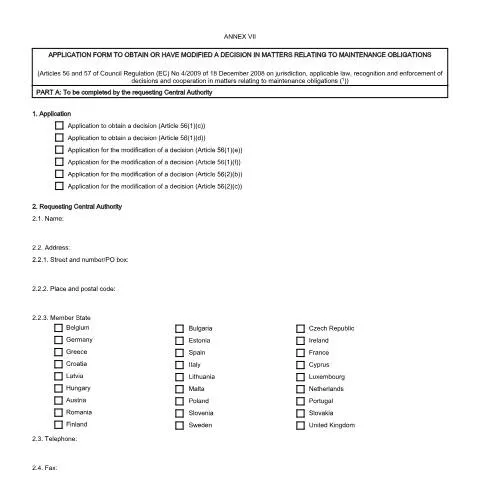
Understanding the Official Solicitor and Public Trustee's Application Process for Maintenance Decisions in the UK
The Official Solicitor and Public Trustee play a vital role within the UK's legal framework, particularly concerning matters related to maintenance obligations. This guide aims to clarify the procedures involved in applying to obtain or modify a maintenance decision, highlighting the legal context, eligible applicants, and essential documentation involved in the process.
Legal Context and Scope of the Application
The application process is governed by European legislation, specifically Articles 56 and 57 of Council Regulation (EC) No 4/2009. This regulation facilitates cross-border recognition and enforcement of maintenance decisions within member states, including the United Kingdom. The process allows individuals or authorities to request the issuance or alteration of decisions related to financial support obligations, often concerning child support or spousal maintenance.
The procedure is applicable in cases where a decision has been made in one member state and needs to be recognized or modified in another. It covers applications for the recognition of existing decisions, as well as requests to change them due to new circumstances or errors.
Who Can Submit an Application?
Applications can be submitted by a designated Central Authority on behalf of individuals involved in maintenance proceedings. In the UK, this typically involves authorities such as the Child Maintenance Service (CMS) or other recognised bodies acting as the requesting authority. The applicant must provide details about themselves and the other party involved, including their legal status and relationship to the case.
Individuals seeking to initiate or modify maintenance decisions should be aware that the process involves formal documentation, and applications are often handled by official legal or governmental bodies rather than individuals directly.
Key Components of the Application Process
Part A: Central Authority Details
- Name and Address: The requesting authority must specify its official name and contact details, including postal address, telephone, fax, and email.
- Reference Number: Each application is assigned a unique reference for tracking purposes.
- Other Member States: The application must specify the member state involved in the case.
Part B: Applicant and Case Details
- Type of Application: Whether it is to obtain a new decision or to modify an existing one.
- Case Information: Details such as the date and reference number of the original decision, the court of origin, and the nature of the requested change.
- Changes in Circumstances: The applicant must specify any recent changes in income, expenses, marital status, or other relevant factors that justify modifying the maintenance decision.
Supporting Documentation
Applicants are required to attach relevant documents to substantiate their application. These may include:
- Decisions and Decisions to be Modified: Copies of the original decision or refusal documents.
- Evidence of Changes: Documents proving alterations in income, expenses, or circumstances, such as bank statements, employment contracts, or court orders.
- Personal Identification: Birth certificates, acknowledgment of parentage, or genetic test results if applicable.
- Legal Documentation: Marriage certificates, divorce decrees, or adoption certificates.
Procedural Aspects and Deadlines
The application process is formal, requiring precise completion of the relevant sections and submission of supporting documents. The UK authorities process these applications in accordance with legal standards, ensuring proper recognition and enforcement of decisions across borders.
Fill in your form directly online
No printing: type your details into the boxes of the official form, tick, then download the PDF ready to send.
- 1Type into the form boxes
- 2Tick in one click
- 3Save and download the PDF
While specific processing times can vary, applicants are advised to prepare comprehensive documentation to facilitate efficient handling. The UK legislation aligns with the overarching EU regulations, ensuring that maintenance decisions are enforceable and adaptable to changing circumstances.
Conclusion
Applying to obtain or modify a maintenance decision through the Official Solicitor and Public Trustee involves a structured process designed to uphold the legal rights of individuals involved in maintenance obligations. Understanding the key requirements, appropriate documentation, and procedural steps is essential for a successful application. For detailed guidance, applicants should consult the official instructions provided by the relevant UK authorities or legal advisers familiar with cross-border maintenance cases.