When Court Protection Orders Need Revision: Understanding the FL403 Process
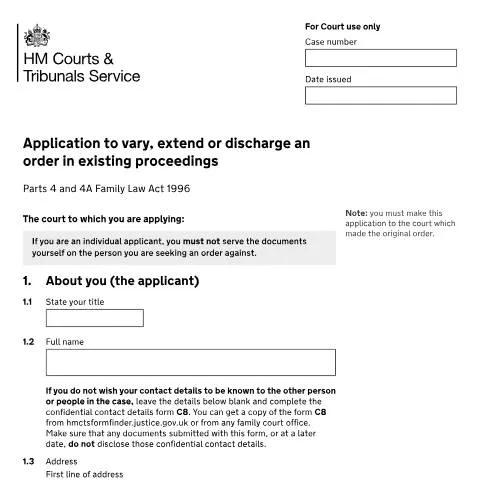
Family court orders don't always remain static—circumstances change, relationships evolve, and what seemed appropriate at the time of the original hearing may no longer serve its intended purpose. When someone needs to modify an existing non-molestation order or occupation order made under the Family Law Act 1996, Form FL403 becomes the gateway to judicial reconsideration.
This application form serves as the formal mechanism for requesting courts to vary, extend, or discharge protective orders that are already in force. Unlike initial applications for protection, which often carry the urgency of immediate danger, FL403 applications typically arise from more measured reassessments of ongoing situations—perhaps where circumstances have genuinely improved, where the original order's scope proves too restrictive, or where additional protection has become necessary.
The process operates within established family proceedings, meaning applicants must return to the same court that issued the original order. This requirement ensures continuity and allows judges familiar with the case history to make informed decisions about modifications.
Navigating the Three Pathways: Vary, Extend, or Discharge
The FL403 form presents applicants with three distinct options, each serving different purposes within the family law framework. Understanding these pathways proves crucial for selecting the appropriate course of action.
Variation applications seek to modify existing order terms without removing the protection entirely. Common scenarios include adjusting geographical restrictions when someone needs to relocate for work, modifying contact arrangements as children mature, or refining property access provisions. The original order remains in place during consideration, but applicants must articulate precisely what changes they're requesting and why current terms no longer serve their purpose.
Extension applications become relevant when fixed-term orders approach expiry but ongoing protection remains necessary. These applications require demonstration that circumstances haven't sufficiently improved to warrant lifting protection. Courts particularly scrutinise extension requests, as indefinite protection orders represent significant ongoing restrictions on the respondent's liberty and property rights.
Discharge applications represent the most substantial change—complete removal of the protective order. These applications often arise when relationships have been successfully repaired, when protected parties feel confident about their safety, or when circumstances have changed so fundamentally that continued protection becomes unnecessary or counterproductive.
| Application Type | Typical Circumstances | Court Considerations |
|---|---|---|
| Vary | Changed living arrangements, employment relocation, child contact needs | Proportionality of proposed changes, ongoing risk assessment |
| Extend | Continuing threat, insufficient behavioural change, vulnerable party protection | Evidence of ongoing need, effectiveness of existing order |
| Discharge | Reconciliation, genuine behavioural change, changed circumstances | Safety of protected persons, likelihood of future incidents |
Who Can Make These Applications and When
The FL403 process remains open to various parties involved in the original proceedings, though their positions and motivations typically differ significantly. Original applicants might seek variations to expand protection or discharge orders when they feel circumstances have improved sufficiently. Respondents commonly apply for discharge or variation to reduce restrictions they consider excessive or outdated.
Importantly, any person protected by the order can also make applications, recognising that protection sometimes extends beyond the original applicant to include children or other vulnerable family members. This provision acknowledges that protected parties may develop different perspectives on their safety needs as situations evolve.
Timing considerations prove particularly significant in FL403 applications. Unlike emergency protection applications, these modifications typically allow for more measured consideration. However, applicants should be aware that existing orders remain fully enforceable throughout the application process unless the court specifically grants interim variations.
Courts expect applicants to demonstrate material changes in circumstances since the original order was made. Simply disliking the restrictions imposed isn't sufficient grounds for modification—applicants must show that circumstances have evolved in ways that make the current order inappropriate, insufficient, or unnecessarily burdensome.
Completing the Form: Critical Details and Common Pitfalls
The FL403 form's apparent simplicity can mislead applicants into underestimating its significance. Every section requires careful attention, as incomplete or inadequate information can delay proceedings or undermine the application's credibility.
Personal details sections must be completed with particular attention to confidentiality requirements. Applicants concerned about revealing their address to respondents should leave the address field blank and complete the separate C8 confidential contact details form. This provision proves especially important when domestic violence concerns persist despite the modification request.
The order identification section requires precise details about the existing order being challenged. Courts handle numerous family cases, and accurate identification prevents confusion or delays. Applicants should attach copies of the original order whenever possible, noting that courts maintain their own records but appreciate having readily accessible documentation.
Section 3's reasoning requirement represents the application's most critical component. While the form requests "brief" reasons, applicants shouldn't interpret this as requiring minimal detail. Effective applications provide clear, factual explanations of changed circumstances while avoiding emotional language or unsubstantiated accusations.
Service Requirements and Legal Representation
The form's service requirements carry particular importance and specific restrictions. Individual applicants must not serve documents themselves on the persons they're seeking orders against—this restriction exists to prevent confrontational situations and ensure proper legal process.
Professional service through solicitors or court bailiffs provides the appropriate mechanism for document delivery. This requirement reflects the sensitive nature of family proceedings and the potential for volatile reactions when protective orders face modification or discharge.
The Court's Decision-Making Framework
Understanding how courts approach FL403 applications helps applicants present more compelling cases and set realistic expectations about likely outcomes. Judges operate within established legal frameworks while exercising considerable discretion based on individual circumstances.
Welfare considerations remain paramount, particularly when children are involved. Courts must balance competing interests: the applicant's desire for modification against the continued safety of protected persons. This balancing act becomes especially complex in discharge applications where courts must assess whether removal of protection might recreate dangerous situations.
Evidence quality proves crucial in court decisions. Documented changes in behaviour, completion of intervention programmes, changed living circumstances, or professional assessments all carry more weight than simple assertions of improvement. Courts particularly value objective evidence from neutral third parties such as social services, probation officers, or medical professionals.
The court's approach also depends significantly on the original order's basis. Orders made following serious domestic violence incidents face higher thresholds for discharge than those addressing less severe harassment. Similarly, orders protecting children typically receive more conservative treatment than those solely protecting adult parties.
Interim Considerations and Urgent Modifications
While FL403 applications don't typically carry the emergency character of initial protection applications, certain circumstances may warrant expedited consideration. Courts can grant interim variations where compelling reasons exist, though such decisions remain exceptional rather than routine.
Common scenarios for interim relief include medical emergencies requiring temporary geographical proximity, employment opportunities with tight deadlines, or genuine child welfare concerns. However, courts remain extremely cautious about any interim modifications that might compromise protected parties' safety.
Procedural Journey from Application to Resolution
The FL403 process follows established family court procedures, though timing and complexity can vary significantly based on case specifics and court schedules. Understanding this journey helps applicants prepare appropriately and manage expectations about resolution timeframes.
After submission, courts typically acknowledge receipt and assign hearing dates within several weeks, though urgent applications may receive expedited scheduling. The responding parties receive served copies and opportunities to file counter-arguments or supporting evidence.
Many cases benefit from preliminary court directions hearings where judges can identify key issues, request additional evidence, or encourage settlement discussions. These directions hearings prove particularly valuable in complex cases involving multiple parties or disputed facts about changed circumstances.
Final hearings provide opportunities for all parties to present evidence and arguments. Unlike initial protection applications, FL403 hearings often involve more detailed examination of evidence about changed circumstances, behavioural improvements, or ongoing risks. Parties should prepare for questions about specific incidents, intervention programmes, living arrangements, and future intentions.
Post-Decision Implementation and Appeals
Court decisions on FL403 applications take immediate effect unless specifically stayed pending appeals. Successful discharge applications result in complete removal of protective restrictions, while successful variation applications produce amended orders with modified terms.
Unsuccessful applicants retain appeal rights, though appeals must demonstrate legal errors in the original decision rather than simple disagreement with judicial conclusions. The appeal process operates under strict time limits and typically requires legal representation due to its complexity.
Strategic Considerations for Different Applicant Types
Different types of applicants face distinct challenges and opportunities within the FL403 process. Understanding these variations helps parties develop appropriate strategies and avoid common mistakes that can undermine otherwise valid applications.
Fill in your form directly online
No printing: type your details into the boxes of the official form, tick, then download the PDF ready to send.
- 1Type into the form boxes
- 2Tick in one click
- 3Save and download the PDF
Respondents seeking discharge face perhaps the greatest challenges, as they must convince courts that circumstances have changed sufficiently to warrant removing protection. Success typically requires demonstrating genuine behavioural change through completion of intervention programmes, sustained periods without incidents, changed living circumstances, or professional therapeutic progress.
These applicants must address courts' natural reluctance to remove protection that may still be necessary. Documentation becomes crucial—certificates of programme completion, character references from neutral parties, evidence of stable employment or housing, and professional assessments all strengthen discharge applications.
Original applicants seeking variations often face more receptive courts, particularly when requesting enhanced protection. However, they must still demonstrate that proposed changes serve legitimate purposes rather than representing harassment or control of the respondent.
Protected parties (particularly children reaching maturity) may find courts especially attentive to their expressed wishes, though judges retain ultimate discretion based on welfare assessments. These applications often require careful consideration of capacity issues and potential undue influence.
Evidence Gathering and Presentation Strategies
Successful FL403 applications typically rest on compelling evidence rather than persuasive arguments alone. Courts expect objective documentation of changed circumstances, not simply parties' assertions about improvement or deterioration.
Effective evidence might include incident reports (or notable absence thereof), programme completion certificates, employment records showing stability, housing documentation, medical or therapeutic assessments, and statements from neutral witnesses. Police records, social services reports, and probation assessments carry particular weight due to their independent nature.
The presentation of evidence requires careful consideration of court rules and procedures. Witness statements must follow prescribed formats, documentary evidence needs proper authentication, and expert reports must comply with family court directions. Poor evidence presentation can undermine otherwise strong applications.
Long-term Implications and Future Considerations
FL403 applications create lasting legal consequences that extend beyond immediate order modifications. Understanding these broader implications helps applicants make informed decisions about whether to pursue modifications and how to present their cases most effectively.
Successful discharge applications don't erase the history of protective orders, and this history may remain relevant in future family proceedings, employment checks, or visa applications. However, discharge does remove ongoing legal restrictions and their associated enforcement mechanisms.
Failed applications, particularly those deemed frivolous or vexatious, can result in costs orders against applicants and may influence courts' attitudes toward future applications. Repeat unsuccessful applications might face additional scrutiny or procedural restrictions.
The FL403 process also establishes precedents for future modifications. Courts consider previous variation requests when assessing new applications, and patterns of behaviour during the modification process can influence judicial attitudes toward ongoing supervision or future protection needs.
For families involved in ongoing disputes, FL403 applications represent opportunities to demonstrate changed attitudes and behaviours. Respectful engagement with the process, compliance with existing orders during consideration, and constructive approaches to resolution can contribute to improved long-term relationships and reduced conflict.
Ultimately, the FL403 process reflects the family law system's recognition that protective orders must remain responsive to changing circumstances while maintaining their essential protective functions. Success requires careful preparation, honest assessment of changed circumstances, and realistic expectations about court processes and likely outcomes.