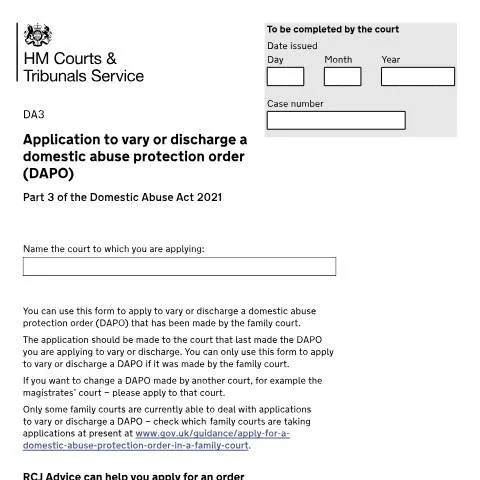
When Family Protection Orders Need Adjusting: Understanding Form DA3 Applications
Domestic Abuse Protection Orders (DAPOs) issued by family courts represent powerful legal safeguards, but circumstances change. Whether a protected person finds the conditions too restrictive for rebuilding their life, or conversely, requires stronger protections due to escalating threats, Form DA3 provides the formal mechanism to request modifications or complete discharge of these orders. This application process, governed by Part 3 of the Domestic Abuse Act 2021, requires careful navigation through specific family court procedures that differ markedly from those used in magistrates' courts.
The DA3 form serves multiple parties with varying needs: protected persons seeking to ease restrictions that may hinder employment or family contact, respondents arguing for order modifications based on changed circumstances, and occasionally police or other agencies applying on behalf of vulnerable individuals. Each scenario demands different evidence and follows distinct procedural pathways through the family court system.
Court Jurisdiction and Application Boundaries
Form DA3 applications face strict jurisdictional limitations that often catch applicants off-guard. Only family courts that originally issued or last varied a DAPO can process DA3 applications – a restriction that prevents forum shopping but can create practical difficulties when parties have relocated or when court availability has changed.
Currently, not all family courts handle DAPO applications. The government maintains an updated list of participating family courts at gov.uk, which applicants must consult before submitting their DA3. This limitation stems from the specialised training and resources required for domestic abuse cases, meaning some regional courts simply cannot process these applications despite having general family court jurisdiction.
Magistrates' Court Orders: A Common Confusion
Applicants frequently attempt to use Form DA3 for orders issued by magistrates' courts, which creates immediate rejection. Magistrates' court DAPOs require separate applications directly to the issuing magistrates' court, using different procedures and forms entirely. This distinction proves crucial because magistrates' courts handle the majority of domestic abuse protection orders in England and Wales, yet their variation procedures follow criminal rather than family court protocols.
| Court Type | Form Required | Application Process | Typical Processing Time |
|---|---|---|---|
| Family Court | DA3 | Civil family proceedings | 4-8 weeks standard track |
| Magistrates' Court | Court-specific forms | Criminal court procedures | 2-4 weeks summary track |
Without Notice Applications: Emergency Modifications
Section 1 of Form DA3 addresses one of the most sensitive aspects of DAPO variations: without notice applications. These emergency procedures allow courts to modify or discharge orders without informing the respondent beforehand, but only under exceptional circumstances where immediate action prevents significant harm.
The form presents three specific grounds for without notice applications, each requiring detailed justification. Applicants must demonstrate either immediate risk of significant harm if the order continues unchanged, likelihood of being deterred from pursuing the application if notice were given, or evidence that the respondent deliberately evades service while serious prejudice results from delays.
Risk Assessment for Without Notice Orders
Courts scrutinise without notice applications intensively, recognising that varying protection orders without respondent input contradicts natural justice principles. Protected persons seeking to discharge orders without notice face particular scrutiny, as courts must ensure such requests don't result from coercion or manipulation by the respondent.
The application must include specific examples of threatened harm, documented attempts at evasion, or evidence of deterrent behaviour. Vague concerns or general safety worries rarely satisfy the "exceptional circumstances" threshold required for without notice orders.
Confidentiality Protocols and Personal Safety
Form DA3 incorporates sophisticated confidentiality measures through integration with Form C8 (Confidential Contact Details). This parallel system allows applicants to maintain essential court communication while preventing respondents from accessing location information that could compromise safety.
The confidentiality requirements extend beyond simple address protection. Applicants living in refuges must never include their actual addresses anywhere on DA3 or supporting documents, relying exclusively on Form C8 for location details. Similarly, employment addresses, children's school information, and even email addresses linked to identifiable locations require careful handling.
Service of Documents and Safety Considerations
Unlike many civil applications, applicants cannot serve DA3 applications or resulting orders personally – a restriction designed to prevent dangerous confrontations. Court officials handle service free of charge, but require completion of Form D89 to locate and identify respondents accurately.
Service methods vary based on circumstances and risk assessments. Standard hand delivery remains the norm, but courts increasingly approve substituted service through email, text messages, or social media platforms when traditional methods prove ineffective or dangerous. However, orders cannot be enforced until proper service occurs, creating potential gaps in protection during service delays.
Evidence Requirements and Supporting Documentation
Form DA3 applications succeed or fail primarily on the quality and relevance of supporting evidence. Courts require clear demonstration of changed circumstances that justify varying or discharging existing orders, with evidence standards varying significantly between different types of applications.
Protected persons seeking order discharge typically must provide evidence of reconciliation, relationship counselling completion, or changed living circumstances that eliminate the need for protection. However, courts remain sceptical of discharge applications that appear sudden or lack independent corroboration, particularly given the cyclical nature of domestic abuse.
Documentary Evidence by Application Type
Respondents seeking order variation often submit employment contracts, medical records, or family court orders from related proceedings that conflict with DAPO conditions. These applications require particularly detailed evidence because courts must balance respondent hardship against continued protection needs.
- Employment-related variations: Job offers, shift patterns, workplace locations that conflict with order conditions
- Medical circumstances: Hospital appointments, therapy requirements, medical emergencies affecting compliance
- Family contact issues: Child contact orders, school events, family emergencies requiring temporary order suspension
- Housing complications: Tenancy agreements, mortgage obligations, shared property arrangements
Third-party applications, typically from police or social services, require different evidence focusing on welfare concerns, risk assessments, or changed threat levels that justify order modifications. These applications often include professional risk assessments, incident reports, or multi-agency case conference minutes.
Court Processing and Hearing Procedures
Once submitted, DA3 applications follow family court tracks determined by complexity and urgency. Without notice applications receive priority processing, often reaching initial hearings within 48-72 hours, while standard applications typically wait 4-6 weeks for listing.
The court's initial review focuses on procedural compliance rather than substantive merit. Applications lacking proper jurisdiction, missing essential information, or failing to include required forms face immediate administrative rejection without judicial consideration. This preliminary screening eliminates approximately 15-20% of submitted DA3 applications before reaching substantive hearings.
Hearing Formats and Representation
DA3 hearings accommodate various participation methods, including telephone and video attendance where appropriate. However, courts strongly prefer in-person hearings for contested applications or those involving complex evidence, particularly when credibility assessments prove central to decisions.
Legal representation, while not mandatory, significantly improves application success rates. The Royal Courts of Justice Citizens Advice provides specialised domestic abuse support services, including legal advice coordination and direct assistance with DA3 applications. Their support navigation service at supportnav.org.uk offers structured pathways to appropriate legal help.
Post-Application Procedures and Order Enforcement
Successful DA3 applications result in varied or discharged orders, but implementation requires careful attention to service and enforcement procedures. Varied orders must be served on all affected parties before taking effect, creating potential enforcement gaps during service periods.
Discharge orders present particular complexities because they eliminate existing protections immediately upon service. Courts often implement graduated discharge procedures, reducing order conditions progressively rather than eliminating all protections simultaneously. This approach allows monitoring of respondent compliance and protected person safety during transition periods.
Breach and Enforcement Considerations
Modified orders frequently create confusion about current conditions, leading to inadvertent breaches by respondents operating under outdated information. Police enforcement becomes complicated when officers lack current order versions or when variations create ambiguous conditions.
The court maintains responsibility for ensuring clear order language and comprehensive service procedures, but practical enforcement relies heavily on all parties understanding their current obligations and protections. Regular order reviews, built into many varied DAPOs, help address these ongoing compliance challenges.
Strategic Timing and Repeat Applications
Form DA3 applications require careful timing considerations that extend beyond immediate circumstances. Courts view frequent variation requests sceptically, particularly from respondents who appear to be testing order boundaries or seeking gradual erosion of protection conditions.
Protected persons face different timing pressures, often balancing immediate safety needs against longer-term relationship or family considerations. Applications submitted during periods of apparent reconciliation receive enhanced scrutiny, with courts requiring evidence of genuine changed circumstances rather than temporary relationship improvements.
The absence of specific time limits for DA3 applications creates both opportunities and complications. While applicants can seek variations at any time based on changed circumstances, courts expect reasonable intervals between applications unless genuine emergencies arise. Repeat applications within short timeframes typically require stronger evidence of changed circumstances and may face expedited hearings to prevent procedural abuse.
Understanding these procedural nuances proves essential for anyone navigating the DA3 application process, whether seeking protection modifications, order discharge, or responding to applications from other parties. The family court system's emphasis on balancing protection with proportionality demands careful preparation and realistic expectations about achievable outcomes.
Understanding the Legal Framework and Grounds for Variation Applications
The legal foundation for varying or discharging domestic abuse protection orders rests on several key principles established under the Domestic Abuse Act 2021 and associated family court procedures. When completing Form DA3, applicants must demonstrate that their circumstances have materially changed since the original order was made, or that new evidence has emerged which wasn't available during the initial proceedings.
The courts recognise four primary grounds for variation applications. Firstly, significant change in circumstances covers situations where the protected person's living arrangements, employment status, or family composition have altered substantially. For instance, if the protected person has relocated to a different area of the country for work purposes, certain geographical restrictions within the original order may no longer serve their intended protective function.
Secondly, proportionality concerns may arise where the original order's terms have become disproportionate to the current risk level. This might occur in cases where the respondent has successfully completed rehabilitation programmes, maintained consistent employment, or demonstrated sustained behavioural change over an extended period. However, courts scrutinise such claims rigorously, often requiring independent verification through probation services or mental health professionals.
The third ground involves procedural irregularities in the original proceedings. This encompasses situations where the respondent wasn't properly served with notice, where relevant evidence wasn't considered, or where there were errors in the application of legal principles. Such technical grounds require careful legal analysis and often benefit from professional legal representation.
Finally, child welfare considerations represent a particularly complex area. Where children are involved, courts must balance the protective benefits of the order against the potential impact on parent-child relationships. The Children Act 1989 requires courts to prioritise the child's welfare as the paramount consideration, which may sometimes conflict with the protective aims of the domestic abuse order.
When preparing Form DA3, applicants should clearly identify which ground(s) apply to their situation and provide comprehensive supporting evidence. The court expects detailed explanations of how circumstances have changed, supported by documentary evidence such as tenancy agreements, employment contracts, medical reports, or character references. Vague assertions about improved behaviour or changed attitudes rarely succeed without corroborating evidence.
It's worth noting that the burden of proof differs depending on who is making the application. Where the protected person seeks variation, courts generally show more flexibility, recognising their autonomy and right to make decisions about their own protection. However, even in such cases, courts retain discretion to refuse variations if they believe the protected person may be under duress or if there are concerns about children's welfare.
Navigating Court Procedures and Hearing Expectations
Once Form DA3 is submitted and accepted by the court, the procedural pathway varies depending on the complexity of the case and local court practices. Family courts across England and Wales operate under unified procedures, but individual courts may have specific requirements regarding hearing scheduling, evidence submission, and case management directions.
The initial case management stage typically occurs within 14 to 28 days of filing Form DA3. During this phase, a district judge or legal adviser reviews the application to determine whether it discloses arguable grounds for variation or discharge. Applications that lack sufficient detail or fail to identify clear legal grounds may be rejected at this stage, though applicants usually receive an opportunity to remedy deficiencies by providing additional information or evidence.
Where the application proceeds, the court issues case management directions specifying deadlines for evidence submission, witness statements, and any expert reports required. These directions are legally binding, and failure to comply can result in the application being struck out or proceeding without the benefit of late evidence. Typical directions include requirements for the applicant to file a detailed witness statement within 21 days, for the respondent (usually the protected person) to file their response within 14 days thereafter, and for any expert evidence to be exchanged within specified timeframes.
Fill in your form directly online
No printing: type your details into the boxes of the official form, tick, then download the PDF ready to send.
- 1Type into the form boxes
- 2Tick in one click
- 3Save and download the PDF
The hearing itself follows established family court protocols, with proceedings generally conducted in private to protect the parties' confidentiality. Judges have considerable discretion in how they conduct hearings, but certain procedural safeguards apply consistently. Both parties have the right to legal representation, though legal aid availability may be limited depending on individual circumstances and means testing outcomes.
Evidence presentation follows strict rules governing admissibility and relevance. Hearsay evidence is generally permissible in family proceedings, but its weight depends on factors such as the reliability of the source and whether the original witness is available for cross-examination. Documentary evidence must be properly authenticated, with original documents preferred over copies where possible.
Cross-examination procedures vary depending on the nature of the case and any special measures in place. Where domestic abuse allegations are involved, courts may implement special measures such as screens, video links, or separate waiting areas to protect vulnerable witnesses. These arrangements don't prejudice the fairness of proceedings but recognise the particular challenges faced by domestic abuse survivors in court settings.
Judges typically reserve their decisions for consideration after the hearing, particularly in complex cases involving multiple legal issues or extensive evidence. Written judgments are usually provided within 7 to 14 days, setting out the court's findings of fact, legal analysis, and reasoning for the decision reached. These judgments become part of the court record and may be relevant to future proceedings.
Appeal procedures are available where parties disagree with the court's decision, though strict time limits apply. Appeals must generally be filed within 21 days of the judgment being handed down, and permission to appeal is required in most cases. The grounds for appeal are limited to errors of law, procedural irregularities, or decisions that are plainly wrong on the facts.
Practical Considerations for Hearing Preparation
Effective hearing preparation requires careful attention to both legal and practical elements. Applicants should prepare comprehensive witness statements addressing each element of their case, supported by chronologically organised documentary evidence. Character witnesses can be valuable, particularly where claims about behavioural change or rehabilitation are central to the application.
Court attendance arrangements require advance planning, especially where special measures are needed. Parties should contact the court at least one week before the hearing to confirm attendance arrangements, accessibility requirements, and any interpreter services needed. Most family courts can accommodate Welsh language proceedings where required, though advance notice is essential.
Post-Decision Implementation and Ongoing Compliance Requirements
The period following a court's decision on Form DA3 applications involves several important procedural and practical steps that parties must navigate carefully. Understanding these requirements ensures proper implementation of any varied orders and helps prevent inadvertent breaches that could result in criminal prosecution or further court proceedings.
Where the court grants a variation application, the modified order takes effect immediately upon pronouncement, unless the judge specifies a different implementation date. This immediate effect can create practical challenges, particularly where the variation involves changes to residence restrictions, contact arrangements, or geographical boundaries. Parties must ensure they understand precisely what the varied order permits or prohibits, as ignorance of the new terms provides no defence against enforcement action.
The court administrative process involves updating official records and ensuring all relevant agencies receive notification of the changes. This includes police forces, probation services where applicable, and any other bodies involved in monitoring compliance with the original order. However, this notification process can take several days to complete, during which time different agencies may be operating under different versions of the order. Parties should retain copies of the court's written judgment as evidence of the variation in case of confusion.
Enforcement mechanisms remain fully operational for any terms of the order that weren't varied or discharged. Police powers of arrest continue to apply where such powers were originally granted, and breach of the varied order remains a criminal offence carrying potential penalties including imprisonment. The variation doesn't create a 'clean slate' – it simply modifies specific terms while leaving the remainder of the protective framework intact.
Where applications for discharge are successful, the termination process involves additional considerations. Complete discharge removes all legal restrictions and monitoring arrangements, but doesn't prevent future applications for new domestic abuse protection orders if circumstances change. The court record of the discharged order remains accessible for future proceedings, and any criminal convictions arising from breaches of the original order remain on the respondent's criminal record.
Ongoing monitoring arrangements may continue even after successful variation applications. Where the original order included requirements for attendance at rehabilitation programmes, anger management courses, or substance abuse treatment, these obligations may persist unless specifically addressed in the variation application. Similarly, any financial provisions such as maintenance payments or compensation orders typically require separate applications for variation through appropriate procedures.
Communication between parties following variation decisions requires careful consideration of any remaining restrictions. Where non-molestation provisions remain in place, even modified contact arrangements must comply with these overriding prohibitions. Parties should establish clear communication protocols that respect the varied order's terms while enabling necessary practical arrangements, particularly where children are involved.
Record-keeping becomes particularly important during the post-variation period. Both parties should maintain detailed records of compliance with the varied order, including dates, times, and circumstances of any permitted contact or activity. These records may prove valuable if future disputes arise or if further court proceedings become necessary.
The implications for related proceedings must also be considered. Where family court proceedings concerning children, financial matters, or divorce are ongoing, the variation of a domestic abuse protection order may affect the approach taken in these parallel cases. Parties should ensure their legal representatives in all proceedings are aware of any changes to protective orders.
Professional support services may need updating about order variations. This includes counselling services, victim support organisations, housing providers, and educational institutions where children are involved. Maintaining accurate information across all relevant services helps ensure continued appropriate support and reduces the risk of misunderstandings about what contact or behaviour is permitted.
Insurance and financial implications can arise from order variations. Some insurance policies, particularly those relating to personal protection or legal expenses, may require notification of changes to court orders. Similarly, mortgage providers or landlords may need updating where residence restrictions are modified, as these can affect tenancy agreements or property insurance arrangements.
Future application procedures remain available to all parties regardless of previous variation outcomes. The court's decision on Form DA3 doesn't prevent subsequent applications for further variations, discharge, or even new domestic abuse protection orders if circumstances change again. However, repeated applications without substantial new evidence or changed circumstances may be viewed unfavourably by the court and could result in costs orders against unsuccessful applicants.