When Executors Cannot Act: The Legal Framework Behind Form PA11
The death of a loved one brings not only emotional grief but also complex legal responsibilities. When someone passes away leaving a will, the named executors bear the crucial duty of administering the deceased's estate. However, life's complications sometimes prevent these appointed individuals from fulfilling their obligations personally. An executor might be elderly, ill, living abroad, or simply lack the time or expertise to navigate the probate process effectively.
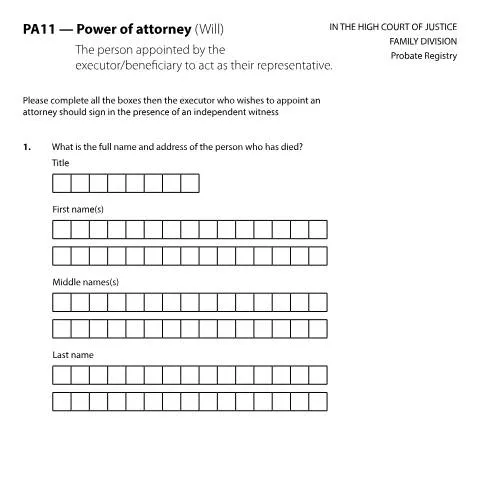
This is where Form PA11 – Power of Attorney (Will) becomes essential. This document allows an executor or beneficiary to formally appoint an attorney to act on their behalf when seeking Letters of Administration with Will Annexed from HM Courts & Tribunals Service. Unlike the more familiar Lasting Power of Attorney arrangements used for living persons, Form PA11 operates specifically within the probate framework, enabling legal representation for estate administration purposes.
The form emerged from centuries of English probate law, where the High Court of Justice Family Division maintains strict oversight over estate administration. The legal principle underlying PA11 recognises that whilst executorship is a personal appointment by the testator, practical circumstances may necessitate professional or alternative representation to ensure the deceased's wishes are properly executed.
Understanding Letters of Administration with Will Annexed
Before examining the PA11 process, it's crucial to understand when Letters of Administration with Will Annexed become necessary. This grant differs from the standard Grant of Probate, which issues directly to named executors. Letters of Administration with Will Annexed apply in several specific circumstances:
- The named executor has died before the testator
- The executor survives but lacks mental capacity to act
- The executor formally renounces their role
- The executor cannot be located despite reasonable efforts
- The executor is a minor and cannot legally act
In these situations, the Probate Registry must determine who should receive authority to administer the estate according to the will's provisions. The PA11 form facilitates this process by allowing eligible parties to appoint suitable attorneys rather than attempting the complex probate procedures personally.
The attorney appointed through PA11 receives limited authority specifically for obtaining the grant. They cannot make broader decisions about estate distribution or management beyond what's necessary to secure the legal documentation. This constraint protects both the estate and the appointing party from potential overreach.
Eligibility and Appointment Rights: Who Can Use Form PA11
Form PA11 serves two distinct categories of applicants, each with different legal standings and requirements. Understanding these distinctions proves vital for determining whether this form applies to your circumstances.
Executor Appointments
An executor named in the will may appoint an attorney when they cannot personally pursue the grant application. This might occur when:
- The executor lives overseas and cannot attend UK legal proceedings
- Physical or mental health issues prevent active participation
- Professional or personal commitments create unavoidable conflicts
- The executor lacks confidence in handling complex legal procedures
Crucially, Form PA11 specifies that an attorney of one executor cannot apply alongside another executor. This restriction prevents potential conflicts where multiple parties might claim authority over the same estate. If multiple executors are named, they must coordinate their approach – either all acting personally or all appointing attorneys.
Beneficiary Appointments
When no executor can or will act, beneficiaries under the will gain the right to seek Letters of Administration with Will Annexed. The PA11 form accommodates both sole beneficiaries and individual beneficiaries within a larger group. However, beneficiaries must demonstrate their entitlement through the will's specific provisions.
The legal hierarchy for beneficiary applications typically follows the will's distribution scheme. Primary beneficiaries – those receiving the residuary estate – generally take precedence over specific legatees. However, the Probate Registry examines each case individually, considering factors such as the value of individual bequests and the practical ability to administer the estate effectively.
Navigating the PA11 Form: Section-by-Section Completion Guide
The PA11 form follows a logical progression from identifying the deceased through to formal appointment of attorneys. Each section requires careful attention to detail, as errors or omissions can delay processing significantly.
Deceased Person Details (Sections 1-4)
The opening sections establish the fundamental case information. Section 1 requires the deceased's full name and address exactly as they appear on the death certificate. Variations in spelling or formatting can create complications, particularly if the deceased used different names during their lifetime.
The date of death (Section 2) must match official records precisely. UK date format applies: day, month, year. Similarly, the will date (Section 3) should correspond to the document's execution date, not any draft or unsigned version.
Section 4 addresses codicils – amendments to the original will. If the deceased executed multiple codicils, list the most recent date. If no codicils exist, leave this section blank rather than inserting "N/A" or similar notations.
Appointing Party Information (Sections 5-6)
These sections identify who seeks to appoint an attorney. Complete postal addresses are mandatory, including postcodes. The Probate Registry uses this information for all correspondence, so ensure accuracy.
Section 6 requires selecting between executor or beneficiary status. This choice affects the legal basis for the application and determines what supporting documentation the Registry will require. Only one option should be selected – attempting to claim both statuses creates legal uncertainty.
Attorney Appointments (Section 7)
This crucial section allows appointment of up to four attorneys. While most applications involve single attorney appointments, complex estates or risk management considerations might justify multiple appointments.
| Attorney Number | Typical Use | Considerations |
|---|---|---|
| First Attorney | Primary representative | Usually a solicitor or experienced family member |
| Second Attorney | Backup or specialist support | May have specific expertise (tax, property, etc.) |
| Third/Fourth Attorney | Complex estates only | Multiple jurisdictions or business interests |
Each attorney must provide complete contact details. The form doesn't explicitly require attorneys to accept their appointments in writing, but prudent practice suggests confirming their willingness before submission.
The Signature Requirements and Witnessing Process
Form PA11 concludes with formal execution requirements that carry significant legal weight. The appointing party must sign "as a deed" – a higher standard than simple contract signatures. This elevated requirement reflects the serious nature of granting legal authority over estate matters.
Independent Witness Obligations
The form explicitly requires an independent witness – someone unrelated to the appointing party with no interest in the estate. This requirement serves multiple purposes:
- Confirms the appointing party's identity
- Verifies voluntary execution without coercion
- Provides evidence of the signature's authenticity
- Creates a traceable record for potential disputes
Suitable witnesses include neighbours, work colleagues, or professional contacts without family connections or financial interests in the estate. Attorneys appointed through the form cannot serve as witnesses, as this would compromise the independence requirement.
The witness must sign, print their name clearly, and date the document. All three elements are mandatory – missing any component renders the form legally ineffective.
Supporting Documentation and Evidence Requirements
While PA11 itself captures the appointment details, the Probate Registry requires substantial supporting evidence before processing applications. The specific documents needed depend on whether the applicant claims executor or beneficiary status.
Standard Documentation for All Applications
Every PA11 submission must include:
- The original will (and any codicils)
- Certified copy of the death certificate
- Completed Inheritance Tax forms (IHT205 or IHT400, depending on estate value)
- Official copy entries for any property owned by the deceased
The Registry accepts only original wills, not photocopies or scanned versions. If the original will is lost or destroyed, separate court proceedings become necessary before PA11 can proceed.
Additional Requirements for Executor Applications
Executors appointing attorneys must demonstrate why they cannot act personally. While the form doesn't explicitly request explanations, the Registry may seek clarification during processing. Common supporting evidence includes:
- Medical certificates for health-related incapacity
- Evidence of overseas residence requiring UK legal representation
- Professional commitments preventing personal attendance
Beneficiary-Specific Documentation
Beneficiaries face more complex evidence requirements, as they must establish both their entitlement under the will and the absence of willing/able executors. Required documentation typically includes:
- Formal renunciation documents from named executors
- Death certificates for deceased executors
- Medical evidence of executor incapacity
- Proof of reasonable efforts to locate missing executors
Processing Timeline and Registry Procedures
Understanding the Probate Registry's internal procedures helps set realistic expectations for PA11 processing times. Unlike routine probate applications, attorney appointments require additional scrutiny and verification steps.
Initial Assessment Phase
Upon receiving a PA11 application, registry staff conduct preliminary checks focusing on:
Fill in your form directly online
No printing: type your details into the boxes of the official form, tick, then download the PDF ready to send.
- 1Type into the form boxes
- 2Tick in one click
- 3Save and download the PDF
- Form completion and signature validity
- Supporting document sufficiency
- Legal basis for the attorney appointment
- Potential conflicts with other applications
This initial review typically takes 2-3 weeks for straightforward cases. However, incomplete submissions or queries about legal standing can extend this phase significantly.
Substantive Review and Verification
Once initial checks are complete, the Registry examines the substantive legal issues. This phase involves:
- Verifying the will's validity and terms
- Confirming the applicant's legal standing
- Assessing the necessity for attorney appointment
- Cross-referencing against other estate-related applications
Complex estates or disputed circumstances may require judicial consideration, adding several months to the processing timeline. The Registry cannot provide definitive timescales during this phase, as much depends on case-specific complexities.
Grant Issuance and Authority Activation
Successful applications result in Letters of Administration with Will Annexed being granted to the appointed attorneys. These documents carry the same legal authority as standard probate grants, enabling attorneys to:
- Access the deceased's bank accounts and investments
- Sell property and other assets
- Pay debts and liabilities
- Distribute assets according to the will's provisions
However, attorneys remain accountable to the appointing party and must act within the scope of their appointment. Significant decisions should involve consultation with the executor or beneficiary who granted the authority.
Strategic Considerations for Complex Family Situations
PA11 applications often arise during emotionally charged periods when family relationships face strain. Understanding the potential complications helps prevent costly disputes and delays.
Multiple Beneficiary Scenarios
When several beneficiaries exist under a will, determining who can appoint attorneys becomes complex. The Registry generally applies these principles:
- Residuary beneficiaries take precedence over specific legatees
- Higher-value beneficiaries may have stronger claims than minor recipients
- Geographic proximity and practical ability influence selection
- Family harmony considerations, while not legally binding, affect practical outcomes
In contentious situations, the Registry may require all significant beneficiaries to consent to the attorney appointment, or alternatively, may direct that administration proceeds through alternative routes.
International Elements and Cross-Border Issues
PA11 applications involving overseas parties or assets require careful handling. Common complications include:
- Foreign domicile questions affecting UK estate liability
- International property requiring local legal representation
- Currency fluctuations impacting inheritance tax calculations
- Treaty obligations affecting tax and administration procedures
Attorneys dealing with international estates should possess relevant expertise or engage specialist advice to ensure compliance with all applicable jurisdictions' requirements.
Time-Sensitive Estate Administration
Certain estate assets require prompt action following death. Business interests, agricultural property, or investment portfolios may deteriorate without swift intervention. PA11 applications in these circumstances should highlight time-critical factors and request expedited processing.
The Registry maintains discretion to prioritise urgent cases, but applicants must provide compelling evidence of potential harm from delays. Generic requests for speed rarely receive special treatment without specific justification.
Ultimately, Form PA11 represents a vital tool for ensuring deceased persons' wishes are honoured even when practical obstacles prevent direct executor action. By understanding the form's requirements, legal framework, and processing procedures, families can navigate this challenging period with greater confidence and reduced stress. The key lies in thorough preparation, accurate completion, and realistic expectations about the time and complexity involved in formal estate administration.