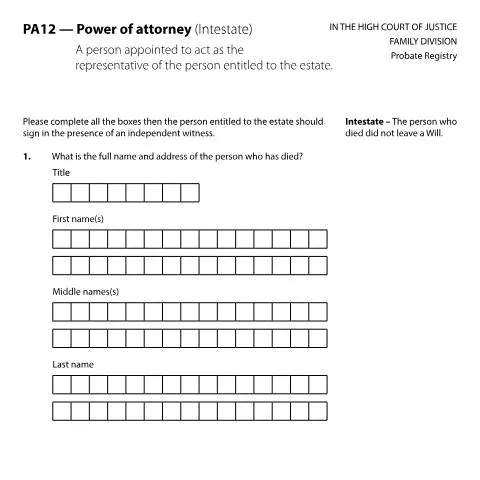
When Family Disputes Meet Legal Necessities: Understanding PA12 Power of Attorney
The death of a loved one without a will creates a complex web of legal obligations that often falls to family members at their most vulnerable time. While the rightful heir to an estate may have clear legal entitlement under intestacy rules, practical circumstances can prevent them from personally handling the administrative burden of securing Letters of Administration. This is precisely where Form PA12 becomes essential—allowing the legally entitled person to formally delegate this responsibility to trusted representatives who can navigate the probate process on their behalf.
The PA12 form serves a highly specific function within the probate system, distinct from the more commonly encountered power of attorney documents used during a person's lifetime. This particular instrument only comes into play after death, when someone dies intestate (without a valid will), and creates a bridge between legal entitlement and practical administration of the deceased's estate.
Distinguishing PA12 from Other Probate Powers
The probate landscape includes several forms that grant authority over deceased estates, and understanding the distinctions is crucial for families navigating this process. Form PA12 specifically applies to intestate estates, where the deceased left no valid will. This creates a fundamentally different legal situation from cases involving wills, where executors are named and different procedures apply.
| Situation | Document Required | Who Can Apply |
|---|---|---|
| Death with valid will | Grant of Probate application | Named executors |
| Death without will (intestate) | Letters of Administration | Next of kin under intestacy rules |
| Intestate heir cannot act personally | PA12 Power of Attorney | Appointed attorneys acting for entitled person |
The PA12 form is particularly valuable when the person entitled to administer the estate faces practical barriers: they may be living abroad, dealing with serious illness, lack confidence in handling complex legal procedures, or simply prefer to delegate this responsibility to professionals or trusted family members with more experience in such matters.
Legal Framework and Intestacy Rules
Under English law, when someone dies intestate, strict rules determine who inherits and in what order. The surviving spouse or civil partner typically takes priority, followed by children, then parents, siblings, and other relatives in a prescribed hierarchy. However, being entitled to inherit doesn't automatically mean that person is best placed to handle the administrative complexities of obtaining Letters of Administration.
The PA12 form recognises this practical reality by allowing the entitled person to remain legally responsible while delegating the actual administrative tasks to appointed attorneys. This arrangement maintains the integrity of intestacy rules while providing flexibility for real-world circumstances.
Anatomy of the PA12 Application Process
The PA12 form follows a structured approach that establishes clear legal relationships between all parties involved. Each section builds upon the previous one, creating a comprehensive record of authority and responsibility that the High Court of Justice Family Division can rely upon when considering the application.
Establishing the Deceased's Details
The opening section requires comprehensive identification of the deceased person, including their full legal name, complete address, and date of death. The form specifically asks for title, first names, middle names, and surname separately, reflecting the precision required for legal documents that will be scrutinised by the probate registry.
Particular attention must be paid to ensuring the name matches exactly with official documents such as the death certificate. Any discrepancies can cause significant delays, as the probate registry will require satisfactory explanation of naming variations. This is especially important where the deceased used different versions of their name in different contexts—perhaps using a middle name professionally but not socially, or having changed their name through marriage or deed poll.
Marital Status and Its Implications
The deceased's marital status directly affects who is entitled to administer the estate under intestacy rules. The form provides five specific categories: married/civil partner, divorced/civil partnership dissolved, judicially separated, spinster/bachelor, and widowed. Each status carries different implications for the hierarchy of entitlement.
For married individuals or civil partners, the surviving spouse typically has priority rights. However, where the marriage had ended in divorce or dissolution, the ex-spouse generally has no automatic entitlement, and priority may pass to children or other relatives. Judicial separation creates a more complex situation, as the couple remains legally married despite living apart, which can affect inheritance rights.
Identifying and Verifying the Entitled Person
Section 4 of the PA12 form focuses on the person legally entitled to the estate under intestacy rules. This individual must be clearly identified with full name and address details, matching the same level of precision required for the deceased's information. The relationship to the deceased must be specified, as this determines their legal standing to inherit and consequently to appoint attorneys.
A crucial distinction appears in Section 6, where the entitled person must declare whether they are the only person entitled or one of the persons entitled to the estate. This seemingly simple choice has significant implications for how the estate administration proceeds.
Sole Entitlement Versus Shared Inheritance
When someone is the sole person entitled to the estate—perhaps a surviving spouse with no children, or an only child whose parents have both died—they have complete authority to appoint attorneys and direct the administration process. The situation becomes more complex when multiple people share entitlement to the estate.
Where several individuals are entitled (such as multiple children inheriting equally), the PA12 form can still be used, but coordination between all entitled parties becomes essential. Each entitled person would typically need to execute their own PA12 if they wish to delegate their responsibilities, or they might agree that one person will handle the administration on behalf of all.
Appointing Multiple Attorneys: Strategic Considerations
The PA12 form accommodates up to four attorneys, reflecting the reality that estate administration often benefits from multiple perspectives and skill sets. The decision of how many attorneys to appoint and who to choose requires careful consideration of various factors.
Single Attorney Appointments
Appointing a single attorney offers simplicity and clear lines of authority. This approach works well when the chosen attorney has relevant experience, trustworthiness, and availability to handle all aspects of the estate administration. Professional appointees such as solicitors often serve as sole attorneys, bringing expertise and impartiality to complex estates.
However, single attorney appointments also concentrate significant responsibility in one person. If that attorney becomes unavailable due to illness, travel, or other commitments, the entire administration process may stall until alternative arrangements can be made.
Multiple Attorney Strategies
Appointing multiple attorneys can provide valuable redundancy and bring different strengths to the administration process. For example, one attorney might have financial expertise while another understands property matters, or family members might be appointed alongside professionals to ensure both competence and family involvement.
The form doesn't specify whether multiple attorneys must act jointly (all agreeing on every decision) or severally (each able to act independently). This crucial detail should be clarified in accompanying documentation or legal advice, as it fundamentally affects how decisions are made and authority is exercised.
The Signature Requirements and Independent Witnessing
The PA12 form requires execution as a deed, which imposes specific formalities that must be observed precisely. The person entitled to the estate must sign the document in the presence of an independent witness, who must also sign and provide their printed name and the date of witnessing.
Understanding Independent Witness Requirements
The form specifically defines an independent witness as someone who is not related to the person appointing the attorneys and has no interest in the estate. This requirement serves to prevent conflicts of interest and ensure the appointment is made freely and without undue influence.
Suitable independent witnesses might include neighbours, work colleagues, professionals such as doctors or teachers, or family friends who have no financial stake in the estate. The witness doesn't need to understand the contents of the document, but they must be able to confirm the identity of the person signing and that the signature was made in their presence.
Importantly, none of the appointed attorneys can serve as the witness, as they clearly have an interest in the estate through their appointment. Similarly, beneficiaries of the estate, their spouses, or close relatives should not act as witnesses to avoid any potential challenges to the validity of the appointment.
Fill in your form directly online
No printing: type your details into the boxes of the official form, tick, then download the PDF ready to send.
- 1Type into the form boxes
- 2Tick in one click
- 3Save and download the PDF
Submission Pathways and Registry Procedures
Once properly completed and executed, the PA12 form must be submitted to the appropriate Probate Registry along with supporting documentation. The choice of registry typically depends on where the deceased lived or where the majority of their assets are located, though the centralised nature of the probate system means applications can often be processed flexibly.
Essential Supporting Documentation
The PA12 form alone is insufficient for obtaining Letters of Administration. The application package must include the original death certificate, detailed information about the deceased's assets and liabilities, and various other forms depending on the specific circumstances of the estate.
The probate registry will scrutinise the PA12 form alongside these supporting documents to ensure the appointment is valid and the attorneys have proper authority to act. Any inconsistencies in names, addresses, or relationships between the various documents can trigger requests for additional evidence or clarification.
Processing Timeline and Registry Response
The probate registry aims to process straightforward applications within several weeks, though complex estates or those requiring additional evidence may take considerably longer. The registry will either grant the Letters of Administration to the appointed attorneys or raise queries that must be resolved before the grant can be issued.
During this period, the appointed attorneys cannot legally act on behalf of the estate, as their authority only becomes effective once the Letters of Administration are formally granted. This waiting period can be frustrating for families eager to progress with estate administration, but it serves important legal safeguards.
Post-Grant Responsibilities and Ongoing Authority
Once Letters of Administration are granted to the appointed attorneys, they assume significant legal responsibilities for administering the estate according to the intestacy rules and in the best interests of the entitled person who appointed them. This authority is both powerful and constrained—attorneys can deal with banks, sell property, and distribute assets, but they remain accountable to the person who granted them this power.
The PA12 form includes important language about ratifying and confirming whatever the attorneys "shall lawfully do or cause to be done in the Premises." This creates a binding commitment from the entitled person to accept and validate the attorneys' actions, provided they act within their legal authority.
Scope and Limitations of Attorney Authority
The attorneys' authority extends to all actions necessary for obtaining and exercising Letters of Administration, but this doesn't grant them unlimited power over the estate. They must act in accordance with intestacy law, follow proper procedures for asset realisation and debt payment, and ultimately ensure the entitled person receives their lawful inheritance.
Attorneys cannot, for example, decide to distribute the estate differently from the intestacy rules, make gifts to charity from the estate, or retain assets for their own benefit (unless they are also beneficiaries in their own right). Their role is administrative rather than discretionary, focused on implementing the law rather than making personal judgements about what might be "fair" or "appropriate."
The PA12 power of attorney arrangement continues until the estate administration is complete, though it can be revoked by the entitled person if circumstances change or if they become dissatisfied with their attorneys' performance. This provides an important safeguard while ensuring the administration can proceed efficiently under professional or experienced guidance.