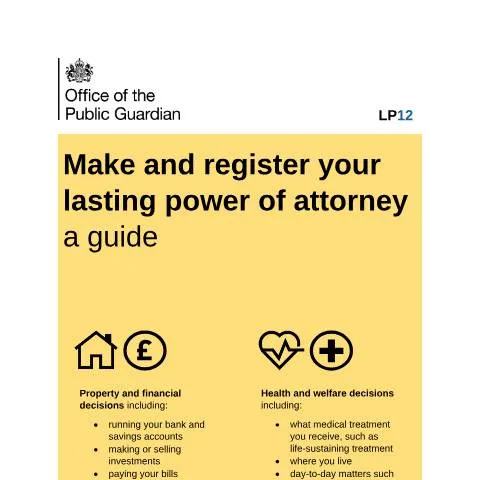
Understanding the LPA Framework: Two Distinct Legal Pathways
When individuals in England and Wales contemplate their future decision-making capacity, lasting powers of attorney emerge as the cornerstone legal instrument for maintaining autonomy. The Office of the Public Guardian administers two fundamentally different LPA forms: LP1F for property and financial affairs and LP1H for health and welfare decisions. Each serves distinct purposes and operates under different activation conditions, yet both require meticulous completion and formal registration to achieve legal validity.
The property and financial affairs LPA encompasses everything from managing bank accounts and investment portfolios to handling benefit claims and property transactions. Crucially, this form allows donors to specify whether attorneys can act immediately upon registration or only when mental capacity diminishes. Conversely, the health and welfare LPA addresses medical treatment decisions, residential care arrangements, and daily living choices, but attorneys can only exercise these powers when the donor lacks capacity to make such decisions independently.
Distinguishing Between Financial and Welfare Decision-Making
The distinction between these two LPA types reflects fundamental differences in decision-making urgency and reversibility. Financial decisions often require immediate action—paying bills, managing investments, or accessing funds during emergencies. Health and welfare decisions, however, involve deeply personal choices about medical treatment, living arrangements, and end-of-life care that should remain with the individual as long as they retain decision-making capacity.
| Decision Category | Property & Financial (LP1F) | Health & Welfare (LP1H) |
|---|---|---|
| Activation timing | Immediate or upon capacity loss | Only upon capacity loss |
| Typical decisions | Banking, investments, property sales | Medical treatment, care arrangements |
| Urgency level | Often time-sensitive | Usually allows deliberation |
| Reversibility | Generally reversible | May be irreversible |
Navigating the Multi-Party Structure of LPA Creation
Creating a valid LPA involves orchestrating multiple parties, each with specific roles and legal responsibilities. The donor initiates the process and must possess mental capacity throughout the form completion and signing phases. Attorneys accept significant fiduciary responsibilities and must understand their duties before agreeing to serve. The certificate provider serves as an independent safeguard, confirming the donor's mental capacity and understanding of the LPA's implications.
Additionally, witnesses must observe signature ceremonies, with strict independence requirements preventing attorneys from witnessing donor signatures and vice versa. The donor may also designate people to notify when registration occurs, creating an additional layer of oversight and potential intervention if concerns arise about the LPA's validity or the attorneys' conduct.
Certificate Provider Selection: Professional versus Personal Routes
The certificate provider role offers two distinct pathways. Donors may choose someone who has known them personally for at least two years, providing intimate knowledge of their character and decision-making patterns. Alternatively, they may select a professional with relevant skills—such as doctors, solicitors, or social workers—who can assess mental capacity objectively despite lacking personal history with the donor.
Professional certificate providers often bring expertise in capacity assessment but may charge fees for their services. Personal certificate providers offer cost-free certification but must genuinely know the donor well enough to evaluate their understanding and decision-making abilities accurately.
Completing Financial Affairs Forms: Section-by-Section Precision
The LP1F form demands careful attention to financial decision-making scope and attorney authority levels. Section 2 requires detailed attorney information, including full legal names, addresses, and dates of birth. Donors must specify whether multiple attorneys should act jointly (requiring unanimous decisions), jointly and severally (allowing individual action), or through mixed arrangements for different decision categories.
Section 3's decision-making framework proves particularly crucial for financial LPAs. Joint decision-making ensures collective oversight but may create delays during emergencies. Joint and several arrangements provide flexibility but reduce checks and balances. Many donors opt for hybrid approaches, requiring joint decisions for major transactions—such as property sales exceeding £50,000—while allowing individual attorney action for routine financial management.
Replacement Attorney Strategies
Section 4 addresses replacement attorney appointments, essential for maintaining LPA functionality if original attorneys become unable or unwilling to serve. Replacement attorneys can substitute for original attorneys in various scenarios: death, loss of mental capacity, disclaimer of appointment, or removal by the Court of Protection.
Strategic replacement planning considers both immediate succession and long-term sustainability. Some donors appoint replacement attorneys to step in only if all original attorneys become unavailable, while others create more complex succession plans with specific replacement triggers for individual attorneys.
Health and Welfare Forms: Navigating Personal Care Decisions
The LP1H form addresses profoundly personal decisions about medical treatment, living arrangements, and daily care routines. Unlike financial LPAs, health and welfare attorneys cannot act until the donor loses capacity to make specific health-related decisions. This timing requirement protects individual autonomy while ensuring appropriate support when needed.
Section 5 of health and welfare LPAs confronts life-sustaining treatment decisions—arguably the most sensitive aspect of advance planning. Donors must explicitly choose whether attorneys can make decisions about accepting or refusing treatment to keep them alive. This section requires careful consideration of personal values, religious beliefs, and quality-of-life preferences.
Life-Sustaining Treatment: Critical Decision Points
The life-sustaining treatment provision encompasses various medical interventions: artificial nutrition and hydration, mechanical ventilation, dialysis, and cardiopulmonary resuscitation. Donors face three options: granting attorneys authority to make these decisions, restricting attorney authority, or providing specific instructions about treatment preferences.
Many donors struggle with this section's implications, particularly the balance between preserving life and maintaining dignity. The form allows detailed instructions about treatment preferences, enabling donors to specify conditions under which they would or would not want life-sustaining interventions.
Registration Process: From Application to Active LPA
LPA registration through the Office of the Public Guardian transforms completed forms into legally operative documents. The registration application requires careful completion of sections 12 through 15, specifying who applies for registration, document delivery preferences, fee arrangements, and final signatures from donors or attorneys.
Current registration fees stand at £82 per LPA, though fee remissions and reductions may apply for individuals receiving certain benefits or demonstrating financial hardship. The Office of the Public Guardian typically processes straightforward applications within eight to ten weeks, though complex cases or those requiring additional documentation may take longer.
Notification Requirements and Potential Objections
Before registration completion, the Office of the Public Guardian notifies designated individuals using form LP3, allowing them to raise concerns about the LPA's validity or attorney suitability. Notification recipients have three weeks to submit objections, which may delay registration while the Office investigates concerns.
Common objection grounds include doubts about the donor's mental capacity when creating the LPA, concerns about attorney fraud or coercion, or technical errors in form completion. Valid objections may result in registration refusal, requiring donors to address identified issues before resubmitting their applications.
Attorney Responsibilities and Ongoing Obligations
Once registered and activated, LPAs create substantial legal responsibilities for attorneys. They must act in the donor's best interests, following Mental Capacity Act principles and any specific instructions or preferences outlined in the LPA. Financial affairs attorneys must maintain detailed records of transactions and decisions, while health and welfare attorneys must consider the donor's previously expressed wishes when making care-related decisions.
The Office of the Public Guardian monitors LPA usage through various mechanisms, including annual returns for property and financial affairs attorneys managing significant assets. Attorneys who fail to fulfil their duties may face removal from their positions, financial liability for losses caused by negligence or misconduct, and potential criminal prosecution for fraud or abuse.
Decision-Making Standards and Documentation
Attorneys must apply the best interests principle when making decisions, considering the donor's past and present wishes, beliefs, and values. For significant decisions—particularly those involving substantial financial transactions or major medical treatments—attorneys should document their decision-making process, including consultations with relevant professionals and family members.
Property and financial affairs attorneys handling substantial assets must typically submit annual reports detailing income, expenditure, and asset management decisions. These reports help the Office of the Public Guardian identify potential misuse of attorney powers and ensure appropriate oversight of vulnerable individuals' affairs.
Correction Mechanisms and LPA Modifications
The Office of the Public Guardian recognises that LPA forms may contain errors requiring correction before or after registration. Minor errors—such as incorrect dates or addresses—can often be corrected through straightforward amendment procedures. More substantial errors may require new LPA creation, particularly if they affect fundamental aspects like attorney appointments or decision-making frameworks.
Post-registration modifications face significant restrictions, reflecting the importance of LPA stability and clarity. Donors retaining mental capacity may revoke their LPAs entirely, but partial modifications typically require creating new LPAs rather than amending existing documents. This approach ensures legal certainty while protecting all parties' interests.
Cancellation and Revocation Procedures
LPA cancellation may occur through various mechanisms: donor revocation while retaining capacity, attorney disclaimer, Court of Protection intervention, or automatic termination upon donor death. Each cancellation type follows specific procedures designed to protect the donor's interests while providing clarity for attorneys and third parties relying on LPA authority.
The Office of the Public Guardian maintains public registers of LPA cancellations, enabling banks, healthcare providers, and other institutions to verify attorney authority before accepting LPA-based instructions. This system balances transparency requirements with privacy protection, ensuring appropriate access to essential information while safeguarding personal details from unnecessary disclosure.
Mental Capacity Assessment and the Role of Certificate Providers
When creating a lasting power of attorney, one of the most critical safeguards involves demonstrating that the donor has mental capacity at the time of signing. This requirement forms the cornerstone of LPA validity and involves specific assessment procedures that vary depending on your chosen approach to certification.
A certificate provider must confirm that you understand the nature and scope of the LPA, the powers being granted, and any restrictions or conditions included. This isn't merely a box-ticking exercise – the certificate provider bears legal responsibility for their assessment and could face consequences if they certify someone who clearly lacks capacity.
Who Can Act as Your Certificate Provider
You have two distinct routes for certification. The first involves professionals with relevant expertise: solicitors, barristers, registered medical practitioners, or chartered psychologists. These individuals can certify your capacity based on their professional knowledge, even if they've never met you before the LPA process.
Alternatively, you can choose someone who has known you personally for at least two years. This person must be over 18 and cannot be a family member, your attorney, or anyone else named in the LPA. They might be a long-standing friend, neighbour, or former colleague who can speak to your usual decision-making abilities and current mental state.
The certificate provider must meet with you in person – remote assessments via video call are not acceptable for LPA certification. During this meeting, they'll discuss the LPA with you, ensuring you understand what you're agreeing to and aren't under any pressure or undue influence from others.
When Capacity Concerns Arise
If you're in the early stages of dementia or have a condition that affects cognitive function, the timing of your LPA becomes crucial. The certificate provider must assess your capacity on the day of signing, not your general or historical capacity. Someone with fluctuating capacity might be deemed capable during a lucid period but not during times when their condition is more pronounced.
Medical evidence can support the certification process, particularly if you have a diagnosed condition affecting mental capacity. Your GP or consultant might provide a letter confirming your current cognitive abilities, though this isn't always necessary if the certificate provider is confident in their assessment.
Where capacity is borderline or disputed, the certificate provider might recommend postponing the LPA or seeking specialist medical assessment. They have a duty to refuse certification if they believe you lack capacity, regardless of pressure from family members or attorneys-to-be.
Witness Requirements and Signing Procedures
The physical signing of your LPA involves strict procedural requirements that, if not followed precisely, can render the document invalid. Understanding these requirements prevents costly rejections and delays in registration.
You must sign your LPA in the presence of a witness who is over 18 and not named elsewhere in the document. This witness cannot be your attorney, replacement attorney, certificate provider, or anyone related to these individuals. The witness must be physically present when you sign – they cannot arrive after you've signed to witness your signature retrospectively.
Fill in your form directly online
No printing: type your details into the boxes of the official form, tick, then download the PDF ready to send.
- 1Type into the form boxes
- 2Tick in one click
- 3Save and download the PDF
The Signing Sequence
The order of signatures follows a specific sequence that cannot be varied. You sign first, in the presence of your witness, who then immediately signs to confirm they witnessed your signature. Your certificate provider signs next, though this can happen before or after your signature, provided they've completed their assessment.
Each attorney must then sign their acceptance in the presence of their own witness. These can be different witnesses from yours, and the attorney signings can happen at different times and locations. However, all signatures must be completed before submitting the LPA for registration.
If you're unable to sign due to physical disability, you can direct someone else to sign on your behalf. This person must sign in your presence and in the presence of two witnesses (rather than one). The LPA form includes specific sections to complete when signature by direction is used.
Common Signing Errors
The Office of the Public Guardian frequently rejects LPAs due to signing irregularities. Using the wrong type of pen (pencil or erasable ink), signing in the wrong section, or having signatures witnessed by ineligible persons all constitute fatal flaws requiring a completely new LPA.
Date errors are particularly problematic. All dates must be consistent with the signing sequence, and using obviously incorrect dates (such as future dates or dates before the LPA was prepared) will trigger rejection. If you make an error while signing, you cannot simply cross it out and initial the correction – the entire form may need to be restarted.
Witnesses must provide their full name and address legibly. A witness who signs but provides incomplete details renders their witnessing invalid, requiring the relevant signature to be repeated with a new witness.
Ongoing Obligations and Post-Registration Responsibilities
Creating an LPA isn't a one-time transaction – it establishes ongoing relationships and responsibilities that continue throughout its active life. Understanding these obligations helps ensure your LPA functions effectively when needed and complies with legal requirements.
Once registered, your attorneys acquire significant legal responsibilities. They must act in your best interests, follow any instructions or preferences you've included, and make decisions you would have made if you had capacity. These aren't merely moral obligations – they're legally enforceable duties that can result in court intervention if breached.
Annual Reporting and Record-Keeping
Property and financial affairs attorneys must maintain detailed records of their decisions and transactions. While there's no automatic requirement to file annual returns with the Office of the Public Guardian, attorneys must be prepared to provide accounts if requested by the OPG, Court of Protection, or other interested parties.
Good practice involves maintaining receipts, bank statements, and decision logs that demonstrate how the attorney has managed your affairs. This documentation becomes crucial if family members or other interested parties raise concerns about the attorney's conduct.
For significant transactions – such as selling property, making large gifts, or changing investment strategies – attorneys may need prior court approval. The LPA itself might specify transaction limits or require consultation with named individuals before major decisions.
Notification Requirements
Changes in circumstances affecting the LPA must be reported to the Office of the Public Guardian. If an attorney dies, becomes bankrupt, or loses mental capacity themselves, they cease to be able to act. Replacement attorneys then step in, but only if properly appointed in the original LPA.
If you recover capacity after it was lost (rare but possible in some medical conditions), this doesn't automatically revoke the LPA. The document remains valid unless you actively revoke it while you have capacity to do so.
Moving house, changing banks, or other administrative changes don't affect the LPA's validity, but keeping the Office of the Public Guardian informed of current addresses ensures important communications reach the right people.
Safeguarding and Abuse Prevention
The LPA system includes built-in safeguards against financial abuse and neglect. Anyone can raise concerns about an attorney's conduct with the Office of the Public Guardian, which has powers to investigate and, if necessary, apply to the Court of Protection for the attorney's removal.
Family members, friends, or professionals who notice unexplained financial changes, inappropriate care decisions, or other concerning behaviour should report these concerns promptly. The OPG treats such reports seriously and can act quickly to protect vulnerable individuals.
Regular contact between you and people outside the attorney relationship provides natural oversight. Isolation often precedes or accompanies abuse, so maintaining social connections helps ensure problems are identified early.