Understanding Guardianship Challenges Under the Mental Health Act
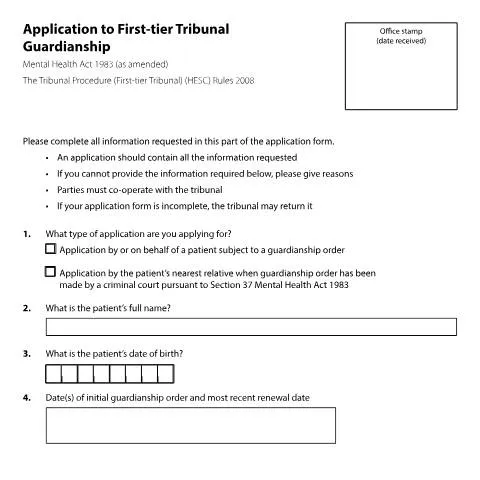
When someone is placed under guardianship through the Mental Health Act 1983, either by a civil order from a local social services authority or following a criminal court's decision under Section 37, the patient or their nearest relative retains the fundamental right to challenge this arrangement. Form T116 serves as the gateway to the First-tier Tribunal (Mental Health), enabling applications to review and potentially discharge guardianship orders that may no longer be necessary or appropriate.
The guardianship system represents one of the least restrictive forms of compulsory care under mental health legislation, yet it still imposes significant limitations on a person's autonomy. Unlike detention in hospital, guardianship allows individuals to remain in the community whilst being subject to specific powers exercised by a guardian - typically the local social services authority or, in some cases, a private individual approved by the authority.
The tribunal application process through Form T116 reflects the delicate balance between protecting vulnerable individuals and preserving their rights to challenge decisions affecting their liberty. This mechanism ensures that guardianship arrangements remain subject to independent judicial scrutiny, with panels comprising legal, medical, and specialist members who can assess whether the statutory criteria continue to be met.
Distinguishing Between Civil and Criminal Guardianship Applications
Form T116 accommodates two distinct pathways to guardianship that require different approaches when making tribunal applications. The form's opening section immediately asks applicants to specify whether they're challenging a standard guardianship order or one imposed following criminal proceedings under Section 37 of the Mental Health Act.
Civil guardianship applications typically arise when local social services authorities have made guardianship orders for individuals in the community who require support and supervision but don't need hospital treatment. These orders can be made by approved mental health professionals and are often used for people with learning disabilities, dementia, or other conditions where some level of oversight is beneficial.
Criminal court guardianship orders under Section 37 represent a sentencing disposal available to courts when dealing with offenders who have mental disorders. These orders allow courts to direct that an individual be placed under guardianship rather than receiving a prison sentence or hospital order. The tribunal process for these cases carries additional considerations around public protection and the original criminal proceedings.
The distinction matters significantly because nearest relatives have more limited rights to make applications when guardianship has been imposed by a criminal court. Form T116 specifically restricts such applications to cases where the nearest relative is challenging a Section 37 order, reflecting the different legal framework governing criminal disposals.
Navigating the Professional Network Around Guardianship
One of Form T116's most complex aspects involves identifying and providing contact details for the various professionals involved in a patient's care under guardianship. The form requires comprehensive information about multiple key figures, each playing distinct roles in the guardianship arrangement.
The Responsible Clinician holds overall clinical responsibility for the patient's treatment and care, despite the individual not being detained in hospital. This role typically falls to a consultant psychiatrist, although other qualified professionals can assume this responsibility. The Responsible Clinician must provide regular reports to the tribunal and plays a crucial role in any review of the guardianship order.
Local social services authorities feature prominently because they either serve as the guardian themselves or supervise private guardians. The form requires details of both the professional contact within the authority and, where applicable, the specific care coordinator assigned to the case. This dual structure reflects the administrative oversight role that local authorities maintain even when not directly acting as guardians.
| Professional Role | Primary Responsibility | Tribunal Involvement |
|---|---|---|
| Responsible Clinician | Clinical oversight and treatment planning | Must provide written evidence and usually attends hearings |
| Care Coordinator | Day-to-day support and monitoring | Provides social circumstances report |
| Guardian (if private) | Exercise of guardianship powers | May be required to attend and give evidence |
| Local Authority Contact | Statutory oversight and compliance | Ensures proper procedures followed |
The 'Other' professional category allows for additional care team members who might have relevant input, such as community psychiatric nurses, occupational therapists, or specialist support workers. Including these details helps the tribunal build a comprehensive picture of the support network and care arrangements.
Nearest Relative Rights and Complexities
The nearest relative provisions within Form T116 reveal some of the most intricate aspects of mental health law. The Mental Health Act establishes a hierarchy of relatives with specific rights and responsibilities, and identifying the correct nearest relative can sometimes prove contentious or complicated.
Form T116 restricts nearest relative information to non-restricted cases only, acknowledging that different rules apply when patients are subject to restriction orders or have been involved in serious criminal proceedings. For standard guardianship cases, the nearest relative holds significant rights including the ability to make tribunal applications and receive information about the patient's care.
The form includes a crucial question about whether the patient objects to their nearest relative being informed about the case. This reflects the tension between family involvement and patient confidentiality that frequently arises in mental health proceedings. When patients object to nearest relative involvement, the tribunal must balance these wishes against the statutory framework that grants relatives specific rights.
Determining the nearest relative follows a strict legal hierarchy: spouse or civil partner, child, parent, sibling, grandparent, grandchild, uncle or aunt, nephew or niece. However, this apparent simplicity can become complex when relationships have broken down, when patients have been living with someone not legally recognised as a relative, or when the statutory nearest relative lives abroad or is otherwise unsuitable.
Legal Representation and Support Options
Form T116 places considerable emphasis on legal representation arrangements, reflecting the complex legal and clinical issues that tribunal hearings typically involve. The form acknowledges that while individuals have the right to represent themselves, the technical nature of mental health law makes professional assistance highly valuable.
The tribunal system provides free legal representation to all applicants, removing financial barriers to accessing justice. This provision recognises that many people subject to guardianship may have limited financial resources and that the stakes involved - personal liberty and autonomy - justify public funding of legal support.
Applicants can choose between three options: appointing their own legal representative, requesting that the tribunal appoint one on their behalf, or proceeding without representation. The middle option often proves most practical, as the tribunal maintains panels of experienced solicitors and barristers specialising in mental health law who understand the specific procedures and legal tests involved.
When the tribunal appoints representation, the assigned lawyer will contact the applicant to discuss the case, gather evidence, and prepare for the hearing. This process typically begins several weeks before the scheduled hearing date, allowing sufficient time for proper preparation and any necessary expert reports.
Hearing Arrangements and Accessibility Provisions
The modern tribunal system has adapted to provide flexible hearing arrangements that accommodate the diverse needs of mental health patients and their circumstances. Form T116 allows applicants to specify their preferences between video hearings and face-to-face proceedings, recognising that different formats may suit different individuals better.
Video hearings have become increasingly common, particularly following developments during the pandemic period. These can reduce travel burdens for patients and families whilst maintaining the interactive nature of tribunal proceedings. However, some applicants prefer the more personal atmosphere of face-to-face hearings, particularly when dealing with complex family dynamics or when patients have conditions that make video interaction challenging.
The form's special requirements section addresses accessibility needs that extend beyond basic hearing formats. Interpreter services are available for patients whose first language isn't English or who have hearing impairments requiring sign language interpretation. The tribunal service maintains access to interpreters in numerous languages and dialects, though advance notice helps ensure appropriate arrangements.
Other special requirements might include physical accessibility needs for wheelchair users, adjustments for patients with autism or learning disabilities, or arrangements for patients who experience anxiety in formal settings. The tribunal's overriding duty is to ensure fair proceedings, which sometimes requires creative solutions to accommodate individual needs.
Submission Pathways and Processing Timelines
Form T116 offers three distinct submission methods, each with specific advantages and considerations. The choice between secure email, postal, and DX delivery can affect processing times and provide different levels of confirmation that applications have been received.
Secure email submission to [email protected] offers the fastest processing route and provides immediate confirmation of receipt. However, applicants must ensure they have secure email capabilities and that all supporting documents can be adequately scanned or photographed. The tribunal service's secure systems protect sensitive medical and personal information during transmission.
Traditional postal submission to the Leicester processing centre remains popular with applicants who prefer handling paper documents or lack reliable internet access. First-class post is recommended to ensure prompt delivery, though applicants should consider using recorded delivery for additional security given the sensitive nature of the documentation.
The DX service provides a professional delivery option typically used by legal representatives and healthcare institutions. This system offers tracking capabilities and is particularly suited to bulk submissions from legal firms handling multiple cases.
Once received, applications undergo initial processing to ensure completeness and compliance with tribunal rules. Incomplete applications may be returned, potentially delaying proceedings by several weeks. The tribunal aims to list hearings within eight weeks of receiving complete applications, though complex cases or those requiring additional reports may take longer.
Strategic Considerations for Effective Applications
Successfully navigating the Form T116 process requires understanding both the immediate procedural requirements and the broader strategic context of challenging guardianship orders. The tribunal will ultimately assess whether the statutory criteria for guardianship continue to be met, making the quality and completeness of the initial application crucial to achieving positive outcomes.
Timing considerations play a significant role in application strategy. While patients and nearest relatives can apply to tribunals at any time during guardianship, the strength of the case may vary depending on how recently the order was made, whether circumstances have changed, and what alternative support arrangements might be available.
The form's requirement for comprehensive professional contact details serves a strategic purpose beyond mere administration. Tribunals rely heavily on reports from responsible clinicians and care coordinators, and ensuring these professionals are properly identified and contacted early in the process helps prevent delays and ensures all relevant evidence reaches the tribunal.
Applicants should consider the implications of their choices regarding legal representation and hearing format. While self-representation is possible, the legal tests for guardianship discharge involve complex assessments of mental disorder, necessity, and alternative arrangements that benefit from professional advocacy. Similarly, hearing format choices should reflect not just personal preferences but also practical considerations about presenting evidence effectively and managing the stress of formal proceedings.
The tribunal's emphasis on cooperation between parties reflects the collaborative approach that often produces the best outcomes. Rather than viewing proceedings as purely adversarial, successful applications often demonstrate constructive engagement with care teams and realistic proposals for alternative support arrangements that address legitimate concerns about the patient's welfare and safety.
Understanding the Legal Framework: Mental Health Act 1983 and Guardianship Orders
The First-tier Tribunal (Mental Health) operates within a comprehensive legal framework established primarily by the Mental Health Act 1983, as amended by the Mental Health Act 2007. When applying using Form T116, you're engaging with a system designed to balance individual rights with necessary protective measures.
Guardianship orders under section 7 of the Mental Health Act 1983 grant specific powers to either a local authority or an approved private guardian. These powers include determining where the person should live, requiring them to attend specific places for medical treatment, work, education or training, and ensuring access for doctors, approved mental health professionals, or other specified persons. Understanding these powers is crucial when completing Form T116, as your application will directly challenge or seek to modify these arrangements.
The tribunal's jurisdiction extends beyond simple approval or rejection of guardianship. Under section 23 of the Act, the tribunal can discharge the guardianship order entirely if they determine it's no longer necessary or appropriate. Alternatively, they may recommend changes to the conditions whilst maintaining the guardianship framework. This nuanced approach means your Form T116 application should clearly articulate not just why you're applying, but what specific outcome you're seeking.
Recent case law has established important precedents regarding the tribunal's approach to guardianship applications. The Court of Appeal's decision in R (on the application of H) v Mental Health Review Tribunal emphasised that guardianship must represent the least restrictive option available. When completing section 4 of Form T116, reference to such legal principles can strengthen your application, particularly if you can demonstrate that less restrictive alternatives now exist or that circumstances have fundamentally changed.
The tribunal must also consider the person's capacity under the Mental Capacity Act 2005. Where someone lacks capacity to make specific decisions, the guardianship order must be proportionate to this incapacity. If you're arguing that capacity has been regained or that the original assessment was flawed, detailed medical evidence supporting this position should accompany your Form T116 submission.
Preparing Supporting Evidence and Documentation Strategy
A successful Form T116 application hinges significantly on the quality and comprehensiveness of supporting documentation. The tribunal expects evidence that goes beyond mere assertions, requiring substantive proof of changed circumstances, improved mental health, or procedural irregularities in the original guardianship order.
Medical evidence forms the cornerstone of most applications. Recent psychiatric reports, ideally no older than three months, should address the specific criteria that justified the original guardianship order. These reports must explicitly state whether the reporting clinician believes guardianship remains necessary and proportionate. If you're instructing an independent psychiatrist, ensure they have access to the complete medical history, including the original assessment that led to guardianship. The tribunal places considerable weight on consistency between different medical opinions, so any discrepancies should be addressed proactively.
Social circumstances evidence is equally critical. This includes accommodation arrangements, support networks, and demonstrated ability to manage daily living tasks independently. Local authority social services departments often maintain detailed care assessments that can support your application if they show improved functioning or changed circumstances. Where family or community support has strengthened since the guardianship order, witness statements from these supporters can provide compelling evidence of reduced risk and increased protective factors.
Financial evidence may be relevant, particularly where the guardianship order includes powers over financial affairs. Bank statements, benefits correspondence, and evidence of successful money management can demonstrate capacity that may not have existed when guardianship was first imposed. If you're using a representative payee arrangement or have other financial safeguards in place, documentation of these alternative protective measures supports arguments for less restrictive alternatives.
Educational or employment evidence can demonstrate significant life changes since guardianship began. Completion of courses, successful work placements, or voluntary activities all indicate improved functioning and reduced need for statutory intervention. Letters from employers, tutors, or voluntary organisations carry particular weight when they address reliability, judgment, and ability to follow guidance – factors directly relevant to guardianship criteria.
Where your application challenges procedural aspects of the original guardianship order, contemporaneous documentation becomes crucial. This might include correspondence with the local authority, records of consultation meetings, or evidence that proper procedures weren't followed during the initial assessment. The Mental Health Act Code of Practice sets detailed standards for guardianship applications, and demonstrable departures from these standards can form grounds for tribunal intervention.
Navigating the Tribunal Hearing Process and Oral Advocacy
Following submission of Form T116, the tribunal hearing represents your primary opportunity to present your case directly to the decision-makers. Understanding the hearing format, panel composition, and effective advocacy strategies significantly influences your prospects of success.
The tribunal panel typically comprises a legally qualified judge, a medical member (usually a consultant psychiatrist), and a lay member with relevant experience in mental health services. Each member brings distinct expertise, requiring your presentation to address legal, medical, and practical considerations simultaneously. The judge focuses on procedural correctness and human rights compliance, the medical member evaluates clinical evidence and treatment recommendations, whilst the lay member considers social factors and the practical impact of guardianship on daily life.
Hearing preparation should include thorough review of all documentation submitted with your Form T116, as panel members will have studied these papers in advance. Be prepared for detailed questioning about inconsistencies, gaps in evidence, or claims that require clarification. If you're representing yourself, practice explaining complex situations clearly and concisely, as tribunal time is limited and panel members appreciate structured, focused presentations.
The responsible authority (usually the local authority) will present their case for maintaining guardianship. Their representative, often a solicitor accompanied by the responsible clinician and allocated social worker, will highlight ongoing risks and argue for continued statutory intervention. Understanding their likely arguments helps you prepare counter-evidence and alternative proposals. Common authority arguments include concerns about medication compliance, accommodation stability, vulnerability to exploitation, and ability to maintain personal safety.
Witness coordination requires careful planning. If family members, friends, or professionals are attending to support your application, brief them on the tribunal format and likely questions. Witnesses should focus on specific examples rather than general character references, particularly evidence of improved judgment, reduced risk-taking behaviour, or successful management of challenging situations. The tribunal values concrete examples over abstract assertions about recovery or capability.
Cross-examination of authority witnesses presents opportunities to challenge their evidence, but requires careful handling. Focus on factual inconsistencies, outdated assessments, or failure to consider less restrictive alternatives rather than attacking professional competence. Panel members respect measured, evidence-based challenges whilst viewing aggressive or personal attacks unfavourably.
Alternative proposals should be detailed and realistic. If you're seeking discharge from guardianship, present specific arrangements for accommodation, medical care, financial management, and crisis support. The tribunal must be satisfied that adequate safeguards exist without statutory intervention. Where complete discharge seems unlikely, propose modifications to guardianship conditions that address the authority's concerns whilst reducing restrictions on your freedom.
The tribunal's decision may be announced immediately after the hearing or reserved for written delivery within a specified timeframe. Immediate decisions often indicate clear-cut cases, whilst reserved decisions suggest the panel requires time to consider complex evidence or legal issues. Regardless of timing, the decision will include detailed reasoning explaining why guardianship should continue, be modified, or be discharged entirely. Understanding these reasons is crucial if you're considering appeal options or planning future applications.