When Mental Health Professionals Must Refer Cases to the First-tier Tribunal
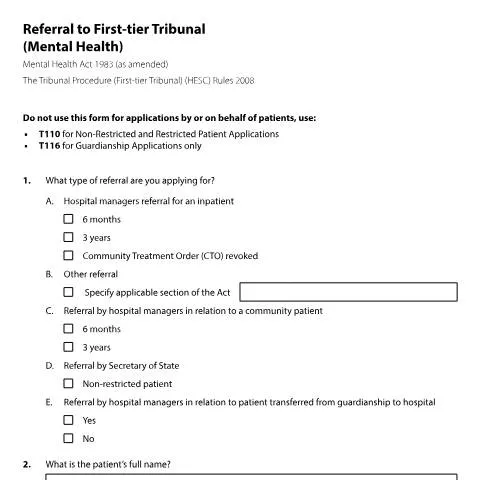
The First-tier Tribunal (Mental Health) serves as a crucial independent judicial body that reviews decisions about patients detained under the Mental Health Act 1983. While patients themselves can apply directly to challenge their detention, certain circumstances require mental health professionals to make formal referrals on their behalf. Form T111 facilitates these mandatory referrals, ensuring that patients' rights are protected even when they haven't initiated proceedings themselves.
This referral mechanism operates as a statutory safeguard, particularly important for patients who may lack capacity to understand their legal rights or who have been detained for extended periods without tribunal review. The form captures five distinct referral scenarios, each triggering specific legal obligations and timescales that mental health services must navigate carefully.
The Five Distinct Referral Pathways Under Form T111
Form T111 accommodates several referral types, each governed by different sections of the Mental Health Act and subject to varying procedural requirements:
Hospital Manager Referrals for Inpatients
Hospital managers must refer cases when patients have been detained continuously for specific periods without tribunal review. The form distinguishes between 6-month referrals for shorter-term sections and 3-year referrals for longer-term detention orders. Additionally, when a Community Treatment Order (CTO) has been revoked and the patient returned to hospital, managers must make an immediate referral.
These timeframes aren't arbitrary - they reflect Parliament's recognition that prolonged detention without independent judicial review undermines fundamental liberties. Hospital managers bear legal responsibility for monitoring these deadlines and cannot delegate this duty to clinical staff.
Community Patient Referrals
For patients subject to Community Treatment Orders, hospital managers must refer cases at 6-month or 3-year intervals, depending on the underlying section. This ensures that patients living in the community but still subject to compulsory powers receive regular independent review of their legal status.
The community setting adds complexity to these referrals, as patients may be geographically dispersed and receiving care from multiple agencies. Form T111 captures details of community supervisors and care coordinators to ensure the tribunal has complete information about current arrangements.
Secretary of State Referrals
The Secretary of State for Justice can refer non-restricted patients to the tribunal, typically exercising this power when systemic concerns arise about a patient's detention or when other referral mechanisms have failed. These referrals are relatively uncommon but serve as an important backstop in the legal framework.
Guardianship Transfer Situations
When patients are transferred from guardianship to hospital detention, specific referral obligations arise. Form T111 includes a dedicated section for these circumstances, recognising that such transfers represent significant changes in the restrictiveness of compulsory powers.
Critical Information Requirements and Legal Representative Provisions
Form T111 demands comprehensive information about the patient's current circumstances, legal status, and support network. The form's structure reflects the tribunal's need to understand both the medical and social context surrounding the detention.
Patient Location and Care Arrangements
The form requires precise details about whether the patient currently resides in hospital or the community, along with complete contact information for the responsible hospital. For community patients, details of the community supervisor or care coordinator must be provided, ensuring the tribunal can access current clinical perspectives.
This information proves vital during tribunal hearings, as panel members need to understand current care arrangements and proposed alternatives to detention. Incomplete or outdated information can delay proceedings and potentially prejudice the patient's case.
Nearest Relative Considerations
For non-restricted cases, Form T111 captures details of the patient's nearest relative, including their relationship and contact information. Critically, the form asks whether the patient objects to their nearest relative being informed about the case - a question that reflects the tension between family involvement and patient autonomy.
The nearest relative provisions in mental health law remain controversial, particularly where family relationships are strained or where patients fear discrimination. The tribunal must balance these concerns against the nearest relative's statutory rights, including their right to receive information about tribunal proceedings.
Legal Representative Arrangements
One of Form T111's most significant features addresses legal representation. The form requires referrers to confirm whether the patient has appointed a legal representative and, if not, to document the patient's preferences regarding representation.
| Patient's Position | Required Action | Tribunal Response |
|---|---|---|
| Has appointed representative | Provide full contact details | Direct correspondence to representative |
| Intends to appoint representative | Note patient's intention | Allow reasonable time for appointment |
| Wants representative appointed | Confirm discussion took place | Arrange appointment through duty scheme |
| Declines representation | Document patient's decision | Proceed without representative |
This systematic approach ensures that patients' representation preferences are properly recorded and respected, while protecting those who may lack capacity to make informed decisions about legal representation.
Navigating Tribunal Procedures and Hearing Arrangements
Form T111 includes provisions for special requirements and hearing preferences, reflecting the tribunal's commitment to accessible justice. These arrangements can significantly impact the patient's experience and their ability to participate effectively in proceedings.
Language and Communication Support
The form specifically asks whether the patient requires an interpreter, covering both different languages and dialects. This reflects the tribunal's recognition that effective participation requires genuine understanding, not merely the ability to speak English. Dialectal differences can be particularly important in mental health contexts, where subtle communication nuances may affect clinical assessments.
Interpretation services extend beyond spoken language to include British Sign Language and other communication methods. The tribunal service maintains approved interpreter lists and can arrange specialist support, but advance notice through Form T111 ensures appropriate resources are available on the hearing date.
Hearing Format Preferences
Recent technological developments have expanded hearing options, and Form T111 now captures patient preferences between video hearings and face-to-face hearings. This choice carries significant implications for patient participation and the tribunal's ability to assess mental state and capacity.
Video hearings offer advantages for patients who find hospital environments distressing or who have mobility difficulties. However, some clinical evidence suggests that video technology can impair the tribunal's ability to assess subtle aspects of mental state, potentially disadvantaging patients whose presentation is complex or fluctuating.
Submission Procedures and Administrative Safeguards
Form T111 must be submitted through specific channels that vary depending on the type of referral, reflecting the tribunal service's need to manage different case types efficiently while maintaining security and audit trails.
Section 2 Applications: Expedited Processing
Section 2 applications receive separate treatment due to their urgency - patients detained under Section 2 face initial 28-day detention periods that can be renewed, making swift tribunal review essential. These applications must be sent to dedicated contact points:
- DX 743090 Leicester 35 for document exchange users
- PO Box 11231, Leicester LE1 8FR for postal submissions
- [email protected] for email submissions
The separate processing stream ensures that Section 2 cases receive priority handling, typically resulting in hearing dates within 7-14 days of referral. This expedited timeframe places significant demands on all parties to prepare cases quickly while maintaining quality.
Other Applications: Standard Processing
All other referral types use the standard submission route to [email protected] or the Leicester postal address. These cases typically involve longer-term detention orders where slightly extended preparation times are acceptable, though the tribunal remains mindful of patients' right to timely justice.
The form explicitly warns against multiple submissions, reflecting problems with duplicate applications that can confuse case management systems and delay processing. Each submission generates a unique case reference that should be used for all subsequent correspondence.
Professional Responsibilities and Statutory Compliance
Completing Form T111 requires understanding of complex legal obligations that extend beyond simple form-filling. Mental health professionals must ensure compliance with statutory timeframes while gathering accurate information that may come from multiple sources.
Declaration Requirements and Legal Certainty
The form's declaration section requires the referrer to confirm that they are making either a Section 68 referral by hospital managers that conforms to statutory time limits or a referral by the Secretary of State. This declaration carries legal significance - incorrect declarations can invalidate referrals and potentially breach patients' rights to timely tribunal review.
Hospital managers making Section 68 referrals must verify that statutory timeframes have been met. These calculations can be complex, particularly where patients have been subject to multiple sections or where detention periods have been interrupted by brief discharges or transfers between hospitals.
Fill in your form directly online
No printing: type your details into the boxes of the official form, tick, then download the PDF ready to send.
- 1Type into the form boxes
- 2Tick in one click
- 3Save and download the PDF
Information Accuracy and Professional Liability
Form T111 warns that only information given on this form will be registered, placing significant responsibility on referrers to ensure completeness and accuracy. Missing or incorrect information can delay tribunal hearings, potentially extending patients' detention periods unnecessarily.
Professional liability considerations arise where referrers provide inaccurate information, particularly regarding dates of detention or current legal status. While tribunals have powers to request additional information, initial inaccuracies can prejudice cases and may breach professional duty of care standards.
Distinguishing Referrals from Patient Applications
Form T111 serves a fundamentally different purpose from patient application forms T110 and T116, though this distinction isn't always clear to mental health staff. Understanding these differences proves crucial for ensuring appropriate legal procedures are followed.
Mandatory versus Voluntary Proceedings
T111 referrals are mandatory professional obligations triggered by statutory timeframes or specific circumstances. In contrast, T110 and T116 applications represent patients exercising their right to challenge detention or guardianship. This distinction affects case management, timescales, and the tribunal's approach to proceedings.
Mandatory referrals cannot be withdrawn by patients or their representatives - once submitted, the tribunal must proceed to hearing unless the patient is discharged or their legal status changes. This differs from patient applications, which can be withdrawn at the patient's request.
Professional versus Patient Perspective
Form T111 captures the professional perspective on detention, focusing on legal compliance and current care arrangements. Patient application forms, by contrast, centre on the patient's experience and their grounds for challenging detention. These different perspectives can lead to significantly different presentations of the same case.
Mental health professionals must recognise that their duty extends beyond completing T111 - they should also ensure patients understand their right to make separate applications and have access to appropriate legal advice about exercising those rights.
Managing Complex Cases and Special Circumstances
Form T111 must accommodate diverse patient populations and complex clinical scenarios that don't always fit neatly into standard categories. Understanding how to handle these situations ensures that vulnerable patients receive appropriate tribunal review.
Patients Lacking Capacity
When patients lack capacity to express preferences about legal representation or hearing arrangements, referrers face difficult decisions about completing relevant sections. The Mental Capacity Act 2005 provides guidance, but practical application in tribunal contexts requires careful consideration of the patient's best interests.
For capacity-related decisions, referrers should document their assessment process and reasoning. Where doubt exists about capacity, involving Independent Mental Capacity Advocates (IMCAs) or seeking court guidance may be appropriate before submitting the referral.
Cross-Border and Jurisdictional Issues
Patients detained in England may have connections to Wales, Scotland, or Northern Ireland that complicate referral procedures. While Form T111 applies to English tribunals, understanding jurisdictional boundaries ensures that patients receive review in the appropriate legal system.
Similar considerations arise for patients with overseas connections, particularly where language barriers or cultural factors affect their ability to participate in proceedings. Early identification of these issues through careful completion of Form T111 enables tribunals to arrange appropriate support services.
The tribunal system continues to evolve in response to changing healthcare delivery models and legal developments. Recent emphasis on digital transformation and patient-centred approaches will likely influence future iterations of Form T111, but the fundamental principles of independent review and procedural fairness remain constant. Mental health professionals using this form contribute to a vital safeguard that protects some of society's most vulnerable individuals from inappropriate detention while ensuring that necessary treatment can continue under proper legal oversight.