Understanding the Application Process for the First-tier Tribunal (Mental Health) Using Form T110
The First-tier Tribunal (Mental Health) plays a crucial role within the UK legal framework for mental health cases, providing a formal process for individuals subject to mental health legislation to challenge or review their detention or treatment arrangements. The official application form, known as Form T110, is a vital document that enables relevant parties to initiate proceedings before the tribunal. This guide offers an overview of the purpose, scope, and key procedures associated with submitting a T110 application.
Purpose and Scope of Form T110
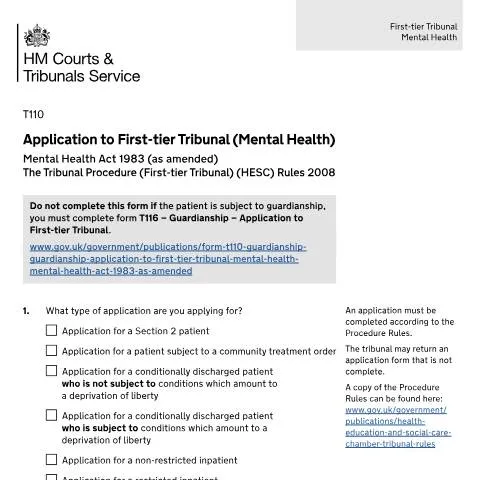
Form T110 is designed to facilitate applications to the First-tier Tribunal (Mental Health) under the authority of the Mental Health Act 1983 (as amended). It covers a range of applications, including requests for review of detention under specific sections of the Act, such as Section 2, or applications related to community treatment orders and conditional discharges. The form also caters to applications by patients’ nearest relatives or legal representatives seeking to challenge or review detention and treatment conditions.
It is important to note that this form is not used for cases subject to guardianship, which require the completion of a different form, specifically Form T116. The T110 form ensures that applications are properly structured and contain all necessary information for the tribunal to process the case efficiently.
Who Can Use Form T110?
- Patients: Individuals detained under the Mental Health Act who wish to challenge their detention or conditions.
- Nearest Relatives: Family members or close relatives of the patient, particularly in non-restricted cases, can submit applications on behalf of the patient.
- Legal Representatives: Solicitors or legal advisors acting on behalf of the patient or relative can submit applications and provide legal support throughout the process.
Key Sections and Information Required
The form is structured to gather comprehensive details essential for the tribunal’s review:
Type of Application
Applicants must specify the nature of their application, selecting from options such as:
- Application for a Section 2 patient
- Application for a patient under community treatment order
- Application for a conditionally discharged patient
- Application for inpatient status (restricted or non-restricted)
- Other specific applications, including dual detention or by a non-restricted patient
Patient Details
Accurate personal information is critical, including the full name, date of birth, and current living arrangements (hospital or community). Details of the original detention section and relevant dates are also required to establish the case context.
Detention and Care Details
The form asks for specifics about the section under which the patient is detained, the date of detention, and whether they are subject to conditions that amount to a deprivation of liberty. Additionally, the current address and the hospital responsible for care are recorded.
Representation and Support
Applicants can specify whether they have legal representation, wish to appoint a legal advisor, or require an interpreter. Details of legal representatives, if applicable, are also collected to facilitate communication and legal proceedings.
Fill in your form directly online
No printing: type your details into the boxes of the official form, tick, then download the PDF ready to send.
- 1Type into the form boxes
- 2Tick in one click
- 3Save and download the PDF
Submission and Next Steps
Once completed, the application must be checked for accuracy and completeness. It can be submitted either by email or postal mail to designated addresses provided by HM Courts & Tribunals Service. It is recommended not to submit multiple copies of the same application to avoid processing delays.
Applicants are encouraged to consult the Procedure Rules for detailed guidance on the application process and tribunal procedures.
Conclusion
Form T110 is a fundamental document for individuals involved in mental health tribunal proceedings in the UK. It ensures that applications are formally registered and contain all relevant information for a fair review of detention or treatment conditions. Understanding the structure and requirements of this form can help applicants navigate the legal process more effectively, ensuring their rights and interests are adequately represented before the tribunal.