The Importance of Form C19 in Child Welfare Proceedings
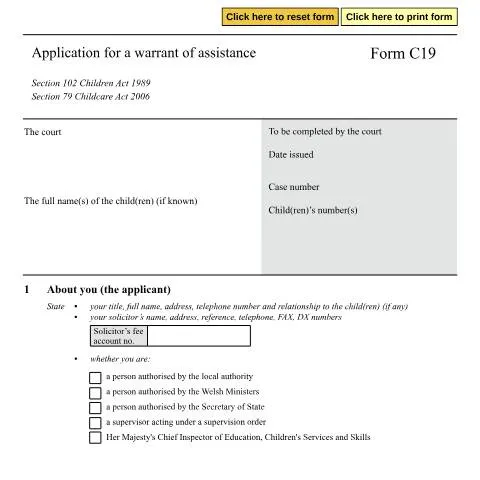
When navigating the complexities of child welfare in the UK, professionals often find themselves needing to apply for a warrant of assistance through the legal system. This is where Form C19, officially titled "Apply for a warrant of assistance," becomes crucial. It serves as a vital tool for those authorized to enter premises in order to protect children or to execute specific duties outlined under the Children Act 1989 and Childcare Act 2006. Understanding how to utilize this form appropriately can significantly impact the welfare of children involved in legal proceedings.Who Needs to Submit Form C19?
This form is primarily submitted by individuals or organizations with legal authority to act in the interest of children. This includes:- Persons authorized by the local authority
- Individuals authorized by the Welsh Ministers
- Persons authorized by the Secretary of State
- Supervisors acting under a supervision order
- Her Majesty's Chief Inspector of Education, Children's Services and Skills
Understanding the Roles in Context
The individuals listed above are not merely bureaucratic titles; they are crucial players in ensuring child safety and welfare. For instance, a social worker from the local authority might submit Form C19 to gain access to a child's residence to conduct an assessment. In contrast, a supervisor under a supervision order may need this warrant to ensure the welfare of a child they oversee.Initiating the Application Process
The journey to obtaining a warrant of assistance begins with a clear understanding of the grounds for application. Depending on the circumstances, the applicant must fill out specific sections of Form C19, including:- Personal details of the applicant
- Description and identification details of the child(ren) involved
- The grounds for the application based on statutory powers
- Information about the respondent(s)
- Reasons for the application
- Specific directions sought from the court
Articulating Grounds for Application
In this section, the applicant must explicitly state why they require the warrant. They must reference applicable sections of the Children Act 1989 or the Childcare Act 2006. This may include situations where the applicant anticipates being denied access to a child or premises where care is provided.Submission Channels: Online, Paper, or In-Person
Once the form is completed, applicants can submit Form C19 through various channels. Choosing the right method depends on urgency, accessibility, and the specifics of the case.Online Submissions
In certain cases, applicants may be able to submit the form online via the HM Courts & Tribunals Service portal. This option is particularly advantageous for those seeking expedited processing.Paper Submission
For those who prefer traditional methods or do not have access to the internet, submitting a paper form is standard. Fill out the form accurately and send it to the appropriate court based on the case number provided.In-Person Submission
Submitting Form C19 in person at the relevant court office can offer the benefit of immediate feedback. This method allows applicants to address any questions or clarifications directly with court staff, which can streamline the process.A Step-by-Step Timeline from Application to Decision
Understanding the timeline of the application process can also help manage expectations. Here’s how it generally unfolds:- Preparation: Gathering the necessary information and completing Form C19 may take several days to weeks, depending on the complexity of the case.
- Submission: Once submitted, the court will assign a case number and schedule a hearing.
- Review: The court will review the application, usually within a few days to a couple of weeks, depending on their caseload.
- Hearing: A hearing may be scheduled where the applicant can present their case. The court will assess the validity of the application based on the information provided.
- Decision: After deliberation, the court will issue a decision, often providing the outcome within a week or two post-hearing.
Post-Decision Actions: Understanding Your Options
Upon receiving a decision regarding the warrant application, the next steps depend entirely on the outcome.Granted Applications
If the warrant of assistance is granted, the applicant is empowered to proceed with their intended action. This may involve accompanying law enforcement officials to the specified premises to execute their duties effectively.Refused Applications
In the event that the application is denied, it’s crucial to understand the grounds for rejection. The court may provide specific reasons, ranging from insufficient evidence to procedural errors.- Rectification: If the refusal is due to missing information, applicants can rectify the issue and resubmit.
- Appeal: If the applicant believes the court's decision was unjust, they may explore options for appeal, although this can be a lengthy process.
Common Challenges and Solutions When Completing Form C19
Filling out Form C19 can pose various challenges, particularly given the sensitive nature of child welfare cases. Here are several common issues and how to navigate them:Inaccurate Information
Providing incorrect details can lead to delays or refusals. Double-check all information, especially identifying details about the child(ren) and relationships to the applicants or respondents.Missing Supporting Documents
It is essential to include any required documentation that supports the arguments made in the application. This may include reports from social services, medical professionals, or any relevant correspondence. Failing to include these can result in an immediate dismissal of the application.Clarifying Legal Terminology
Legal jargon can be daunting. If unsure about specific terminology or sections of the form, consulting with a legal professional or a representative from the local authority can help clarify important points.Understanding the Broader Context of Child Welfare Legal Frameworks
Form C19 does not exist in isolation but is part of a broader system designed to safeguard children's welfare. The legal frameworks established by the Children Act 1989 and the Childcare Act 2006 play pivotal roles in shaping how authorities interact with families and children.Legislative Background
The Children Act 1989 emphasizes the paramount importance of the child's welfare in all decisions relating to them. This underpins the need for warrants, allowing access to children in potentially harmful situations. Similarly, the Childcare Act 2006 enhances protections for children in early years settings, ensuring their needs are met with appropriate care and oversight.Interagency Collaboration
Effective child welfare requires collaboration among various agencies, including the local authority, healthcare providers, and educational institutions. The issuance of a warrant of assistance is often a collaborative effort involving multiple stakeholders, each with a role in ensuring the child’s best interests are prioritized.Moving Forward: Best Practices for Applicants
To navigate the application process effectively and increase the likelihood of success, consider implementing these best practices:- Engage Early: Gather information and documents as soon as a concern arises to ensure a timely submission.
- Consult Legal Experts: When in doubt, seeking advice from legal professionals can provide invaluable guidance and clarity.
- Follow Up: After submission, it’s wise to follow up with the court to ensure your application is being processed as expected.
Understanding the Purpose and Process of a Warrant of Assistance
A Warrant of Assistance is a judicial order that authorises certain individuals, often related to assessing and collecting debts or enforcing a court order, to assist in the execution of that order. In the context of Form C19, which is the application form for a Warrant of Assistance, it is crucial to understand not only the procedural steps involved but also the specific circumstances under which such a warrant can be issued.
This form is particularly relevant in cases where an individual has failed to comply with a judgment or an order, such as non-payment of debts, and further enforcement actions are warranted. The application for a Warrant of Assistance typically requires the submission of detailed information regarding the circumstances of the case, including previous actions taken to enforce the judgment. Details such as the identity of the debtor, the nature of the debt, and any communication that has occurred regarding the debt are essential.
It's essential to note that the issuance of a Warrant of Assistance is not automatic and is subject to the discretion of the court. The applicant must provide a compelling case that outlines why the assistance of the court is necessary to enforce compliance. The court will consider factors such as the debtor's financial situation, any previous attempts at recovery, and whether the warrant would be a proportionate response.
Eligibility Criteria for Applying for a Warrant of Assistance
Before applying for a Warrant of Assistance using Form C19, it is important to determine whether you meet the eligibility criteria set forth by the court. Not all cases will qualify for a Warrant of Assistance, and understanding these criteria can save applicants time and resources.
One of the primary conditions is that there must be an existing court order that has not been complied with. This means that a Warrant of Assistance is typically used in conjunction with other court orders, like judgments for money owed or enforcement orders. Additionally, the applicant must be able to demonstrate that they have made reasonable attempts to collect the debt without the assistance of the court, which may include providing evidence of communication with the debtor or records of any payments made or arrangements proposed.
Another important aspect is the nature of the relationship between the applicant and the debtor. The court is likely to scrutinise any potential conflicts of interest and may require that the applicant be an impartial party with the legitimate interest in enforcing the order. Furthermore, the applicant should understand that the process can take time, and patience is often necessary as the court assesses the legitimacy of the application.
In some instances, specific exemptions may apply that could affect eligibility. For example, if the debtor is in a vulnerable situation, such as experiencing financial hardship, the court may hesitate to issue a Warrant of Assistance. This consideration underscores the need for applicants to be thoroughly prepared, understanding not only their rights but also the rights of the debtor they are seeking to compel compliance from.
Steps Following the Issuance of a Warrant of Assistance
Once a Warrant of Assistance has been granted, there are several steps the applicant must follow to execute the court's order effectively. It’s essential to approach this phase with a clear understanding of the legal implications and the involved parties to avoid further complications.
The first step is to ensure that a copy of the Warrant is served to the relevant parties. This may include the debtor as well as any other individuals or organisations that may be involved in the enforcement process. Serving the Warrant properly is crucial, as failure to do so could lead to delays or a dismissal of the enforcement action.
Fill in your form directly online
No printing: type your details into the boxes of the official form, tick, then download the PDF ready to send.
- 1Type into the form boxes
- 2Tick in one click
- 3Save and download the PDF
Next, it is advisable to liaise with the enforcement officers or bailiffs appointed by the court. They play a pivotal role in the execution of the Warrant of Assistance and can provide guidance on what actions can or cannot be taken. Depending on the circumstances, this may include seizing assets, garnishing wages, or taking further legal steps to ensure compliance.
Throughout this process, maintaining detailed records of all communications and actions taken is imperative. This documentation can serve as vital evidence should any disputes arise or if further legal actions become necessary. Additionally, applicants should remain aware of the legal rights of the debtor, ensuring that all actions taken comply with the law and the regulatory standards set forth in the UK legal system.
Finally, after the Warrant has been executed, the applicant may need to provide the court with evidence of compliance, such as payment records or confirmation that the matter has been resolved. This follow-up ensures that the case is officially closed, and the court's records are updated accordingly.