Criminal advocacy assistance: when legal representation becomes essential
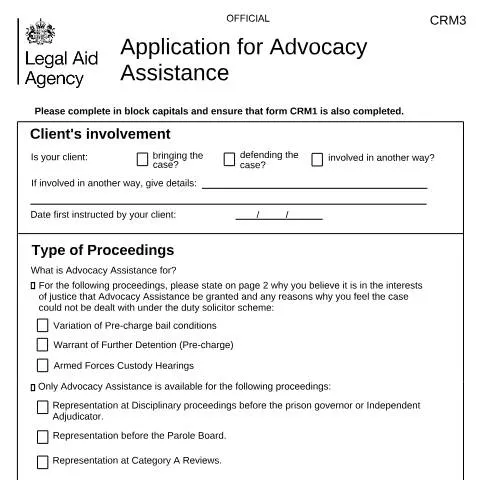
Within the complex landscape of criminal justice proceedings, certain situations demand professional advocacy that goes beyond basic legal advice. The CRM3 application for advocacy assistance serves as the gateway to securing representation for specific types of proceedings where the stakes are particularly high and the legal complexities substantial.
This Legal Aid Agency form addresses a critical gap in the justice system: ensuring that individuals facing serious disciplinary actions, parole hearings, or specialised custody proceedings have access to qualified legal representation. Unlike standard duty solicitor schemes, advocacy assistance provides dedicated representation tailored to proceedings that require specialist knowledge and sustained preparation.
The CRM3 form specifically covers representation in prison disciplinary proceedings before governors or Independent Adjudicators, Parole Board hearings, Category A security reviews, and Armed Forces custody hearings. Each of these proceedings carries significant consequences for an individual's liberty, security classification, or future prospects, making professional advocacy not just beneficial but often essential for a fair hearing.
Understanding the scope: when advocacy assistance applies
The Legal Aid Agency has carefully delineated which proceedings qualify for advocacy assistance through the CRM3 process. This targeted approach reflects the recognition that certain types of hearings require specialised advocacy skills and sustained preparation that standard duty solicitor arrangements cannot adequately provide.
Automatic qualification proceedings
Several types of proceedings automatically qualify for advocacy assistance, reflecting their serious nature and complex legal requirements:
- Prison disciplinary proceedings before the prison governor or Independent Adjudicator, where charges can result in additional days being added to sentences
- Parole Board hearings, which determine release decisions for life sentence prisoners and those serving indeterminate sentences
- Category A security reviews, affecting the highest security classification and prison conditions
- Minimum term reviews for life sentence prisoners, potentially affecting earliest release dates
- Armed Forces custody hearings, involving military justice procedures
Discretionary advocacy assistance
For certain other proceedings, advocacy assistance may be granted where applicants can demonstrate it serves the interests of justice. These include:
- Applications for variation of pre-charge bail conditions
- Warrants of Further Detention hearings in pre-charge situations
For these discretionary cases, the CRM3 form requires detailed justification explaining why the case merits advocacy assistance and why the duty solicitor scheme would be inadequate. This assessment considers factors such as case complexity, potential consequences, and the client's ability to represent themselves effectively.
Completing the client involvement and proceedings sections
The CRM3 form begins with fundamental details about the client's role in the proceedings, which directly impacts the type and extent of advocacy assistance that may be granted. This section requires precision, as mischaracterising the client's involvement can lead to delays or inappropriate assistance levels.
Defining client involvement
The form distinguishes between clients who are defending the case, bringing the case, or involved in another way. In most advocacy assistance scenarios, clients are defending against charges or challenging decisions, but the "involved in another way" category covers situations such as:
- Witnesses requiring protection in sensitive proceedings
- Third parties affected by security classification decisions
- Family members participating in parole hearings under victim impact provisions
When selecting "involved in another way," detailed explanation in the provided text box is crucial. The Legal Aid Agency uses this information to determine appropriate assistance levels and ensure the representation aligns with the client's actual role in proceedings.
Court and hearing details
Accurate completion of venue and hearing information enables proper case tracking and ensures advocates are prepared for the specific procedural requirements of different institutions. Prison disciplinary hearings, for example, follow different protocols than Parole Board oral hearings, affecting preparation strategies and representation approaches.
| Proceeding Type | Typical Venue | Key Timing Considerations |
|---|---|---|
| Prison Disciplinary | Prison establishment | Usually within 28 days of charge |
| Parole Board | Prison or hearing centre | Scheduled months in advance |
| Category A Review | Prison or video link | Annual or following incidents |
| Armed Forces Custody | Military establishment | Varies by service requirements |
Demonstrating the merits: building the case for advocacy assistance
The statement of case section represents the most critical component of the CRM3 application, particularly for discretionary proceedings. This section requires applicants to articulate not merely what happened, but why professional advocacy is essential for ensuring fair proceedings and protecting the client's interests.
Structuring the case statement
Effective case statements follow a logical progression that addresses both factual circumstances and legal complexity. The statement should begin with a concise overview of the charges, allegations, or decisions under review, then progress to explaining the specific challenges that necessitate professional representation.
For prison disciplinary proceedings, the statement might address factors such as:
- Complexity of evidence, particularly CCTV footage or witness testimony requiring cross-examination
- Potential for additional sentence days affecting release prospects
- Client vulnerabilities, including mental health conditions or learning difficulties
- Procedural challenges, such as disclosure issues or witness availability
For Parole Board hearings, considerations typically include:
- Risk assessment challenges requiring expert testimony
- Complex release planning involving multiple agencies
- Victim impact evidence requiring sensitive handling
- Previous hearing outcomes and changed circumstances
Meeting the merits test criteria
The Legal Aid Agency applies specific merits tests outlined in the Contract Specification, which vary according to proceeding type. For most advocacy assistance applications, the test focuses on whether representation is in the interests of justice, considering factors such as:
- Likelihood of loss of liberty or significant restrictions on freedom
- Complexity of law or procedure beyond what an unrepresented person could reasonably handle
- Client capacity issues affecting ability to participate effectively
- Substantial consequences for the client's future prospects or conditions
The statement should explicitly address these criteria, providing specific examples rather than generic assertions. Rather than stating "the case is complex," effective applications explain exactly what makes it complex and why this complexity requires professional advocacy.
Counsel instruction and coordination with existing representation
The CRM3 form includes specific provisions for cases where counsel has already been instructed, recognising that advocacy assistance often involves coordination between solicitors and barristers specialising in particular types of proceedings. This coordination is particularly important in Parole Board hearings and Category A reviews, where specialist knowledge of risk assessment procedures and security considerations is essential.
When counsel involvement is necessary
Certain types of advocacy assistance almost invariably require counsel involvement due to their complexity and specialised nature. Parole Board oral hearings, for example, typically involve:
- Cross-examination of expert witnesses, including psychologists and probation officers
- Presentation of complex risk assessment evidence
- Legal arguments about disclosure and procedural fairness
- Coordination with multiple agencies involved in release planning
The form's counsel instruction section ensures that existing representation arrangements are properly documented and that advocacy assistance funding covers appropriate professional fees for the level of representation required.
Managing representation transitions
In some cases, clients may have existing legal representation that needs to transition to advocacy assistance funding. This commonly occurs when:
- Initial legal advice reveals the need for sustained representation throughout proceedings
- Case complexity increases following disclosure or expert reports
- Procedural developments create additional representation requirements
The CRM3 process accommodates these transitions by allowing existing representatives to apply for advocacy assistance funding, ensuring continuity of representation while meeting Legal Aid Agency funding requirements.
Timing considerations and application deadlines
The effectiveness of advocacy assistance often depends on timely application and adequate preparation time before hearings. Unlike some legal aid applications that can be submitted retrospectively, advocacy assistance applications should be submitted as soon as the need for representation becomes apparent.
Critical timing factors by proceeding type
Different types of proceedings have varying lead times and preparation requirements that affect CRM3 application timing:
Prison disciplinary proceedings typically provide limited notice, often requiring applications within days of charges being laid. The compressed timeframe means applications must focus on immediate representation needs rather than extensive preparation.
Parole Board hearings usually offer several months' notice, allowing time for comprehensive case preparation including expert instruction and evidence gathering. However, this extended timeframe also means advocacy assistance must cover sustained representation over months rather than weeks.
Category A reviews may arise with minimal notice following security incidents, requiring rapid response capabilities while also addressing ongoing classification challenges that may span multiple review cycles.
Managing urgent applications
When proceedings arise with minimal notice, the CRM3 application process includes provisions for urgent consideration. These applications should clearly identify the urgent nature of the case and the specific timeframes involved. The Legal Aid Agency prioritises urgent applications but requires sufficient information to make informed decisions about representation needs.
Urgent applications benefit from early contact with the Legal Aid Agency to discuss case requirements and ensure all necessary information is provided efficiently. This preliminary contact can prevent delays caused by incomplete applications or requests for additional information.
Post-application procedures and decision outcomes
Once submitted, CRM3 applications undergo assessment by Legal Aid Agency caseworkers who specialise in criminal legal aid and understand the specific requirements of different proceeding types. The assessment process considers both eligibility criteria and the merits of individual cases, leading to various possible outcomes that affect how representation proceeds.
Standard decision timeframes
The Legal Aid Agency aims to process CRM3 applications within specific timeframes that vary according to urgency and complexity. Standard applications typically receive decisions within 10-15 working days, while urgent applications may be processed within 48-72 hours when circumstances require immediate representation.
Decision timeframes also depend on the completeness of applications and the availability of any additional information required. Applications that include comprehensive case statements and all necessary supporting documentation generally process more quickly than those requiring follow-up correspondence.
Possible decision outcomes
CRM3 applications can result in several different outcomes, each with specific implications for how representation proceeds:
- Full advocacy assistance granted - covering all necessary representation through to conclusion of proceedings
- Limited advocacy assistance - covering specific aspects such as initial hearings or particular procedural stages
- Conditional approval - subject to additional information or changed circumstances
- Refusal - with reasons provided and appeal rights explained
When advocacy assistance is granted, the decision notice specifies the scope of coverage, any limitations on representation activities, and reporting requirements for ongoing cases. This information guides both solicitors and clients in understanding what representation services are covered under the assistance grant.
Managing refused applications
Applications refused on merits grounds can often be resubmitted with additional evidence or clarification addressing the specific concerns raised in refusal notices. The Legal Aid Agency provides detailed reasons for refusal decisions, enabling targeted responses that address identified weaknesses in original applications.
For proceedings with imminent hearing dates, refused applications may still allow for duty solicitor representation or other forms of limited assistance. Understanding these alternative options ensures that clients maintain some level of representation even when full advocacy assistance is not available.
Fill in your form directly online
No printing: type your details into the boxes of the official form, tick, then download the PDF ready to send.
- 1Type into the form boxes
- 2Tick in one click
- 3Save and download the PDF
The CRM3 process ultimately serves as a crucial bridge between the recognition that certain proceedings require professional advocacy and the practical delivery of appropriate representation. Through careful application preparation and understanding of Legal Aid Agency requirements, practitioners can secure necessary assistance for clients facing some of the most consequential proceedings within the criminal justice system.
Understanding Advocacy Assistance Eligibility Beyond Basic Requirements
Whilst the fundamental eligibility criteria for advocacy assistance through CRM3 applications are well-established, the Legal Aid Agency applies nuanced assessments that extend beyond straightforward income thresholds. Understanding these subtleties can significantly impact your application's success rate.
The means test incorporates sophisticated calculations that account for regional variations in living costs, particularly relevant for applicants in London where housing costs substantially exceed national averages. The Agency recognises that identical gross incomes carry different financial pressures across England and Wales, leading to adjusted thresholds that reflect local economic realities.
Exceptional funding circumstances warrant particular attention. The Legal Aid Agency maintains discretionary powers to approve advocacy assistance even when standard financial criteria aren't met, provided the case demonstrates exceptional complexity or public interest elements. This might include cases involving novel legal principles, systematic human rights violations, or matters affecting vulnerable groups where precedent-setting outcomes could benefit wider society.
Capital assessments present another layer of complexity often misunderstood by applicants. The £8,000 capital limit excludes certain assets including your primary residence's first £100,000 of equity, essential household items, and tools of trade necessary for employment. However, jointly held assets undergo proportional assessment, and recent financial transactions receive scrutiny to prevent artificial capital reduction.
Family circumstances significantly influence eligibility determinations. Applicants with dependants benefit from enhanced income disregards, whilst those supporting adult children in full-time education or caring for disabled family members may qualify for additional allowances. The Agency's assessment considers both direct financial support obligations and opportunity costs associated with caring responsibilities.
Navigating Complex Case Categories and Specialist Advocacy Requirements
Different case types within the advocacy assistance framework demand varying levels of specialist representation, directly influencing both approval likelihood and funding scope. Mental health proceedings, for instance, require advocates with specific competencies in capacity assessments and therapeutic jurisprudence, factors the Legal Aid Agency considers when evaluating CRM3 applications.
Immigration and asylum cases present unique challenges requiring culturally competent advocacy. The Agency recognises that effective representation in these matters demands understanding of country-specific conditions, international human rights law, and trauma-informed communication techniques. Applicants should emphasise these specialist requirements when demonstrating why standard legal aid provision proves insufficient.
Corporate and commercial disputes rarely qualify for advocacy assistance, but exceptions exist where individual applicants face well-resourced opponents in cases involving consumer protection, employment rights, or regulatory enforcement. The David versus Goliath principle applies, where resource imbalances threaten fair proceedings despite the commercial context.
Family law proceedings involving domestic violence or child protection require immediate advocacy assistance, often processed through expedited procedures. The Agency maintains emergency protocols recognising that delays in such cases can compromise safety and welfare. Applicants should clearly articulate urgency factors and risk assessments when seeking rapid approval.
Clinical negligence claims demand advocates with medical law expertise and access to expert witnesses. The Agency's assessment considers whether the case's technical complexity exceeds typical personal injury representation capabilities, evaluating factors such as multiple medical disciplines involved, causation complexity, and quantum calculations requiring specialist actuarial input.
Strategic Application Timing and Administrative Considerations
The timing of your CRM3 application can significantly influence both processing speed and approval probability. The Legal Aid Agency operates within budgetary constraints that create seasonal variations in funding availability, with applications submitted early in the financial year (April-June) often receiving more favourable consideration than those lodged during peak demand periods.
Court listing pressures create additional timing considerations. Applications submitted well before anticipated hearing dates allow thorough assessment and, if approved, adequate preparation time for advocates. Last-minute applications, whilst sometimes unavoidable, face heightened scrutiny regarding why earlier application wasn't possible, potentially impacting approval decisions.
The Agency's case management systems track application patterns, identifying solicitors or chambers with unusually high CRM3 submission rates. Whilst this doesn't automatically disadvantage applications, it can trigger enhanced review procedures. Legal representatives should maintain detailed records justifying each application's necessity and ensure applications demonstrate genuine advocacy gaps rather than routine case enhancement.
Regional variations in Legal Aid Agency processing capacity affect application timescales. London and Manchester offices typically handle higher caseloads, potentially extending assessment periods, whilst regional offices may offer quicker turnaround times. Understanding your application's likely processing route helps manage client expectations and case preparation timelines.
The Agency maintains quality assurance protocols involving random application audits and outcome monitoring. Successful applicants should maintain comprehensive records throughout their case, as post-completion reviews can influence future application assessments. This includes detailed time records, case progression documentation, and outcome reports demonstrating the advocacy assistance's effectiveness.
Electronic submission through the Legal Aid Agency's portal offers tracking capabilities and automated acknowledgment systems, reducing administrative uncertainties. However, complex cases involving extensive supporting documentation may benefit from hybrid approaches combining electronic applications with supplementary postal submissions, ensuring all relevant materials receive proper consideration.