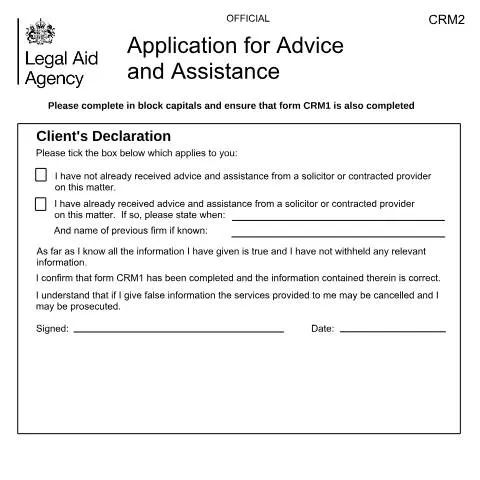
When Legal Troubles Demand Immediate Support: Understanding the CRM2 Gateway
Facing a legal crisis often means confronting an immediate dilemma: you need professional advice urgently, yet solicitors' fees can stretch well beyond most people's reach. The CRM2 application for advice and assistance serves as a crucial bridge in this gap, providing a formal pathway to access initial legal support through the Legal Aid Agency's funding schemes.
This application operates within the broader framework of legal aid provision, specifically targeting situations where individuals require preliminary legal guidance rather than full representation. Unlike comprehensive legal aid applications that cover extensive court proceedings, the CRM2 focuses on what legal professionals term "advice and assistance" – essentially the foundational consultation and document preparation phases that often determine whether a case should proceed.
The significance of this form extends beyond simple bureaucracy. It represents the Legal Aid Agency's recognition that early intervention through qualified legal advice can prevent minor disputes from escalating into costly court battles, whilst ensuring that those facing genuine legal challenges aren't denied access to justice due to financial constraints.
The Legal Framework: Where CRM2 Fits Within Modern Legal Aid
The CRM2 application operates under the Legal Aid, Sentencing and Punishment of Offenders Act 2012, which fundamentally reshaped legal aid provision in England and Wales. This legislation introduced strict eligibility criteria and means testing, making forms like CRM2 essential gatekeepers to publicly funded legal support.
The "advice and assistance" scheme differs markedly from other legal aid categories. Whilst civil legal aid typically covers court representation and legal help covers specific problem-solving activities, advice and assistance occupies a middle ground – providing sufficient support to help individuals understand their legal position and explore options without committing to full litigation funding.
| Legal Aid Type | Coverage Scope | Typical Duration | Application Process |
|---|---|---|---|
| Advice and Assistance (CRM2) | Initial consultation, document review, preliminary advice | 2-3 hours typically | CRM2 + CRM1 forms |
| Civil Legal Aid | Full representation in qualifying cases | Case duration | Separate application process |
| Criminal Legal Aid | Defence representation | Case duration | Automatic or separate application |
The Legal Aid Agency processes CRM2 applications within this controlled framework, ensuring that public funds support genuine need whilst preventing system abuse. The form's structure reflects these dual priorities – comprehensive enough to assess genuine eligibility, yet accessible enough not to deter those requiring urgent legal guidance.
Navigating the Dual-Form Requirement: CRM2 and CRM1 Together
A critical aspect often overlooked by applicants is that CRM2 cannot stand alone. The form explicitly states that CRM1 must also be completed, creating a two-part application system that serves distinct but complementary purposes.
The CRM1 form handles the detailed financial assessment – income, expenditure, capital assets, and household circumstances that determine eligibility for publicly funded legal support. Meanwhile, CRM2 focuses specifically on the applicant's declaration regarding previous legal assistance and their understanding of the process.
This separation serves several administrative purposes. Firstly, it allows legal aid providers to complete the technical financial assessment (CRM1) whilst ensuring clients personally acknowledge their circumstances and responsibilities (CRM2). Secondly, it creates a clear audit trail showing that applicants understood their obligations when signing up for legal aid support.
The Critical Declaration Elements
The CRM2's client declaration section requires careful attention to two specific scenarios:
- No previous assistance: Confirming this is genuinely the first time seeking legal aid for this particular matter
- Previous assistance received: Declaring when and from which firm previous support was obtained
This distinction isn't merely administrative housekeeping. The Legal Aid Agency uses this information to prevent duplicate funding and ensure that where previous assistance was provided, any new application represents either a different legal matter or a continuation of support under changed circumstances.
Critical Compliance Points: What Makes CRM2 Applications Succeed or Fail
The Legal Aid Agency's processing of CRM2 applications follows strict protocols, and understanding these can mean the difference between swift approval and frustrating delays or rejections.
Accuracy in previous assistance declarations represents perhaps the most crucial compliance point. The Legal Aid Agency maintains comprehensive records of all funded legal support, making false declarations easily detectable. Where applicants have genuinely forgotten previous assistance, this can usually be resolved through amended applications, but deliberate omissions risk prosecution under fraud provisions.
The requirement for block capitals throughout the form reflects the Legal Aid Agency's need for clear, unambiguous information that can be processed efficiently. Handwriting that's difficult to read can delay processing whilst administrators seek clarification.
Understanding the Consequences of False Information
The form's stark warning about prosecution for false information isn't mere bureaucratic intimidation. The Legal Aid Agency, working with other government departments including HMRC and DWP, routinely cross-references application data against official records. Discrepancies trigger investigation procedures that can result in:
- Immediate suspension of legal aid funding
- Recovery of costs already paid to legal providers
- Referral to relevant authorities for potential fraud prosecution
- Permanent exclusion from future legal aid eligibility
The Provider Relationship: How Solicitors and Clients Navigate CRM2 Together
Most individuals encounter the CRM2 through their chosen legal provider rather than directly approaching the Legal Aid Agency. This creates a three-way relationship between client, solicitor, and funding body that requires careful coordination.
Contracted providers – solicitors and advice agencies holding Legal Aid Agency contracts – typically guide clients through the CRM2 completion process. However, the personal declaration elements remain the client's responsibility, creating potential complications where clients aren't fully transparent with their legal advisers about previous assistance or financial circumstances.
The timing of CRM2 submission often proves critical. Unlike some legal aid applications that can be processed retrospectively, advice and assistance applications typically need approval before work commences. This means clients seeking urgent legal support may find themselves in challenging situations where immediate advice is necessary but funding approval remains pending.
Emergency Provisions and Exceptional Circumstances
Whilst the CRM2 doesn't explicitly address emergency situations, the Legal Aid Agency recognises that some circumstances demand immediate legal intervention. In such cases, contracted providers may commence work under emergency provisions, submitting CRM2 applications retrospectively whilst accepting the financial risk if funding is subsequently refused.
These emergency provisions typically apply in situations involving:
- Imminent court deadlines where delay would prejudice the client's case
- Urgent child protection matters requiring immediate legal intervention
- Housing possession cases where eviction dates have been set
- Immigration matters with pending removal directions
Cross-Government Data Sharing: Privacy Implications of CRM2 Applications
The Legal Aid Agency's privacy notice accompanying CRM2 applications reveals the extensive data sharing arrangements that underpin legal aid administration. Understanding these arrangements helps applicants appreciate both the thoroughness of eligibility checking and the privacy implications of seeking publicly funded legal support.
Under UK GDPR Article 6(1)(e), the Legal Aid Agency processes personal data as part of its public interest function. This legal basis permits extensive information gathering and sharing with other public bodies, creating a comprehensive picture of applicants' circumstances that extends far beyond the information provided on CRM2 and CRM1 forms.
| Data Sharing Partner | Information Exchanged | Purpose |
|---|---|---|
| HMRC | Income, tax records, benefit payments | Financial eligibility verification |
| DWP | Benefit entitlements, employment status | Means testing and fraud prevention |
| HM Land Registry | Property ownership, mortgages | Capital assessment |
| Credit Reference Agencies | Credit history, outstanding debts | Financial circumstances verification |
Special Category Data and Criminal Records
The Legal Aid Agency's processing of special category personal data under Article 9(g) of UK GDPR enables collection of sensitive information including health records, ethnic origin, and political opinions where relevant to legal aid provision. This might occur in discrimination cases, medical negligence claims, or asylum applications where such information directly relates to the legal matter requiring support.
Criminal conviction data processing operates under Article 10 of UK GDPR, recognising the Legal Aid Agency's status as an official authority. This permits comprehensive background checking that may reveal information not disclosed on CRM2 applications, potentially affecting eligibility decisions.
When Things Go Wrong: Addressing Refusals and Disputes
CRM2 application refusals can occur for various reasons, from simple administrative errors to complex eligibility disputes. Understanding the appeal mechanisms and resolution pathways proves essential for both applicants and their legal representatives.
Administrative refusals typically stem from incomplete applications, missing signatures, or failure to provide supporting documentation. These usually resolve quickly once deficiencies are addressed, though delays can prove problematic where urgent legal advice is needed.
More complex refusals involve eligibility disputes where the Legal Aid Agency concludes that applicants don't qualify for publicly funded support. These decisions consider both financial eligibility and the nature of the legal problem, as advice and assistance coverage doesn't extend to all legal matters.
The Review and Appeal Process
Applicants dissatisfied with CRM2 refusal decisions can request administrative reviews through the Legal Aid Agency's internal procedures. These reviews examine both the original decision-making process and any additional evidence applicants provide to support their cases.
Where internal reviews don't resolve disputes, applicants may pursue complaints through the Legal Ombudsman or seek judicial review in exceptional circumstances. However, these escalation routes typically apply only where procedural errors occurred rather than disagreements with eligibility assessments based on established criteria.
Future Developments: Digital Transformation and CRM2 Evolution
The Legal Aid Agency continues modernising its application processes, with digital transformation initiatives likely to affect CRM2 procedures significantly. Current discussions include online application portals, automated eligibility checking, and integrated case management systems that could streamline the advice and assistance application process.
These developments aim to reduce processing times whilst maintaining rigorous eligibility checking. However, they also raise questions about digital exclusion, particularly affecting vulnerable populations who may struggle with online-only application systems.
The integration of CRM2 applications with other government digital services represents a longer-term aspiration, potentially enabling automatic population of financial information from HMRC and DWP systems whilst reducing the administrative burden on both applicants and legal aid providers.
For practitioners and potential applicants, staying informed about these developments proves increasingly important as the legal aid system continues evolving to balance access to justice with efficient use of public resources. The CRM2, whilst currently a paper-based process, serves as a gateway to legal support that may become increasingly digitalised whilst maintaining its fundamental role in ensuring appropriate access to publicly funded legal advice.
Understanding Exceptional Funding Circumstances
Whilst most CRM2 applications follow standard eligibility criteria, certain exceptional circumstances may warrant special consideration for advice and assistance funding. These situations typically involve cases where the usual financial thresholds would ordinarily exclude an applicant, yet the complexity or urgency of their legal matter justifies public funding intervention.
Exceptional funding may be considered when your case involves fundamental human rights issues under the European Convention on Human Rights, particularly where failure to provide legal assistance could result in a breach of Article 6 (right to fair trial) or Article 8 (right to private and family life). Immigration cases involving potential deportation to countries where torture or inhuman treatment may occur often qualify for this enhanced consideration.
The Legal Aid Agency evaluates exceptional funding requests against a two-stage test: whether legal aid is required as a matter of law under the Human Rights Act 1998 or EU law, and whether failure to provide funding would be a breach of the applicant's Convention rights or EU rights. This assessment considers both the merits of your underlying case and the potential consequences of proceeding without legal representation.
Documentary evidence becomes particularly crucial for exceptional funding applications. You must demonstrate not only your financial circumstances but also the specific legal complexities that make professional assistance essential. This might include expert reports, medical evidence in mental health cases, or country guidance documents in asylum matters. The Legal Aid Agency expects comprehensive supporting documentation that clearly establishes why your case meets the exceptional criteria.
Fill in your form directly online
No printing: type your details into the boxes of the official form, tick, then download the PDF ready to send.
- 1Type into the form boxes
- 2Tick in one click
- 3Save and download the PDF
Processing times for exceptional funding applications typically exceed standard CRM2 determinations, often taking 4-8 weeks depending on case complexity. The Legal Aid Agency may request additional information or seek specialist input before reaching a decision. During this period, some solicitors may agree to commence preliminary work on a conditional basis, though this arrangement varies between providers and depends on the perceived strength of your exceptional funding application.
Appealing CRM2 Decisions and Review Procedures
When your initial CRM2 application receives an unfavourable determination, several review mechanisms exist to challenge this decision. Understanding these procedures and their respective timelines proves essential for maintaining access to legal assistance, particularly in time-sensitive matters where delays could prejudice your position.
The first avenue involves requesting an internal review by the Legal Aid Agency's decision review unit. This administrative review examines whether the original determination correctly applied the relevant legal aid regulations and properly considered all submitted evidence. You must submit your review request within 30 days of receiving the original decision, though the Legal Aid Agency may accept late applications where good reasons exist for the delay.
Internal reviews focus on procedural correctness rather than re-examining the merits of your underlying legal matter. The review officer will assess whether the original caseworker correctly calculated your disposable income and capital, properly applied any applicable disregards, and adequately considered exceptional circumstances where claimed. New evidence may be submitted during this process, particularly where it addresses specific reasons given for the original refusal.
Should the internal review uphold the original refusal, you may pursue an independent review before a Legal Aid Agency Independent Review Panel. These panels comprise legally qualified members independent of the Legal Aid Agency's operational structure. The independent review process operates more formally than internal reviews, with written submissions and, in some cases, oral hearings where complex issues require detailed exploration.
Independent review applications must be submitted within 30 days of receiving the internal review decision. The panel's determination is binding on the Legal Aid Agency, meaning successful appeals result in mandatory reconsideration of your original application. However, panels cannot substitute their own decision for that of the Legal Aid Agency; they can only direct fresh consideration where procedural errors or misapplication of criteria are identified.
For cases involving points of law or where fundamental procedural unfairness has occurred, judicial review proceedings in the Administrative Court represent the final avenue of challenge. These proceedings are complex, expensive, and subject to strict time limits, typically requiring expert legal representation. Most solicitors will honestly assess whether your circumstances justify this level of challenge before recommending judicial review as an option.
Interim Funding Arrangements During Appeals
Whilst appeal processes unfold, maintaining legal representation often requires interim arrangements. Some solicitors offer conditional representation pending appeal outcomes, particularly where they assess strong prospects of successful challenge. These arrangements typically involve written agreements outlining the scope of work to be undertaken and payment responsibilities should the appeal fail.
Alternative funding sources may bridge gaps during appeal periods. Trade union legal services cover members facing employment-related issues, whilst some charitable organisations provide limited legal assistance for specific case types. Professional indemnity insurance policies occasionally include legal expenses coverage, though this varies significantly between providers and policy terms.
Navigating Provider Networks and Solicitor Selection
Successfully obtaining CRM2 funding represents only the initial step in accessing legal assistance. Selecting an appropriate solicitor from the Legal Aid Agency's contracted provider network significantly influences the quality and effectiveness of your legal representation. Understanding how this network operates and the factors that distinguish providers helps ensure optimal outcomes for your specific legal matter.
Legal aid contracts operate on a category-specific basis, meaning solicitors hold contracts for particular areas of law rather than general legal aid provision. Immigration solicitors cannot undertake housing matters under legal aid contracts, whilst family law specialists cannot represent clients in asylum cases. The Legal Aid Agency maintains online directories showing which providers hold contracts for specific legal categories in particular geographical areas.
Provider capacity varies considerably across different regions and legal specialisms. Urban areas typically offer multiple contracted providers for common legal aid categories, whilst rural locations may have limited options, particularly for specialist areas like immigration or mental health law. Some providers maintain waiting lists during periods of high demand, potentially affecting the immediacy of assistance you can access.
Quality standards among legal aid providers differ significantly, despite common contractual obligations. The Legal Aid Agency's contract management includes quality assurance mechanisms, but these focus primarily on procedural compliance rather than case outcomes. Researching provider track records through professional directories, client feedback, and specialist legal publications provides valuable insight into provider capabilities.
Many contracted providers operate mixed practices, combining legal aid work with privately funded cases. This structure can affect service delivery, as privately funded matters typically generate higher fees per hour than legal aid rates. Understanding a provider's practice composition helps set realistic expectations about responsiveness and resource allocation for your legal aid matter.
Specialist accreditations often indicate enhanced expertise within particular legal areas. The Immigration Law Practitioners' Association, Resolution (for family law), and the Law Society's specialist panels provide voluntary accreditation schemes that demonstrate additional competency beyond basic contractual requirements. Providers holding these accreditations typically invest more heavily in specialist training and development.
Geographic restrictions within legal aid contracts may limit provider selection for certain case types. Some contracts specify catchment areas within which providers can represent clients, whilst others allow representation regardless of client location. Understanding these restrictions proves particularly important for specialist areas where local contracted providers may be unavailable.
Communication preferences and accessibility requirements should influence provider selection where multiple options exist. Some providers offer services in community languages, employ specialist support staff, or maintain enhanced accessibility features for clients with disabilities. The Legal Aid Agency's provider directory includes basic accessibility information, though detailed arrangements typically require direct discussion with potential providers.