When Property Disputes Hit Procedural Roadblocks: Understanding Time Extension Applications
Property disputes rarely follow neat timelines. Whether you're challenging a Land Registry decision or defending your registered title, the procedural requirements of the First-tier Tribunal (Property Chamber) can prove unforgiving when life intervenes. Medical emergencies, family crises, or simple administrative oversights can derail carefully planned case preparations, leaving parties scrambling to meet statutory deadlines for witness statements, expert reports, or disclosure obligations.
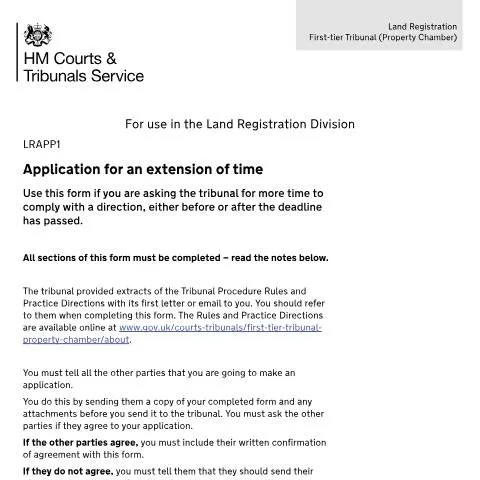
Form LRAPP1 serves as the formal mechanism for requesting additional time when tribunal directions cannot be met within their original timeframes. This application process operates within the Land Registration Division of the First-tier Tribunal (Property Chamber), where cases involving disputed property registrations, boundary determinations, and rectification claims are adjudicated under strict procedural rules.
The tribunal's approach to time extensions balances procedural efficiency against fairness to all parties. Unlike simple administrative delays, these applications require substantive justification and must demonstrate genuine impediments to compliance rather than mere inconvenience or poor planning.
Navigating the Land Registration Division's Procedural Framework
The Land Registration Division handles some of the most technically complex property disputes in the tribunal system. Cases typically involve challenges to Land Registry decisions under sections 73 or 108 of the Land Registration Act 2002, disputes over boundary determinations, or applications for rectification of the register. Each case type carries specific procedural requirements with non-negotiable deadlines.
When the tribunal issues directions—whether at an initial case management conference or through written orders—these create legally binding obligations with precise timeframes. Common directions include:
- Statement of case deadlines: Typically 28 days from the direction, requiring detailed factual and legal arguments
- Disclosure obligations: Usually 42 days for document exchange between parties
- Witness statement preparation: Often 56 days, allowing for witness interviews and statement drafting
- Expert report commissioning: Frequently 84 days, accounting for site inspections and technical analysis
- Joint expert statements: Additional 21 days after individual reports for collaborative discussions
The tribunal operates under the Tribunal Procedure (First-tier Tribunal) (Property Chamber) Rules 2013, which provide limited flexibility for deadline extensions while maintaining case progression momentum. Rule 6 specifically addresses time extensions, requiring applications to be made "as soon as practicable" and with "good reason".
Case Reference Systems and Tracking
Land Registration Division cases receive alphanumeric references beginning with either "REF/" or "REC/" followed by the year and sequential number. The "REF" prefix typically indicates reference applications challenging Land Registry decisions, while "REC" denotes rectification or indemnity claims. Understanding your case type influences the procedural expectations and typical timeline pressures.
Parties, Representatives, and Procedural Standing
Form LRAPP1 accommodates the complex party structures common in property disputes. Land registration cases frequently involve multiple applicants or respondents, particularly in boundary disputes affecting several neighbouring properties or cases involving joint ownership arrangements.
The form's party identification section reflects these realities, distinguishing between:
| Party Type | Typical Scenarios | Application Considerations |
|---|---|---|
| Single Applicant/Respondent | Individual property owner challenges | Straightforward application process |
| Multiple Applicants | Joint owners, neighbouring properties | Requires coordination between parties |
| Representative Applications | Solicitor or surveyor acting for client | Must demonstrate authority to act |
| All Parties Together | Consensual extension requests | Streamlined processing when agreed |
Professional representatives—typically solicitors specialising in property law or chartered surveyors with tribunal experience—often handle these applications. However, the form accommodates self-represented parties, reflecting the tribunal's commitment to accessible justice in property disputes.
Authority and Representative Status
When representatives submit LRAPP1 applications, the tribunal expects clear evidence of their authority to act. This becomes particularly important when seeking extensions that might prejudice the opposing party's position or delay scheduled hearings. The tribunal may request confirmation of instructions, especially where the extension request appears strategically motivated rather than genuinely necessitated.
Dissecting Extension Requests: Types, Timing, and Tactical Considerations
The form's structured approach to identifying specific deadlines reflects the tribunal's recognition that different procedural obligations carry varying degrees of urgency and complexity. Section 6 of LRAPP1 requires precise identification of affected deadlines alongside proposed new timeframes, forcing applicants to demonstrate realistic planning rather than open-ended delays.
Statement of case extensions frequently arise from the complexity of property law research required. Land registration disputes often involve historical title investigations, examination of pre-registration deeds, and analysis of statutory provisions dating back decades. A reasonable extension might seek an additional 21-28 days where extensive archive research proves necessary.
Disclosure deadline extensions commonly reflect practical difficulties in locating historical documents. Property files may be scattered across multiple locations—solicitors' archives, mortgage lenders' records, local authority planning departments, or family collections. Extensions of 14-21 days typically suffice for document gathering, though complex estates might justify longer periods.
Witness statement preparation extensions often involve coordination challenges with multiple witnesses, particularly in boundary disputes where historical recollections from long-term residents prove crucial. Medical evidence supporting witness unavailability carries significant weight, as does evidence of witness intimidation or harassment.
Expert Evidence Complications
Expert report deadlines present unique extension challenges in land registration cases. Chartered surveyors, boundary specialists, or historic building experts may require site access permissions, weather-dependent investigations, or coordination with utility companies for underground surveys. The tribunal generally accepts that expert investigations cannot be rushed, but expects evidence of genuine impediments rather than expert scheduling conflicts.
Joint expert statement deadlines depend on prior completion of individual reports, creating cascading delay effects. When one party's expert receives a time extension, the joint statement deadline automatically requires adjustment, illustrating the interconnected nature of tribunal directions.
Crafting Persuasive Justifications: The Art of Section 7
Section 7 represents the application's critical component, requiring detailed explanation of circumstances necessitating the extension. The tribunal expects honesty, specificity, and proportionality rather than generic assertions of difficulty or inconvenience.
Medical circumstances constitute the most commonly accepted justification, but require appropriate documentation. A GP's letter confirming hospital admission or ongoing treatment carries more weight than self-certified illness. The tribunal particularly scrutinises claims of stress-related conditions, expecting evidence of genuine incapacity rather than case-related anxiety.
Family emergencies receive sympathetic consideration when properly documented. Death certificates, court orders in family proceedings, or social services correspondence provide objective verification of circumstances beyond the applicant's control.
Professional obligations offer weaker grounds unless exceptional circumstances apply. Conflicting court hearings in other cases may justify extensions, but routine professional commitments typically do not. Barristers' unavailability due to higher court fixtures receives more favourable consideration than solicitors' diary conflicts.
Avoiding Common Pitfalls in Justification
The tribunal routinely rejects extensions based on:
- Late instruction of representatives without explanation for the delay
- Complexity arguments unsupported by specific examples
- Financial constraints affecting expert instruction timing
- Holiday arrangements made after directions were issued
- Disagreements between clients and their representatives
Successful applications demonstrate that reasonable steps were taken to comply with original deadlines and that the extension request represents the minimum additional time required rather than a convenient buffer period.
The Notification Protocol: Managing Multi-Party Dynamics
Form LRAPP1's emphasis on inter-party notification reflects the tribunal's commitment to procedural fairness and case management efficiency. The requirement to provide copies to all parties before submission prevents ambush tactics while encouraging consensual solutions.
The notification process operates in two stages. Initially, applicants must send completed forms to all parties, demonstrating transparency about the extension request and its justification. This stage often prompts settlement discussions or reveals shared difficulties justifying consensual extensions.
Subsequently, applicants must actively seek agreement from other parties. Positive responses require written confirmation accompanying the tribunal submission. Negative responses trigger an obligation to inform opposing parties of their right to object formally, ensuring balanced representation of competing interests.
Strategic Considerations in Notification
The timing of notifications can influence outcomes significantly. Early notification—immediately upon recognising compliance difficulties—demonstrates good faith and may encourage cooperative responses. Conversely, last-minute notifications, particularly on deadline days, typically generate hostile reactions and scepticism about the applicant's motives.
Some applicants attempt to leverage notification requirements tactically, arguing that opposing parties' failure to respond constitutes implied consent. The tribunal rejects such interpretations, requiring explicit written agreement for consensual applications.
Supporting Evidence and Documentary Requirements
Section 8 of LRAPP1 addresses supporting documentation, with the tribunal expecting proportionate evidence matching the claimed circumstances. Medical evidence requires particular attention to relevance and timing—retrospective medical certificates addressing periods when compliance was still possible receive limited weight.
Professional evidence carries varying credibility depending on the source. Letters from instructed solicitors or barristers regarding case complexity receive respectful consideration, while unsupported assertions from unqualified representatives may be dismissed. Expert opinions on technical difficulties—such as surveyors explaining site access problems or archivists confirming document location challenges—provide objective support for extension requests.
Financial evidence requires careful presentation. While the tribunal cannot extend deadlines simply because parties cannot afford compliance, evidence of unexpected circumstances affecting funding—such as mortgage lender delays or inheritance complications—may support applications where financial constraints arose after directions were issued.
Electronic Submission Protocols
The tribunal's requirement for email submission to [email protected] with copied parties reflects modern case management practices while maintaining procedural safeguards. The CC requirement ensures transparency and prevents disputes about notification timing.
Large supporting documents may require separate transmission methods, with the tribunal accepting postal delivery or secure file transfer arrangements for voluminous historical archives or technical reports exceeding email attachment limits.
Hearing Implications and Case Management Consequences
Section 5's inquiry about future hearing dates reflects the tribunal's concern about cascading delays affecting scheduled proceedings. Listed hearings create significant administrative and cost implications, involving tribunal member availability, venue bookings, and other parties' preparation investments.
When hearings are already scheduled, extension applications face heightened scrutiny. The tribunal balances fairness to the applicant against prejudice to other parties and efficient resource utilisation. Applications threatening imminent hearings typically require exceptional justification, with medical emergencies or genuine procedural unfairness providing the strongest grounds.
Successful extensions affecting hearing dates often result in case management conferences to reassess directions and ensure realistic new timetables. This provides opportunities to address systemic case difficulties but may extend overall resolution timeframes significantly.
The tribunal's case management powers extend beyond simple deadline extensions to encompass direction modifications, expert appointment variations, or even case consolidation where multiple related applications experience similar difficulties. Understanding these broader powers helps applicants frame extension requests within wider case progression strategies rather than isolated procedural requests.
Common Grounds for Extension Requests and Supporting Evidence
When completing Form LRAPP1, the strength of your extension request largely depends on demonstrating legitimate grounds with appropriate supporting evidence. The Lands Tribunal recognises several categories of circumstances that may warrant additional time, though each case receives individual assessment.
Medical circumstances form one of the most frequently accepted grounds. If illness prevented you from meeting the original deadline, you'll need medical evidence from a registered practitioner. A standard GP letter stating "patient was unwell" rarely suffices—the documentation should specify how the condition materially affected your ability to engage with legal proceedings or prepare necessary paperwork. Hospital discharge summaries, specialist consultant reports, or evidence of emergency treatment carry more weight than routine sick notes.
For mental health conditions, obtaining appropriate medical evidence can be more complex but equally valid. Psychiatrist reports, evidence of counselling or therapy, or documentation from mental health services can support your application. The key is demonstrating that your condition genuinely impacted your capacity to handle legal matters during the relevant period.
Bereavement and family emergencies also constitute recognised grounds, particularly when you were dealing with the deceased's affairs or urgent family responsibilities. Death certificates, probate documentation, or evidence of your role as executor can substantiate such claims. If caring responsibilities prevented you from meeting deadlines—such as suddenly becoming a carer for a family member—social services assessments or medical evidence about the person requiring care strengthen your position.
Legal representative issues present another common scenario. If your solicitor withdrew from acting, became unavailable due to illness, or failed to progress your case adequately, this can justify an extension request. However, you'll typically need to demonstrate that you acted promptly to find alternative representation and that the delay wasn't simply due to your own inaction. Correspondence with the Law Society, evidence of attempts to instruct new solicitors, or formal complaints about previous representatives may be relevant.
Administrative errors or postal problems occasionally provide valid grounds, though these require careful documentation. If HM Courts & Tribunals Service or another official body made an error affecting your deadline, retain all correspondence as evidence. For postal issues, Royal Mail's track and trace records, proof of posting certificates, or evidence of address changes can be crucial.
Financial difficulties alone rarely justify extensions, but exceptional circumstances might include sudden job loss, business failure, or bank account freezing that prevented you from instructing representatives or obtaining necessary documentation. Supporting evidence might include redundancy notices, company liquidation documents, or correspondence with financial institutions.
When gathering supporting evidence, ensure documents are recent, relevant, and from credible sources. Avoid relying solely on self-certification or statements from family members unless corroborated by independent evidence. The Lands Tribunal expects applicants to have made reasonable efforts to comply with original deadlines despite their difficulties.
Fill in your form directly online
No printing: type your details into the boxes of the official form, tick, then download the PDF ready to send.
- 1Type into the form boxes
- 2Tick in one click
- 3Save and download the PDF
Procedural Variations for Different Land Registry Matters
Form LRAPP1 applications vary significantly depending on the underlying Land Registry matter you're seeking to extend. Understanding these procedural nuances helps ensure your application addresses the specific requirements and expectations for your type of case.
Boundary dispute extensions often involve complex technical evidence and expert reports. If you're seeking additional time to obtain a chartered surveyor's report or resolve access issues for site inspections, your LRAPP1 should specify the technical challenges involved. The Lands Tribunal recognises that boundary disputes frequently require detailed measured surveys, historical research, and sometimes archaeological investigation—all time-consuming processes that may justify extensions.
When boundary matters involve multiple parties or properties, coordination difficulties can provide legitimate grounds for extension. If neighbouring property owners are uncooperative with access for surveys, or if multiple expert reports need coordination, document these challenges thoroughly. Include correspondence with surveyors, evidence of access requests, and any relevant communications with other parties.
Adverse possession claims present unique evidential challenges that may warrant extensions. Gathering historical evidence spanning potentially decades requires extensive research through local archives, Land Registry records, and witness statements from long-term residents. If elderly witnesses become unavailable or archival material proves difficult to locate, these circumstances can justify additional time.
The 12-year limitation period for adverse possession claims means that evidence often spans significant periods, requiring careful collation and analysis. If you discover additional relevant documentation or witnesses after the initial deadline, this new evidence might justify an extension—particularly if it significantly strengthens your case or addresses weaknesses identified by the Land Registry.
Easement and rights of way disputes frequently involve historical research and user evidence that takes time to compile. If your case depends on demonstrating 20 years of continuous use for a prescriptive easement, gathering witness statements and documentary evidence from multiple decades can be challenging. The Lands Tribunal understands these evidential requirements and may grant extensions where applicants demonstrate genuine efforts to compile comprehensive historical evidence.
Restrictive covenant matters often require legal research into historical planning decisions, development schemes, and property transactions. If you need additional time to research the original development scheme or trace the benefit and burden of covenants through complex property transactions, this technical legal work can justify extensions.
Overriding interest claims under Schedule 3 of the Land Registration Act 2002 may require specialist legal analysis and evidence gathering. If your case involves complex questions about actual occupation or inquiry notice, additional time for legal research and expert evidence might be justified—particularly where Court of Appeal or Supreme Court decisions have clarified relevant legal principles after your original deadline.
For rectification applications, extensions might be needed to obtain additional surveying evidence, resolve technical mapping issues, or address complex questions about proprietary estoppel. If Ordnance Survey mapping proves inadequate or contradictory, commissioning detailed topographical surveys can take considerable time.
When applying for extensions in these specialised contexts, your LRAPP1 should demonstrate understanding of the specific evidential and legal requirements for your type of case. Generic requests for "more time to prepare" carry less weight than targeted explanations of particular technical or legal challenges you're addressing.
Strategic Considerations and Alternative Dispute Resolution Options
Before submitting Form LRAPP1, consider whether an extension application represents the most effective strategy for your situation. The Lands Tribunal increasingly encourages alternative dispute resolution (ADR), and demonstrating engagement with these processes can strengthen your position—whether in an extension application or the underlying dispute.
Mediation opportunities often emerge during the period when you might otherwise apply for an extension. If the other party has shown willingness to engage in settlement discussions or mediation, this can provide compelling grounds for an extension request. The Civil Procedure Rules emphasise the importance of attempting ADR before formal litigation, and the Lands Tribunal applies similar principles.
When citing ongoing settlement negotiations in your LRAPP1, provide specific evidence of the other party's engagement. This might include correspondence expressing willingness to mediate, confirmed mediation appointments, or evidence of without prejudice negotiations. Avoid vague assertions about "ongoing discussions" without substantive evidence of genuine progress.
The Property Ombudsman scheme may be relevant for certain types of land registration disputes, particularly those involving property professionals' conduct. If you're pursuing a complaint through this route that might resolve or significantly affect your Land Registry matter, this parallel process could justify an extension request.
Planning and regulatory considerations sometimes intersect with Land Registry disputes in ways that affect timing strategies. If your case involves development potential, rights of way affecting development, or boundary disputes impacting planning applications, ongoing planning processes might influence the optimal timing for your Land Registry proceedings.
For example, if a local planning authority is considering a development proposal that would affect disputed land, or if highway authority investigations into claimed rights of way are ongoing, these processes might provide relevant evidence or even resolve the underlying dispute. Your LRAPP1 could cite these parallel proceedings as grounds for extension, particularly where their outcomes would significantly affect your case.
Cost management represents another strategic consideration. Legal costs in Land Registry proceedings can escalate quickly, particularly where technical expert evidence is required. If an extension would allow you to obtain more cost-effective expert reports, coordinate multiple expert instructions efficiently, or take advantage of reduced legal costs during quieter periods, these practical considerations might influence your timing strategy.
However, avoid citing purely financial convenience as grounds for extension—the Lands Tribunal expects applicants to manage their cases efficiently within standard timeframes. Focus instead on how additional time would improve the quality of evidence or enable more effective case preparation that serves the interests of justice.
Tactical timing around other legal proceedings requires careful consideration. If you're involved in related County Court or High Court proceedings, family law matters affecting property ownership, or insolvency proceedings, the interaction between these cases might justify coordinated timing through extension applications.
For instance, if divorce proceedings are determining beneficial interests in disputed property, or if probate proceedings are clarifying ownership rights relevant to your Land Registry matter, waiting for these determinations might avoid duplicated evidence gathering and potentially conflicting decisions.
Evidence preservation concerns can provide legitimate grounds for extensions, particularly where witnesses are elderly or documentary evidence is at risk. If key witnesses have become available who were previously overseas or unavailable, or if recently discovered documents require expert analysis, these developments can justify additional time.
When citing evidence preservation concerns, demonstrate proactive steps you've taken to secure evidence and explain why additional time is necessary despite your efforts. This shows the Lands Tribunal that you're using extension time constructively rather than simply delaying proceedings.