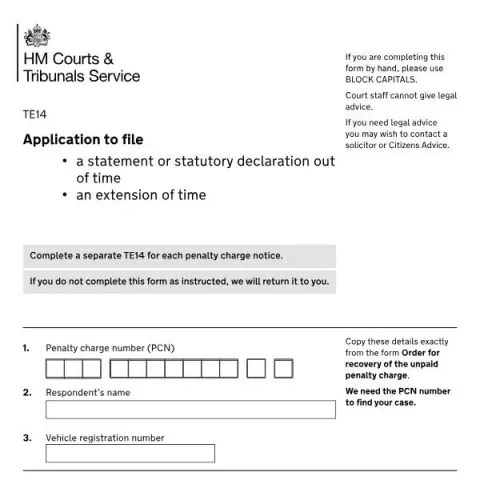
Understanding the TE14 Form: Application to File a Statement Out of Time or Request an Extension of Time
The TE14 form is an official document issued by the HM Courts and Tribunals Service in the United Kingdom. Its primary purpose is to enable individuals or entities involved in penalty charge recovery proceedings to seek permission to file a statement or statutory declaration outside the standard time limits, or to request an extension of time for doing so. This process is crucial in legal cases where delays have occurred, and the respondent wishes to present evidence or make a formal declaration after the deadline has passed.
Scope and Typical Use Cases
The TE14 form is applicable specifically in cases related to penalty charge notices (PCNs) where a formal recovery process is underway, and the respondent needs to:
- File a witness statement (using form TE13) or a statutory declaration (using form PE3) after the original deadline has expired.
- Request additional time to prepare or submit relevant evidence or declarations.
This form is used exclusively by the person named on the original order for recovery of the unpaid penalty charge or their authorised representative, such as a litigation friend or a solicitor. It is essential to complete a separate TE14 form for each penalty charge notice involved in the proceedings.
Eligibility and Conditions for Submission
Applicants must meet specific criteria to be eligible to submit the TE14 form:
- The applicant must be the respondent named in the original order for recovery of the penalty charge or an authorised representative acting on their behalf.
- The application must be made within a reasonable period after the original deadline, and the applicant must provide valid reasons for the delay.
- The purpose of the application is strictly limited to requesting permission to file a statement or declaration out of time or to extend the deadline, not to dispute the penalty charge itself.
It is important to note that the court staff cannot provide legal advice regarding the submission or content of the form. Applicants are advised to consult a solicitor or Citizens Advice if they require legal guidance.
Step-by-Step Procedure for Completing the Form
1. Filling in Penalty and Respondent Details
Begin by providing the penalty charge number (PCN) and the respondent’s name, as stated on the order for recovery. If the respondent is a company, include the company name and your position within the organisation. Ensure all details are accurate and written in BLOCK CAPITALS if completing the form by hand.
2. Providing Contact and Address Information
Next, enter the respondent’s current address, including postcode, and an email address if available. This information is necessary for official correspondence and to identify the case accurately.
3. Stating the Application Reason
In the section titled "My reasons for applying," clearly explain why the application is being made late. This should include valid reasons for the delay in submitting the statement or declaration, such as unforeseen circumstances or procedural issues. Attach any supporting evidence if available.
4. Declaration and Signature
The applicant must read the statement of truth carefully, acknowledging the importance of honesty and the legal implications of false statements. The respondent or their authorised representative must then sign, date, and print their full name. If signing on behalf of a company or organisation, appropriate boxes should be ticked, and the signatory’s role specified.
Legal and Procedural Considerations
Making a false statement in the TE14 form can have serious legal consequences, including proceedings for contempt of court. It is therefore vital that all information provided is truthful and supported by relevant evidence. The form must be completed accurately and submitted to the court handling the penalty recovery process.
Fill in your form directly online
No printing: type your details into the boxes of the official form, tick, then download the PDF ready to send.
- 1Type into the form boxes
- 2Tick in one click
- 3Save and download the PDF
Once submitted, the court will review the application and decide whether to grant permission to file the statement or declaration out of time, or to extend the deadline. The decision will be communicated to the applicant, who can then proceed with their case accordingly.
Post-Submission Steps
If the application is successful, the respondent will be permitted to file their witness statement or statutory declaration beyond the original deadline. It is important to adhere to any new timelines set by the court to ensure the case progresses smoothly.
Failure to obtain court permission or to comply with the extended deadline can result in the application being refused, which may impact the respondent's ability to present their case or defend against the penalty charge.
In summary, the TE14 form is a vital procedural tool for respondents seeking flexibility in legal proceedings related to penalty charges, ensuring that they have a fair opportunity to present their evidence even after the standard time limits have expired.