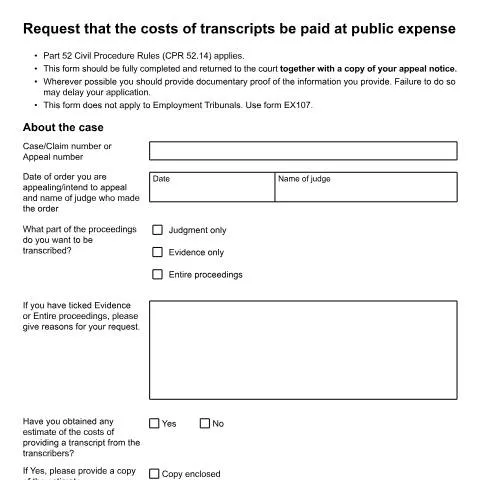
When Court Transcripts Become Essential: Understanding the EX105 Financial Assistance Framework
The moment you decide to appeal a court decision, you enter a complex procedural landscape where access to accurate records becomes paramount. Yet the cost of obtaining official transcripts can prove prohibitive for many appellants, creating a potential barrier to justice. Form EX105 addresses this critical gap by providing a structured pathway for individuals to request that transcript costs be met from public funds rather than their own pocket.
This application sits at the intersection of procedural fairness and financial accessibility within the civil justice system. Under Civil Procedure Rule 52.14, the courts recognise that effective appeal preparation often requires detailed transcripts of lower court proceedings, yet the associated costs—frequently running into hundreds or thousands of pounds—can place such records beyond reach for those with limited means.
The EX105 form operates within a carefully structured framework that balances public expenditure control with legitimate access to justice concerns. Unlike general legal aid applications, this specific mechanism focuses solely on transcript costs, requiring detailed financial disclosure to determine eligibility for this targeted form of public assistance.
The Strategic Importance of Transcript Selection in Appeal Proceedings
Understanding which portions of proceedings to transcribe represents one of the most crucial decisions when completing Form EX105. The form offers three distinct options, each carrying different cost implications and strategic considerations for your appeal.
Judgment-only transcripts capture the judge's final decision and reasoning, typically representing the most cost-effective option. This choice proves particularly suitable when your appeal focuses on legal interpretation or the application of established facts rather than challenging the factual findings themselves. Many successful appeals rely solely on challenging the judge's legal conclusions, making judgment transcripts sufficient for effective preparation.
Evidence-only transcripts document witness testimony, cross-examination, and the presentation of documentary evidence. This option becomes essential when your appeal challenges the judge's factual findings or suggests that crucial evidence was misinterpreted or overlooked. However, evidence transcripts typically involve significantly higher costs due to their length and complexity.
The entire proceedings option encompasses both judgment and evidence, representing the most comprehensive but expensive choice. Courts scrutinise requests for complete transcripts particularly carefully, requiring compelling justification for why both elements are necessary for your appeal. The form specifically demands detailed reasons when requesting evidence or entire proceedings, reflecting the courts' commitment to proportionate use of public resources.
| Transcript Type | Typical Content | Best Suited For | Cost Consideration |
|---|---|---|---|
| Judgment only | Judge's decision and reasoning | Legal interpretation appeals | Lowest cost option |
| Evidence only | Witness testimony, examination | Factual findings challenges | Moderate to high cost |
| Entire proceedings | Complete hearing record | Complex multi-issue appeals | Highest cost option |
Financial Assessment Framework: Beyond Simple Income Thresholds
The EX105 financial evaluation process extends far beyond basic income assessment, incorporating a sophisticated analysis of your complete financial circumstances. This comprehensive approach reflects the courts' recognition that transcript costs can impact individuals differently based on their overall financial position, not merely their gross income.
The savings assessment encompasses diverse financial instruments, from traditional bank accounts to premium bonds and stock holdings. Courts examine not just current balances but also the accessibility and liquidity of these assets. For instance, pension funds may receive different treatment than readily accessible savings accounts, reflecting the practical difficulties in accessing such funds for immediate transcript costs.
Property ownership receives particular scrutiny, with the form distinguishing between sole ownership, joint ownership, and rental arrangements. Joint property ownership presents complex assessment challenges, as courts must determine your accessible equity share while considering any legal restrictions on property disposal or borrowing against the asset.
The monthly income and expenditure analysis incorporates sophisticated understanding of necessary versus discretionary spending. Essential expenses such as mortgage payments, council tax, and childcare costs receive different treatment than discretionary spending categories. The form's detailed breakdown allows courts to identify genuine financial hardship rather than simply inconvenience.
Partner and Household Financial Considerations
When you live with a spouse, civil partner, or in another committed relationship, their financial circumstances become integral to your assessment. This reflects the legal presumption that household resources may be available to meet transcript costs, even when formal legal obligations don't exist.
However, the assessment recognises practical limitations on accessing partner resources, particularly in cases where relationship breakdown precipitated the legal proceedings. Courts may exercise discretion when partner cooperation seems unlikely or when relationship dynamics suggest that relying on partner resources would be inappropriate.
Documentary Evidence Requirements: Building a Compelling Financial Picture
The success of your EX105 application often hinges on the quality and completeness of supporting documentation rather than simply the form completion itself. Courts require concrete evidence to verify the financial information provided, with incomplete documentation frequently leading to application delays or refusal.
For employed applicants, the three most recent payslips provide courts with insight into income stability and any fluctuations that might affect your ability to meet transcript costs. Your P60 certificate offers annual income verification, helping courts understand whether your current circumstances represent typical or exceptional financial conditions.
Bank statements spanning recent months demonstrate spending patterns and financial management, potentially supporting or undermining your claimed expenses. Courts may scrutinise unusual transactions or spending that appears inconsistent with claimed financial hardship.
Property-related documentation becomes crucial when you own real estate, requiring evidence of mortgage balances, property valuations, and any restrictions on your ability to access equity. Joint ownership situations demand additional documentation clarifying ownership percentages and any legal constraints on property dealings.
Benefits and State Support Verification
Recipients of state benefits must provide current award letters or benefit statements demonstrating entitlement levels and payment schedules. Courts recognise that benefit income may fluctuate due to reassessments, sanctions, or changing circumstances, requiring up-to-date documentation to ensure accurate assessment.
Universal Credit recipients face particular documentation challenges due to the system's monthly assessment cycles and potential fluctuations. Providing several months of statements helps courts understand your typical benefit income rather than relying on potentially unrepresentative single-month figures.
The Relationship Between EX105 and Broader Legal Aid Provision
Form EX105 occupies a specific niche within the broader legal aid landscape, addressing transcript costs that fall outside traditional legal aid scope. Understanding this distinction proves crucial for managing expectations and ensuring you pursue appropriate funding avenues for different aspects of your legal proceedings.
Unlike comprehensive legal aid applications, EX105 focuses exclusively on transcript costs, offering no assistance with legal representation, court fees, or other litigation expenses. This narrow scope reflects policy decisions about targeted public funding for specific barriers to justice access.
The form's relationship with exceptional funding provisions creates potential complications for some appellants. Those who might qualify for broader exceptional legal aid funding may need to coordinate their EX105 application with other funding requests, ensuring consistency in financial disclosure across different applications.
Previous applications for publicly-funded transcripts, whether successful or unsuccessful, influence current assessments. Courts maintain records of such applications, and the form specifically requires disclosure of any previous requests, reflecting concerns about repeated applications or potential abuse of public funding mechanisms.
Processing Timelines and Court Decision-Making Procedures
The timing of your EX105 application significantly impacts both processing speed and ultimate success prospects. Courts encourage early applications, ideally submitted alongside your appeal notice, to avoid delays in appeal preparation and hearing scheduling.
Processing times vary considerably between court centres and depend on application complexity, documentation completeness, and current caseload pressures. Simple applications with comprehensive supporting documentation typically receive faster processing than those requiring additional evidence or clarification.
The court's decision-making process involves judicial assessment rather than administrative determination, reflecting the discretionary nature of transcript funding decisions. Judges consider not only financial eligibility but also the proportionality of transcript costs relative to the appeal's prospects and potential significance.
Courts may grant applications in full, partially (specifying particular transcript portions), or refuse them entirely. Partial grants often reflect judicial assessment that certain transcript elements are unnecessary for effective appeal preparation, balancing public expenditure concerns with access to justice requirements.
Appeal Preparation Implications
Successful EX105 applications trigger transcript preparation processes that may affect your appeal timeline. Court reporting services require time to produce accurate transcripts, particularly for complex or lengthy proceedings, potentially impacting appeal preparation schedules.
The transcript delivery process involves coordination between courts, transcription services, and appellants, requiring clear communication about delivery addresses and contact arrangements. Delays in this process can affect appeal deadlines, making early application submission particularly important.
Employment Tribunal Exclusions and Alternative Pathways
The EX105 form explicitly excludes Employment Tribunal proceedings, directing such applicants to use Form EX107 instead. This distinction reflects different funding frameworks and procedural requirements between employment law and general civil proceedings.
Employment tribunal transcript applications follow separate assessment criteria, recognising the different nature of employment disputes and their typical financial implications for individual applicants. The employment tribunal system incorporates specific provisions for transcript access that reflect the unique characteristics of workplace dispute resolution.
Understanding these distinctions prevents application delays and ensures you use appropriate forms for your specific tribunal or court proceedings. Submitting EX105 applications for employment matters results in automatic rejection and referral to correct procedures, potentially causing significant delays in transcript access.
Strategic Considerations for Complex Financial Circumstances
Applicants with fluctuating income or complex financial arrangements face particular challenges in completing Form EX105 effectively. Self-employed individuals, those with seasonal work patterns, or people transitioning between employment and benefits require careful consideration of how to present their financial circumstances accurately.
Recent financial changes, such as job loss, relationship breakdown, or significant expense increases, may not be fully reflected in historical documentation but significantly impact your ability to meet transcript costs. The form allows for explanatory information that contextualises your financial figures within recent life changes.
Debt obligations receive detailed scrutiny, with courts distinguishing between secured debts, priority debts, and general consumer credit. The impact of debt management plans, individual voluntary arrangements, or other formal debt solutions on your available income requires clear explanation and supporting documentation.
Business owners and those with investment income face additional complexity in demonstrating their true financial position, particularly when business assets cannot readily be accessed for personal expenses or when investment values fluctuate significantly.
Understanding Transcript Types and Their Associated Costs
When applying for help with court transcript costs using Form EX105, it's crucial to understand the different types of transcripts available and their varying cost implications. The HM Courts & Tribunals Service recognises several distinct categories of transcripts, each serving specific purposes and carrying different fee structures.
Daily transcripts represent the most common type requested through the EX105 process. These provide a verbatim record of proceedings from a specific hearing date and typically form the basis for most appeals or review applications. The standard cost for daily transcripts can vary significantly depending on the length of proceedings, with rates generally calculated per page or per hour of recorded material.
For complex cases involving multiple hearing days, applicants may require expedited transcripts, which command premium rates due to the urgent processing required. These are particularly relevant when statutory time limits for appeals are approaching, and the transcript is essential for meeting court deadlines. The EX105 application must clearly justify why expedited service is necessary, as courts scrutinise these requests more rigorously given the additional costs involved.
Fill in your form directly online
No printing: type your details into the boxes of the official form, tick, then download the PDF ready to send.
- 1Type into the form boxes
- 2Tick in one click
- 3Save and download the PDF
Specified portions of transcripts offer a cost-effective alternative when only particular segments of proceedings are relevant. This might include specific witness testimony, judicial directions, or closing arguments. Applicants can request these targeted excerpts through EX105, potentially reducing costs while still obtaining the essential material needed for their legal proceedings. However, the court may require justification for why a complete transcript isn't necessary.
Digital audio recordings present another consideration within the EX105 framework. While generally less expensive than full written transcripts, these may not be acceptable for all purposes, particularly formal appeals to higher courts. The application should specify whether digital audio would suffice for the intended use, as this can significantly impact the overall cost assessment.
Specialist transcript requirements, such as those involving interpreters or technical evidence, may incur additional charges. These cases often require expert transcription services familiar with specific terminology or multilingual proceedings. The EX105 application should detail any such special requirements to ensure accurate cost assessment and appropriate fee remission consideration.
Strategic Timing and Procedural Considerations for EX105 Applications
The timing of an EX105 application can significantly impact both its success rate and the practical utility of any granted assistance. Understanding the procedural landscape surrounding transcript requests helps applicants maximise their chances of securing appropriate support while meeting their legal obligations.
Pre-emptive applications represent the most strategic approach when transcript needs can be anticipated. Filing EX105 before the actual transcript order allows the court to assess financial circumstances without the pressure of urgent deadlines. This approach is particularly valuable when planning appeals, as it enables applicants to understand their potential liability before committing to expensive legal proceedings.
The relationship between EX105 applications and appeal timeframes requires careful navigation. Many appeals must be lodged within strict statutory periods, often 21 or 28 days from the original judgment. Where transcripts are essential for appeal preparation, the EX105 application should be filed immediately after the hearing, highlighting the time-sensitive nature of the request. Courts may expedite EX105 processing when genuine appeal deadlines are at stake.
Concurrent proceedings present particular challenges for EX105 applications. Where multiple cases are running simultaneously, or where related proceedings in different jurisdictions require the same transcript, applicants should coordinate their requests to avoid duplicate costs. The form allows for detailed explanation of how transcripts will be used across different proceedings, potentially justifying broader fee remission.
For cases involving ongoing litigation, strategic consideration should be given to whether transcript costs might be recoverable from other parties. While EX105 provides immediate relief for those unable to afford transcripts, successful litigants may later recover these costs through detailed assessment procedures. The application should acknowledge this possibility while demonstrating current financial inability to advance the costs.
Judicial review proceedings present unique timing considerations for EX105 applications. These cases often involve tight deadlines and complex procedural requirements where transcripts are essential for proper case preparation. The urgent nature of judicial review can strengthen an EX105 application, particularly where administrative law points require precise reference to judicial observations or reasoning from lower court proceedings.
Applications submitted retrospectively after transcript orders have been made face additional scrutiny. While EX105 can still be processed in these circumstances, applicants must explain why advance application wasn't possible and demonstrate that their financial circumstances haven't materially improved since the original order. Late applications may face reduced prospects of success, particularly where significant time has elapsed.
Complex Financial Circumstances and Evidence Requirements
The financial assessment component of Form EX105 extends beyond simple income and expenditure calculations, particularly for applicants with complex financial arrangements or non-standard circumstances. Understanding how courts evaluate different types of financial evidence ensures more effective applications and reduces the likelihood of requests for additional information.
Self-employed applicants face particular challenges in demonstrating financial need through EX105. Unlike employed individuals with straightforward payslips, self-employed people must provide more comprehensive financial documentation. This typically includes recent Self Assessment returns, business bank statements, and profit and loss accounts. The volatile nature of self-employment income means courts may average earnings over longer periods, potentially affecting eligibility for assistance.
Where business expenses are substantial, the EX105 application should clearly distinguish between personal and business financial obligations. Courts recognise that business overheads may limit personal disposable income, but they require detailed evidence to support these claims. Professional accounting records strengthen such applications, though simplified records may suffice for smaller businesses.
Seasonal or irregular income presents another complex scenario for EX105 assessment. Agricultural workers, tourism industry employees, or freelance professionals may experience significant income fluctuations throughout the year. The application should provide evidence of income patterns over at least 12 months, highlighting how current low-income periods affect ability to pay transcript costs. Courts may consider average annual income rather than snapshot monthly figures.
Applicants with significant assets but limited liquidity require careful handling of their EX105 submissions. Property ownership, pension funds, or investment portfolios may suggest wealth while actual disposable income remains limited. The form allows detailed explanation of why assets cannot readily be converted to meet transcript costs, though courts scrutinise such claims carefully. Recent asset transfers or attempts to reduce apparent wealth may negatively impact applications.
Joint finances in married couples or civil partnerships add complexity to EX105 assessments. While the applicant's personal financial circumstances are primary, courts may consider household income and shared financial responsibilities. Partners' income and assets may be relevant, particularly where they benefit from the transcript or could reasonably contribute to costs. The application should address these joint financial arrangements transparently.
For applicants receiving means-tested benefits, EX105 assessment may be more straightforward, as benefit entitlement often indicates financial need. However, courts still require evidence of benefit payments and may consider additional household income not reflected in benefit calculations. Recent benefit changes or appeals may affect the assessment, requiring explanation within the application.
Debt obligations and their impact on disposable income require careful presentation in EX105 applications. Courts distinguish between essential debts (mortgages, secured loans, priority debts like council tax) and discretionary spending or consumer credit. Priority debt payments are typically accepted as legitimate reductions to available income, while excessive consumer debt may be viewed less favourably. Recent debt consolidation or financial restructuring should be explained to provide context for current financial circumstances.