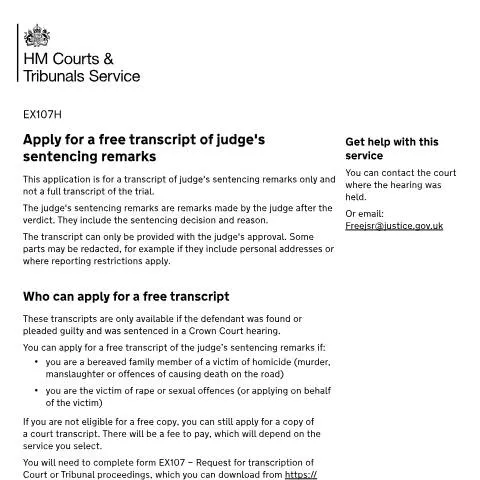
Understanding Judge's Sentencing Remarks Transcripts in Crown Court Proceedings
When a Crown Court judge delivers their sentencing decision after finding a defendant guilty, their remarks carry profound weight for all those affected by the crime. These carefully crafted statements explain not just the sentence imposed, but the reasoning behind it, often addressing the impact on victims and the wider community. For bereaved families of homicide victims or survivors of rape and sexual offences, accessing these remarks can provide crucial closure and understanding in their journey through the criminal justice system.
Form EX107H represents a significant development in victim support services, offering free access to these transcripts for specific groups who have endured the most serious crimes. This application process recognises that the judge's words at sentencing often hold particular significance for those most directly affected, providing validation, explanation, and sometimes the beginning of a healing process.
Eligibility Criteria: Who Qualifies for Free Transcripts
The scope of EX107H is deliberately focused on the most serious criminal cases where victim impact is at its most severe. Bereaved family members of homicide victims form the primary eligible group, covering cases involving murder, manslaughter, and offences causing death on the road. This includes immediate family members such as parents, siblings, spouses, and children, though the form allows flexibility in how family relationships are defined.
The second eligible category encompasses victims of rape or sexual offences, recognising the particular trauma associated with these crimes and the importance of understanding the court's response. Significantly, the form also accommodates applications made on behalf of victims, acknowledging that some survivors may prefer to have a trusted person handle this process for them.
Crown Court Jurisdiction Requirements
A crucial limitation is that transcripts are only available for cases where the defendant was sentenced in a Crown Court hearing after being found or pleading guilty. This excludes magistrates' court sentencing, even for serious offences that may have started in the Crown Court. However, it's worth noting that Crown Court cases can sometimes be heard in alternative venues such as magistrates' courts or other law courts, and these remain eligible provided the sentencing judge was acting in their Crown Court capacity.
| Eligible Cases | Requirements | Key Considerations |
|---|---|---|
| Homicide (murder, manslaughter) | Crown Court sentencing after guilty verdict/plea | Bereaved family member status required |
| Causing death by dangerous/careless driving | Crown Court sentencing after guilty verdict/plea | Road traffic death offences included |
| Rape and sexual offences | Crown Court sentencing after guilty verdict/plea | Victim or authorised representative can apply |
The Judge's Approval Process and Potential Redactions
Unlike standard court transcripts that follow administrative procedures, EX107H applications require individual judicial approval. The sentencing judge retains discretion over whether to release their remarks, creating a personalised assessment process that considers the specific circumstances of each case.
This judicial oversight serves multiple purposes. Firstly, it ensures that releasing the transcript serves the legitimate interests of the applicant without compromising ongoing proceedings or appeals. Secondly, it allows judges to consider whether any sensitive information within their remarks requires protection before release.
Understanding Redaction Practices
Even when approved, transcripts may not be released in their entirety. Personal addresses are routinely redacted to protect privacy and security, particularly important in cases involving domestic violence or where there may be ongoing risks to individuals mentioned in the proceedings.
Reporting restrictions present another common reason for redaction. These might include restrictions protecting the identity of vulnerable witnesses, children involved in proceedings, or information that could prejudice other ongoing cases. In sexual offence cases, automatic reporting restrictions often apply to protect victim anonymity, though this doesn't typically affect sentencing remarks themselves.
Completing Form EX107H: Essential Information and Common Challenges
The form's structure reflects the need to identify specific proceedings accurately within the Crown Court system. Question 2 requires the precise name of the Crown Court where sentencing occurred, which isn't always straightforward when cases have moved between venues or when hearings have taken place in temporary locations.
The sentencing hearing date (Question 3) specifically refers to the final hearing when the judge imposed sentence, not earlier hearings where verdicts were delivered or preliminary sentencing discussions occurred. In complex cases with multiple hearings, this distinction becomes crucial for locating the correct proceedings.
Reference Numbers and Case Identification
Questions 4 and 5 work together to pinpoint the specific case. The defendant's name should match exactly how it appeared in court records, including any aliases used during proceedings. The Unique Reference Number (URN) or case reference, while marked optional, significantly speeds up processing when available.
These reference numbers appear on various documents throughout the criminal justice process, including police correspondence, victim personal statements, court listings, and any previous transcript requests. Victims often receive multiple documents with different reference formats, so checking police victim liaison correspondence or court witness service communications typically yields the most reliable references.
Audio Quality and Technical Limitations in Transcript Production
The success of any transcript request depends fundamentally on audio recording quality during the original proceedings. Crown Courts use sophisticated recording equipment, but various factors can affect clarity: courtroom acoustics, multiple speakers, technical malfunctions, or instances where judges speak away from microphones during informal discussions.
The 20 working day processing timeframe allows for thorough audio review and transcription quality checks. Court reporters must verify that recordings capture the judge's complete remarks clearly enough to produce an accurate transcript. Where audio quality falls short of professional transcription standards, applications may be declined on technical grounds rather than judicial discretion.
Alternative Options When EX107H Applications Fail
Applicants whose EX107H requests are declined—whether for technical or judicial reasons—retain the option to pursue paid transcript services through form EX107. This standard transcript request process doesn't require judicial approval and covers broader categories of court proceedings, though fees vary depending on urgency and format requirements.
The paid route also accommodates those who don't meet EX107H eligibility criteria but have legitimate interests in accessing sentencing remarks, such as extended family members, victim support workers, or legal representatives handling related civil proceedings.
Delivery Methods and Privacy Considerations
Question 7's delivery options reflect practical and security considerations for sensitive documents. Email delivery offers speed and convenience but requires careful attention to email security, particularly for victims who may be using shared computers or whose email accounts might be accessed by others.
Postal delivery provides greater security control, allowing recipients to specify safe addresses that may differ from their home addresses. This proves particularly important in domestic violence cases or where victims have relocated for safety reasons following the original offence.
Managing Sensitive Information After Receipt
Recipients should consider how they'll store and potentially share transcript content. These documents often contain detailed descriptions of criminal acts and their impact, making them potentially distressing to re-read or inappropriate for sharing with certain family members, particularly children or vulnerable adults.
Some victims find it helpful to review transcripts with support from victim liaison services or counselling professionals who can provide context and emotional support during what can be a difficult but important part of processing their experience.
Integration with Victim Support Services and Ongoing Proceedings
EX107H applications often occur alongside other victim support processes. Victim Personal Statements submitted before sentencing may be referenced in the judge's remarks, creating connections between the victim's own words and the court's response. Understanding these connections can enhance the value victims derive from reading the transcript.
The timing of applications varies significantly. Some families and victims seek transcripts immediately after sentencing to understand the judge's reasoning while proceedings remain fresh in their minds. Others prefer to wait until they feel emotionally prepared to engage with detailed accounts of the crime and its impact.
Appeals and Sentence Review Implications
Sentencing remarks transcripts can play important roles in subsequent proceedings. Defence appeals against sentence length or prosecution appeals for increased sentences often reference specific judicial comments made during original sentencing. Victims accessing these transcripts gain insight into reasoning that may be scrutinised in higher courts.
The Unduly Lenient Sentence scheme, which allows certain sentences to be referred to the Court of Appeal for review, frequently involves detailed analysis of judicial reasoning as expressed in sentencing remarks. Victims who understand this reasoning through transcript access are better positioned to engage with any subsequent review processes.
Practical Considerations for Bereaved Families and Sexual Offence Survivors
The emotional impact of reading sentencing remarks shouldn't be underestimated. These documents often contain detailed descriptions of criminal acts, victim impact assessments, and judicial observations about the defendant's behaviour and character. Preparation and support prove crucial for managing this potentially distressing material constructively.
Many applicants benefit from coordinating their EX107H application with victim support services, which can provide context about the sentencing process and emotional support when reviewing transcript content. Family liaison officers in homicide cases often assist with understanding both the application process and the likely content of sentencing remarks.
The distinction between sentencing remarks and full trial transcripts matters significantly for emotional preparation. Sentencing remarks focus on the judge's reasoning and the impact of the crime, typically avoiding detailed evidence rehearsal. However, they may still contain distressing content, particularly in cases involving violence or sexual assault.
Supporting Multiple Family Members and Collective Applications
While each EX107H form represents an individual application, bereaved families often coordinate multiple requests to ensure all eligible family members receive copies. This approach recognises that different family members may process the information at different paces and may benefit from having their own copies to review privately.
The form accommodates applications made on behalf of others, particularly valuable in sexual offence cases where victims may prefer trusted family members or support workers to handle the administrative aspects while retaining control over whether and when to review the transcript content themselves.
When You Cannot Use Form EX107H: Alternative Routes for Accessing Court Records
Form EX107H specifically covers transcripts of judges' sentencing remarks, but several scenarios exist where this form won't meet your requirements. Understanding these limitations helps avoid unnecessary delays and directs you toward the correct procedure from the outset.
Proceedings where EX107H doesn't apply include magistrates' courts sentencing, where remarks are typically brief and may not be formally recorded verbatim. Instead, you'll need to contact the specific magistrates' court directly through their administrative office. Similarly, youth court proceedings follow different protocols under the Children and Young Persons Act 1933, with restricted access even for parties involved.
For civil proceedings transcripts, including family court judgments, employment tribunal decisions, or Upper Tribunal determinations, separate application processes apply. The Family Court uses Form FP25 for transcript requests, whilst employment tribunals have their own system administered through HM Courts & Tribunals Service regional offices. Each jurisdiction maintains distinct procedures reflecting the nature of proceedings and applicable disclosure rules.
Historical cases pre-dating digital recording systems present particular challenges. Courts began systematic audio recording in the 1980s, but implementation varied significantly across different court centres. For cases from the 1970s or earlier, you may need to rely on contemporaneous newspaper reports, legal journals, or archived court files held by The National Archives in Kew. Some significant cases have published law reports in series like the All England Law Reports or Weekly Law Reports, accessible through legal databases or law libraries.
When proceedings occurred in specialist courts—such as the Court of Appeal, Supreme Court, or certain divisional courts—direct application to those institutions may be more appropriate than using EX107H. The Supreme Court, for instance, maintains its own transcript service and typically makes judgments freely available online shortly after delivery.
Alternative documentation might serve your purpose without requiring a full transcript. Court registers provide case outcomes, sentence details, and key dates. For research purposes, anonymised case summaries from legal databases often contain sufficient detail about sentencing reasoning without requiring personal data or incurring transcript costs.
If you're seeking information for appeals or post-conviction proceedings, your solicitor can often obtain relevant extracts through professional channels more efficiently than individual applications. The Criminal Appeal Office maintains relationships with court recording services that can expedite requests where time-sensitive legal deadlines apply.
Technical Specifications and Quality Standards for Court Transcripts
Understanding the technical production process behind court transcripts helps set realistic expectations about delivery times, formatting, and potential limitations you might encounter when receiving your EX107H transcript.
Fill in your form directly online
No printing: type your details into the boxes of the official form, tick, then download the PDF ready to send.
- 1Type into the form boxes
- 2Tick in one click
- 3Save and download the PDF
Recording methods vary significantly across court centres and affect transcript quality. Modern digital systems like the Digital Audio Recording and Transcription (DART) service produce high-quality audio files that transcribers can process efficiently. However, older analogue systems, still in use at some court centres, may produce recordings with background noise, unclear speech, or technical interruptions that impact transcript accuracy.
Transcription standards follow guidelines established by HM Courts & Tribunals Service, requiring verbatim reproduction of spoken words including false starts, repetitions, and grammatical errors as actually spoken. This differs from edited summaries or paraphrased accounts. Transcribers use standardised notation for inaudible passages [inaudible], interrupted speech, and simultaneous speakers, which you'll see reflected in your final document.
Formatting conventions ensure consistency across all court transcripts. Speaker identification appears in capitals (e.g., "HIS HONOUR JUDGE SMITH:", "MR WILLIAMS:"), with timestamps inserted at regular intervals. Legal terminology remains unchanged, preserving Latin phrases, case citations, and technical language as spoken. This maintains evidential value but may require legal interpretation for lay readers.
Quality assurance processes involve multiple checks before transcript release. Initial transcription undergoes supervisor review, with particular attention to legal terminology, proper names, and case references. However, the final transcript reflects what was actually said rather than what should have been said, meaning judicial slips of the tongue or misstatements remain uncorrected unless subsequently clarified on record.
Digital delivery formats typically include both PDF and Word documents, with PDF versions carrying digital signatures or watermarks confirming authenticity. The Word format allows text searching and copying, useful for legal professionals preparing appeal documents or academic researchers analysing judicial language patterns.
Confidentiality markings appear on transcripts containing sensitive information. These might include reporting restrictions under the Contempt of Court Act 1981, anonymisation requirements for vulnerable witnesses, or limitations on disclosure under the Data Protection Act 2018. Understanding these markings prevents inadvertent breaches that could result in legal consequences.
Audio quality factors affecting transcription include courtroom acoustics, microphone placement, and speaker clarity. Barristers wearing traditional wigs and gowns may have muffled speech, whilst defendants speaking from the dock often appear distant on recordings. These technical limitations can result in [inaudible] notations even in recent proceedings with modern equipment.
Correction procedures exist for demonstrable transcription errors, but the threshold for amendments is high. Factual errors in spelling of names, case numbers, or clearly misheard words may be correctable, but disputed interpretations of unclear speech typically remain unchanged. The original audio recording serves as the definitive record for resolving such disputes.
Strategic Considerations for Legal Professionals and Researchers
Beyond the basic application process, legal practitioners and academic researchers face specific considerations when requesting transcripts through Form EX107H that can significantly impact the utility and admissibility of obtained documents.
Evidential weight and authentication requirements vary depending on intended use. For appeal proceedings, transcripts must meet strict authenticity standards under the Criminal Procedure Rules. The transcript provider's certification becomes crucial, as courts may reject uncertified or informally obtained transcripts. Legal professionals should specify the intended use when applying, as this affects the level of certification provided.
Timing strategies prove critical in time-sensitive legal proceedings. Appeal deadlines under the Criminal Appeal Act 1995 don't typically extend to accommodate transcript delays, making early application essential. For complex cases with lengthy sentencing remarks, consider applying immediately after sentence rather than waiting for potential appeal decisions. The 21-day appeal window passes quickly, and transcript delays can effectively preclude appeal rights.
Partial transcript requests can reduce costs and delivery times when full proceedings aren't required. Specify particular aspects of sentencing remarks—such as mitigation consideration, aggravating factors assessment, or guideline application—rather than requesting complete transcripts. This approach particularly benefits academic researchers studying specific aspects of judicial decision-making.
Cross-referencing with other court documents enhances transcript utility. Sentencing remarks should be read alongside pre-sentence reports, victim impact statements, and plea hearing transcripts to understand the full context of judicial reasoning. These additional documents require separate applications through different procedures, often involving probation services or witness care units.
Comparative analysis considerations for researchers studying sentencing patterns across multiple cases require consistent transcript sources and formatting. Variations between different court centres' transcription services can complicate systematic analysis. Consider focusing research on specific court centres or time periods to ensure consistency in recording and transcription methods.
Professional indemnity implications affect solicitors and barristers using transcript evidence. Ensure transcript accuracy through careful review against any personal notes or recollections from the original hearing. Errors in transcripts used for appeal grounds can have significant professional liability consequences, particularly if they mislead appellate courts about the original proceedings.
Data protection compliance becomes complex when transcripts contain personal information about third parties. Academic researchers must consider whether transcript content requires ethical approval from institutional review boards, particularly when studying sensitive topics like domestic violence or sexual offences. Anonymisation may be necessary even when transcripts are legitimately obtained.
International jurisdiction issues arise when transcript evidence is required for proceedings in other legal systems. Some foreign courts have specific authentication requirements that standard UK transcript certification may not meet. Consider whether apostille certification under the Hague Convention might be necessary, which requires additional procedures through the Foreign, Commonwealth & Development Office.
Cost-benefit analysis should weigh transcript expenses against alternative research methods or evidence sources. For academic research, published case reports or judicial sentencing guidelines databases might provide sufficient information without incurring individual transcript costs. Legal practitioners should consider whether transcript evidence will materially strengthen their case before committing to potentially significant expenses.