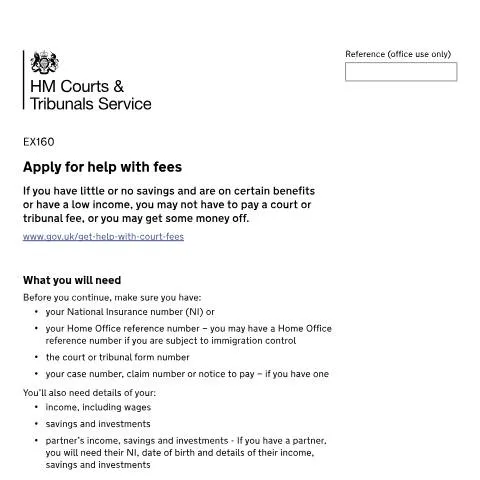
When Court Proceedings Risk Breaking the Bank: Understanding Fee Relief Through Form EX160
Court and tribunal proceedings can place significant financial strain on individuals seeking justice, particularly when facing family disputes, housing issues, or employment matters. The stark reality is that court fees can range from modest sums to several hundred pounds, potentially preventing access to the legal system for those with limited means. Form EX160 serves as the gateway for financial relief, enabling eligible individuals to secure full or partial exemption from these mandatory charges.
The system operates on a means-tested basis, examining both income thresholds and benefit entitlements to determine eligibility. Those receiving qualifying benefits may receive automatic fee exemption, whilst others undergo income assessment based on household circumstances, savings levels, and dependent children. The process requires precise financial disclosure, as HM Courts & Tribunals Service cross-references information with other government departments including the Department for Work and Pensions.
Understanding this mechanism proves crucial for anyone contemplating legal action who may struggle with associated costs. The form applies across the entire court and tribunal system, from family proceedings to employment disputes, making it a universal tool for accessing justice regardless of financial circumstances.
Navigating the Eligibility Maze: Who Qualifies for Fee Assistance
The eligibility framework operates through multiple pathways, each with distinct criteria and evidence requirements. Benefit recipients form the primary category, encompassing those receiving Income-based Jobseeker's Allowance, Income-related Employment and Support Allowance, Income Support, Universal Credit (with annual earnings below £6,000), or Pension Credit guarantee credit. Critically, contribution-based variants of these benefits do not qualify, requiring careful distinction between benefit types.
For non-benefit recipients, assessment hinges on household income levels measured against specific thresholds. The calculation includes wages, self-employment income, pensions, and investment returns, creating a comprehensive financial picture. Savings thresholds prove equally significant, with amounts exceeding £16,000 typically disqualifying applicants entirely, though special provisions exist for individuals aged 66 or over.
| Savings Amount | Eligibility Impact | Special Considerations |
|---|---|---|
| Under £4,250 | Proceed to income assessment | No savings deduction applied |
| £4,250 - £15,999 | May qualify with income test | Deemed income calculation applies |
| £16,000 or more | Generally ineligible | Age 66+ may have different thresholds |
Partner circumstances complicate eligibility determination, as married couples and those cohabiting must combine financial resources for assessment purposes. However, exceptions exist where partners have conflicting interests in the legal proceedings, or where couples live separately due to relationship breakdown. Immigration status also influences eligibility, with Home Office reference numbers accepted as alternatives to National Insurance numbers for those subject to immigration control.
Decoding Relationship Status: When Partners Count and When They Don't
The relationship status determination carries profound implications for fee relief eligibility, as it fundamentally alters the financial assessment basis. Single applicants include not only those living alone but also individuals permanently separated from partners, those in divorce proceedings, and crucially, those whose partners have conflicting interests in the court case itself.
This latter category proves particularly significant in family law proceedings, where spouses may find themselves on opposing sides of custody disputes or financial settlements. The guidance recognises that combining such partners' resources would create an inherent unfairness, potentially preventing one party from accessing justice due to the other's financial position.
Conversely, married or cohabiting status encompasses formal marriages, civil partnerships, and couples living together as if married or in civil partnership. The assessment extends to couples who maintain separate residences but continue their relationship, requiring careful evaluation of the genuine nature of any separation. Partners forced to live apart due to work commitments, military service, or caring responsibilities typically remain classified as couples for assessment purposes.
The implications prove substantial: single applicants face assessment based solely on their individual circumstances, whilst coupled applicants undergo combined financial evaluation. This distinction can determine whether someone qualifies for full fee remission, partial assistance, or faces the full court fee burden.
Mastering the Documentation Requirements: What Evidence Matters
Successful EX160 applications depend heavily on accurate documentation and supporting evidence. The form itself requires specific identifiers, primarily National Insurance numbers for UK residents or Home Office reference numbers for those subject to immigration control. Children under 16 may lack National Insurance numbers, requiring alternative identification methods and careful completion of relevant sections.
Income documentation varies significantly based on employment status and benefit receipt. Employed individuals must provide wage slips, P60 certificates, and employment contracts, whilst self-employed applicants need business accounts, tax returns, and bank statements demonstrating actual income levels. Benefit recipients require current award notices and correspondence from the Department for Work and Pensions confirming ongoing entitlement.
Savings evidence encompasses all financial institutions, including current accounts, savings accounts, ISAs, premium bonds, and investment portfolios. Property ownership beyond the primary residence requires valuation, as does any business ownership or partnership interests. The assessment includes both liquid assets and investments that could reasonably be converted to cash.
Partner documentation mirrors these requirements when applicable, necessitating comprehensive financial disclosure from both parties. The system's cross-referencing capabilities mean that incomplete or inaccurate information risks automatic rejection, making thorough preparation essential before submission.
Strategic Timing: Retroactive Claims and Forward Planning
The temporal aspects of EX160 applications offer both opportunities and constraints that applicants must navigate carefully. Prospective applications represent the standard approach, submitted alongside or before the relevant court or tribunal form. This timing ensures seamless processing and prevents initial fee payment requirements.
However, the system accommodates retrospective claims for fees paid within the preceding three months. This provision proves invaluable for individuals who paid fees before discovering their eligibility for assistance, or whose circumstances changed shortly after payment. Retroactive applications require particular attention to the timing of financial circumstances, as assessment occurs based on the situation at the time of original fee payment rather than current circumstances.
This temporal distinction creates strategic considerations for applicants whose financial position fluctuates. Those experiencing temporary income increases might benefit from immediate application, whilst those anticipating reduced circumstances could time their submissions accordingly. However, such strategic timing must balance against the risk of missing court deadlines or facing enforcement action for unpaid fees.
The three-month limitation for refund claims operates strictly, making prompt action essential once eligibility becomes apparent. Extensions to this timeframe remain exceptional, typically requiring compelling circumstances such as serious illness, bereavement, or administrative error by court staff.
Specialist Scenarios: Probate Cases and Complex Proceedings
Certain legal proceedings present unique considerations within the EX160 framework, requiring specialised knowledge and approach. Probate cases carry particular complexity, as they involve the administration of deceased persons' estates and may feature multiple interested parties with varying financial circumstances.
When applying for fee relief in probate matters, the form requires specific details about the deceased, including their full name and death date. The financial assessment focuses on the applicant's personal circumstances rather than the estate value, recognising that beneficiaries or executors may lack personal funds despite potentially valuable estates. This distinction proves crucial in cases where estates contain illiquid assets or face disputed claims.
Employment tribunal cases present another specialised area, where fee relief applications often coincide with ongoing workplace disputes. The timing becomes particularly sensitive, as tribunal deadlines operate independently of fee relief processing times. Applicants must balance the need for thorough EX160 preparation against strict tribunal submission requirements.
Family proceedings involving children or vulnerable adults may require litigation friend involvement, where appointed representatives complete EX160 applications on behalf of those lacking capacity. These cases demand additional documentation proving appointment authority and may involve court oversight of the fee relief decision.
Immigration-Related Proceedings
Immigration and asylum cases frequently involve applicants without traditional UK documentation, making Home Office reference numbers essential alternatives to National Insurance numbers. These cases may also feature complex income calculations where overseas earnings, family remittances, or restricted work permissions affect standard assessment criteria.
Processing Pathways: How HM Courts & Tribunals Service Evaluates Applications
The administrative processing of EX160 applications involves sophisticated cross-referencing systems designed to verify information accuracy whilst minimising applicant burden. Upon submission, the system automatically contacts the Department for Work and Pensions to confirm benefit entitlements, eliminating the need for supporting documentation in straightforward cases.
For income-based assessments, processing times vary significantly depending on information complexity and verification requirements. Straightforward cases with clear benefit entitlement typically receive decisions within 10-15 working days, whilst complex income calculations or partnership arrangements may require several weeks for thorough evaluation.
The verification process extends beyond basic income checks to encompass savings validation through financial institutions and property ownership confirmation through Land Registry searches. This comprehensive approach ensures accurate assessment whilst identifying potential discrepancies requiring further investigation.
Decision outcomes fall into three categories: full fee remission, partial fee reduction, or application rejection. Partial remissions calculate based on household income levels above minimum thresholds but below full fee payment requirements. The calculation methodology considers both income levels and dependent children numbers, creating tailored assistance reflecting individual circumstances.
| Decision Type | Outcome | Next Steps |
|---|---|---|
| Full Remission | No fee payment required | Proceed with court/tribunal application |
| Partial Remission | Reduced fee calculation provided | Pay reduced amount within specified timeframe |
| Rejection | Full fee payment required | Pay full fee or request reconsideration |
Reconsideration Rights and Appeal Mechanisms
When EX160 applications face rejection or generate unexpected outcomes, applicants retain several avenues for challenge and reconsideration. The primary mechanism involves requesting administrative reconsideration, typically available within 14 days of the original decision notification.
Reconsideration requests must identify specific grounds for challenge, whether factual errors, misapplied criteria, or changed circumstances since the original application. Common grounds include miscalculated income figures, failure to account for essential expenses, or incorrect partnership status determination. Supporting evidence proving the alleged errors strengthens reconsideration prospects significantly.
The reconsideration process operates independently from original application processing, often involving senior administrative staff or specialist units. This separation ensures fresh evaluation of disputed decisions whilst maintaining system integrity. Processing times for reconsiderations typically exceed initial application timeframes, reflecting the additional scrutiny applied to challenged decisions.
Beyond administrative reconsideration, applicants may pursue formal appeals through appropriate tribunal channels, though this avenue remains exceptional given the administrative nature of fee relief decisions. More commonly, applicants resubmit fresh EX160 applications when circumstances change or additional evidence becomes available, treating the process as iterative rather than final.
The system recognises that financial circumstances fluctuate, particularly for those experiencing unemployment, illness, or family breakdown. Consequently, previous rejections do not preclude future applications, provided genuine changes in circumstances warrant reassessment. This flexibility ensures that temporary financial improvements do not permanently exclude individuals from fee relief eligibility during subsequent periods of hardship.
Understanding the Assessment Process and Decision Timeline
Once you submit your EX160 application, HM Courts & Tribunals Service follows a structured assessment process that typically takes between 10 to 20 working days, though complex cases involving multiple income sources or disputed evidence may require additional time. The court staff reviewing your application are trained assessors who evaluate applications against strict criteria outlined in the Civil Proceedings Fees Order 2008 and subsequent amendments.
During the initial review stage, assessors verify the mathematical calculations on your form, cross-reference your stated income against supporting documents, and check for any obvious discrepancies or missing information. If your gross monthly household income clearly falls below the threshold for your household size, and all required evidence is present and consistent, your application may be approved within the shorter timeframe.
Fill in your form directly online
No printing: type your details into the boxes of the official form, tick, then download the PDF ready to send.
- 1Type into the form boxes
- 2Tick in one click
- 3Save and download the PDF
However, certain circumstances trigger more detailed scrutiny. These include applications where your income fluctuates significantly month-to-month (common among seasonal workers or those with irregular freelance income), cases where you've declared substantial assets despite low income, or situations where your living arrangements are complex—such as shared custody arrangements affecting household composition or adults living together who aren't in a relationship.
If assessors require clarification, they'll contact you in writing, typically requesting specific additional documents or explanations. Common requests include bank statements covering a longer period to establish income patterns, tenancy agreements to verify housing costs, or medical certificates to substantiate claims about inability to work. You'll normally have 14 days to respond to such requests, and failure to provide the requested information within this timeframe may result in your application being refused.
The decision notification arrives by post and includes detailed reasoning if your application is refused. Successful applications result in either full remission (complete fee waiver) or partial remission (reduced fee). If you receive partial remission, you must pay the remaining amount before your case can proceed, and the court will provide specific payment instructions and deadlines.
Special Circumstances and Complex Household Situations
Form EX160 accommodates various complex living situations that don't fit standard household models, though these require careful documentation and often benefit from additional explanation. Understanding how to present your circumstances accurately is crucial for a successful application, particularly when your situation involves non-traditional family structures or temporary arrangements.
Separated couples who continue living in the same property present a common complexity. If you're separated but still sharing accommodation due to financial constraints, you can apply as a single person household, but you must provide clear evidence of the separation. This typically includes a signed statement from both parties confirming the separation date, evidence of separate finances (such as individual bank accounts and benefit claims), and documentation showing you maintain separate living arrangements within the property where possible. Some applicants provide utility bills showing separate responsibility or tenancy agreements reflecting the changed circumstances.
Shared custody arrangements require particular attention to timing and household composition. If children spend equal time between two households, you should include them in your household size calculation and provide evidence of the custody arrangement, such as a court order or signed agreement between parents. However, if custody is primarily with the other parent and you have only weekend or holiday access, the children typically wouldn't count toward your household size for fee remission purposes.
Students living in shared accommodation face unique challenges, especially when determining which income sources to declare. If you're a full-time student, certain benefits like housing benefit or student loans may affect your eligibility differently than employment income. Student accommodation that includes meals or utilities requires careful calculation to determine your actual disposable income after essential living costs.
Care leavers and young people estranged from their families can apply based on their individual circumstances rather than parental income, but must provide evidence of their status. Local authority letters confirming care leaver status or statements from support workers can substantiate these claims. Similarly, young people who've experienced family breakdown may need to provide evidence from social services, housing departments, or support organisations to demonstrate their independence.
Households including elderly relatives or adult children with disabilities require documentation of any benefits or income these individuals receive, as well as evidence of their dependency status. If an adult child receives disability benefits but contributes these entirely to household expenses due to their care needs, this should be clearly explained and evidenced through benefit award letters and care assessments.
Managing Urgent Cases and Emergency Applications
Certain legal proceedings operate under tight deadlines that don't accommodate the standard 10-20 day assessment period for fee remission applications. Understanding how to handle urgent cases while still securing financial assistance requires strategic planning and knowledge of available expedited procedures.
Emergency applications for fee remission can be submitted alongside urgent court applications in specific circumstances, such as injunction proceedings, urgent family matters involving child welfare, or employment tribunal cases with imminent deadlines. When submitting an emergency application, you must complete EX160 as thoroughly as possible with available documentation and include a covering letter explaining the urgency and requesting expedited processing.
In genuinely urgent situations where you cannot gather all supporting documents within the required timeframe, courts may accept provisional applications with undertakings to provide missing evidence within a specified period post-submission. However, this discretion is exercised sparingly and typically only when the underlying legal matter involves immediate risk to welfare, liberty, or significant financial loss that cannot be remedied if proceedings are delayed.
For employment tribunal cases, the three-month limitation period for most claims creates particular pressure. If you're approaching this deadline and haven't yet submitted your fee remission application, you can submit your tribunal claim alongside a partially completed EX160, clearly marking it as an emergency application and providing whatever financial documentation is immediately available. The tribunal will typically issue the claim while the fee remission is assessed, though you remain liable for the fee if the application is unsuccessful.
Immigration and asylum cases often involve urgent elements, particularly when individuals face imminent removal or have visa deadlines approaching. In these circumstances, you can request expedited processing by demonstrating the time-sensitive nature of your case through Home Office correspondence, legal representative letters, or other official documentation showing deadlines.
When emergency processing is granted, you may receive a provisional decision within 2-5 working days, though this often comes with conditions requiring full documentation within a specified timeframe post-decision. If you fail to meet these subsequent requirements, any granted remission may be revoked, and you'll become liable for the full fee plus potential additional costs.
Emergency applications require complete honesty about your financial situation, even when full documentation isn't immediately available. Providing estimated figures clearly marked as such, with explanations of why precise documentation isn't available and timescales for providing it, helps maintain credibility and demonstrates good faith engagement with the process.