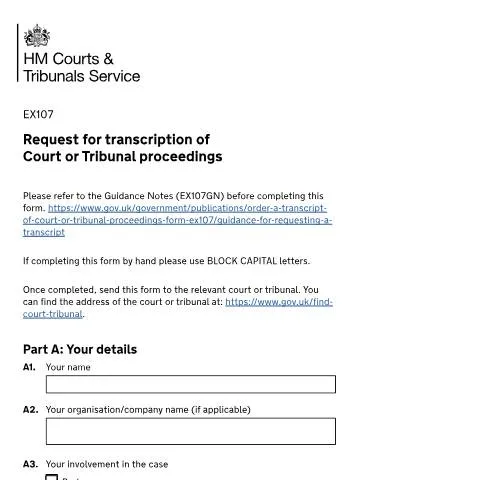
Understanding Your Rights to Court and Tribunal Transcripts
When legal proceedings conclude, the spoken word often holds the key to understanding what truly transpired in court. Whether you're appealing a decision, preparing for subsequent hearings, or simply need an accurate record of proceedings, Form EX107 serves as your gateway to obtaining official transcripts from HM Courts & Tribunals Service. This comprehensive request form bridges the gap between oral proceedings and written records, ensuring that justice remains accessible through proper documentation.
The transcript ordering process has evolved significantly in recent years, moving from a predominantly paper-based system to a more streamlined digital approach. However, this modernisation has also introduced complexities around provider selection, payment arrangements, and technical specifications that can perplex even experienced legal professionals.
Navigating the Transcription Landscape: Companies and Court Allocations
One of the most crucial aspects of Form EX107 lies in understanding which transcription company you must use. The system operates on a hybrid model where choice varies dramatically depending on your court type and location.
For Crown Court proceedings, you have no choice in transcription provider. Each Crown Court has a designated company, and Annex A of the guidance notes provides the definitive allocation list. This restriction ensures consistency in quality and turnaround times but can frustrate parties accustomed to competitive tendering in other areas of legal services.
| Court Type | Provider Selection | Key Considerations |
|---|---|---|
| Crown Court | Allocated provider only | Check Annex A for specific court allocation |
| Civil Courts | Choice from approved list | Compare pricing and turnaround times |
| Employment Tribunals | Choice from approved list | Public funding may be available |
| Family Courts | Choice from approved list | Consider confidentiality requirements |
The approved companies include eScribers (formerly Auscript), Marten Walsh Cherer, The Transcription Agency, Acolad UK Ltd (formerly Ubiqus), and Epiq (formerly DTI). Each brings different strengths in terms of specialisation, turnaround times, and pricing structures, making the selection process in non-Crown Court cases a strategic decision.
Employment Tribunal Transcripts: The Public Expense Exception
Employment tribunals operate under a unique framework where transcripts may be provided at public expense in specific circumstances. This provision, outlined in questions A11 and A12 of Form EX107, reflects the tribunal system's commitment to ensuring effective participation of vulnerable parties and making reasonable adjustments for individuals with disabilities.
The criteria for public expense transcripts are deliberately narrow. You must demonstrate that the transcript is essential for a vulnerable party's effective participation or constitutes a reasonable adjustment under disability legislation. Simply wanting a transcript for appeal purposes or general record-keeping will not qualify for public funding.
Decoding Case Information Requirements: Precision Matters
Part B of Form EX107 demands meticulous attention to detail, as incomplete or inaccurate information will inevitably delay processing. The seemingly straightforward request for case details actually requires sophisticated understanding of court hierarchies and case management systems.
The court name specification in question B1 goes beyond simple identification. You must provide the precise court designation—not just "Crown Court" but "Liverpool Crown Court" or "Southwark Crown Court." For High Court matters, specify the division: Queen's Bench, Chancery, or Family. This granularity reflects the complex administrative structure of the court system and ensures your request reaches the correct records department.
Judicial Identification and Legal Representation Details
Questions B4 and B5 address judicial and legal representation identification, which serves multiple purposes beyond mere record-keeping. The judge's name helps court staff locate the correct hearing from potentially dozens occurring daily, while barrister and solicitor details assist in cross-referencing case files and ensuring all parties receive appropriate notification of transcript availability.
In complex multi-party litigation, particularly in commercial or family cases, these details become crucial for managing confidentiality requirements and ensuring that sensitive information doesn't inadvertently reach unauthorised recipients.
Reporting Restrictions and Privacy Considerations
Questions B7 and B8 of Form EX107 address two of the most legally significant aspects of transcript requests: reporting restrictions and private hearings. These provisions reflect the delicate balance between open justice principles and protection of vulnerable individuals or sensitive information.
Reporting restrictions can take various forms, from simple anonymisation orders to comprehensive publication bans. Common examples include:
- Youth court proceedings where defendants' identities must be protected
- Family cases involving children's welfare
- Commercial disputes with sensitive trade information
- Cases involving national security considerations
Private hearings present additional complications. These may occur ex parte (with only one party present), in camera (excluding the public), or with restricted access for specific portions of proceedings. Employment tribunals frequently conduct portions of hearings in private when discussing sensitive personal or commercial information.
The significance of accurately completing these sections cannot be overstated. Transcripts subject to reporting restrictions require special handling, additional security measures, and may incur supplementary charges. Failure to identify restrictions properly can result in delayed processing or, in serious cases, contempt of court proceedings.
Technical Specifications: Timing, Formats, and Delivery Methods
Part C of Form EX107 transforms general transcript requests into specific, actionable instructions for transcription companies. The precision required in questions C1 and C2 reflects the technical realities of modern court recording systems, which capture proceedings in discrete segments tied to specific times and locations.
The timing information in question C1 serves multiple purposes beyond simple identification. Court recording systems often operate on hourly or session-based segments, and precise timing helps technicians locate the correct audio files. Additionally, accurate timing enables more precise cost estimates, as most transcription companies charge based on audio duration rather than page count.
Transcription Categories: Understanding What You Actually Need
Question C3 presents a comprehensive menu of transcript types, each serving different strategic purposes. The categories reflect common legal requirements and help ensure you receive exactly what you need without paying for unnecessary material.
In criminal proceedings, the options range from complete hearing transcripts to highly specific segments like prosecution opening of facts or judge's summing up. This granularity proves particularly valuable in appeal preparation, where specific judicial comments or legal arguments may be crucial.
The evidence category requires additional specification, as it encompasses witness testimony, expert evidence, and documentary submissions. When selecting this option, you must provide detailed information about specific witnesses or evidence types to ensure accurate identification and transcription.
Payment Arrangements and Invoice Management
The financial aspects of transcript ordering, addressed in questions A12 through A15, reflect the complex realities of litigation funding and multi-party cases. These provisions accommodate various payment scenarios, from simple single-party requests to elaborate cost-sharing arrangements mandated by court orders.
When transcripts are ordered pursuant to court orders—particularly in cases where costs are shared between parties—Form EX107 requires attachment of the relevant order and specification of the order date. This documentation proves essential for transcription companies' billing departments and helps avoid disputes over payment responsibility.
Invoice splitting arrangements require careful planning and clear communication. Question A14 demands comprehensive contact details for all parties sharing costs, including email addresses where possible. Experience demonstrates that incomplete contact information frequently leads to delayed invoicing and frustrated parties seeking urgent transcript delivery.
Digital Delivery and Security Considerations
The default delivery method via email (question A8) reflects modern efficiency expectations but raises important security considerations. Legal transcripts often contain sensitive information requiring appropriate handling under professional conduct rules and data protection legislation.
Most transcription companies employ secure email systems with encryption and access controls, but parties must consider their own IT security arrangements. Law firms with strict information security policies may need to specify alternative delivery methods or provide dedicated secure email addresses for transcript receipt.
Processing Timelines and Quality Assurance
While Form EX107 doesn't specify processing timelines, understanding typical transcription workflows helps set realistic expectations and plan accordingly. Standard processing times vary significantly based on transcript type, audio quality, and transcription company workload.
Simple sentencing remarks or brief legal arguments typically require 3-5 working days for completion, while complex multi-day hearings with multiple speakers may require several weeks. Rush orders are available from most providers but command premium pricing and may not be feasible during peak periods.
Quality assurance processes vary between providers but typically include multiple review stages, particularly for complex legal terminology and proper names. However, parties should review transcripts promptly upon receipt, as correction requests become more difficult to accommodate once initial delivery occurs.
The integration of Form EX107 into broader case management strategies requires forward planning and clear communication between all stakeholders. Whether supporting appeal preparation, facilitating settlement negotiations, or preserving crucial evidence for future proceedings, transcript requests represent strategic decisions with implications extending far beyond simple record-keeping requirements.
Understanding Transcript Types and Their Applications
Court transcripts serve different purposes depending on your specific needs, and understanding these distinctions is crucial when completing Form EX107. The most common type is a verbatim transcript, which captures every word spoken during proceedings, including judicial remarks, witness testimony, and legal arguments from all parties. This comprehensive record proves invaluable for appeals, where precise wording can determine the outcome of your case.
Fill in your form directly online
No printing: type your details into the boxes of the official form, tick, then download the PDF ready to send.
- 1Type into the form boxes
- 2Tick in one click
- 3Save and download the PDF
Alternatively, you might require a summary transcript, which provides a condensed version focusing on key decisions, rulings, and significant exchanges. Summary transcripts typically cost less and arrive faster, making them suitable when you need a general overview rather than word-for-word accuracy. However, appeal courts generally require verbatim transcripts, so consider your intended use carefully.
For proceedings involving vulnerable witnesses or children, special handling protocols apply. These transcripts may contain redacted sections to protect identities, and additional approval stages can extend processing times. Similarly, cases involving national security or commercial sensitivity might require security clearance before transcript release, which Form EX107 cannot expedite.
Digital audio recordings, where available, offer another option. Some courts provide these at lower cost than traditional transcripts, though you'll need compatible playback equipment and may face restrictions on sharing or copying. Check with the specific court registry whether digital recordings exist for your proceedings, as availability varies significantly between jurisdictions and case types.
Navigating Costs and Payment Arrangements
Transcript costs vary considerably based on multiple factors, making accurate budgeting challenging without insider knowledge. Hourly rates for transcription services typically reflect the complexity of proceedings—a straightforward hearing with clear audio costs less per hour than a complex multi-party case with overlapping speakers and technical evidence.
The length of proceedings directly impacts your bill, but don't assume a simple multiplication. Many transcription providers apply sliding scale pricing, where longer proceedings receive per-hour discounts. Additionally, same-day or expedited service commands premium rates, sometimes doubling standard charges. If your timeline allows, standard processing often provides better value.
Payment arrangements deserve careful attention, particularly for lengthy proceedings where costs might reach hundreds or thousands of pounds. Some courts accept staged payment plans for substantial transcripts, allowing you to pay deposits upfront with balance due upon completion. This arrangement proves especially valuable for self-represented litigants managing tight budgets.
Legal aid may cover transcript costs in specific circumstances, though eligibility criteria remain strict. If you're pursuing an appeal with legal aid coverage, your solicitor should coordinate transcript ordering through established channels. However, if legal aid was refused or unavailable for your original proceedings, transcript costs typically fall to you personally, regardless of case outcome.
Corporate litigants face different considerations, as transcript costs form part of overall legal expenses that may be recoverable from opposing parties if successful. Keep detailed records of all transcript-related payments, including Form EX107 processing fees, as these might feature in subsequent costs applications.
Special Circumstances and Alternative Procedures
Certain situations require departing from standard Form EX107 procedures, and recognising these exceptions prevents delays and complications. Proceedings involving deceased parties often trigger additional verification requirements, as estate representatives must demonstrate legal authority to access transcripts. Letters of administration or grant of probate typically satisfy these requirements, but processing times extend accordingly.
Cross-border cases present unique challenges, particularly when proceedings involve international jurisdictions or enforcement. Transcripts destined for foreign courts may require apostille certification or specific formatting to meet overseas legal requirements. Form EX107 alone cannot address these needs—coordinate with the court registry about additional authentication procedures before submitting your application.
Cases involving interpreters or foreign language elements create transcription complexities that affect both timing and accuracy. Standard transcripts typically record interpreted speech in English, but you might need the original foreign language portions for appeal purposes. Specify these requirements clearly on Form EX107, as retrospective additions prove difficult and expensive.
Mental health tribunal proceedings follow distinct protocols, with enhanced confidentiality protections that may limit transcript availability to specific parties. If you're seeking transcripts from mental health tribunals, expect additional scrutiny of your legal standing and intended use, even when completing Form EX107 correctly.
Emergency applications represent another special category, where urgent transcript needs might justify expedited procedures. However, true emergencies remain rare in legal terms—imminent appeal deadlines or urgent injunction applications typically qualify, while general curiosity about proceedings does not. Courts retain discretion over emergency processing, and premium charges invariably apply.
Historical proceedings from closed or amalgamated courts require different handling entirely. These transcripts may exist in archived formats requiring specialist retrieval services, and Form EX107 might not apply at all. Contact the National Archives or regional court administration for guidance on accessing historical records, as standard transcript ordering procedures rarely accommodate these requests.