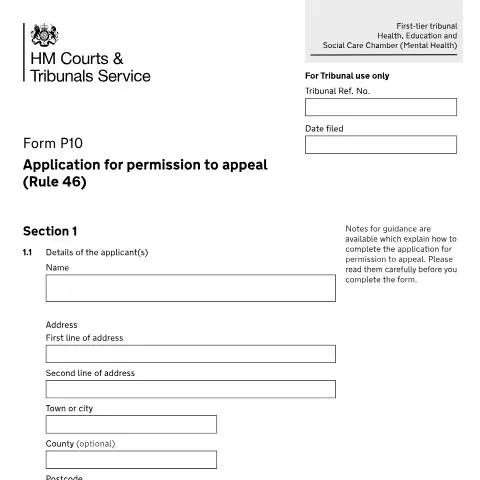
When Mental Health Tribunal Decisions Fall Short: The P10 Route to Upper Tribunal Appeal
A Mental Health Tribunal decision has just landed in your letterbox, and the outcome feels fundamentally wrong. Perhaps the tribunal dismissed your appeal against detention under the Mental Health Act 1983, or refused discharge when you believed the criteria for continued hospitalisation were no longer met. In such circumstances, Form P10 represents your statutory gateway to challenge that decision before the Upper Tribunal (Administrative Appeals Chamber).
This application for permission to appeal operates under Rule 46 of the Tribunal Procedure (First-tier Tribunal) (Health, Education and Social Care Chamber) Rules 2008. Unlike straightforward appeals, this process requires you to first convince the same First-tier Tribunal that made the original decision that their ruling contained an error of law significant enough to warrant Upper Tribunal scrutiny.
The Mental Health Chamber of the First-tier Tribunal handles some of the most sensitive cases in the tribunal system, dealing with individuals' liberty, treatment decisions, and fundamental rights. When these decisions go wrong, the P10 application becomes a crucial safeguard, though one hedged with strict procedural requirements and tight deadlines.
The Narrow Window: Time Limits and Extension Applications
Form P10 must be filed within one month of the date when written notice of the tribunal's decision was sent to you. This is not the date you received it, but when the tribunal dispatched it—a distinction that can prove crucial if postal delays occur. The clock starts ticking immediately, making swift action essential.
Section 3.1 of the form specifically addresses extension applications. If you've missed the one-month deadline, you must tick 'Yes' and provide compelling reasons why the application was delayed. The tribunal considers factors such as:
- Serious illness or mental health crisis that prevented timely action
- Lack of legal representation and difficulty understanding the process
- Administrative errors by legal representatives or support services
- Genuine postal or communication failures
However, extensions are not granted lightly. The tribunal expects applicants to act with reasonable diligence, and mere inconvenience or busy schedules rarely suffice. If you're applying months after the deadline, you'll need exceptional circumstances backed by documentary evidence.
For those detained under the Mental Health Act, the urgency becomes even more pronounced. Each day of continued detention following a potentially flawed tribunal decision represents a continuing restriction of liberty, making the P10 application time-sensitive in ways that extend beyond mere procedural compliance.
Constructing Your Legal Challenge: The Grounds That Matter
Section 4.1 demands a 'detailed statement of grounds'—the legal heart of your P10 application. This isn't an opportunity to simply disagree with the tribunal's conclusion; you must identify specific errors of law that undermined the decision-making process.
Successful grounds typically fall into several categories:
| Type of Error | Examples | Evidence Required |
|---|---|---|
| Procedural Unfairness | Inadequate opportunity to present evidence, bias by tribunal members | Hearing transcripts, correspondence showing denied requests |
| Misdirection on Law | Incorrect application of Mental Health Act criteria, wrong legal test applied | Relevant case law, statutory provisions |
| Inadequate Reasoning | Decision fails to address key evidence, contradictory findings | Decision notice analysis, expert reports ignored |
| Factual Findings Without Evidence | Conclusions reached despite absence of supporting medical evidence | Medical records, expert testimony transcripts |
The statement must be detailed and specific. Vague assertions like "the decision was unfair" will not suffice. You need to pinpoint exactly where the tribunal went wrong legally, referencing specific paragraphs of their decision notice and explaining how these errors materially affected the outcome.
If space on the form proves insufficient, Section 4.1 allows you to attach additional pages. This attached statement should be clearly structured, with numbered paragraphs and subheadings that make your legal arguments easy to follow.
Beyond Permission: Strategic Considerations for Your Appeal
Section 5.1 requires you to specify the outcome you're seeking. This goes beyond simply stating "I want the decision overturned." The Upper Tribunal has several options available:
- Setting aside the decision and remitting the case for fresh consideration by a differently constituted tribunal
- Substituting their own decision if the facts are clear and only one conclusion is possible
- Upholding the original decision despite identifying errors, if they consider the outcome would inevitably have been the same
Your statement should indicate which approach you believe appropriate and why. If seeking substitution of decision, you must demonstrate that the evidence so clearly supports your position that no reasonable tribunal could reach a different conclusion.
Section 5.2 addresses suspension of the tribunal's decision pending appeal. This is particularly significant in mental health cases where the original decision authorises continued detention or treatment. Suspension effectively puts the tribunal's decision on hold, but the grounds must be exceptionally strong—typically involving clear procedural violations or fundamental errors that make the decision legally unsustainable.
Applications for suspension require immediate attention from the tribunal, as they directly impact the applicant's liberty. The test involves balancing the strength of the appeal prospects against the potential harm from continued implementation of a potentially flawed decision.
Documentary Evidence and the Paper Trail
Section 7 lists the supporting documents required with your P10 application. This checklist represents more than bureaucratic box-ticking—each document serves a specific purpose in building your legal case.
The copy of the tribunal's decision must be the complete version, including any separate statement of reasons. Sometimes tribunals issue brief decisions on the day, followed by detailed written reasons weeks later. Your P10 application should reference the full reasoned decision, as this contains the detailed legal analysis that forms the target of your challenge.
Relevant case law requires careful selection. The Upper Tribunal expects applicants to demonstrate awareness of the legal framework governing their case. Key authorities might include:
- Supreme Court decisions on Mental Health Act interpretation
- Court of Appeal judgments on tribunal procedure
- Upper Tribunal precedents on similar fact patterns
However, avoid overwhelming the tribunal with extensive legal authorities. Focus on the most directly relevant cases that support your specific grounds of appeal.
The essential documents list for advance reading helps the tribunal prepare efficiently. This typically includes the original tribunal decision, key medical reports, and any documents that the tribunal appears to have overlooked or misinterpreted.
Navigating Legal Representation and Self-Representation Challenges
Section 1.2 allows for documents to be sent to your solicitor's address, reflecting the complex nature of mental health tribunal appeals. While legal representation isn't mandatory, the technical requirements of identifying errors of law make professional assistance highly valuable.
For those proceeding without representation, several resources can provide crucial support:
Law centres and advice agencies often have specialists in mental health law who can review tribunal decisions and identify potential grounds of appeal. Even if they cannot provide ongoing representation, initial advice on the viability of a P10 application can prove invaluable.
Mental health advocacy services may offer support in understanding the tribunal's reasoning and identifying where it may have gone wrong. While advocates cannot provide legal advice, their experience with tribunal decisions can help spot procedural irregularities or gaps in reasoning.
Self-represented applicants should be particularly careful about the technical language required in Section 4.1. The tribunal expects legal precision—terms like "Wednesbury unreasonableness" or "procedural ultra vires" carry specific meanings that must be used correctly. If uncertain about legal terminology, it's better to explain the problem in plain English rather than misuse technical terms.
The guidance notes referenced on page 1 of Form P10 provide essential information for completing the application correctly. These notes, available from HM Courts & Tribunals Service, explain the legal framework and procedural requirements in more accessible language.
The Tribunal's Decision-Making Process and Your Follow-Up Strategy
Once submitted, your P10 application follows a specific procedural pathway. The same tribunal judge who made the original decision typically considers whether to grant permission to appeal—a process that might seem counterintuitive, asking someone to identify errors in their own work.
However, this system reflects the legal principle that permission should only be granted where there's an arguable case that an error of law occurred. Experienced tribunal judges can recognise when their decisions may have overstepped legal boundaries, even if they personally believe the outcome was correct on the facts.
If the First-tier Tribunal refuses permission, you can renew your application directly to the Upper Tribunal within one month of that refusal. This provides a second opportunity, with a fresh judicial perspective on whether your grounds of appeal have merit.
The Upper Tribunal applies the same test—whether there's an arguable case of error of law—but brings different expertise and distance from the original decision. Upper Tribunal judges specialise in identifying legal errors and may spot issues that the original tribunal panel missed.
Throughout this process, maintain detailed records of all correspondence and deadlines. The tribunal system operates on strict timetables, and missing a deadline at any stage can derail even the strongest appeal. Consider using recorded delivery for postal submissions and retain proof of posting dates.
Strategic Timing and the Broader Mental Health Law Context
Form P10 applications exist within the broader framework of mental health law reform and evolving judicial interpretation of detention criteria. Recent Court of Appeal decisions have clarified various aspects of the Mental Health Act 1983, potentially providing new grounds for challenging tribunal decisions that pre-date these clarifications.
The timing of your P10 application can be crucial beyond the strict deadline requirements. If your case involves ongoing detention, the tribunal's decision continues to have immediate legal effect until successfully challenged. This creates pressure to act swiftly, but also means that any delay in the appeal process prolongs the impact of a potentially flawed decision.
Consider whether parallel applications might be appropriate. For instance, if detained under the Mental Health Act, you retain the right to apply for fresh tribunal consideration of your detention, regardless of pending appeal proceedings. While this doesn't directly challenge the previous tribunal's legal reasoning, it provides an alternative route to discharge based on changed circumstances or new evidence.
The Mental Health Act's nearest relative provisions may also be relevant if your P10 application concerns discharge decisions. Nearest relatives retain independent rights to seek discharge, creating potential tactical considerations about timing and coordination of different legal challenges.
For those subject to Community Treatment Orders, tribunal decisions refusing revocation carry ongoing implications for your legal status and treatment obligations. A successful P10 appeal might not only vindicate your legal position but also remove conditions that restrict your daily life and treatment choices.
Understanding these broader implications helps inform both the urgency of your P10 application and the specific outcomes you seek in Section 5.1. The form represents not just a procedural step, but a potential turning point in your engagement with mental health services and the legal framework governing your care and detention.
Alternative Routes When Rule 46 Permission is Refused
If your initial Form P10 application for permission to appeal under Rule 46 is refused, you're not necessarily at the end of the road. The tribunal system provides several alternative pathways, though each carries specific procedural requirements and strategic considerations that require careful evaluation.
When the First-tier Tribunal refuses permission to appeal, you retain the right to apply directly to the Upper Tribunal for permission to appeal the same decision. This application must be made within one month of receiving the refusal notice from the First-tier Tribunal. The Upper Tribunal operates under Rule 21 of the Tribunal Procedure (Upper Tribunal) Rules 2008, which sets out distinct criteria from those applied at first instance.
The Upper Tribunal judges often take a more expansive view of what constitutes an arguable point of law, particularly where the case involves novel legal questions or areas where tribunal jurisprudence remains unsettled. They're also more likely to grant permission where the decision under challenge affects a significant number of similar cases, even if the individual case might not otherwise meet the strict Rule 46 criteria.
For applications involving complex areas such as disability benefits assessments or immigration appeals with human rights elements, the Upper Tribunal frequently considers whether the First-tier Tribunal properly engaged with expert evidence or adequately reasoned its findings on credibility. These factors can provide alternative grounds for permission even where the original Rule 46 application focused on different legal arguments.
Fill in your form directly online
No printing: type your details into the boxes of the official form, tick, then download the PDF ready to send.
- 1Type into the form boxes
- 2Tick in one click
- 3Save and download the PDF
In certain circumstances, you might also consider whether judicial review proceedings in the Administrative Court offer a more appropriate remedy. This is particularly relevant where the tribunal's refusal to grant permission appears to result from a failure to follow proper procedure, misunderstanding of its own jurisdiction, or where there are grounds to suggest bias or procedural irregularity in how your original case was handled.
However, judicial review applications carry significantly higher costs risks and must generally be brought within three months of the decision being challenged. The Administrative Court will also expect you to have exhausted alternative remedies, including any direct application to the Upper Tribunal for permission to appeal, before entertaining a judicial review claim.
Some appellants explore whether their case might benefit from being reconsidered as a fresh application rather than pursuing the appeals route. This is particularly relevant in benefits cases where circumstances have materially changed, or where new evidence has emerged that wasn't available at the time of the original decision. The DWP's revision and supersession powers under sections 9 and 10 of the Social Security Act 1998 can sometimes provide a more direct route to achieving the desired outcome.
Procedural Pitfalls and How to Avoid Them
Form P10 applications frequently fail not because they lack merit on the substantive legal issues, but due to procedural errors that could easily have been avoided with proper preparation. Understanding these common pitfalls can significantly improve your prospects of success and prevent unnecessary delays in the appeals process.
One of the most frequent errors involves confusion over time limits and their calculation. The 28-day deadline for submitting Form P10 runs from the date you received the tribunal's decision, not from the date the decision was made or sent. If you received the decision by post, there's a presumption that you received it on the second working day after it was posted, unless you can prove otherwise. This distinction becomes crucial when decisions are sent close to weekends or public holidays.
Many appellants also fail to appreciate that the time limit can be extended in exceptional circumstances, but applications for extension must be made promptly and supported by compelling evidence. Acceptable reasons typically include serious illness preventing you from acting within the deadline, postal strikes affecting delivery, or fundamental procedural errors by the tribunal that prevented you from understanding your appeal rights.
Another common procedural trap involves the scope of what can be challenged in a Rule 46 application. You cannot use Form P10 to introduce new evidence that wasn't before the First-tier Tribunal, nor can you ask the Upper Tribunal to make different factual findings based on the same evidence. The focus must remain strictly on identifying errors of law in how the tribunal approached its task, applied relevant legal principles, or reasoned its conclusions.
Document management presents particular challenges in complex cases involving multiple government departments or lengthy hearing transcripts. The Upper Tribunal expects your Form P10 to include precise references to relevant parts of the tribunal's decision, specific paragraphs in witness statements, or particular exchanges during oral hearings. Vague references to "the tribunal's approach to credibility" or "inadequate consideration of medical evidence" will likely result in refusal.
Many successful applications include a chronological summary of key procedural steps, particularly where the case involves multiple adjournments, late evidence, or changes in legal representation. This helps Upper Tribunal judges understand the context in which alleged errors occurred and assess whether procedural irregularities materially affected the outcome.
The format and structure of your written submissions within Form P10 also require careful attention. Each alleged error of law should be addressed in a separate numbered paragraph, with clear sub-headings indicating the legal principle at stake. Cross-references between different grounds of appeal should be explicit, particularly where multiple errors compound each other or where the tribunal's reasoning on one issue undermines its conclusions on another.
Electronic submission through the tribunal's online portal has introduced new potential pitfalls around file size limits, acceptable document formats, and confirmation of receipt. Large bundles of medical evidence or expert reports may need to be compressed or submitted in multiple parts, but this must be clearly explained in your covering letter to prevent confusion about missing documents.
Strategic Considerations for Specific Tribunal Jurisdictions
The tactical approach to Form P10 applications varies significantly depending on which tribunal jurisdiction heard your original case, as different chambers of the First-tier Tribunal have developed distinct approaches to common legal issues and varying standards for the quality of reasoning expected in their decisions.
In Social Entitlement Chamber cases, particularly those involving Personal Independence Payment or Employment and Support Allowance appeals, Upper Tribunal case law has established that tribunals must provide adequate reasons for departing from medical evidence, especially where multiple healthcare professionals have reached consistent conclusions. Your Form P10 application should therefore focus on whether the tribunal properly engaged with medical evidence rather than simply disagreeing with medical opinions.
The Upper Tribunal has been particularly critical of First-tier Tribunals that fail to explain how they resolved conflicts between different medical assessments, or that appear to substitute their own medical judgment for that of qualified professionals without adequate justification. Cases such as Zamora v Secretary of State for Work and Pensions have established that tribunals cannot simply prefer one medical opinion over another without explaining their reasoning in terms that demonstrate proper understanding of the relevant medical issues.
Immigration and Asylum Chamber appeals present different strategic considerations, particularly around country guidance cases and the application of credibility assessments. The Upper Tribunal expects First-tier Tribunals to engage properly with current country guidance and to explain any departures from established country conditions evidence. Your Form P10 should identify specific country guidance cases that the tribunal failed to consider or misapplied, rather than making general assertions about inadequate consideration of country conditions.
Credibility findings in asylum cases are particularly difficult to challenge successfully, but the Upper Tribunal has indicated that tribunals must provide clear reasoning for adverse credibility findings, particularly where these relate to core elements of the asylum claim. Successful appeals often focus on whether the tribunal properly considered cultural or linguistic factors that might explain apparent inconsistencies in evidence.
Tax Chamber appeals frequently involve complex interactions between different areas of tax law, and the Upper Tribunal expects First-tier Tribunals to demonstrate proper understanding of relevant statutory provisions and case law. Your Form P10 application should focus on whether the tribunal correctly identified the relevant legal test and properly applied it to the established facts, rather than challenging the tribunal's factual findings.
In cases involving penalties or discovery assessments, the Upper Tribunal has emphasised that tribunals must properly consider the burden of proof and ensure that HMRC has discharged any evidential burdens before shifting focus to the taxpayer's explanations. This provides a clear framework for identifying potential errors of law in how the tribunal structured its analysis.
Mental Health Tribunal cases present unique challenges around the application of statutory criteria under the Mental Health Act 1983. The Upper Tribunal expects tribunals to address each relevant criterion separately and to explain how the evidence supports or undermines each element of the legal test. Your Form P10 should therefore examine whether the tribunal properly structured its analysis around the relevant statutory framework rather than taking a more general approach to the evidence.
Property Chamber cases often involve detailed consideration of surveyor evidence and technical building standards, areas where First-tier Tribunals may lack specialist expertise. The Upper Tribunal has indicated that tribunals should be cautious about rejecting expert evidence without clear reasoning and should seek clarification where expert opinions appear inconsistent or incomplete.