Understanding the Official Guide for Applying to Set Aside a Decision under Rule 45 (Form P9)
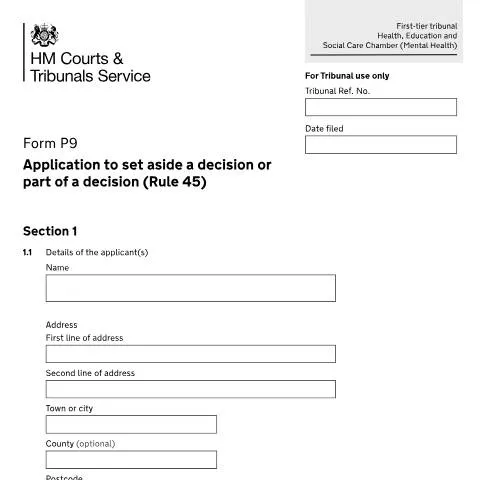
The Form P9 is an official document used within the UK’s First-tier Tribunal, specifically within the Health, Education and Social Care Chamber (Mental Health), to request the setting aside of a decision or part of a decision made by the tribunal. This guide aims to clarify the purpose, scope, and procedural aspects of this form, ensuring applicants understand how to approach this process correctly.
Purpose and Scope of Form P9
The primary objective of the Form P9 is to enable a party involved in a tribunal case to challenge a decision that they believe was made improperly or unfairly. This could involve situations where procedural irregularities have occurred, or where relevant documents were not properly sent or received. The form is an essential part of the legal process to ensure fairness and correctness in tribunal proceedings.
Specifically, this application is relevant under Rule 45 of the Tribunal Procedure Rules, which provides the legal basis for requesting a decision to be set aside. This process allows the tribunal to revisit or nullify decisions that may have been affected by procedural errors or other irregularities, thereby safeguarding the rights of parties involved.
Key Conditions for Applying under Rule 45
Applicants relying on Rule 45(2) must demonstrate that one or more of the following conditions apply:
- Failure to send or receive documents: A relevant document was not properly sent or received at an appropriate time.
- Procedural irregularity: There has been some other procedural irregularity affecting the proceedings.
- Hearing irregularity: A party or their representative was not present at a hearing when they should have been.
- Other grounds: Any additional procedural issues that may have compromised the fairness of the decision.
Understanding these conditions helps applicants to determine whether their case qualifies for a set-aside application and guides them in preparing the necessary supporting evidence.
Structure and Content of the Application
Section 1: Applicant Details
This section requires basic information about the applicant or their solicitor, including name, address, contact details, and the tribunal reference number. Accurate details ensure proper communication and processing of the application.
Section 2: Details of the Decision
Here, the applicant must specify which decision or part of a decision they seek to have set aside, along with the date when the decision was made. Precise identification of the decision is crucial for the tribunal to locate and review the relevant case record.
Section 3: Grounds for Application
This section involves selecting the applicable conditions under Rule 45(2) that justify the application. Applicants should tick all relevant boxes and provide a detailed explanation of how these conditions apply to their case.
Section 4 & 6: Grounds and Facts
Applicants must clearly set out the grounds for their application and state the facts they rely on. This information forms the basis of the tribunal’s assessment of whether the decision should be set aside.
Section 5 & 7: Desired Outcome and Supporting Evidence
Applicants specify what outcome they are seeking—typically the setting aside of the decision—and list any supporting documents. These could include copies of relevant correspondence, evidence of procedural errors, or other pertinent records.
Fill in your form directly online
No printing: type your details into the boxes of the official form, tick, then download the PDF ready to send.
- 1Type into the form boxes
- 2Tick in one click
- 3Save and download the PDF
Procedural Considerations and Submission
It is important to note that applicants should include all relevant supporting documents with their application. If any documents are not yet available, they should specify the expected date of availability and reasons for the delay.
Once completed, the application must be signed and dated by the applicant or their solicitor. The tribunal will then review the submission, and further steps may involve hearings or additional evidence, depending on the case.
Implications for Applicants
Applying to set aside a decision using Form P9 is a formal legal process. It provides an opportunity for parties to correct procedural errors or unfair decisions that could significantly affect their case. Understanding the structure and requirements of the form ensures that applications are complete, clear, and compliant with tribunal procedures, thereby increasing the likelihood of a successful outcome.
For further guidance, applicants should refer to the official tribunal rules and consider seeking legal advice if they are unsure about any part of the process.