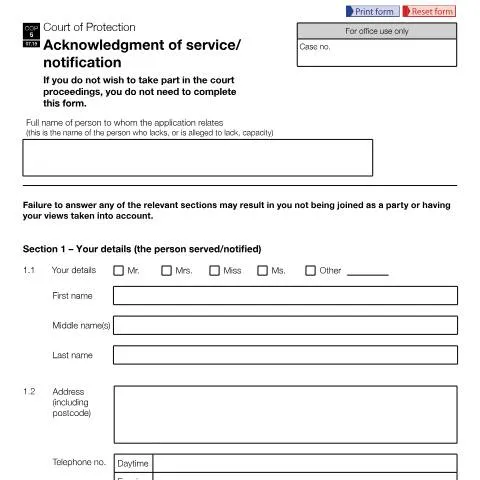
When Legal Capacity Comes Under Question: Navigating the COP5 Acknowledgment Process
The moment someone's mental capacity becomes the subject of a Court of Protection application, a web of legal relationships springs into action. Family members, carers, healthcare professionals, and financial institutions may suddenly find themselves thrust into complex proceedings they never anticipated. The Form COP5 serves as their formal gateway to participate in these sensitive deliberations, yet many recipients underestimate its significance until they realise their window for meaningful involvement is rapidly closing.
This acknowledgment of service form represents more than mere administrative housekeeping. It determines whether interested parties can influence crucial decisions about someone's property, finances, healthcare, and personal welfare. Unlike standard civil litigation where parties are typically clear-cut, Court of Protection cases often involve multiple stakeholders with overlapping concerns and conflicting perspectives about what constitutes the person's best interests.
The Architecture of Court of Protection Notifications
When someone files a COP1 application with the Court of Protection, the court doesn't simply process it in isolation. The Mental Capacity Act 2005 requires that certain individuals be formally notified or served with copies of the application. This creates a structured opportunity for affected parties to respond before any orders are made that could fundamentally alter someone's life.
The notification system operates on two distinct levels. Respondents are those who have been formally served with the COP1 application form itself. They possess automatic standing in the proceedings and have established rights to participate. Meanwhile, persons notified receive notification that an application has been issued but must take active steps through the COP5 form if they wish to become formal parties to the case.
Understanding Your Position in the Proceedings
The form's Section 1.5 requires recipients to identify their role, but this seemingly straightforward question often causes confusion. The distinction matters enormously because it determines both your existing rights and the steps you must take to secure ongoing involvement.
If you're the person to whom the application relates – essentially, the individual whose capacity is in question – your position is unique. The court has specific duties to ensure your voice is heard, even when others argue you lack capacity to participate meaningfully. The COP5 allows you to express your wishes and feelings directly to the court.
Respondent status typically applies to close family members, existing attorneys under lasting powers of attorney, or court-appointed deputies who are directly affected by the proposed orders. Person notified status often extends to more distant relatives, care providers, or professionals who have significant involvement in the person's life but weren't considered primary stakeholders in the initial application.
Strategic Decisions: To Join or Not to Join
Section 2 of the COP5 form presents what may be the most consequential choice you'll make in these proceedings: whether to apply for party status. This decision shouldn't be taken lightly, as it fundamentally shapes your ability to influence the outcome and your ongoing obligations throughout the case.
Joining as a party grants you significant procedural rights. You'll receive copies of all court documents, can file your own evidence and witness statements, attend hearings as of right, and potentially recover your legal costs if successful. However, party status also brings responsibilities – you may face adverse costs orders if your position is deemed unreasonable, and you'll be expected to engage constructively with case management directions.
Demonstrating Your Interest
The requirement in Section 2.2 to state your interest isn't merely bureaucratic box-ticking. The court needs to understand why your involvement would assist in determining the person's best interests. Effective responses often highlight specific knowledge about the person's wishes, values, and circumstances that others may lack.
Consider a scenario where an elderly person's daughter applies for a property and affairs deputyship, but the person's long-term partner – who has no formal legal relationship – receives notification. The partner's interest might centre on their intimate knowledge of the person's expressed preferences about remaining in their shared home, information crucial to decisions about selling property to fund care costs.
| Type of Interest | Typical Examples | Strength of Position |
|---|---|---|
| Financial/Property | Joint account holder, business partner, beneficiary | Strong - direct material interest |
| Care/Welfare | Long-term carer, close friend, healthcare professional | Variable - depends on relationship depth |
| Family | Distant relative, estranged family member | Weak unless special circumstances |
| Professional | Social worker, care manager, treating clinician | Moderate - professional knowledge valued |
The Critical 28-Day Window
Time operates differently in Court of Protection proceedings compared to other legal contexts. The 28-day deadline for filing evidence appears throughout the COP5 form, creating multiple pressure points that can catch unwary participants off-guard.
This timeframe begins from when you were served or given notice – not from when you decide to act or when you receive legal advice. The court takes a strict approach to these deadlines, particularly given that delays can prejudice vulnerable individuals whose circumstances may be deteriorating while legal processes unfold.
The evidence requirement serves multiple purposes beyond simple compliance. Through Form COP24 witness statements, parties provide the court with detailed factual foundations for their positions. This isn't about legal argument – that comes later – but about establishing the evidential basis upon which the court will make its determinations.
Crafting Effective Evidence
The most compelling witness statements in Court of Protection cases focus on the person's expressed wishes, their values and beliefs, and specific examples of their decision-making patterns when they had capacity. Abstract assertions about someone being "a family person" or "very independent" carry less weight than concrete examples of choices they made and reasoning they provided.
For instance, evidence might detail how the person repeatedly expressed reluctance to move from their family home, specific concerns they raised about particular family members managing their affairs, or their demonstrated priorities when making financial decisions in the past.
Positioning Your Response: Consent, Opposition, or Alternative Relief
Section 3.1 of the COP5 requires you to declare your fundamental stance toward the application. This choice – consent, oppose, seek different order, or seek different direction – shapes how the court approaches your involvement and influences case management decisions.
Consenting to the application doesn't mean passive agreement. Even when you support the broad thrust of what's proposed, you may have valuable information about implementation details or specific concerns about how orders should be framed. The court welcomes this input as it helps ensure orders are workable and properly protect the person's interests.
Opposing the application requires careful consideration of your grounds and realistic assessment of your prospects. Blanket opposition without credible alternatives rarely succeeds and may result in adverse costs consequences. More effective approaches often involve proposing alternative arrangements that better serve the person's interests.
Seeking Different Orders or Directions
The distinction between seeking a "different order" versus "different directions" reflects the Court of Protection's dual role. Orders create binding legal frameworks – such as appointing a deputy or authorising specific transactions. Directions guide how those frameworks operate in practice – such as requirements for consultation, reporting arrangements, or restrictions on particular types of decisions.
Parties often find success in proposing modified orders that address the same underlying needs through less restrictive means. For example, rather than opposing a property and affairs deputyship entirely, you might propose a more limited deputyship covering only specific assets, or additional safeguards requiring family consultation for major decisions.
Practical Mechanics of Form Completion and Submission
The COP5 form's design reflects the Court of Protection's commitment to accessibility, but several sections require careful attention to avoid inadvertent errors that could undermine your position.
Section 1.4's address selection determines where all future court communications will be sent. This seemingly minor detail can have significant practical implications, particularly if you're represented by solicitors or if your circumstances change during lengthy proceedings. The court's administrative systems rely heavily on postal communications, making accurate address details crucial for staying informed about case developments.
Legal representation details in Section 1.3 aren't merely informational. They determine who receives court communications and who can act on your behalf in procedural matters. If you're considering instructing solicitors but haven't yet done so, it's often better to complete the form yourself initially rather than delay submission past the 21-day acknowledgment deadline.
Special Requirements and Accessibility
Section 4's inquiry about special assistance reflects the Court of Protection's recognition that many participants may themselves have disabilities or health conditions. The court maintains sophisticated facilities for supporting participation, including hearing loops, wheelchair access, British Sign Language interpreters, and arrangements for video links where attendance is difficult.
However, these arrangements require advance notice to implement effectively. Simply noting "mobility difficulties" isn't sufficient – the court needs specific information about wheelchair access requirements, assistance needs, or timing considerations for medication schedules.
The Broader Context: What Happens After COP5 Submission
Filing your COP5 form doesn't end your involvement – it formally begins it. The court uses acknowledgment responses to shape case management directions, identify key issues in dispute, and determine appropriate procedural tracks for resolution.
Cases where multiple parties consent to applications often proceed through streamlined processes with limited court hearings. Conversely, cases with substantive opposition or complex family dynamics may require case management conferences, directions hearings, and ultimately contested final hearings spanning multiple days.
The court's approach to evidence gathering also depends partly on COP5 responses. Where parties identify conflicting accounts of the person's wishes or circumstances, the court may order independent expert assessments, commission reports from court visitors, or require additional witness statements from healthcare professionals.
Ongoing Obligations and Case Progression
Party status brings continuing obligations throughout proceedings. You'll need to respond to case management directions, potentially attend further hearings, and keep the court informed of any significant changes in circumstances. The court expects parties to engage constructively in attempts to narrow issues and reach agreements where possible.
The Mental Capacity Act's emphasis on the person's best interests also creates ongoing duties to share relevant information with other parties and the court. This includes both positive developments – such as improvements in capacity – and concerning changes that might affect the appropriateness of proposed orders.
Understanding these broader implications helps ensure that your COP5 response positions you effectively not just for immediate procedural purposes, but for meaningful participation throughout proceedings that may extend over many months or even years.
Understanding the Court of Protection's Decision-Making Process
When you submit Form COP5, you're entering a judicial process that operates under specific principles and procedures. The Court of Protection doesn't simply rubber-stamp applications—it conducts a thorough assessment based on the Mental Capacity Act 2005's best interests framework.
The court typically follows a structured approach when reviewing acknowledgment of service forms. Initially, a court officer will examine whether your COP5 meets the basic requirements: proper completion, correct fee payment, and submission within the 21-day deadline. If these criteria aren't met, you may receive a rejection notice requiring rectification within a specified timeframe.
Once accepted, your acknowledgment becomes part of the case file that the judge will review. The court considers several factors when determining how to proceed with your involvement. These include the nature of your relationship with P (the person who lacks capacity), whether you support or oppose the application, and what evidence you can provide about P's wishes, feelings, and best interests.
If you've indicated opposition to the original application, the court may schedule a case management hearing. During this hearing, the judge will explore the grounds for your opposition and determine whether a full hearing is necessary. The court has discretionary powers to limit or expand your participation based on the merits of your position and the potential impact on P's welfare.
Fill in your form directly online
No printing: type your details into the boxes of the official form, tick, then download the PDF ready to send.
- 1Type into the form boxes
- 2Tick in one click
- 3Save and download the PDF
For those seeking to become parties to the proceedings, the court applies a stricter test. You must demonstrate that your involvement is necessary for the fair and effective resolution of the case. This might include showing that you possess unique knowledge about P's circumstances, that you represent interests not adequately covered by existing parties, or that you have a legitimate stake in the outcome that warrants formal party status.
The court also considers the proportionality principle—whether the time and resources required for your participation are justified by the potential benefits to P. In straightforward cases, the court may prefer to limit formal participation to essential parties while still considering written submissions from other interested persons.
Rights and Responsibilities of Different Participant Categories
Your status following submission of Form COP5 determines your rights within the proceedings and the responsibilities you'll assume. Understanding these distinctions is crucial for managing your expectations and preparing for your role effectively.
Respondents occupy a unique position in Court of Protection proceedings. Unlike in many other legal contexts, being named as a respondent doesn't imply wrongdoing—it simply means the court requires your input on the application. As a respondent, you have the right to receive all court documents, attend hearings, and present evidence. However, you're not automatically entitled to legal aid, and you may be liable for your own legal costs unless the court orders otherwise.
Respondents can choose to take an active or passive role. An active respondent might file detailed evidence, instruct solicitors, or request specific court orders. A passive respondent might simply acknowledge the proceedings without taking further action, perhaps because they neither support nor oppose the application. The court respects both approaches, provided your position is clearly communicated through Form COP5.
Parties to the proceedings enjoy enhanced rights but also face greater responsibilities. If the court grants you party status, you'll receive automatic notification of all developments, have the right to attend all hearings, and can apply for interim orders. You may also cross-examine witnesses and make formal applications to the court. However, parties are expected to actively participate in case management and may face cost orders if their conduct is deemed unreasonable.
Parties must comply with court directions regarding evidence disclosure, witness statements, and case preparation deadlines. Failure to meet these obligations can result in your evidence being excluded or cost sanctions being imposed. The court expects parties to engage constructively with alternative dispute resolution where appropriate and to focus on P's best interests rather than pursuing peripheral disputes.
Interested persons have more limited rights but fewer obligations. You'll typically receive key documents and hearing notices, but you may not be entitled to attend all case management conferences. The court may invite your written submissions on specific issues but won't expect you to participate in detailed case preparation. This status suits individuals who have relevant information to share but don't wish to become fully involved in the proceedings.
All participants, regardless of status, must respect the court's case management directions and conduct themselves appropriately during hearings. The Court of Protection maintains high standards of behaviour, expecting all participants to focus on P's welfare rather than pursuing personal grievances or family disputes through the legal process.
Financial Implications and Cost Considerations
Participating in Court of Protection proceedings through Form COP5 can have significant financial implications that extend well beyond the initial application fee. Understanding these potential costs is essential for making informed decisions about your level of involvement.
The most immediate cost is the COP5 fee itself, which you must pay when submitting your acknowledgment of service. However, this represents only the beginning of potential financial exposure. If you become actively involved in the proceedings, you may need to consider legal representation, expert witness fees, travel costs for attending hearings, and time away from work.
Legal representation costs vary significantly depending on the complexity of your case and your chosen solicitor's experience. Specialist Court of Protection solicitors typically charge between £200-600 per hour, though some may offer fixed-fee arrangements for straightforward matters. If you're eligible for legal aid—which is means and merits tested—this can substantially reduce your personal liability, but legal aid isn't available for all types of Court of Protection work.
The court has discretionary powers to make cost orders, meaning you could potentially be required to pay another party's legal costs if your conduct is deemed unreasonable or if you pursue hopeless applications. Conversely, if you succeed in protecting P's interests against an inappropriate application, you might recover your costs from the unsuccessful applicant or from P's estate if the court deems this appropriate.
Expert witness fees can be substantial, particularly in complex medical or financial cases. Psychiatric assessments might cost £2,000-5,000, while financial experts reviewing complex trust arrangements could charge significantly more. The court will only order expert evidence where necessary, but if you're seeking to challenge the original application on technical grounds, expert input may be essential.
Consider also the indirect costs of participation. Court hearings often require multiple attendances, potentially involving overnight accommodation if you live far from the court. If you're employed, you may need to negotiate time off work, which could affect your income. Self-employed individuals face particular challenges in balancing their business commitments with court requirements.
Before committing to extensive involvement, assess your financial capacity realistically. The court can make protective costs orders in appropriate cases, limiting your liability if unsuccessful, but these aren't automatically granted. If you're concerned about costs, discuss this with a specialist solicitor early in the process—they may be able to suggest cost-effective strategies for protecting your interests while minimising financial exposure.
For those representing P's interests rather than their own, different cost considerations apply. The court may be more willing to order costs from P's estate where the representation genuinely protects P's welfare, but this isn't guaranteed. Always clarify the potential cost implications with your legal representative before taking significant steps in the proceedings.