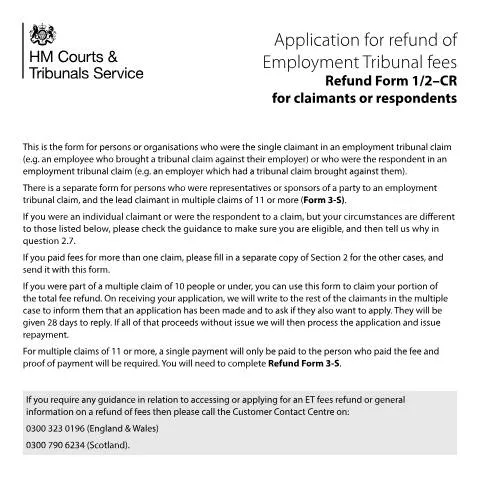
The Abolition of Employment Tribunal Fees and the Birth of Form 1/2-CR
When employment tribunal fees were scrapped in July 2017 following the landmark R (UNISON) v Lord Chancellor Supreme Court ruling, thousands of workers suddenly found themselves entitled to reclaim money they had paid to pursue workplace justice. The introduction of Form 1/2-CR by HM Courts & Tribunals Service became the gateway for individual claimants and respondents to recover these fees, marking a significant shift in how employment disputes are handled across England, Wales and Scotland.
The Supreme Court's unanimous decision declared that employment tribunal fees were unlawful because they prevented access to justice, particularly affecting those on lower incomes who couldn't afford the £390 for unfair dismissal claims or up to £1,200 for discrimination cases. This ruling didn't just abolish future fees—it opened the door for retrospective refunds dating back to July 2013 when the fee system was first introduced.
Form 1/2-CR specifically addresses the needs of single claimants who brought cases against employers and respondents (typically employers) who defended tribunal claims. The form's design acknowledges the complex web of payment scenarios that emerged during the fee period: direct payments by parties, reimbursements through representatives, and court-ordered fee transfers between opposing parties.
Navigating the Eight Eligibility Categories
The form's strength lies in its comprehensive approach to different payment scenarios through eight distinct reference categories, each with specific evidence requirements. Understanding which category applies determines both eligibility and the supporting documentation needed.
| Reference | Situation | Key Evidence Required |
|---|---|---|
| UJ01 | Individual claimant who paid directly | Payment records, no tribunal reimbursement order |
| UJ02 | Claimant/respondent who reimbursed their representative | Evidence of reimbursement to representative |
| UJ03 | Ordered to reimburse opponent's fees | Tribunal order copy, proof of payment to opponent |
| UJ04 | Name change since original proceedings | Marriage certificate, deed poll, or other legal proof |
| UJ05 | Executor or attorney for eligible party | Death certificate or power of attorney documentation |
| UJ06 | Respondent who paid fees directly | Payment records, no tribunal reimbursement received |
| UJ08 | Multiple claim participant (10 or fewer) | Evidence of individual fee contribution |
| UJ07 | Exceptional circumstances | Detailed explanation in section 2.7 |
Category UJ03 often catches applicants off-guard, as it covers situations where someone won their case but was subsequently ordered to reimburse the losing party's fees—a scenario that occurred when tribunals made costs orders. The evidence requirements here are particularly stringent, requiring both the tribunal's order and proof that the reimbursement was actually made.
The UJ07 catch-all category serves as a safety net for unusual circumstances not covered by the standard categories. Applicants using this route must provide compelling explanations in the additional information section, as HM Courts & Tribunals Service will scrutinise these applications more carefully to prevent fraudulent claims.
Decoding Section 2: The Heart of Your Claim
Section 2 transforms your fee refund application from a simple request into a detailed reconstruction of your employment tribunal journey. The case details required here serve multiple purposes: verifying your eligibility, cross-referencing with tribunal records, and ensuring payments reach the correct recipients.
The Employment Tribunal claim number acts as the primary identifier, following the format of seven digits, forward slash, and four-digit year (e.g., 1234567/2017). This number appears on all tribunal correspondence and is essential for HM Courts & Tribunals Service to locate your case file. If applying for Employment Appeal Tribunal fee refunds, the reference format differs, typically starting with "UKEAT" followed by case-specific numbers.
When completing the lead claimant details in section 2.2, accuracy is crucial even if you weren't the lead claimant yourself. In multiple claims, the lead claimant's name appears first on all documentation, and any discrepancies between your form and tribunal records can delay processing. If your address has changed since the original claim, providing both current and historical addresses helps verification.
The representative details in section 2.3 often cause confusion. This refers to legal representatives who acted for you during the tribunal proceedings—solicitors, barristers, or trade union representatives—not HR personnel or managers who may have been involved in the case. If you represented yourself throughout the proceedings, this section can be left blank.
Multiple Case Applications and Documentation Strategy
For applicants who paid fees across multiple tribunal claims, the form requires separate Section 2 completions for each case. This approach prevents cross-contamination between different claims and ensures each refund is processed against the correct tribunal file. When submitting multiple Section 2 forms, clearly label each with the corresponding case number and maintain consistent personal details across all copies.
The additional information box in section 2.7 provides space for crucial context that doesn't fit elsewhere. Common uses include explaining settlement arrangements that affected fee liability, clarifying complex payment arrangements between multiple parties, or providing background on unusual procedural circumstances that might affect eligibility.
Fee Categories and Payment Verification
Section 2.8 requires meticulous attention to detail, as this is where HM Courts & Tribunals Service verifies the amounts you're claiming against their payment records. The fee structure during the 2013-2017 period included several distinct categories, each with different amounts depending on the type of claim and hearing complexity.
Employment Tribunal issue fees were charged when initially submitting a claim, with amounts varying from £160 for straightforward cases to £250 for complex discrimination claims. Hearing fees applied when cases proceeded to tribunal hearings, ranging from £230 to £950 depending on case type and expected hearing duration.
For Employment Appeal Tribunal cases, lodgment fees were required when submitting appeals, while hearing fees applied if the appeal proceeded to a full hearing. These amounts were generally higher than employment tribunal fees, reflecting the appellate nature of the proceedings.
Interlocutory fees covered various procedural applications during case progression, including judicial mediation (£600), reconsideration applications for default judgments (£100), and reconsideration requests following final hearings (£350). Employer contract claims, where employers brought counterclaims against employees, incurred separate fees that are also eligible for refund.
Payment Method Documentation
Accurate payment method recording helps HM Courts & Tribunals Service match your application to their financial records. Card payments are often easiest to verify through tribunal systems, while cheque payments may require additional documentation such as bank statements showing the transaction. Cash payments, though less common, were accepted at some tribunal offices and should be noted accordingly.
If you're unsure about payment methods or amounts, selecting "don't know" is acceptable, but this may extend processing time as HM Courts & Tribunals Service will need to conduct more detailed record searches. Where possible, gathering supporting documentation such as receipts, bank statements, or correspondence mentioning fee payments strengthens your application.
The Complex Landscape of Multiple Claims
Multiple claims present unique challenges for fee refunds, with different procedures depending on whether the group comprised 10 or fewer claimants versus 11 or more. This distinction reflects both administrative efficiency and the practicalities of processing numerous refund applications.
For multiple claims of 10 or fewer participants, Form 1/2-CR allows individual claimants to apply for their proportional share of the total fees paid. When HM Courts & Tribunals Service receives such an application, they initiate a notification process to alert all other claimants in the multiple case that a refund application has been submitted. These other claimants then have 28 days to submit their own applications if they wish to claim refunds.
This notification system prevents some claimants from receiving refunds while others in the same case are overlooked. However, it also means that your refund processing may be delayed while HM Courts & Tribunals Service waits for the 28-day response period to expire and processes any additional applications that arise.
For multiple claims involving 11 or more claimants, the process shifts to Form 3-S, which is designed for lead claimants who coordinate refunds for the entire group. In these cases, a single payment is made to the person who originally paid the fees, typically the lead claimant or their representative, who then becomes responsible for distributing individual shares to group members.
Coordination Challenges in Group Claims
The multiple claim refund process can create coordination challenges, particularly when claimants have lost touch with each other since the original proceedings concluded. HM Courts & Tribunals Service uses the last known contact details from tribunal files to reach all parties, but if these are outdated, some eligible claimants may miss the opportunity to apply within the 28-day window.
If you're aware of other claimants from your multiple case who might be entitled to refunds, proactively contacting them about the refund opportunity can help ensure everyone receives their due amounts. However, you're not legally obligated to track down other claimants—this responsibility lies with HM Courts & Tribunals Service through their notification procedures.
Banking Requirements and Payment Processing
Section 3's banking requirements reflect stringent financial controls designed to prevent fraud and ensure refunds reach legitimate recipients. The restriction to UK bank accounts only means that applicants living abroad or using international banking services must arrange alternative collection methods, such as having refunds paid to UK-based representatives or opening UK accounts specifically for this purpose.
The requirement that accounts must be in the name of the person or organisation making the refund application prevents third-party collection arrangements that could facilitate fraudulent claims. For individual applicants, this means the account holder name must exactly match the name provided in Section 1 of the form. Any discrepancies, even minor variations in how names are recorded, can result in payment delays or rejection.
Joint account holders face particular challenges here. If the tribunal fees were paid by someone whose name appears on a joint account, but that person isn't the primary account holder, additional documentation may be required to verify the account relationship and authorise payment.
Processing Timeframes and Payment Methods
While HM Courts & Tribunals Service doesn't guarantee specific processing timeframes on Form 1/2-CR, the complexity of verifying tribunal records and cross-referencing payment information means refunds typically take several weeks to process. Applications with complete documentation and clear eligibility generally process faster than those requiring additional verification or falling under the UJ07 exceptional circumstances category.
Payments are made via electronic bank transfer directly to the nominated account. HM Courts & Tribunals Service doesn't issue cheques or make cash payments for fee refunds, reflecting modern financial security practices and audit trail requirements. Once processed, refunds typically appear in recipient accounts within 3-5 working days of authorisation.
Submission Pathways and Documentation Assembly
Form 1/2-CR can be submitted through multiple channels, each with distinct advantages and considerations. Online submission through the HM Courts & Tribunals Service website offers the fastest processing route, with automatic validation checks that identify missing information before submission. The online system also provides immediate confirmation of receipt and allows applicants to track application status.
Fill in your form directly online
No printing: type your details into the boxes of the official form, tick, then download the PDF ready to send.
- 1Type into the form boxes
- 2Tick in one click
- 3Save and download the PDF
Postal submission remains available for those preferring paper applications or lacking reliable internet access. When posting applications, use recorded delivery to ensure safe arrival and retain proof of posting. The processing address depends on where your original tribunal case was heard—England and Wales cases use different addresses from Scottish cases, reflecting the distinct legal jurisdictions.
Document assembly requires careful attention to ensure all supporting evidence accompanies the main form. Create a checklist based on your selected eligibility categories, ensuring you have original or certified copies of all required documents. Photocopies are generally acceptable for most supporting evidence, but HM Courts & Tribunals Service may request originals if document authenticity is questioned.
Evidence Standards and Acceptable Documentation
The evidence requirements vary significantly between eligibility categories, but certain standards apply across all applications. Tribunal orders must be official copies bearing the tribunal's seal or stamp—informal notes or draft orders aren't sufficient. Payment evidence should clearly show the amount paid, payment date, and recipient organisation (typically "HM Courts & Tribunals Service" or the specific tribunal office).
For name change documentation, marriage certificates, civil partnership certificates, and deed polls are all acceptable, but the document must clearly link your current name to the name used during the original tribunal proceedings. Divorce decrees alone aren't sufficient unless they specifically address name changes.
Power of attorney documentation must be current and specifically grant authority over financial matters. General powers of attorney may not be sufficient if they exclude specific types of financial transactions. Similarly, executor documentation should include both the death certificate and probate grant or letters of administration demonstrating legal authority to act for the deceased's estate.
When Applications Face Scrutiny or Rejection
HM Courts & Tribunals Service applies rigorous verification procedures to prevent fraudulent refund claims, meaning some legitimate applications may face additional scrutiny or initial rejection. Understanding common reasons for application challenges helps applicants prepare more robust submissions and respond effectively to requests for additional information.
Incomplete tribunal records present a frequent challenge, particularly for older cases where digital records may be limited. If HM Courts & Tribunals Service cannot locate your tribunal file or verify fee payments, they may request additional documentation such as personal copies of tribunal correspondence, receipt evidence, or bank statements showing payments to tribunal services.
Eligibility disputes often arise when applicants' circumstances don't clearly fit the standard categories or when multiple parties claim entitlement to the same refund. In these situations, HM Courts & Tribunals Service may conduct detailed investigations, potentially contacting other parties involved in the original proceedings to verify claims.
Applications face particular scrutiny when significant time has elapsed since the original proceedings. While there's no formal deadline for fee refund applications, cases from 2013-2014 may require more extensive verification due to record-keeping changes and staff turnover at tribunal offices.
Appeal and Reconsideration Procedures
If your application is rejected, HM Courts & Tribunals Service should provide clear reasons for the decision and information about challenge procedures. The first step typically involves requesting reconsideration, providing additional evidence that addresses the stated concerns about your application.
For reconsideration requests, focus on directly addressing each point raised in the rejection letter rather than simply resubmitting the same information. If new evidence has become available—such as located tribunal correspondence or clarified payment records—highlight these additions clearly in your reconsideration submission.
More complex disputes may require escalation through HM Courts & Tribunals Service's formal complaints procedure or, in exceptional cases, judicial review proceedings. However, these routes should be considered only after exhausting standard reconsideration processes and obtaining legal advice about the strength of your challenge.
The Customer Contact Centre numbers provided on the form (0300 323 0196 for England & Wales, 0300 790 6234 for Scotland) serve as valuable resources for clarifying application requirements, checking processing status, and understanding rejection reasons. These services can often resolve minor documentation issues without requiring formal reconsideration procedures.