When Time Runs Out: The Emergency Court Fee Undertaking That Keeps Your Case Alive
Picture this: it's 4:30 PM on a Friday afternoon, and you've just discovered that an urgent injunction must be filed before the court closes. Your finances are precarious, you haven't had time to gather evidence for fee remission, but the legal clock is ticking relentlessly. This is precisely when Form EX160B becomes your lifeline—a formal promise to HM Courts & Tribunals Service that bridges the gap between urgent legal necessity and financial reality.
Form EX160B represents one of the most pragmatic solutions within the British court system, acknowledging that justice cannot always wait for administrative convenience. Unlike standard court procedures where fees must be paid upfront or remission applications completed in advance, this undertaking allows you to secure your court date first and sort out the financial arrangements within a strictly defined timeframe afterwards.
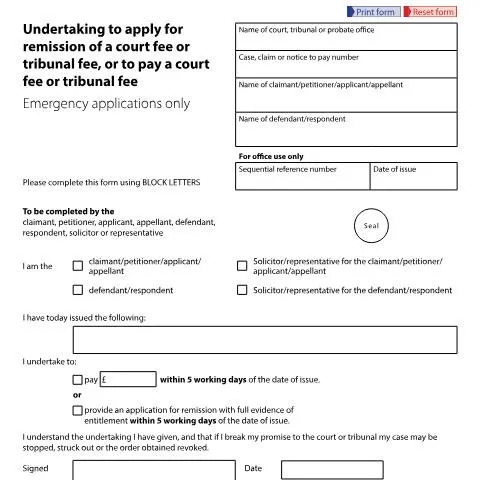
The form's official title—Undertaking to apply for remission of a court or tribunal fee, or to pay a court or tribunal fee, for emergency applications only—tells the entire story. You're making a binding legal promise to either pay the required court fee or provide a complete remission application within five working days of your case being issued. Break this promise, and your case faces immediate jeopardy.
The Narrow Gateway: Understanding Emergency-Only Eligibility
Form EX160B operates within strict parameters that distinguish genuine emergencies from routine case management failures. The emergency applications only restriction isn't merely advisory—it's a fundamental requirement that court officers scrutinise carefully before accepting any undertaking.
True emergency situations typically involve imminent threats to person or property where delay could render legal remedies meaningless. Consider domestic violence cases where an immediate non-molestation order prevents further harm, or commercial disputes where assets risk being dissipated before a freezing injunction can take effect. These scenarios demonstrate the genuine urgency that justifies bypassing standard fee payment procedures.
However, poor planning doesn't constitute an emergency. If you've known about a hearing date for weeks but failed to arrange fee payment or submit a remission application, courts won't typically accept this as grounds for using Form EX160B. The distinction matters because court officers have discretion to refuse undertakings they consider inappropriate, potentially leaving you without recourse if alternative emergency procedures aren't available.
Professional vs Self-Represented Applicants
The form accommodates both solicitor-represented and self-represented parties, but the practical implications differ significantly. Solicitors familiar with emergency procedures often maintain arrangements with courts for urgent out-of-hours applications, making Form EX160B part of established protocols. They understand the five-day deadline's implications and can coordinate fee payment or remission applications efficiently.
Self-represented litigants face greater challenges. Without professional guidance, they may struggle to assess whether their situation truly qualifies as an emergency or fail to appreciate the binding nature of the undertaking they're signing. The form's straightforward language helps, but the underlying legal consequences require careful consideration.
Dissecting the Undertaking: Your Two-Path Promise
The heart of Form EX160B lies in its binary choice structure, forcing applicants to commit to one of two specific courses of action within the five-day deadline. This isn't a general promise to "sort things out"—it's a precise legal undertaking with measurable outcomes.
Path One: Direct Fee Payment
The first option involves promising to pay a specific amount within five working days. You must insert the exact fee amount in the designated space, creating a precise financial obligation. This figure should match the court or tribunal fee applicable to your specific application type, whether it's a claim form, application notice, or appeal filing.
Court fees vary dramatically depending on the nature and value of your case. A simple money claim under £300 carries a £35 fee, while high-value commercial cases can attract fees exceeding £10,000. Emergency applications often involve complex proceedings with correspondingly substantial fees, making this path suitable primarily for those confident of their ability to pay but temporarily unable to access funds.
Payment methods must align with the receiving court or tribunal's accepted procedures. Most courts accept online payments, postal cheques, or in-person card payments, but specific offices may have limitations. Confirming acceptable payment methods before signing the undertaking prevents last-minute complications.
Path Two: Remission Application with Evidence
The alternative involves providing "an application for remission with full evidence of entitlement within 5 working days." This path requires significantly more preparation and documentation than simple fee payment, but offers potential complete or partial fee waiver for eligible applicants.
Remission eligibility depends on detailed financial criteria covering income, capital, and essential expenditure. Applicants must provide comprehensive evidence including recent payslips, benefit award letters, bank statements, and proof of essential outgoings like rent or mortgage payments. The full evidence requirement means incomplete applications face immediate rejection, potentially triggering undertaking breach consequences.
| Income Source | Required Evidence | Time Period |
|---|---|---|
| Employment | Last 3 payslips or P60 | Most recent quarter |
| Benefits | Current award letters | Valid award period |
| Self-employment | SA302 tax calculation | Latest complete tax year |
| Savings/investments | Bank statements | Last 3 months |
The Five-Day Countdown: Managing Your Deadline
The five working day deadline starts from your case's official issue date, not from when you sign Form EX160B. This distinction matters because issue dates depend on court processing times, which can vary between different offices and case types. Emergency applications filed late on Friday afternoons might not receive official issue until the following Monday, affecting your calculation of the five-day window.
Working days exclude weekends and public holidays, but court closure days can complicate delivery requirements. If your fifth working day falls on a day when the court office is closed for administrative reasons, you may need to ensure delivery by the previous working day or risk breach of undertaking.
Delivery Methods and Timing
The form includes spaces for recording delivery methods—by hand, through solicitor, or by post. Each method carries different risk profiles for meeting the deadline. Hand delivery offers certainty but requires physical presence during court office hours. Postal delivery provides convenience but introduces timing uncertainties, particularly around public holidays when postal services may be disrupted.
Solicitor delivery often provides the most reliable option, as legal representatives typically maintain established relationships with court offices and understand local delivery procedures. However, this assumes your solicitor remains instructed throughout the five-day period and maintains clear communication about deadline management.
Court Processing and Administrative Realities
Once submitted, Form EX160B enters the court's administrative system where processing speeds vary significantly between different offices and case types. The "For office use only" sections reveal the bureaucratic machinery behind emergency applications, including sequential reference numbering and official sealing procedures.
Court officers must verify that your case genuinely qualifies as an emergency application before accepting the undertaking. This assessment can involve consultation with duty judges or senior court staff, particularly for unusual or complex emergency applications. The verification process doesn't stop your case from proceeding, but it establishes the administrative record for potential future enforcement if you breach the undertaking.
Tracking Your Undertaking Status
The sequential reference number assigned to your undertaking becomes crucial for tracking compliance and communicating with court staff about payment or remission applications. This reference appears on all subsequent correspondence and should be quoted when making fee payments or submitting remission evidence.
Court systems don't automatically send reminder notices about approaching deadlines. The responsibility for monitoring the five-day countdown rests entirely with you or your legal representative. Missing the deadline triggers automatic consequences regardless of whether you intended to comply or simply lost track of time.
When Undertakings Fail: Consequences and Recovery Options
The form's warning language—"if I break my promise to the court or tribunal my case may be stopped, struck out or the order obtained revoked"—understates the severity of potential consequences. Breach of undertaking represents contempt of court, carrying implications beyond simple case dismissal.
Striking out typically means complete case termination with potential adverse costs consequences. For claimants, this eliminates any prospect of recovering damages or obtaining desired remedies. For defendants or respondents, struck-out cases can still result in default judgments or orders being made against them, creating the worst of both worlds—no opportunity to defend combined with adverse outcomes.
Emergency Extensions and Exceptional Circumstances
Courts retain discretion to accept late compliance in exceptional circumstances, but the threshold for "exceptional" is deliberately high. Medical emergencies affecting the applicant personally, natural disasters preventing document delivery, or court administrative errors might qualify, but financial difficulties or solicitor delays typically don't.
Applications for extension must include compelling evidence of the exceptional circumstances and demonstrate that breach wasn't due to negligence or poor planning. The court may require witness statements, medical certificates, or other independent verification before considering any extension request.
Strategic Considerations for Different Case Types
Form EX160B's utility varies dramatically depending on your specific legal proceedings and underlying circumstances. Family law emergencies often involve child welfare concerns where immediate court intervention outweighs financial considerations, making undertakings particularly valuable even for applicants with limited resources.
Commercial litigation presents different challenges. High-value business disputes typically involve substantial court fees, but the parties often have greater financial resources to meet undertaking obligations. However, corporate applicants must ensure proper authorisation for individuals signing undertakings on behalf of companies or other legal entities.
Insolvency and Financial Distress Cases
Parties facing insolvency proceedings encounter unique complications with Form EX160B. While their financial distress may create genuine emergencies requiring immediate court intervention, their ability to comply with payment undertakings becomes questionable. Remission applications may offer the only viable path, but gathering comprehensive financial evidence becomes challenging when businesses are failing or individuals face severe financial crisis.
Insolvency practitioners and debt advisers often coordinate with courts to manage these situations, but the five-day deadline remains inflexible regardless of the complexity of financial circumstances involved.
Documentation Standards and Evidence Requirements
Successful completion of Form EX160B demands meticulous attention to documentation standards, particularly for applicants choosing the remission route. The form's requirement for "full evidence of entitlement" means partial or incomplete submissions face automatic rejection without opportunities for supplementary filing within the deadline period.
Financial evidence must reflect current circumstances rather than historical positions. Bank statements showing account balances from several months ago won't satisfy current means assessment requirements, even if more recent statements aren't yet available. Similarly, employment documentation must reflect current salary levels and working patterns rather than previous arrangements that may no longer apply.
Special Documentation for Complex Financial Situations
Self-employed applicants face particular challenges gathering acceptable evidence within tight timeframes. SA302 tax calculations from HMRC provide the most reliable income evidence, but obtaining these documents can take several days even through online services. Alternative evidence like accountant-prepared profit and loss statements may be acceptable, but courts prefer official HMRC documentation where available.
Applicants with multiple income sources must provide comprehensive evidence covering all financial streams. Part-time employment combined with benefit receipts, rental income, or investment returns requires separate documentation for each source, creating substantial administrative burden within the five-day window.
The undertaking you sign on Form EX160B creates a binding legal obligation that courts take seriously. Unlike administrative deadlines that might be extended for good reasons, this represents a formal promise to the court with immediate consequences for breach. Understanding this distinction helps ensure you only sign undertakings you're confident of fulfilling within the specified timeframe.
For emergency applications where genuine urgency meets temporary financial constraints, Form EX160B provides an essential safety valve within the British court system. However, its effectiveness depends entirely on careful planning, realistic assessment of your ability to comply, and meticulous attention to deadline management throughout the five-day compliance period.