Understanding the D50G Application: Navigating Financial Relief Challenges
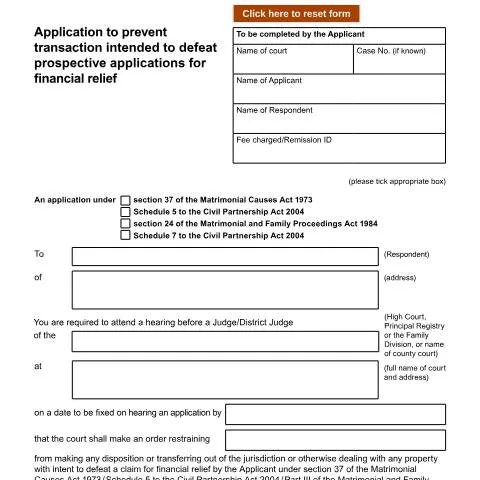
When financial disputes arise in the context of separation or divorce, the stakes can be incredibly high. The D50G Application to prevent transaction intended to defeat prospective applications for financial relief plays a critical role in protecting the rights of an applicant seeking financial relief under UK law. This document allows individuals to take preemptive legal action against a spouse or partner who may attempt to dissipate assets during contentious proceedings. Understanding this application is essential for safeguarding one's financial interests.
Who Needs to File the D50G Application?
The D50G application is particularly relevant for individuals who are currently involved in divorce or civil partnership dissolution proceedings. It can be filed by the applicant—typically the spouse or partner seeking financial relief—as a protective measure against actions that could undermine their potential claims. This form is typically submitted under:
- Section 37 of the Matrimonial Causes Act 1973
- Schedule 5 to the Civil Partnership Act 2004
- Section 24 of the Matrimonial and Family Proceedings Act 1984
- Schedule 7 to the Civil Partnership Act 2004
To qualify for this application, the applicant must demonstrate a reasonable belief that the respondent is attempting to make a disposition of property with the intention of defeating the financial relief claim. This proactive step ensures that financial settlements are not compromised.
Key Components of the D50G Form: A Closer Look
Each section of the D50G form is designed to elicit specific information necessary for the court's consideration. Here’s a breakdown of the critical parts:
- Name of Court and Case No.: If known, provide the specific court handling your case. This ensures that the application is directed to the appropriate judicial authority.
- Name of Applicant and Respondent: Clearly state the names of all parties involved. Accurate names are crucial for legal identification.
- Fee Charged/Remission ID: Indicate whether a fee is charged or if a remission ID applies. If you qualify for a fee remission, be prepared to submit supporting evidence.
- Hearing Details: This includes the requirement for the respondent to attend a hearing. Specify the court's name and address, which is vital for proper notification.
- Specific Legislation: Check the appropriate box relating to the legal grounds for the application, as this informs the court of the basis for your request.
Every detail matters when filling out the D50G form—oversights or inaccuracies can lead to delays or even rejections of the application.
Submitting the D50G Application: Methods and Considerations
Once completed, the D50G form can be submitted through various channels, each with its unique procedures:
- Online Submission: For those familiar with digital processes, applications can often be filed online via the official HM Courts & Tribunals Service (HMCTS) platform. Ensure you have all necessary documents ready for upload.
- In-Person at Court: You may choose to file your application in person. Bring multiple copies of your D50G form and any supporting documents. The court will provide a stamped copy for your records.
- By Post: If you opt for postal submission, ensure you send the form via recorded delivery to confirm its receipt. Include a cover letter outlining any accompanying documents.
Regardless of the submission method, keep copies of all documents and confirmation of submission, as these may be required later in proceedings.
What Happens Next? The Timeline After Filing
After submitting the D50G application, a timeline of events unfolds:
- Hearing Date Notification: The court will fix a date for the hearing, which you will be notified of. This is a crucial step, as the respondent must be informed of the hearing details.
- Attend the Hearing: Both the applicant and the respondent are required to attend. It is advisable to seek legal representation to navigate the complexities of the hearing effectively.
- The Judge's Decision: The judge will evaluate the merits of the application based on evidence presented. They may issue an interim order restraining the respondent from dealing with the property in question.
Timely adherence to the timeline is essential. Missing the hearing or failing to provide necessary documentation can adversely affect the outcome of your application.
The Legal Framework: Context Behind the D50G Application
The D50G application is rooted in legislation that seeks to ensure fairness in financial settlements post-separation. Primarily governed by the:
- Matrimonial Causes Act 1973: This act provides the legal foundation for financial orders in divorce cases.
- Civil Partnership Act 2004: Offers similar protections for individuals in civil partnerships, ensuring equitable treatment.
- Matrimonial and Family Proceedings Act 1984: This act further outlines the processes and provisions for financial relief applications.
Understanding the legal context of these legislative frameworks can empower applicants and inform their decisions throughout the process.
Distinguishing the D50G Form from Other Applications
The D50G application is sometimes confused with other financial relief forms, such as the Form D81 (Financial Disclosures) or the D84 (Application for Financial Provision). Key differences include:
| Form | Purpose | Context of Use |
|---|---|---|
| D50G | Prevent transfers that might defeat financial claims | During divorce/civil partnership proceedings when asset dissipation is suspected |
| D81 | Financial disclosures related to asset and income | At any stage in divorce proceedings to assess financial positions |
| D84 | Application for financial provision | To formally request financial orders after separation |
Understanding these distinctions can help applicants choose the correct form for their specific situation, avoiding delays and complications.
Addressing Common Concerns: What to Know Before You Apply
Filing a D50G application can be daunting, especially with the stakes involved. Some common concerns include:
- Legal Representation: While it’s not mandatory to have a solicitor, it is highly recommended, particularly if the case involves significant assets or complexities.
- Cost Implications: Be clear about the fees associated with filing this application. If eligible, apply for fee remission to alleviate costs.
- Emotional Impact: Engaging in legal proceedings can be emotionally taxing. Seek support from friends, family, or professionals during this process.
Understanding these aspects can not only demystify the process but also help in preparing mentally and financially for the journey ahead.
Understanding the Legal Framework Behind Form D50G
Form D50G serves as a pivotal instrument within the realm of family law in the UK, particularly in cases where one party seeks to prevent transactions that could undermine prospective applications for financial relief. This form is utilized under established principles that address the need for transparency and fairness in financial dealings, especially during divorce proceedings or separation. One of the key legal frameworks governing this process is the Matrimonial Causes Act 1973, which provides the courts with the authority to safeguard the interests of parties who may be disadvantaged by the financial decisions of their ex-partners.
Moreover, practitioners must consider the implications of the Family Proceedings Rules 2010, which outline the procedural requirements for filing such applications. The rules ensure that the process is efficient and fair, allowing parties the opportunity to present their case adequately. It’s essential to provide robust evidence when submitting Form D50G, as the court will carefully assess the circumstances surrounding the transaction in question. Factors such as the timing of the transaction, the financial status of both parties, and any potential intent to defraud the other party will be scrutinized closely.
In practice, it is wise to consult with a family law solicitor who has experience in this area. They can guide you through the intricacies of the legal framework and help you prepare a compelling case for the court. Remember that the burden of proof rests with the applicant, meaning that you must demonstrate that the transaction in question is likely to thwart your claim for financial relief. This often involves gathering documentation, such as bank statements, valuations of assets, and any communication that indicates the intent behind the transaction.
Practical Steps to Complete Form D50G Effectively
Completing Form D50G is not merely a bureaucratic task; it is a strategic move in the legal process of securing financial relief. To ensure that your application is successful, here are some practical steps to follow:
1. Gather Relevant Documentation: Before you start filling out the form, collect all pertinent financial documents. This may include tax returns, payslips, bank statements, and any financial agreements that have been made. The more evidence you have to support your claims, the stronger your application will be.
2. Accurate Completion of the Form: When filling out Form D50G, pay close attention to detail. Be sure to provide all requested information, including your personal details, your ex-partner's details, and the specifics surrounding the transaction you wish to prevent. If certain sections do not apply to your situation, indicate this clearly rather than leaving them blank.
3. Provide a Clear Explanation: In Section 6 of the form, where you explain why you believe the transaction should be prevented, be concise yet comprehensive. Clearly articulate your concerns about how the transaction may negatively impact your financial relief application. Use factual evidence wherever possible to substantiate your claims.
4. Seek Legal Advice: It’s crucial to have a qualified solicitor review your application before submission. They can help you identify any weaknesses in your application and suggest improvements. Furthermore, they can assist in drafting any accompanying affidavits or statements that may bolster your case.
5. Submit Your Application Timely: There are no hard and fast rules regarding the timing of your application, but it is generally advisable to submit Form D50G as soon as you become aware of the transaction in question. Delaying your application may limit your ability to take effective action.
6. Follow Up: Once you've submitted your form, be diligent in following up with the court. Ensure that you are notified of any hearings or decisions related to your application. Being proactive will demonstrate your commitment to seeking financial relief and may influence the court’s perception of your case.
Common Misconceptions Regarding Form D50G
As with many legal processes, several misconceptions surround the use of Form D50G that can lead to confusion for those unfamiliar with family law. Here, we debunk some of the most common myths:
1. "The Form Guarantees Financial Relief": Many individuals mistakenly believe that submitting Form D50G automatically guarantees that they will receive financial relief. However, the form is simply a tool to prevent transactions; the actual granting of relief is contingent on the merits of the overall case and the subsequent financial proceedings.
2. "You Must Show Intent to Defraud": While it is beneficial to demonstrate that the transaction was designed to thwart financial relief, it is not strictly necessary to prove intent to defraud in every case. The court may consider the implications of the transaction itself, as well as the financial situation of both parties, to make a determination.
3. "Only Certain Transactions Can Be Prevented": Some people think that only large or overtly suspicious transactions can be challenged. However, any transaction that could potentially impact financial relief—whether it’s a transfer of assets, a business deal, or even a simple change in joint accounts—can be subject to challenge under Form D50G.
4. "Legal Representation is Not Necessary": While it is possible to submit Form D50G without legal representation, this can be a risky move. Legal experts can provide significant advantages in terms of understanding the law, preparing documentation, and presenting the case effectively in court. As the stakes are often high, investing in legal assistance is often advisable.
5. "The Process is Quick and Straightforward": Lastly, many individuals underestimate the complexity of the process. While Form D50G may appear straightforward on the surface, the legal intricacies behind financial relief applications can be quite complicated. Preparing a solid application and understanding potential outcomes require careful thought and consideration.