The Strategic Role of Form N316A in Corporate Debt Recovery
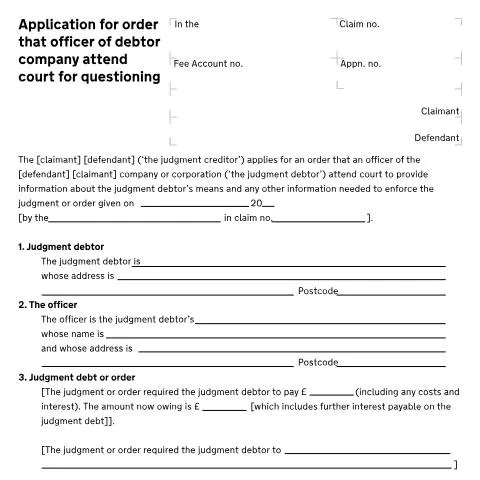
When a judgment creditor faces difficulties collecting money from a corporate debtor, the standard enforcement methods may prove insufficient. Form N316A represents a powerful investigative tool that allows creditors to compel company officers to attend court and provide detailed information about the debtor company's financial position under oath. This application form transforms the enforcement process from a paper chase into a direct interrogation, where directors and senior officers must account for their company's assets and explain why the debt remains unpaid.
The form serves as the gateway to what courts term examination proceedings – a formal process where company officers face questioning about their organisation's means, transactions, and ability to satisfy outstanding judgments. Unlike standard enforcement methods such as bailiff action or charging orders, Form N316A enables creditors to uncover hidden assets, suspicious transfers, or deliberate attempts to frustrate enforcement.
Identifying the Right Company Officer for Examination
The effectiveness of Form N316A depends critically on selecting the appropriate officer to summon. The form requires creditors to identify a specific individual within the debtor company who possesses relevant knowledge about the organisation's financial affairs. This strategic decision can determine whether the examination yields actionable intelligence or merely surface-level information.
Categories of Suitable Officers
Company directors represent the most obvious targets, particularly executive directors with day-to-day operational involvement. However, the definition extends beyond the boardroom to include:
- Company secretaries who maintain statutory records and oversee compliance obligations
- Chief financial officers and finance directors with intimate knowledge of cash flow and financial commitments
- Managing directors who control strategic decisions affecting the company's ability to pay debts
- Shadow directors who exercise real control despite lacking formal appointment
The judgment creditor must provide the officer's full name and residential address in section 2 of the form. This requirement often necessitates preliminary investigations through Companies House records, electoral rolls, or professional databases to locate current contact details.
Timing Considerations for Officer Selection
The choice of officer may depend on the company's recent history. If the debtor has undergone recent changes in management, creditors might target former directors who were in post when the debt arose. Conversely, if the company appears to be trading whilst insolvent, current management may hold the key to understanding ongoing financial manipulation.
Navigating the Court Application Process
Form N316A must be filed at the same court that issued the original judgment, accompanied by the prescribed court fee. The application requires precise details about the underlying judgment, including the exact amount owed and any accrued interest since the judgment date.
Essential Documentation Requirements
Section 3 of the form demands comprehensive information about the judgment debt. Creditors must specify whether they seek recovery of a monetary judgment or compliance with a non-monetary order. For monetary judgments, the form requires:
| Information Required | Source Document | Accuracy Standard |
|---|---|---|
| Original judgment amount | Court judgment or order | Exact figure including costs |
| Current amount owing | Updated calculation | Must include statutory interest |
| Interest accrual details | Court records | Rate and calculation method |
| Previous enforcement attempts | Court files | Chronological summary |
The court expects applicants to demonstrate that conventional enforcement methods have been attempted or would prove futile. This might include evidence of returned warrants of execution, unsuccessful third-party debt orders, or charging orders against property with insufficient equity.
Customising the Examination Scope Through Additional Questions
While Form EX141 contains standard questions for examining judgment debtors, Form N316A allows creditors to request additional specific inquiries through section 4. This customisation opportunity enables targeted investigation of particular concerns or suspicious circumstances.
Strategic Question Formulation
Effective additional questions focus on areas where standard examination might miss crucial information. Common themes include:
- Related party transactions that might constitute preferences or undervalue transfers
- Offshore arrangements including foreign subsidiaries or trust structures
- Personal guarantees given by directors for company obligations
- Asset disposals occurring after the judgment date
- Management charges or fees paid to associated companies
Questions must be relevant to enforcement prospects and cannot serve purely punitive purposes. The court retains discretion to exclude questions that appear oppressive or designed to harass rather than assist legitimate debt recovery.
Documentary Production Orders
Section 5 enables creditors to request specific documents beyond the standard list. While the form automatically requires bank statements, accounts, and basic commercial records, additional documents might include:
Insurance policies with surrender values, intellectual property licences generating royalties, franchise agreements, or management service agreements with related entities.
The court expects reasonable justification for additional document requests, particularly where they might impose significant compliance burdens on the debtor company.
When Judicial Examination Becomes Necessary
Section 6 of Form N316A addresses circumstances where examination before a judge, rather than a court officer, becomes appropriate. This represents a significant escalation that courts grant sparingly, recognising the additional costs and judicial time involved.
Compelling Reasons Standard
The form requires creditors to articulate compelling reasons why judicial examination is necessary. Accepted grounds typically include:
- Complex legal issues requiring judicial determination during questioning
- Anticipated contempt proceedings if the officer refuses to cooperate adequately
- Need for immediate enforcement orders based on examination responses
- Cross-examination requirements where creditor representation is essential
Courts rarely accept general assertions about case complexity or debtor non-cooperation as sufficient justification. The creditor must demonstrate specific circumstances that court officers cannot adequately address through standard examination procedures.
Court Processing and Scheduling Procedures
Once filed, Form N316A triggers a multi-stage court process designed to balance creditor rights against debtor company protections. The court first reviews the application for completeness and jurisdiction, then considers whether to grant the examination order.
Administrative Review Stage
Court staff initially verify that the application relates to a valid, unsatisfied judgment within the court's records. They check fee payment, ensure proper service addresses are provided, and confirm that the named officer has sufficient connection to the debtor company. Incomplete applications face rejection with opportunities for resubmission within specified timeframes.
The court may request additional information where the connection between the named officer and the debtor company appears unclear. This commonly occurs with complex corporate structures involving multiple subsidiaries or where officers hold positions across several related entities.
Judicial Consideration Process
A district judge or designated court officer reviews substantive aspects of the application, including:
- Whether the judgment remains enforceable and unsatisfied
- The appropriateness of examining the specific officer identified
- The reasonableness of any additional questions or document requests
- Whether compelling reasons exist for judicial rather than officer examination
The court may grant the application in full, impose modifications to protect the debtor's legitimate interests, or refuse the application where it appears premature or oppressive.
Enforcement Consequences and Follow-Up Actions
Successful Form N316A applications generate court orders compelling attendance that carry significant legal consequences for non-compliance. The examination process often reveals information that transforms the creditor's enforcement strategy and may lead to fresh proceedings against the debtor company or its officers personally.
Contempt of Court Implications
Officers who fail to attend as ordered, refuse to answer legitimate questions, or provide false information face potential contempt proceedings. The court may issue warrants for arrest, impose fines, or order imprisonment for serious breaches. These sanctions apply regardless of whether the underlying debt remains disputed, as they address obstruction of court processes rather than the merits of the original claim.
The examination transcript becomes a permanent court record that may be used in subsequent proceedings. Information disclosed during examination can support applications for:
| Enforcement Method | Information Required | Typical Outcome |
|---|---|---|
| Third-party debt orders | Bank account details | Freezing of company accounts |
| Charging orders | Property ownership evidence | Security over company assets |
| Receivership applications | Asset location and values | Court-appointed receiver |
| Director disqualification | Misconduct evidence | Personal sanctions |
Strategic Leverage and Settlement Prospects
The mere prospect of compulsory examination often motivates settlement discussions, particularly where company officers prefer to avoid public scrutiny of their management decisions. Creditors may find that filing Form N316A generates more productive negotiations than months of conventional enforcement attempts.
However, the examination process can also reveal genuine inability to pay, leading creditors to reassess their enforcement strategy or consider alternative dispute resolution approaches. The detailed financial picture emerging from examination helps creditors make informed decisions about pursuing further enforcement or accepting compromise arrangements.
Strategic Considerations for Creditors Before Filing Form N316A
Before submitting Form N316A, creditors must carefully evaluate whether this enforcement route offers the best prospects for debt recovery. The application represents a significant escalation in proceedings and requires substantial preparation to maximise effectiveness.
The choice of which company officer to summon requires strategic thinking beyond simply targeting the most senior executive. Directors who have been directly involved in financial decision-making during the relevant period often possess more detailed knowledge than figureheads. Former directors who resigned before insolvency proceedings may hold crucial information about asset transfers or preferential payments that occurred prior to their departure.
Timing considerations prove equally critical. Filing Form N316A too early in enforcement proceedings may result in incomplete information gathering, as officers can claim ignorance of current financial positions. Conversely, waiting too long risks asset dissipation or the company entering formal insolvency procedures, which can complicate or restrict questioning rights.
Creditors should assess the company's current trading status before proceeding. If the debtor company has ceased trading entirely, officers may have limited current knowledge of asset locations or recovery prospects. However, they retain valuable information about historical transactions, banking relationships, and asset disposals that occurred while the company remained active.
The existence of other creditors pursuing similar remedies requires coordination to avoid duplicative proceedings. Multiple Form N316A applications targeting the same officers can overwhelm the court's resources and may result in consolidated hearings that dilute individual creditor interests.
Professional advisors often recommend conducting preliminary asset investigations before filing Form N316A. Company searches, land registry checks, and insolvency register reviews can identify specific areas for questioning and help formulate targeted inquiries that maximise the examination's effectiveness.
Security for costs considerations may apply in certain circumstances, particularly where the creditor is based outside England and Wales or where the debtor company can demonstrate that the application is vexatious or without merit. Understanding these potential requirements helps creditors prepare appropriate financial arrangements.
Preparing Effective Questions for Court Examinations
The success of proceedings initiated through Form N316A largely depends on the quality and preparation of questions posed during the court examination. Effective questioning requires thorough preparation, strategic thinking, and detailed knowledge of the company's financial history.
Questions should follow a logical progression from general company structure to specific asset inquiries. Beginning with the officer's role, responsibilities, and period of service establishes their knowledge base and credibility. This foundation enables more targeted questioning about specific transactions, decisions, or asset movements within their area of responsibility.
Banking relationships represent a crucial line of inquiry. Officers can be questioned about all bank accounts held by the company, including dormant accounts, foreign accounts, or accounts held in alternative names. Details about account signatories, online banking access, and recent transaction patterns often reveal hidden assets or preferential payments to connected parties.
Property interests require systematic exploration. Beyond registered property ownership, officers should be questioned about lease arrangements, security deposits, equipment financing agreements, and hire purchase arrangements. Intellectual property rights, including trademarks, patents, or licensing agreements, may represent significant but overlooked value.
Personal guarantees and cross-guarantees within corporate groups can create additional recovery opportunities. Officers possess detailed knowledge of guarantee arrangements, particularly those involving their personal assets or assets of related companies within the same corporate structure.
Transaction timing becomes critical when examining potentially voidable transactions. Officers can be questioned about the precise timing of payments, asset transfers, or security arrangements in relation to the company's knowledge of insolvency or inability to pay debts as they fell due.
Professional relationships provide another avenue for inquiry. Details about accountants, solicitors, insolvency practitioners, or other advisors may reveal additional assets under professional custody or highlight transactions requiring further investigation.
Documentation requests should be specific and enforceable. Rather than requesting "all financial records," effective questioning identifies particular documents, correspondence, or electronic records that officers should produce or explain their absence.
Contingency questions prove essential when initial lines of inquiry meet with denials or claims of ignorance. Prepared follow-up questions about record-keeping practices, decision-making processes, or communication with other officers can overcome evasive responses and maintain examination momentum.
Post-Examination Enforcement and Follow-up Actions
The court examination represents only the beginning of potential enforcement actions available following successful Form N316A proceedings. Information gathered during questioning often reveals new assets, transactions, or parties that require additional legal action to secure debt recovery.
Asset tracing frequently becomes necessary when examinations reveal previously unknown property interests or financial arrangements. Professional asset investigation services may be required to locate and verify assets identified through officer testimony, particularly where assets have been transferred to offshore jurisdictions or complex corporate structures.
Applications for delivery up of assets can follow where examinations reveal company property held by third parties. Officers who admit knowledge of asset locations but claim inability to recover them may face contempt proceedings if they fail to take reasonable steps to secure asset return.
Preference claims under the Insolvency Act 1986 may arise where examinations reveal payments made to connected parties within the relevant look-back periods. Officer testimony about the timing, circumstances, and decision-making process surrounding such payments provides essential evidence for subsequent recovery actions.
Director disqualification proceedings can be supported by evidence gathered during Form N316A examinations. Officer testimony about decision-making processes, breach of duties, or conduct prejudicial to creditor interests may support applications under the Company Directors Disqualification Act 1986.
Personal liability claims against directors may be strengthened by examination evidence. Wrongful trading, misfeasance, or breach of fiduciary duty claims often require detailed evidence about director knowledge and decision-making that emerges through systematic questioning.
Third-party debt orders can target bank accounts or other assets identified during examinations. Officer testimony about account details, balances, or control arrangements provides the specific information required for effective third-party debt order applications.
Contempt of court proceedings may become necessary where officers provide false information, refuse to answer proper questions, or fail to attend examination appointments without reasonable excuse. Such proceedings can result in committal orders and imprisonment until the contempt is purged.
Information sharing with other creditors requires careful consideration of legal professional privilege and confidentiality restrictions. While examination transcripts become public documents, strategic decisions about information dissemination can affect the success of parallel recovery actions.
International enforcement considerations arise where examinations reveal overseas assets or operations. Evidence gathered through Form N316A proceedings may support foreign judgment enforcement or asset recovery actions in appropriate jurisdictions.
Monitoring compliance with court orders remains essential throughout the post-examination period. Officers who fail to comply with directions for document production or asset delivery may face additional sanctions or enforcement measures that strengthen the creditor's overall recovery position.