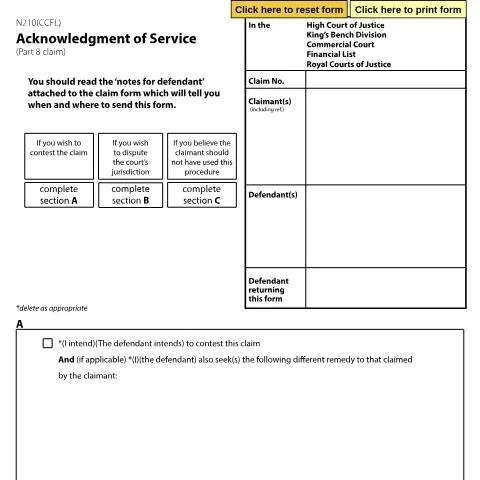
Understanding the Acknowledgment of Service: The N210(CCFL) in Commercial Court Proceedings
For individuals and businesses involved in financial disputes in the UK, the process can seem daunting, particularly when navigating the legal framework within which these disputes are resolved. One important document in this landscape is the N210(CCFL), formally known as the Acknowledgment of Service - Commercial Court Financial List. This document plays a pivotal role in the procedural flow of a claim. It serves as a formal notification to the court regarding the defendant's stance on the claim, thereby shaping the subsequent legal proceedings.
Who Needs to Submit the N210(CCFL) and Why?
The N210(CCFL) is particularly relevant for defendants in a financial claim initiated under the King’s Bench Division of the High Court of Justice. The parties involved typically include:
- Individuals: Private citizens who are being sued in financial matters.
- Corporations: Businesses facing litigation regarding financial claims.
- Legal Representatives: Solicitors or legal advisors acting on behalf of the defendants.
Understanding the requirement to submit this form is crucial, as failure to do so could lead to a default judgment against the defendant. The timeline for submission is set out clearly in the accompanying notes for the defendant, which accompany the initial claim form. Typically, the defendant must submit the N210(CCFL) within 14 days of receiving the claim form.
The Process Flow: From Claim Notification to Acknowledgment
Once a claim is initiated, the timeline begins. Here’s a step-by-step guide:
- Claim Issuance: The claimant formally initiates a financial claim in the Commercial Court.
- Notification: The defendant receives a claim form, which includes critical instructions and the N210(CCFL) form.
- Completion of the N210(CCFL): The defendant fills out this acknowledgment form, indicating whether they intend to dispute the claim or the court's jurisdiction.
- Submission to the Court: The completed form is submitted to the court, usually at the Rolls Building in London, where all Commercial Court matters are handled.
- Awaiting Further Instructions: Following submission, the court will provide the next steps based on the acknowledgment and any objections raised.
This sequence ensures that both parties are aware of the status of the claim and can prepare for the next phase of proceedings.
Diving Deep: Key Sections of the N210(CCFL)
The N210(CCFL) consists of specific sections that require careful attention and accurate completion. Here’s a breakdown:
| Section | Description | Common Pitfalls |
|---|---|---|
| A | Details of the defendant and their intention regarding the claim. | Choosing the wrong option regarding intention can lead to complications. |
| B | Information on whether the defendant intends to dispute jurisdiction. | Failing to specify details if disputing can result in the invalidation of the objection. |
| C | Defendant's alternative remedy request if applicable. | Not articulating a different remedy clearly can hinder the defense. |
| D | Signature and contact details of the defendant or their legal representative. | Missing signature or contact information can cause delays. |
Each section serves a clear purpose, and completing them incorrectly can adversely affect the defendant's ability to mount a successful defense. Therefore, attention to detail is crucial in this initial stage.
Handling Special Situations: Unique Scenarios in Filing the N210(CCFL)
There are specific circumstances that may affect how the N210(CCFL) is filled out and submitted. Understanding these can prevent unnecessary complications:
International Defendants
For defendants located outside the UK, additional considerations may come into play. If a defendant wishes to challenge the jurisdiction of the UK courts due to their international status, it’s essential to make this explicit in Section B. This might involve providing further evidence to support the claim of jurisdictional dispute.
Minors and Protected Individuals
In cases where the defendant is a minor or otherwise protected, additional legal representation may be required. It’s often prudent for a parent or guardian to complete the N210(CCFL) on behalf of the minor, ensuring compliance with legal standards for representation.
Complex Cases Involving Multiple Defendants
In situations involving multiple defendants, each party must submit their own N210(CCFL). However, there may be strategic advantages in coordinating responses, particularly regarding jurisdictional challenges. Legal counsel can provide guidance on how to approach these situations collectively.
The Court's Perspective: How the N210(CCFL) Influences Legal Proceedings
Once submitted, the N210(CCFL) becomes a part of the court's official record. The court will review the acknowledgment and determine its implications:
- Next Steps: Depending on whether the defendant intends to contest the claim, the court may set deadlines for further submissions or hearings.
- Dismissal of Claims: If a jurisdictional dispute is raised successfully, the court may dismiss the claim, saving the defendant from further litigation.
- Preparation for Hearing: If the case proceeds, filing the N210(CCFL) correctly ensures that the defendant's position is clear when the case is heard.
In essence, the N210(CCFL) acts as a critical gatekeeper, determining how the court will proceed with the case based on the defendant's stated intentions.
Monitoring Your Case: Keeping Track of the N210(CCFL) Submission
After submitting the N210(CCFL), it’s vital for defendants to actively monitor their case’s progress. Here’s how:
- Confirmation of Receipt: The court should send a confirmation once they’ve received the N210(CCFL). It’s advisable to keep this confirmation for records.
- Check for Further Instructions: The court may provide additional paperwork or instructions. Keeping an eye on these communications ensures that defendants do not miss critical deadlines.
- Engage with Legal Counsel: Regular communication with a solicitor can provide clarity on the implications of the Acknowledgment of Service and the next steps in the case.
Following these steps can mitigate risks associated with missed communications or deadlines.
Final Considerations: The Importance of Accurate Completion of the N210(CCFL)
The completion and submission of the N210(CCFL) cannot be understated. It is a legally binding document, and inaccuracies can have significant repercussions. Here are some best practices:
- Review Thoroughly: Before submitting, review the form multiple times. Consider having a legal professional double-check your responses.
- Keep Records: Maintain a copy of the submitted form and any related correspondence with the court.
- Stay Informed: Familiarize yourself with the court processes and terminology. Understanding the context can better equip you for future dealings.
In the realm of the Commercial Court Financial List, the N210(CCFL) serves as a crucial cog in the judicial machinery, facilitating the flow of information and ensuring that all parties are adequately informed of their standing and obligations. Proper handling of this document can significantly influence the outcomes of financial disputes, making it essential for defendants to approach this process with diligence and care.
Understanding the Purpose and Importance of Form N210(CCFL)
The Acknowledgement of Service for the Commercial Court Financial List, known as Form N210(CCFL), plays a pivotal role in the litigation process. This document serves as formal recognition by a defendant that they have received the claim against them. By filing this form, defendants not only comply with procedural requirements but also protect their rights within the legal framework.
One of the key purposes of this form is to establish the timeline for the subsequent legal proceedings. The filing of Form N210(CCFL) indicates that the defendant has acknowledged the claim and intends to respond. A timely submission is crucial as it contributes to the management of the court's calendar, ensuring that cases are heard in an orderly and efficient manner. Furthermore, it demonstrates to the court that the defendant is engaged in the process and wishes to challenge or respond to the claims made against them.
Fill in your form directly online
No printing: type your details into the boxes of the official form, tick, then download the PDF ready to send.
- 1Type into the form boxes
- 2Tick in one click
- 3Save and download the PDF
Moreover, understanding the implications of failing to submit Form N210(CCFL) is vital. A defendant who neglects to file this acknowledgment may face a default judgment, where the court can rule in favor of the claimant without hearing the defendant’s side. This highlights the necessity of being vigilant and proactive in legal matters, as oversight can lead to significant financial and legal repercussions.
Common Challenges and How to Overcome Them when Filing Form N210(CCFL)
Filing Form N210(CCFL) can present various challenges for defendants, particularly for those who are not familiar with legal processes. One common issue is misunderstanding the timeline for submission. The court typically requires the form to be filed within 14 days of receiving the claim, but this period can be affected by the method of service. For instance, if the claim was served by post, the defendant should account for additional time in accordance with the Civil Procedure Rules (CPR).
Another challenge can arise from gathering the necessary information to complete the form accurately. Defendants must ensure that they provide all required details, including their full name, address, and a concise statement of their intentions regarding the claim. Incomplete or incorrect information can lead to delays and complications in the proceedings.
To overcome these hurdles, defendants should consider seeking professional legal advice when preparing to file Form N210(CCFL). Engaging a solicitor with expertise in commercial law can clarify the requirements and help navigate any complexities that may arise. Additionally, utilizing resources from the HM Courts & Tribunals Service website can provide guidance on proper completion and submission processes. Understanding the importance of this form and taking proactive steps can significantly enhance a defendant’s position in the litigation.
The Implications of Acknowledging Service: Next Steps
Once a defendant has successfully filed Form N210(CCFL), the next steps in the litigation process become crucial. Acknowledging service does not equate to admitting liability; rather, it is a formal step indicating that the defendant is prepared to respond to the claims made. Following this acknowledgment, defendants must decide on their course of action. They can either contest the claim, negotiate a settlement, or, in some instances, seek to have the claim struck out based on procedural grounds or lack of merit.
For those opting to contest the claim, the defendant will need to prepare a detailed defence statement, typically using Form N9 or the relevant defence form for the specific court. This document outlines their argument and any counterclaims they wish to assert. It is essential that this form is completed and submitted within the specified timeframe, which is usually 14 days following the acknowledgement of service.
On the other hand, if the defendant considers settling the matter outside of court, they may wish to engage in discussions with the claimant. In this scenario, pursuing alternative dispute resolution (ADR) can be beneficial. ADR methods, such as mediation or negotiation, may lead to a resolution that is satisfactory for both parties without the need for lengthy litigation.
Ultimately, the implications of filing Form N210(CCFL) stretch beyond the immediate acknowledgment of service. The successful navigation of the subsequent steps can significantly influence the outcome of the case, making it vital for defendants to remain informed and proactive throughout the litigation process.